
How often military outreach ministries should publish annual reports is not a cosmetic question. For Christian donors, it is one of the clearest indicators of whether a ministry treats stewardship as a spiritual obligation rather than a fundraising technique. Annual reports are where a ministry makes its work legible: what was attempted, what was accomplished, what was learned, and what is still unresolved.
Military contexts add distinct pressures. Security, privacy, chaplaincy relationships, and the moral injury many service members carry all require careful communication. Yet caution cannot become an excuse for opacity. Scripture ties faithfulness to accountable stewardship: “it is required of stewards that they be found faithful” (1 Corinthians 4:2). A faithful steward does not merely do good work; a faithful steward can be responsibly examined.
Annual reporting is a baseline of Christian accountability
An annual report is the minimum viable public accounting for a ministry that solicits charitable gifts. It is the consistent, predictable rhythm by which donors can see whether leadership is governing well, whether resources are handled with integrity, and whether ministry claims correspond to verifiable activity. For military outreach, that rhythm matters because stories and emotional appeals can easily outpace evidence.
Why donors should expect at least annual cadence
Annual reporting aligns with the basic cycles by which organizations measure progress: budgets are set annually, audits and Form 990 filings typically follow annual timelines, and boards commonly review strategy and performance on an annual calendar. Donors are not asking for perfection; they are asking for a disciplined habit of truth-telling.
When ministries defer reporting for multiple years, donor discernment becomes difficult in ways that invite avoidable harm: ineffective programs persist uncorrected, leadership cultures calcify, and restricted gifts drift from their intended purposes. Theologically, hiddenness is not a neutral administrative choice. Jesus’ warnings about money and sincerity are direct, and Christian organizations should be especially wary of substituting spiritual language for public accountability (Matthew 6:1–4).
Annual reports and the credibility of the sector
Military outreach ministries operate in a field where the public already weighs the legitimacy of “support our troops” messaging. Consistent reporting protects the ministry’s witness by demonstrating that donor dollars do more than purchase sentiment. It also protects donors from cynicism. When transparency is absent, even faithful work becomes vulnerable to suspicion.
What we recommend for publishing frequency and timing
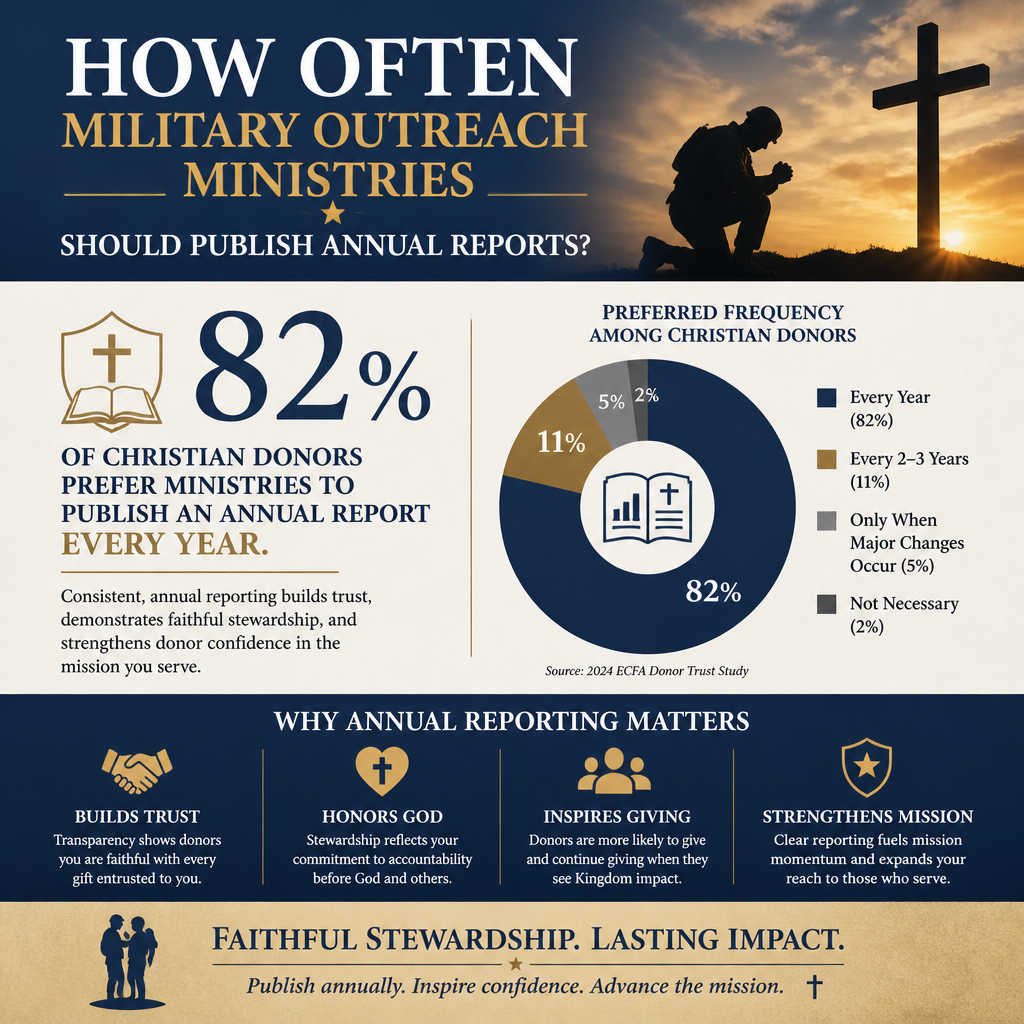
We recommend that military outreach ministries publish a full annual report every year, released within a reasonable window after the fiscal year closes. “Annual” should mean annual: a donor should not need to wonder whether the next report is coming or whether the ministry has quietly abandoned the practice.
A practical release window that signals seriousness
For most organizations, a credible target is publishing the annual report within 4–6 months after fiscal year-end. That window allows for closing the books, completing governance review, and aligning program summaries with final financials. When a ministry’s audit timeline runs longer, the report can still be published with clearly labeled unaudited figures and a commitment to update when audited statements are available.
It is worth observing that donors already have an expectation of annual financial disclosure in the wider nonprofit ecosystem. Tax-exempt organizations in the United States generally file an annual information return (Form 990 series) with the IRS, and those filings become part of the public record for most organizations. The IRS describes the Form 990 series as providing the public with financial information about exempt organizations (Internal Revenue Service).
When a ministry should report more often than annually
Some military outreach ministries should add a mid-year update, especially when they manage a large donor base, operate multiple programs across regions, or respond to fast-changing conditions. That update does not need to be glossy. It should be substantive: measurable outputs where appropriate, narrative explanations where necessary, and a clear account of material changes (leadership transitions, program closures, significant new initiatives, or major shifts in spending).
Across our verification work at Most Trusted, the ministries that meet The Most Trusted Standard tend to treat transparency as a discipline, not a campaign. They do not wait for external pressure to communicate. They assume that donors will rightly ask for clarity, and they prepare for that scrutiny as an act of stewardship.
What a military outreach annual report must include to be trustworthy
Frequency without substance can create a false sense of accountability. A report that offers only inspiring stories and photos, without financial clarity and program candor, does not meaningfully serve donors. The question is not whether the report exists, but whether it contains what a prudent Christian steward needs to make a decision.
Core elements donors should be able to find quickly
- Mission and strategy stated plainly, including what the ministry does not do
- Program outcomes described with appropriate evidence, including limitations and lessons learned
- Financial summary that reconciles major revenue sources and expense categories
- Governance disclosures including board leadership, independence norms, and conflict-of-interest practices
- Donor integrity practices for restricted gifts and partner designations
Outcomes reporting without reductionism
Christians genuinely disagree about how “results” should be measured in spiritual ministry. Some outcomes are quantitative (chaplain-supported events hosted, Bibles distributed, counseling sessions provided). Others are qualitative and pastoral (discipleship relationships, repentance, perseverance in faith, marital restoration). Mature reporting holds both realities together. It avoids the pretense that every spiritual fruit can be counted, while still refusing the idea that nothing can be assessed.
When a ministry cites growth claims, it should distinguish between attendance, engagements, and sustained participation. It should also address safeguarding practices, especially where service members and their families may be vulnerable. These are not public-relations concerns; they are matters of shepherding.
Security and confidentiality are real, but they do not nullify transparency
Military outreach often touches sensitive environments: deployments, installation access, command relationships, and individuals dealing with trauma or security clearances. Donors should not demand information that compromises safety. But ministries should not confuse legitimate confidentiality with institutional secrecy.
How to report responsibly without exposing people or operations
Responsible annual reporting in military contexts often requires aggregation and restraint. Locations can be reported at the regional level. Personal stories can be shared with consent, names changed, and identifying details removed. Partnerships can be described by type (chaplaincy coordination, local church collaboration, counseling referral networks) without naming specific units or commanders. These practices are common in other sensitive fields, including work with survivors of abuse, refugees, and persecuted believers.
When a ministry claims that “we cannot share details,” donors should still expect an explanation of what can be shared and why some details cannot. That distinction signals maturity. Vagueness without boundaries is a warning sign.
Donor confidence requires more than private assurances
Private conversations with major donors can be appropriate, but they should not become a substitute for public accountability. Ministries that reserve meaningful information only for insiders create a two-tier transparency culture that is difficult to reconcile with Christian teaching on impartiality (James 2:1–4). Public reporting does not need to satisfy every curiosity. It must satisfy a reasonable standard of stewardship for the whole donor community.
How donors can evaluate annual reports using The Most Trusted Standard
Annual reports should be read with a framework that reflects both Christian convictions and nonprofit best practices. At Most Trusted, we evaluate ministries against The Most Trusted Standard, a 15-criteria framework spanning Faith Foundation, Financial Integrity, Governance and Leadership, and Transparency and Effectiveness. Donors do not need to become auditors, but they should read annual reports with disciplined attention.
Signals of integrity donors should reward
Strong annual reports show a willingness to be examined. They disclose board names and governance practices. They make financial statements intelligible. They describe programs in ways that could be falsified if untrue. They acknowledge setbacks without excuse-making. In a military outreach setting, they also show pastoral sobriety: a refusal to market trauma, and a refusal to treat service members as props for fundraising.
For donors seeking broader context on how ministries in this space operate, the parent topic page on Military Outreach Ministries offers a useful starting point for understanding common models and accountability considerations.
Red flags that often accompany weak reporting habits
When annual reports are sporadic, donors should ask why. Sometimes the reason is understandable: leadership turnover, financial systems in disarray, or a sudden crisis response. But patterns matter. A ministry that repeatedly delays reporting may be signaling deeper governance weaknesses, such as an inactive board, poor financial controls, or a culture that resists evaluation.
The wider nonprofit field has also had to correct a common donor error: equating low overhead with effectiveness. The “Overhead Myth” letter, signed by leaders from GuideStar, BBB Wise Giving Alliance, and Charity Navigator, urged donors to move beyond simplistic overhead ratios and to focus on governance, strategy, and results (Candid GuideStar). Annual reports are one of the main places where those deeper questions can be answered in a public, reviewable way. For more on these expectations within this discipline, see Accountability and Transparency in Military Outreach Ministries.
FAQs for How often military outreach ministries should publish annual reports
Is an annual report still necessary if a ministry posts frequent updates on social media?
Yes. Social media updates can communicate activity, but they rarely provide a coherent accounting of finances, governance, and outcomes over a full fiscal year. An annual report gathers the year into a single, reviewable statement that a donor can evaluate, save, and compare year over year.
What if a military outreach ministry says it cannot publish details for security reasons?
Security constraints are sometimes legitimate, but they do not eliminate the duty to report. Donors should still expect aggregated program descriptions, a clear financial summary, governance disclosures, and an explanation of what categories of information are restricted and why. Responsible confidentiality has boundaries; secrecy does not.
A faithful annual rhythm serves both mission and witness
Military outreach ministries ask the Church to invest in spiritual care for those who bear heavy burdens. Donors are right to insist that this work be carried out with integrity that can be examined. Publishing an annual report every year, on a predictable timeline, is one of the simplest ways a ministry can demonstrate that it understands stewardship as a Christian duty and transparency as an act of love toward its supporters.



