

What is the best way to give to discipleship ministries when the work is both spiritually central and operationally difficult to measure? Christian donors often sense, rightly, that discipleship is not an accessory to the Great Commission but its core: Jesus commanded the church to “make disciples… teaching them to observe all that I have commanded you” (Matthew 28:19–20). The challenge is that the fruit of discipleship is real, but it is rarely immediate, linear, or easily quantified.
The best way to give is to fund discipleship ministries that are theologically sound, relationally rooted, and verifiably responsible with money and authority. That requires more than admiration for a charismatic teacher or a moving testimony. It requires disciplined discernment about doctrine, governance, financial integrity, and whether a ministry’s model actually forms people into durable obedience to Christ.
Begin with a discipleship theology that is more than content
Discipleship is formation into obedience, not merely information transfer
Many ministries can produce curriculum, conferences, or media at scale. Not all can form disciples. Scripture presses beyond knowledge to obedience and love: “If you love me, you will keep my commandments” (John 14:15). The best giving decisions start by asking whether a ministry’s stated aim matches the biblical aim—apprenticeship to Jesus that reshapes worship, habits, relationships, and witness.
In practice, this means resisting a common modern reduction: treating discipleship as “Bible content consumed.” Teaching matters. But the New Testament pattern is teaching embedded in life together, accountable relationships, and the ordinary means of grace (Word, prayer, sacraments where practiced, and the fellowship of the saints). A ministry that grows rapidly through media may still be faithful; but donors should ask what structures translate teaching into lived formation.
Christians genuinely disagree about methods, but not about the aim
The field contains real debates: programmatic small groups versus organic mentoring, centralized curriculum versus local contextualization, digital platforms versus embodied community. Mature donors do not need false certainty. The question is whether the method chosen is coherent with the aim, and whether it has safeguards against predictable failures: celebrity culture, shallow conversionism, or formation that never reaches the level of character and church membership.
Giving is most faithful when it strengthens ministries that can articulate how their approach serves the whole disciple—mind, affections, and conduct—and how it connects people to the local church rather than replacing it. For broader context on how discipleship work fits within Christian giving priorities, see Discipleship Ministries.

Give to models that are accountable, local, and relational
Disciple-making is normally slower than donors prefer
Donors understandably want clarity: how many people were reached, how many groups launched, what outcomes occurred. Yet Scripture’s agricultural imagery reminds us that growth is often hidden before it is visible (Mark 4:26–29). What this means in practice is that the best discipleship ministries tend to emphasize structures that sustain long obedience over time: trained leaders, repeatable practices, and pathways that move people from curiosity to commitment.
A credible ministry can name its target population and its “next faith step” outcomes without promising what only the Spirit can produce. It can also describe the cost of quality. A one-time event may encourage; it rarely shepherds. A well-supported mentor, a trained small-group leader, or a pastoral cohort costs more, but it often produces thicker fruit.
Healthy models clarify their relationship to the local church
Some discipleship nonprofits exist to serve churches: training leaders, providing curriculum, resourcing spiritual formation. Others function more like parachurch communities for people on the margins of church life. Both can be legitimate. The concern is when a ministry becomes an alternative authority structure without the pastoral accountability and sacramental life that Scripture assumes in the gathered church (Hebrews 10:24–25).
Donors can ask simple, revealing questions: Does this ministry partner with churches? Does it strengthen pastors or compete with them? Does it encourage membership in a local congregation? Is spiritual authority exercised with humility, accountability, and clear boundaries?
Evaluate financial integrity without obsessing over overhead
The harder question is whether spending aligns with mission and truth
Christian donors have been trained to fixate on overhead ratios, as if the holiest ministry is the one with the thinnest administrative line. The nonprofit sector itself has warned against this simplification. Charity Navigator, Candid, and the BBB Wise Giving Alliance jointly argued that overhead metrics can mislead and can even pressure nonprofits to underinvest in the infrastructure that protects beneficiaries and donors alike Charity Navigator.
Discipleship work, especially, requires “invisible” investments: background checks, trauma-informed training, leader development, content review, data security for sensitive pastoral information, and governance processes that prevent spiritual abuse. These are not distractions from mission; they are often prerequisites for faithful mission.
What to look for in financial stewardship
Across our verification work at Most Trusted, the ministries that meet The Most Trusted Standard tend to treat financial reporting as a form of truth-telling. They make it possible for donors to understand where money goes, what it accomplishes, and what risks remain. In many cases, the decisive issue is not the percentage spent on administration; it is whether the ministry can demonstrate internal controls, responsible compensation practices, and honest communication about results.
For donors, a short set of financial questions can clarify whether a discipleship ministry is stewarding wisely:
- Are audited financial statements or reviewed statements available, and are they current?
- Is the budget understandable, with clear program categories rather than vague buckets?
- Is donor intent protected, especially for restricted gifts?
- Are fundraising claims consistent with actual financial reports?
- Does leadership compensation appear justified and governed, not self-set?
Insist on governance that protects people from spiritual and organizational harm
Discipleship ministries carry unique power dynamics
Discipleship is inherently personal. It involves confession, counsel, and authority. That is why it is especially vulnerable to manipulation when leadership is not accountable. Recent years have shown, across multiple traditions, that ministries can produce compelling teaching while tolerating patterns of control, secrecy, or retaliation. Donors who care about the purity of the church cannot treat governance as a secondary concern.
Faithful governance is not a secular intrusion into spiritual work. Scripture assumes accountable leadership (1 Peter 5:2–3) and warns against domineering shepherds. A ministry’s board, policies, and reporting lines are not merely legal necessities; they are instruments that can restrain sin, protect the vulnerable, and preserve the credibility of the gospel.
Practical markers of a governed ministry
We recommend looking for evidence that authority is shared and supervised. At a minimum, donors should expect a functioning board with independence, documented conflict-of-interest practices, and a credible process for receiving and investigating complaints. When a ministry is built around a founder, donors should be even more attentive: founder-led ministries can be healthy, but they require mature governance to prevent an organization from becoming indistinguishable from one personality.
Donors should also consider child protection and safeguarding practices where minors are involved. Discipleship camps, youth mentoring, and training programs often create access to children and teens. Responsible ministries treat screening, training, and reporting requirements as non-negotiable.
Give in ways that strengthen long-term effectiveness and transparency
Measure what can be measured, and tell the truth about what cannot
Discipleship outcomes are partly measurable: participation, retention, leader multiplication, completion of training pathways, and engagement with local churches. But the most important fruit—repentance, perseverance, holiness, reconciliation—resists simple metrics. A credible ministry does not pretend otherwise. It will combine quantitative indicators with qualitative evidence, and it will avoid manipulative storytelling that treats donors as consumers.
Transparency is a spiritual issue as well as an operational one. “We refuse to practice cunning or to tamper with God’s word, but by the open statement of the truth…” (2 Corinthians 4:2). Ministries should publish clear descriptions of programs, leadership, doctrinal commitments, and outcomes, and they should communicate setbacks without spin. For donors who want a broader set of practical considerations for funding disciple-making work responsibly, see How to Give to Discipleship Ministries.
Consider the form of your gift, not only the destination
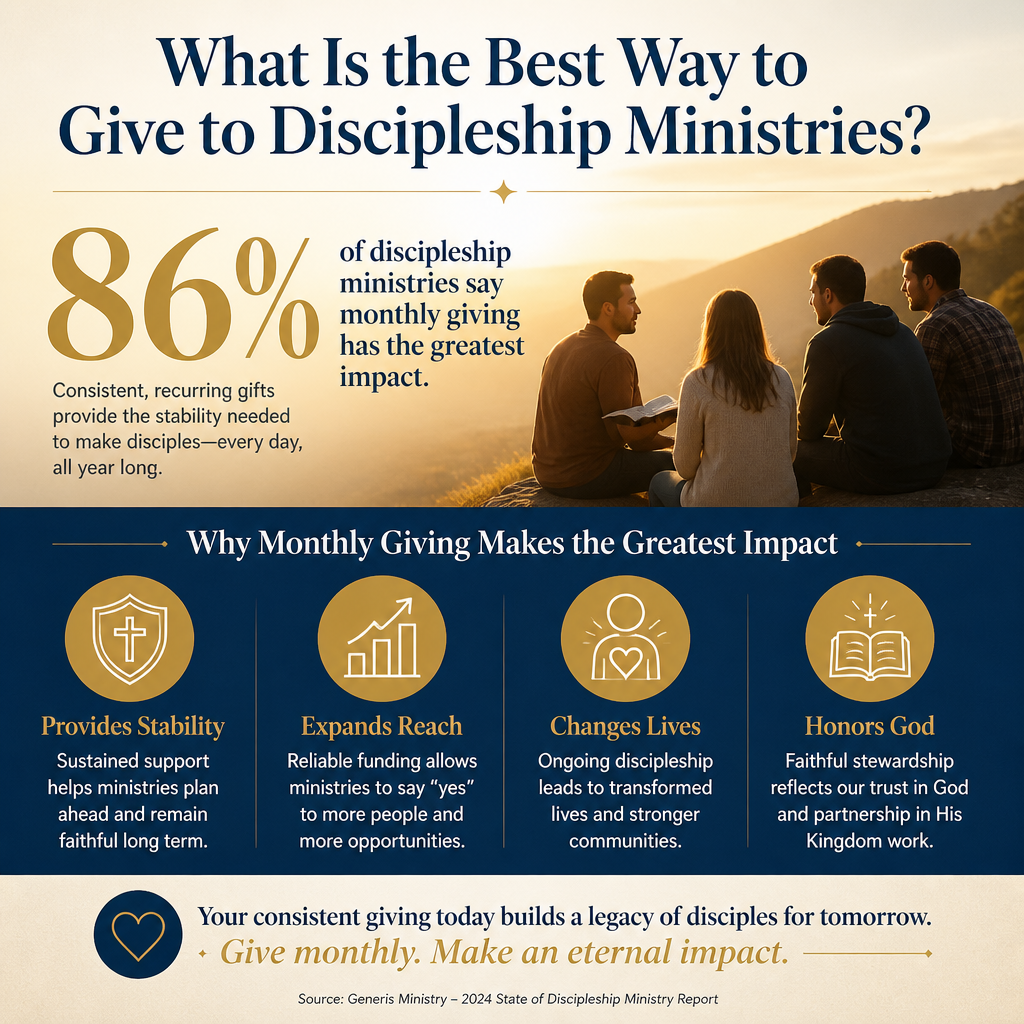
The best way to give is often not a single transaction but a thoughtful approach: multi-year support that allows a ministry to train leaders well, targeted funding that strengthens core systems, and restricted gifts only when a ministry can manage them without distorting priorities. Discipleship ministries frequently struggle with volatility—event-driven revenue, donor churn, and short planning horizons. Stable funding can be a strategic act of love.
At the same time, donors should be candid about trade-offs. Unrestricted giving offers flexibility but requires trust. Restricted giving can protect donor intent but can also push ministries into fragmentation if restrictions multiply. The wisest donors calibrate the form of their giving to the maturity and transparency of the organization.
FAQs for What is the best way to give to discipleship ministries
Should we prioritize local church discipleship over parachurch discipleship ministries?
Ordinarily, the local church is the primary context for discipleship because it is where Word and sacrament, pastoral oversight, and durable community converge (Hebrews 10:24–25). Parachurch ministries can still serve the church well when they operate with theological clarity, relational accountability, and a posture of partnership rather than replacement. The giving priority is not “church versus parachurch” so much as “accountable disciple-making that strengthens the church’s witness.”
Is it better to fund discipleship content or discipleship relationships?
Content can travel far and serve many, but relationships are often where formation becomes concrete. The strongest ministries typically integrate both: doctrinally sound teaching delivered in ways that are embedded in community, practiced over time, and supported by trained leaders. Donors can look for a clear theory of ministry that explains how content becomes lived obedience, and for evidence that the ministry invests in leader development and safeguarding rather than assuming formation happens automatically.
A faithful giving posture for disciple-making
The best way to give to discipleship ministries is to fund work that is unmistakably centered on Christ, structured for accountable relationships, and governed with integrity. Donors honor the Great Commission not only by giving generously, but by giving truthfully—supporting ministries that tell the truth about outcomes, handle money as stewardship, and exercise authority as service. When discipleship is treated as holy work requiring both spiritual seriousness and verifiable responsibility, giving becomes an instrument of formation for donors as well as beneficiaries.



