

When Christian donors ask where to find discipleship ministry financial reports, they are rarely seeking curiosity alone. They are trying to practice stewardship with a clear conscience—giving in ways that honor Christ, protect the vulnerable, and strengthen the church rather than subsidize dysfunction. Because money is never merely technical in Scripture; it is a moral and spiritual matter. Jesus’ repeated warnings about wealth and trust make financial clarity a discipleship issue in its own right.
Discipleship ministries also present a distinctive accountability challenge. Many do not fit a simple program-output model. Their work can be relational, long-horizon, and often integrated with local churches. That does not make financial reporting optional. It means donors should know which documents to request, what “good” looks like for a ministry’s size and model, and what to do when a ministry offers vision without verifiable numbers.
Start with the primary financial documents that responsible ministries publish
A serious discipleship ministry should be able to point donors to financial reports that describe (1) where money came from, (2) how it was spent, and (3) what safeguards govern decision-making. The documents vary by legal structure, but the core evidence is consistent across the field.
Form 990 for US nonprofits and what it can and cannot tell you
In the United States, most 501(c)(3) organizations file an annual IRS Form 990, which includes revenue, expenses, key contractors, related organizations, and governance disclosures. Under federal law, an exempt organization must make its Form 990 available for public inspection. The IRS summarizes this obligation in its guidance for public charities and private foundations (IRS).
Two cautions matter for discipleship work. First, the Form 990 is often time-lagged; a 2026 donor may be reading a 2024 filing. Second, the categories can be broad. “Program services” may bundle multiple initiatives, and “management and general” can reflect real complexity rather than waste. A mature reading asks whether the filing is coherent with the ministry’s stated model, not whether an arbitrary ratio looks attractive.
Audited financial statements and the difference between audit and review
Many ministries—especially those of meaningful scale—commission an independent audit. An audit provides the strongest external assurance available in standard nonprofit reporting. Smaller ministries may reasonably use a “review” or “compilation” for a season, but they should name that choice clearly and be able to explain when they intend to move to an audit.
When a ministry publishes audited financials, donors should look for a clean audit opinion, consistent year-over-year presentation, and notes that disclose related-party transactions, restricted funds, and significant risks. A ministry that treats these notes as inconvenient fine print is not treating accountability as discipleship.

Use credible public databases to locate filings and compare patterns
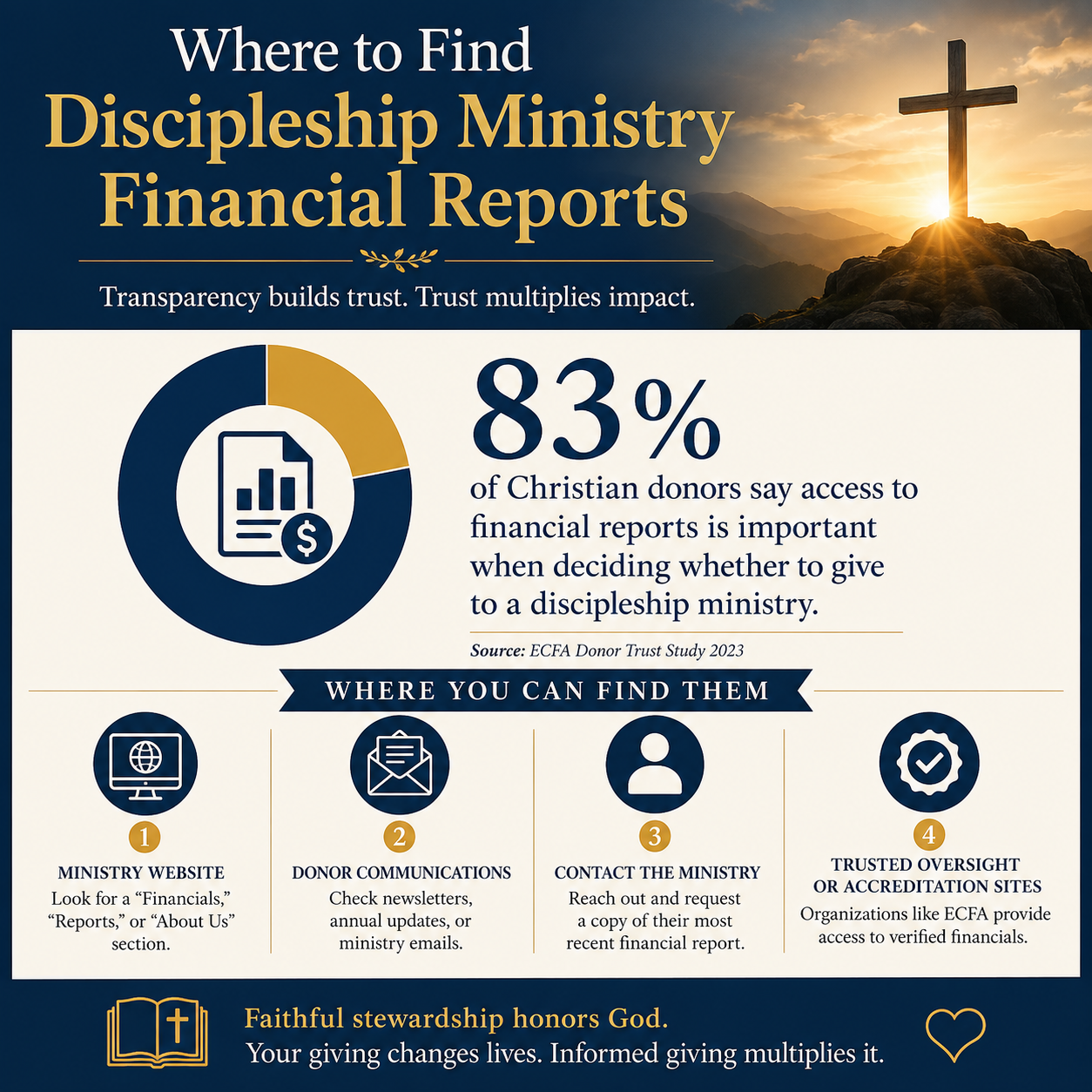
Donors are not limited to what a ministry chooses to feature on its website. Several public databases make it possible to locate tax filings and identify patterns over time. This matters because transparency is not a single PDF; it is consistency.
IRS Tax Exempt Organization Search and why it is the first stop
The IRS Tax Exempt Organization Search allows donors to confirm an organization’s current tax-exempt status and, in many cases, view available filings. It is the baseline verification step for US giving (IRS). If a ministry cannot be found, or if its status is revoked, donors should pause and seek clarification before giving.
Nonprofit data platforms and what they add beyond the IRS
Platforms such as GuideStar (Candid) and ProPublica’s Nonprofit Explorer often make it easier to pull multiple years of Form 990s and to view summary charts. These platforms can be helpful when used with discernment, but they do not replace reading the underlying documents. Summary badges and surface-level scoring can conceal the most important questions: board independence, concentration risk, restricted-fund integrity, and whether a ministry tells the truth about itself in public.
Across our verification work at Most Trusted, the ministries that meet The Most Trusted Standard tend to treat public databases as an extension of their own transparency, not as an adversarial environment. Their filings align with their communications, their stated theology of stewardship, and their on-the-ground model of ministry.
Know where discipleship ministries hide complexity and where donors should press
Discipleship ministries often operate with a mix of direct program work, conferences, publishing, coaching networks, and church partnerships. Complexity is not inherently a red flag. Unexplained complexity is.
Revenue concentration, designated giving, and restricted funds
One of the most consequential financial questions is whether a ministry is dependent on a small number of donors, a single church, or a narrow stream of event income. Concentration can be prudent for a season, but it increases fragility and can create undue influence. Responsible ministries disclose this risk and describe their mitigation plan.
Donors should also pay attention to how a ministry handles restricted giving (sometimes called designated or donor-restricted funds). The ethical issue is straightforward: if a donor gives for training pastors in a specific region, those funds must be used for that purpose or formally released according to accepted accounting rules. Financial statements and their notes often reveal whether restricted balances are tracked and honored with discipline.
Related organizations and transactions that require daylight
Discipleship leaders frequently have parallel entities: a church, a publishing imprint, a conference business, or a counseling practice. None of that is automatically improper. But it creates opportunities for conflicts of interest if contracts, salaries, rent, or intellectual property payments flow among entities without independent oversight.
Form 990 schedules and audited financial statement notes are designed to surface these realities. Donors do not need to assume guilt; they need to insist on clarity. Transparency is not distrust. It is love of neighbor expressed through responsible governance.
Evaluate financial reporting in light of biblical stewardship and real-world nonprofit practice
Some Christian donors were formed in a simplistic “low overhead equals faithful” narrative. The sector has repeatedly warned against this reduction. Charity Navigator, Candid (GuideStar), and the BBB Wise Giving Alliance jointly argued that overhead ratios are a poor measure of nonprofit performance and can pressure organizations into underinvesting in the very systems that prevent abuse and waste (Charity Navigator).
For discipleship ministries, the more faithful question is whether spending patterns fit the ministry’s calling and claims. A ministry training church leaders across multiple states will require travel, staff development, curriculum production, and compliance capacity. A ministry doing local mentoring may show a different cost structure. Stewardship is not austerity; it is integrity and fruitfulness under God.
What mature financial transparency tends to include
- Multiple years of Form 990s or equivalent filings available without gatekeeping
- Audited financial statements when scale and complexity warrant it, with a clear opinion letter
- A plain-language annual report that connects spending to mission without exaggeration
- Board and leadership disclosures, including conflict-of-interest practices
- A candid explanation of reserves, debt, and major risks rather than promotional optimism
Where donors should be patient and where they should not
Smaller ministries may not have the administrative infrastructure of national organizations, and donors should not confuse modest capacity with moral failure. Yet there are limits. A ministry asking the church for significant, ongoing support should be able to answer basic questions: Who governs? How are decisions documented? What does an independent accountant say? Where can donors see the numbers without special access?
Christians genuinely disagree about how much public disclosure is prudent in contexts of persecution, security risk, or sensitive pastoral work. These are real concerns, and we take them seriously. Even in constrained contexts, a ministry can still provide controlled transparency: audited statements shared under NDA with major donors, summarized financials with consistent categories, and governance policies that demonstrate real oversight.
Apply a verification mindset and use independent standards when decisions carry weight
Because financial documents can be difficult to interpret, many donors look for a credible third party to assess whether the evidence is coherent. This is especially true when a discipleship ministry is closely associated with a charismatic leader, a fast-growing conference movement, or a media platform that can outpace governance maturity.
Most Trusted exists to serve donors in precisely this gap. We evaluate Christian nonprofits against The Most Trusted Standard, a 15-criteria framework covering Faith Foundation, Financial Integrity, Governance and Leadership, and Transparency and Effectiveness. The purpose is not to replace donor discernment, but to ground it in verifiable evidence and consistent expectations.
How donors can proceed when documents are missing or confusing
When a ministry does not publish basic financial reports, a direct request is appropriate. The response often reveals more than the document itself. Responsible ministries answer with clarity, reasonable timelines, and a willingness to be understood. Defensive responses, vague spiritualization, or appeals to “trust the mission” should be treated as governance signals, not personality quirks.
For donors comparing multiple organizations, it can help to anchor your research in two broader contexts: the range of models within Discipleship Ministries and the specific expectations that belong to Accountability and Transparency in Discipleship Ministries. Financial reports are not isolated artifacts; they are part of the ministry’s public moral witness.
FAQs for Where to find discipleship ministry financial reports
Where can we find a discipleship ministry Form 990?
For US-based 501(c)(3) ministries, start with the IRS Tax Exempt Organization Search and confirm the organization’s legal name and EIN (IRS). Then use nonprofit databases such as Candid’s GuideStar or ProPublica’s Nonprofit Explorer to pull multiple years of filings and read the underlying schedules, not only the summaries.
What if a discipleship ministry says it is not required to file a 990?
Some organizations are exempt from filing, including many churches and certain church-integrated entities. Others may be fiscally sponsored, meaning the sponsor files and the project operates under the sponsor’s umbrella. In those cases, donors can still ask for audited financial statements, a current budget, governance policies, and clear explanations of how restricted gifts are handled. A ministry that cannot provide any credible financial reporting should not expect donors to treat that opacity as spiritually virtuous.
Financial reports are part of a ministry’s discipleship of donors
Christian donors do not ask for financial reports because they believe ministries are guilty until proven innocent. They ask because Scripture treats stewardship as a matter of truth, accountability, and love. A discipleship ministry that receives the church’s gifts should welcome scrutiny as an opportunity to practice integrity in the light, not as an intrusion. Where financial reporting is clear, consistent, and independently grounded, giving becomes not only generous but rightly ordered.



