
Why financial accountability matters in discipleship ministries is not a secondary question for Christian donors. It is a discipleship question in itself, because Scripture treats money as a reliable revealer of love, trust, and obedience, not merely as a neutral tool.
Jesus spoke with unusual frequency about wealth and stewardship, and he placed faithfulness with “unrighteous wealth” alongside readiness for true riches (Luke 16:10–11). The point is not that budgets save souls. The point is that financial practices can either serve the gospel with integrity or quietly contradict it. For donors who want their giving to strengthen formation rather than distort it, accountability is part of spiritual realism.
Financial stewardship is a discipleship issue before it is a compliance issue
Scripture assumes that money disciplines desire
When Paul organized a major relief offering for suffering believers, he treated the handling of funds as a matter of honor before God and before people. He insisted on safeguards so that “no one should blame us about this generous gift” and emphasized what is “honorable not only in the Lord’s sight but also in the sight of man” (2 Corinthians 8:20–21). That is not modern bureaucracy; it is apostolic pastoral wisdom. Churches and ministries that form disciples must also model the kind of righteousness that can be seen and tested.
Christian donors often feel the tension here. The church is not a corporation, and yet Christian ministry does operate in the real world: salaries, rent, travel, child protection training, software, counseling referrals, insurance, and reporting. The question is not whether discipleship ministries can avoid administrative complexity. The question is whether they will carry that complexity truthfully, with structures that protect people and keep the ministry’s public witness intact.
The aim is not suspicion but credibility
Financial accountability is not about treating leaders as presumed guilty. It is about recognizing that temptation is ordinary, that mistakes are costly, and that trust is fragile. Even exemplary leaders benefit from controls that prevent small errors from becoming patterns and patterns from becoming scandals. A ministry that teaches repentance should not require a crisis before it practices it.

Discipleship ministries face distinctive financial risks donors should understand
Relational ministry can hide weak controls
Discipleship ministries often grow through personal trust: a charismatic teacher, a local network, a compelling vision for formation. That relational strength can become a financial weakness if “family culture” substitutes for review. Informality can make it difficult to ask basic questions about expense reimbursement, credit card use, related-party transactions, or how restricted gifts are tracked.
Christians genuinely disagree about what “counts” as discipleship impact. Some emphasize measurable behavior change. Others emphasize faithfulness, presence, and long-term formation that resists simple metrics. That disagreement is not an excuse for financial vagueness. Even when outcomes are difficult to quantify, inputs can and should be handled with clarity.
Revenue can be unusually complex
Many discipleship ministries blend donor support with program revenue: retreats, conferences, curriculum sales, coaching fees, licensing, book royalties, or international partnerships. Each stream carries different accounting and governance questions. When a founder both leads a nonprofit and sells personal products through the same platform, donors should expect strong conflict-of-interest policies and clear allocation of shared costs. The goal is not to shame bivocational creativity; it is to keep the lines clean.
Across our verification work at Most Trusted, the ministries that meet The Most Trusted Standard tend to treat these complexities as predictable stewardship challenges rather than as distractions from “real ministry.” That posture is often the difference between sustainable fruitfulness and perpetual fragility.
What accountability looks like when it is worthy of donor trust
Controls that protect the mission and the people
Financial accountability becomes credible when it is embodied in routines, documentation, and oversight that do not depend on a single personality. Donors should not need to infer integrity from charisma. They should be able to see it in governance and financial practice.
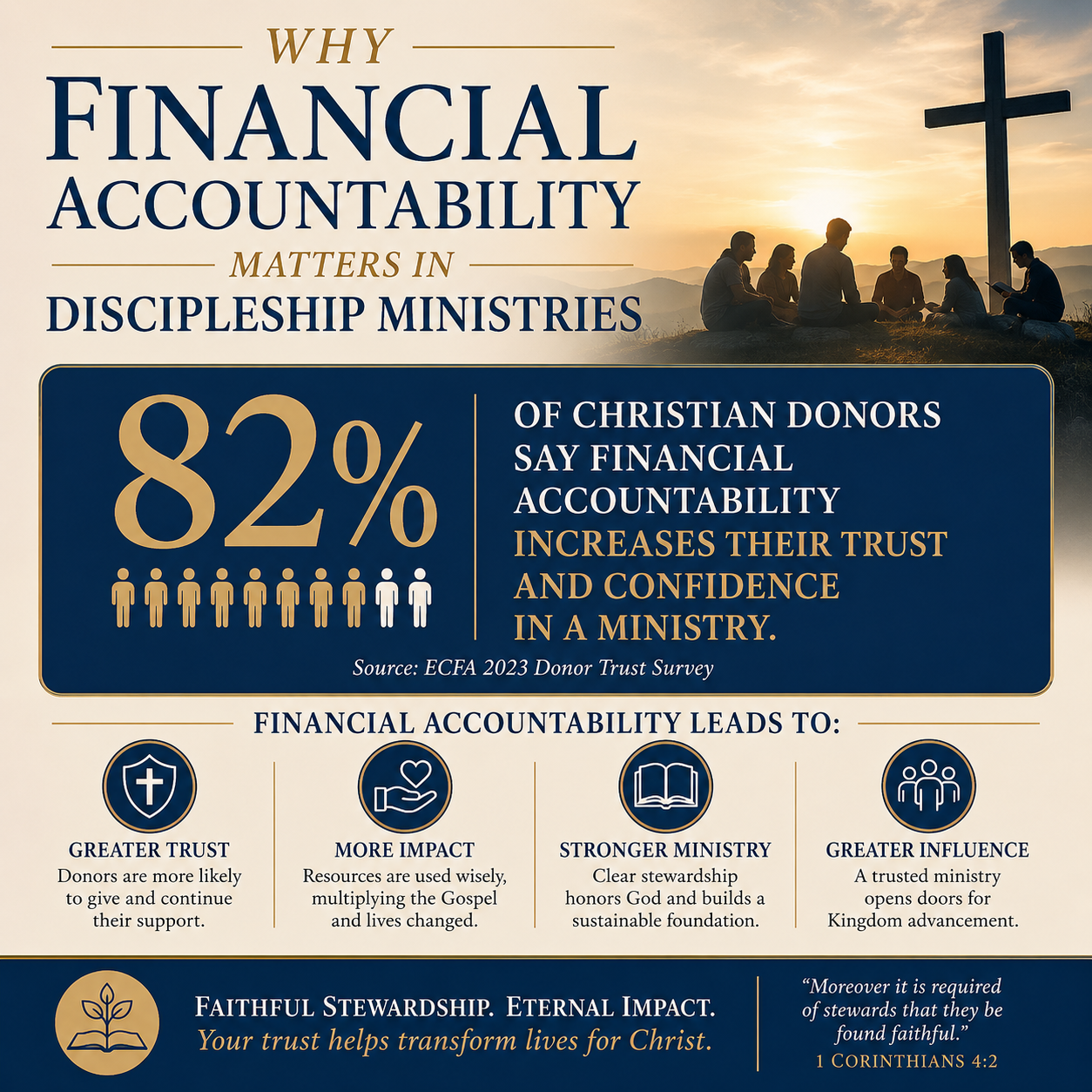
- Board oversight that is active, including review of budgets, major contracts, and executive compensation.
- Separation of duties so that no one person controls authorizing, spending, and reconciling funds.
- Clear gift acceptance and restricted fund policies that prevent mission drift and donor misunderstanding.
- Conflict-of-interest disclosures that are documented and revisited, not filed once and forgotten.
- Regular external review appropriate to size, whether an independent audit, review, or compilation.
Transparency that respects donors without performing for them
Some donors have learned to equate low overhead with faithfulness. The nonprofit sector has pushed back on that assumption for good reason. In 2013, Charity Navigator, GuideStar, and the BBB Wise Giving Alliance issued a joint statement warning that “overhead ratios” can be misleading and can drive unhealthy underinvestment in capacity and accountability.Charity Navigator That warning matters for discipleship ministries, where underfunding financial operations can quietly increase risk.
Transparency is not a marketing performance, but it should be real: accessible financial statements, clear descriptions of programs, and an honest account of how money supports the work. When ministries are forthright about both strengths and constraints, donors can give with maturity rather than sentiment.
How donors can evaluate discipleship ministries without reducing ministry to metrics
Ask for evidence that matches the ministry’s claims
Discipleship cannot be reduced to a dashboard, and Christian donors should resist the false choice between rigorous accountability and spiritual depth. The deeper question is whether a ministry’s reported activities plausibly connect to its stated outcomes, and whether finances align with those activities.
For example, a ministry focused on mentoring should be able to explain volunteer screening, safeguarding practices, training hours, and supervision ratios, even if it cannot promise uniform outcomes. A curriculum-focused ministry should be able to show product development costs, editorial controls, theological review processes, and how restricted gifts support translation or distribution. Evidence should be appropriate to the kind of work.
Use the public signals that are meant for donors
In the United States, most nonprofits file IRS Form 990, which can be read as a window into governance, related-party transactions, revenue sources, and top-line program spending. The IRS makes clear that most exempt organizations’ returns are public documents, and donors are right to use them as part of due diligence.Internal Revenue Service
What this means in practice is that donors can ask disciplined questions without adopting a cynical posture. When a ministry cannot explain unusual transactions, persistent deficits, or opaque arrangements, the burden is not on donors to ignore those signals. It is on ministries to lead with clarity.
Donors who want a ministry-by-ministry view can also consult our research across Discipleship Ministries, where verification is framed around The Most Trusted Standard rather than around a single ratio or trendline.
Accountability strengthens discipleship by protecting witness and sustaining fruit
Scandal is not only a financial loss
When Christian ministries mishandle funds, the damage extends beyond the balance sheet. It weakens trust in the church’s moral seriousness, burdens staff and volunteers, and can harden the skepticism of those already inclined to doubt Christian credibility. Donors often carry a quiet grief here: the desire to give generously and the fear of enabling dysfunction.
Financial accountability is one of the ways ministries love their neighbors. It protects donors from manipulation, beneficiaries from instability, and staff from environments where blurred lines become normalized. It also protects leaders from the isolation that can accompany unchallenged authority.
Donor partnership becomes steadier when trust is verifiable
Many discipleship ministries operate close to the margin. Cash flow is uneven. Program demand shifts. A major donor can leave with little warning. Under those conditions, basic financial integrity is not an optional add-on; it is the scaffolding that keeps ministry from lurching between urgency and exhaustion.
Most Trusted exists because Christian donors have legitimate reasons to ask hard questions without becoming adversarial. Our evaluations against The Most Trusted Standard examine financial integrity, governance, transparency, and ministry effectiveness in a unified view. The aim is confidence rooted in evidence, not optimism rooted in personal affinity. For donors focused specifically on financial questions, our work also aligns with the concerns gathered under Accountability and Transparency in Discipleship Ministries.
FAQs for Why financial accountability matters in discipleship ministries
Should donors judge discipleship ministries by overhead ratios?
Overhead ratios can be a limited data point, but they are a poor primary test of faithfulness. Healthy ministries may spend more on finance, compliance, safeguarding, and systems precisely because they take stewardship seriously. The sector’s leading evaluators have cautioned that an overemphasis on overhead can mislead donors and pressure nonprofits into underinvesting in accountability.Charity Navigator
What documents should a credible discipleship ministry provide to donors?
At minimum, donors should expect clear financial reporting appropriate to the ministry’s size: recent financial statements, an explanation of revenue sources, and evidence of board oversight. For many U.S. nonprofits, the IRS Form 990 is also an accessible public document that supports donor due diligence.Internal Revenue Service Larger organizations should often provide an independent audit and be prepared to explain how restricted gifts are tracked and honored.
Giving that forms disciples requires stewardship that can be examined
Financial accountability matters in discipleship ministries because the credibility of the message is tied to the integrity of the messenger. Donors are not merely funding activities; they are participating in a formative ecosystem that teaches, implicitly and explicitly, what faithfulness looks like with resources.
When a ministry welcomes scrutiny, documents its decisions, and submits to governance, it communicates something profoundly Christian: that light is not a threat. For mature donors seeking durable gospel fruit, that posture is not a peripheral virtue. It is part of the ministry itself.



