
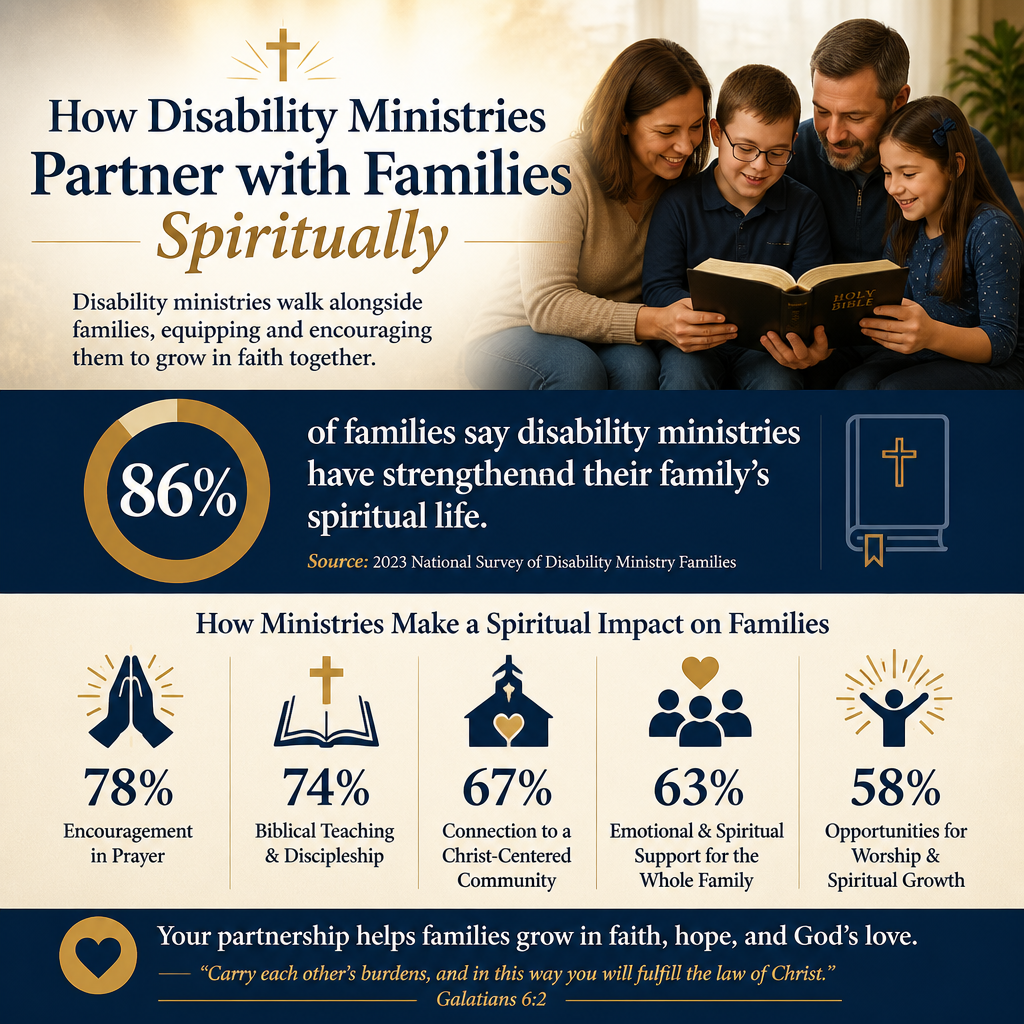
How disability ministries partner with families spiritually is not a soft add-on to “real” care. It is the core question for Christian donors who want their giving to strengthen the body of Christ rather than substitute for it. When disability is present in a household, parents and siblings often carry a complex mixture of love, fatigue, fear about the future, and quiet isolation in church spaces that were not built with them in mind.
Scripture does not treat weakness as a footnote. Paul’s testimony that Christ’s power is made perfect in weakness (2 Corinthians 12:9) is not romantic language for donors; it is a theological claim about where God chooses to display his sufficiency. Disability ministries that partner well with families take that claim seriously in practice: they refuse to reduce a person to a diagnosis, they honor parents without idolizing them, and they build spiritual supports that endure beyond a single program year.
Partnership begins with ecclesiology, not programming
The church is a body before it is a service provider
Disability ministry becomes spiritually formative for families when it functions as an expression of the church’s life together rather than a parallel system of care. Paul’s “one body, many members” is not a metaphor for volunteer recruitment; it is a doctrine of belonging (1 Corinthians 12:12–27). Families affected by disability do not merely need respite; they need to be seen as integral members whose presence changes the community’s discipleship.
This is where donors often face an uncomfortable tension. A ministry can run excellent programs while quietly communicating that the “main” church is elsewhere. The spiritually mature model is integration with integrity: appropriate supports, trained volunteers, and wise boundaries, but with a clear aim that people with disabilities and their families are participating in worship, sacraments, relationships, and mission as full members of Christ’s body.
Spiritual partnership requires mutuality, not paternalism
Many families have experienced well-intentioned attention that still feels like being managed. The When Helping Hurts framework, articulated by Steve Corbett and Brian Fikkert, has helped the Christian sector name a recurring pattern: help that is not grounded in dignity and mutuality can unintentionally harm both giver and receiver by reinforcing dependency or shame. Donors should look for disability ministries that treat families as co-laborers in discipleship, not as projects.
Mutuality does not mean pretending needs are equal. It means honoring agency: inviting parents into planning, seeking consent in caregiving, and listening carefully to siblings who often carry invisible burdens. It also means recognizing that families bring gifts to the church—spiritual insight, perseverance, and a clearer sense of what it means to trust God when outcomes are not controllable.
Families need spiritual care that matches the moral weight they carry
Chronic stress is a spiritual and pastoral reality
Households navigating disability frequently live with chronic stress: medical complexity, educational advocacy, financial strain, and the exhaustion of constant vigilance. These pressures are not merely logistical; they shape prayer life, marriage health, and a parent’s sense of God’s nearness. A ministry that partners spiritually will not force a simplistic testimony narrative onto families. It will make room for lament, endurance, and the long obedience of faithfulness.
Empirically, many caregivers are stretched past what a typical church calendar assumes. For example, a 2020 report by the Centers for Disease Control and Prevention notes that caregiving responsibilities can affect caregivers’ health and well-being, including elevated stress and poorer health outcomes. A credible disability ministry will treat these realities as part of discipleship, not as distractions from it.
Good partnership addresses conscience questions, not only calendars
Parents often make morally weighty decisions with no perfect options: medication changes, behavioral interventions, school placements, guardianship planning, and questions about future residential support. The spiritual needs here are not solved by inspirational messaging. They require pastoral wisdom, a theologically grounded view of personhood, and community companions who can pray with families without trying to control their decisions.
Christians genuinely disagree about some disability-related ethical questions, particularly around prenatal testing, end-of-life decisions, and forms of therapy that may blur into coercion. A trustworthy ministry does not exploit those debates for fundraising. It acknowledges the complexity, clarifies its own theological commitments, and serves families without weaponizing conscience.
Spiritual partnership is built through faithful presence and disciplined boundaries
Consistency is a form of love
Families often describe a recurring grief: people offer help in a crisis and disappear when life becomes ordinary again. Disability ministry that partners spiritually is designed for longevity—stable volunteer teams, predictable rhythms, and a structure that does not collapse when a charismatic leader leaves. This is one reason donors should value governance and leadership strength alongside visible program activity.
Consistency also matters for individuals with disabilities who experience anxiety around change or who rely on relational continuity to participate fully. Faithful presence is not sentimental; it is a disciplined practice of keeping promises. It communicates something deeply theological: that God’s covenant faithfulness is not an abstraction.
Healthy boundaries protect families and volunteers
Spiritual partnership is not achieved by asking exhausted parents to accept any help offered or by expecting volunteers to become quasi-family without support. Mature disability ministries train volunteers in safe care, confidentiality, mandated reporting where applicable, and respectful communication. They also create escalation pathways when behavioral or medical issues exceed volunteer competence.
Across our verification work at Most Trusted, we observe that ministries that meet The Most Trusted Standard tend to document these boundary practices clearly: what volunteers are trained to do, what they are not trained to do, and how families can raise concerns without fear of losing access to support. This is not bureaucratic caution; it is moral seriousness.
Donors should fund systems that strengthen the local church, not replace it
Capacity building is often more spiritually significant than events
Many disability ministries are asked to fill gaps created by unprepared congregations. The healthier long-term approach is to strengthen churches so families do not have to choose between spiritual belonging and practical accessibility. This includes training for pastors and lay leaders, classroom supports for children’s ministry, sensory-friendly worship planning, and equipping small groups to include families who cannot attend consistently.
Donors can also consider whether a ministry partners with churches across denominations without flattening theological differences. The goal is not uniformity; it is shared fidelity to the dignity of persons made in God’s image and to the church’s calling to bear one another’s burdens (Galatians 6:2).
What we examine when disability ministry claims are “spiritual”
Spiritual partnership is easy to promise and harder to demonstrate. Our team looks for verifiable signals that a ministry’s spiritual claims are matched by operational integrity. For donors exploring Disability Ministries, it is reasonable to ask for clarity in areas like governance, financial controls, and outcome reporting, not because disability care should be reduced to metrics, but because trust is a moral category in Christian stewardship.
One practical way to think about donor support is to fund what families cannot build alone. That often includes:
- Volunteer training systems that sustain consistent relationships
- Accessible curriculum and support tools that churches can reuse
- Pastoral care coordination for crisis seasons and long-term planning
- Respite models with clear safety protocols and accountability
- Family discipleship resources that include siblings and caregivers
Donors should also resist simplistic overhead narratives. The “Overhead Myth” statement—signed by major nonprofit evaluators and foundations—helped the sector clarify that administrative spending can be essential to effectiveness and accountability when it supports governance, evaluation, and internal controls. See the statement hosted by Candid. In disability ministry, underfunded administration can translate into undertrained volunteers, inconsistent care, and avoidable risk.
Evidence of partnership shows up in transparency, safeguards, and family voice
Families should be able to see how decisions are made
Because disability ministry often serves vulnerable people, donors should expect a higher standard of transparency. A credible ministry publishes clear program descriptions, complaint pathways, child and vulnerable adult protection policies, and financial reporting that a lay reader can understand. These are not merely compliance documents. They signal whether the organization expects scrutiny and welcomes it.
In addition to basic governance, donors can look for ethical fundraising practices. Families affected by disability are frequently asked to share stories. The question is whether the ministry treats testimony as sacred or as marketing content. A trustworthy ministry secures informed consent, avoids sensationalism, and does not present disability as a problem to be solved in order to justify giving.
Outcomes should be defined with theological realism
Measuring spiritual partnership is not the same as counting attendance. Some outcomes are appropriately qualitative: reduced isolation, increased participation in corporate worship, more stable caregiving networks, and deeper family prayer practices. Christians should not demand proof in ways that deny the hiddenness of much faithful obedience.
At the same time, donors are right to ask whether a ministry learns and improves. For instance, does it track volunteer retention, incident reports, family satisfaction, or accessibility barriers encountered in partner churches? The point is not to make families into data points. The point is to ensure that compassion is governed by wisdom.
For readers who want to explore the theological convictions that should undergird this work, we commend The Theology Behind Christian Disability Ministry as a context for thinking carefully about personhood, suffering, healing, and the church’s vocation.
FAQs for How disability ministries partner with families spiritually
What should donors prioritize when giving to disability ministries serving families?
We recommend prioritizing ministries that strengthen belonging in the local church through consistent relationships, trained volunteers, and clear safeguarding practices. Donors should look for transparency in finances and governance, evidence of family voice in decision-making, and theological clarity that affirms the full dignity and agency of people with disabilities without using their stories as fundraising instruments.
How can donors evaluate whether a ministry is truly partnering with families rather than running programs near them?
Partnership is visible when families can describe the ministry as a stable spiritual support: people who know them, pray with them, and help them participate in worship and community over time. On the organizational side, donors can ask for documented training, protection policies, complaint pathways, and reporting that shows learning and accountability. Most Trusted’s evaluations against The Most Trusted Standard are designed to help donors assess these claims with confidence and appropriate scrutiny.
What faithful partnership requires from donors
Disability ministry is one of the places where Christian donors can either fund a parallel system of care or underwrite the slow work of ecclesial faithfulness. The latter is less dramatic, more costly over time, and more aligned with the New Testament’s vision of the church as a body in which weaker members are treated with greater honor. When disability ministries partner with families spiritually, they are not offering an accessory to family life; they are helping the church become what it already is in Christ.



