
Volunteer training and safety in disability ministries is where compassion either becomes durable care or becomes preventable harm. Donors often see the fruit of these ministries—friendship, worship access, family respite—but the integrity of the work is tested in the hidden systems: who is allowed to serve, how they are formed, and what happens when something goes wrong.
The theological stakes are not decorative. If each person is made in the image of God, then protecting people with disabilities from exploitation, neglect, and spiritual manipulation is not merely a legal obligation; it is a matter of justice and neighbor love. The church’s credibility is also at stake. A ministry can be sincere and still be unsafe, particularly when it relies on enthusiastic volunteers without clear standards, supervision, and accountability.
Safety is a ministry outcome, not an administrative add-on
Many disability ministries were built by faithful improvisation: someone notices a family’s need, recruits a few helpers, and creates a place to belong. That origin story can be holy, and it can also produce weak points—informal screening, inconsistent supervision, or vague boundaries—especially when the ministry expands faster than its governance.
Donors should resist a common false dichotomy: either a ministry is “relational” or it is “procedural.” The most relational ministries are typically the most disciplined about safety. Clear policies and training do not replace love; they protect it from confusion, favoritism, and avoidable harm.
Why disability contexts require heightened clarity
Disability ministry often involves vulnerable participants, intimate helping tasks, and complex communication needs. Many friends with disabilities depend on others for transportation, toileting assistance, feeding, or decision support. That dependency can create opportunities for boundary violations even when no one intends harm. It also increases the likelihood of misunderstandings and false allegations unless expectations are explicit and consistently practiced.
The harder question is not whether volunteers are kind. It is whether the ministry has built a predictable environment where kindness is governed by wisdom—where volunteers know what they may do, what they must never do, and what they are required to report.
What donors should expect in baseline safeguards
Church-based disability programs vary widely, but donors can still look for non-negotiables: documented child and vulnerable-adult protection policies, screening and background checks suited to volunteer roles, a two-adult standard where feasible, controlled check-in and pick-up procedures, incident reporting pathways, and supervision ratios that reflect participant needs.
Some of these practices are shaped by state law and denominational policy; others are simply prudent. Where legal requirements differ, the strongest ministries tend to hold themselves to a higher internal standard rather than treating compliance as the ceiling.
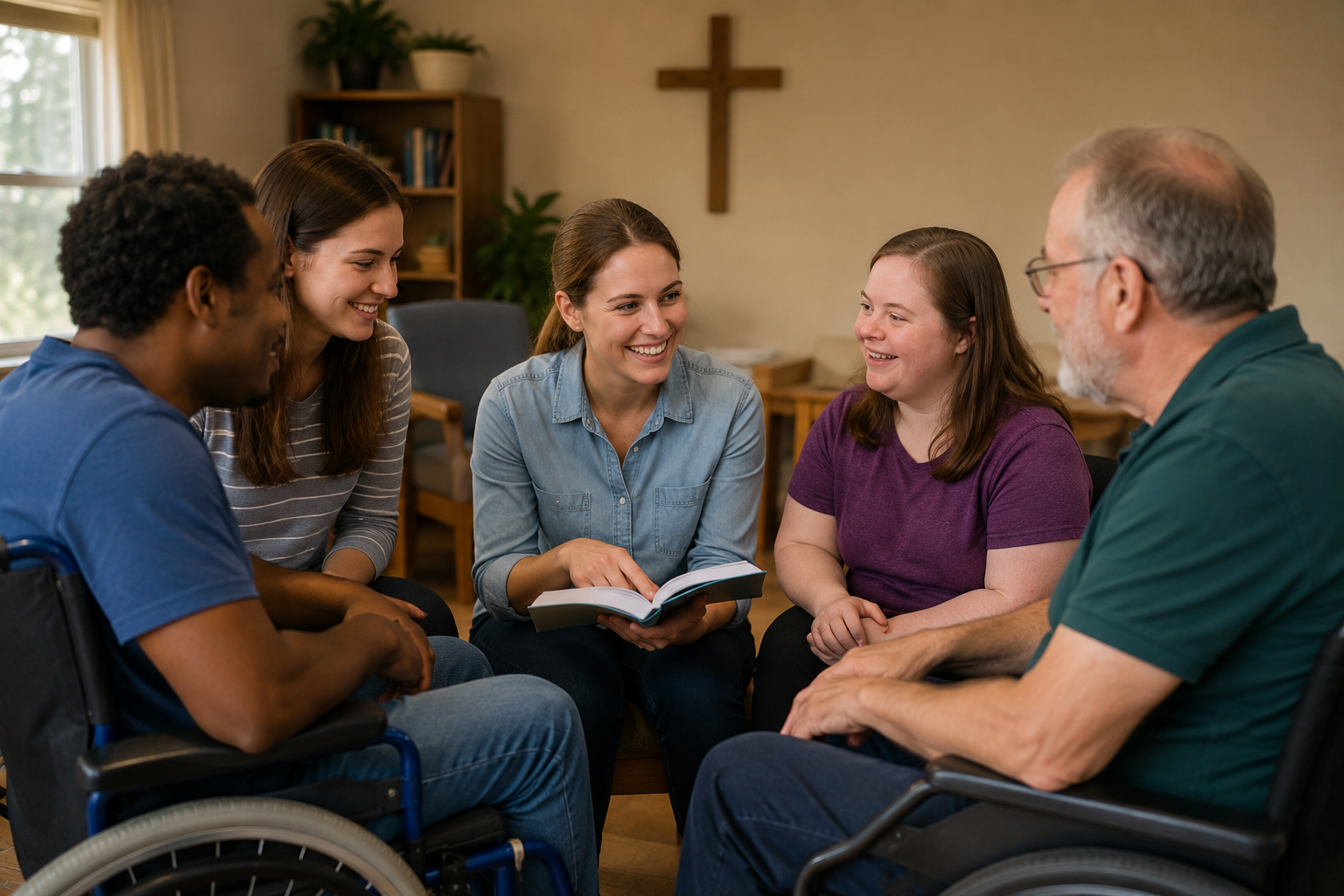
Screening and policies must be proportionate, documented, and enforced
Volunteer screening is not about assuming the worst of the church. It is about recognizing reality. Abuse occurs in every sector, and faith communities are not exempt. The U.S. Department of Justice’s National Crime Victimization Survey reports that people with disabilities experience higher rates of violent victimization than people without disabilities, a vulnerability that should sharpen, not soften, protective measures. See Bureau of Justice Statistics.
Proportionate screening means that the rigor matches the access. A greeter at a disability-friendly service does not carry the same risk profile as a one-on-one buddy accompanying a child to the restroom. Donors should expect ministries to differentiate roles and apply controls accordingly.
Background checks and references are necessary but insufficient
Background checks can disqualify certain individuals, but they do not reveal most boundary problems, grooming dynamics, or spiritual coercion. References can be helpful, but they are only as candid as the referee and only as probing as the questions asked. Effective screening combines documented applications, interviews that test judgment, reference checks that ask role-specific questions, and a clear probation period for new volunteers.
Where ministries are housed within a local church, donors should also ask whether the disability program follows the church’s overall child protection policies or has created its own exceptions. Exceptions are often where risk concentrates.
Child protection and vulnerable-adult protection cannot be an afterthought
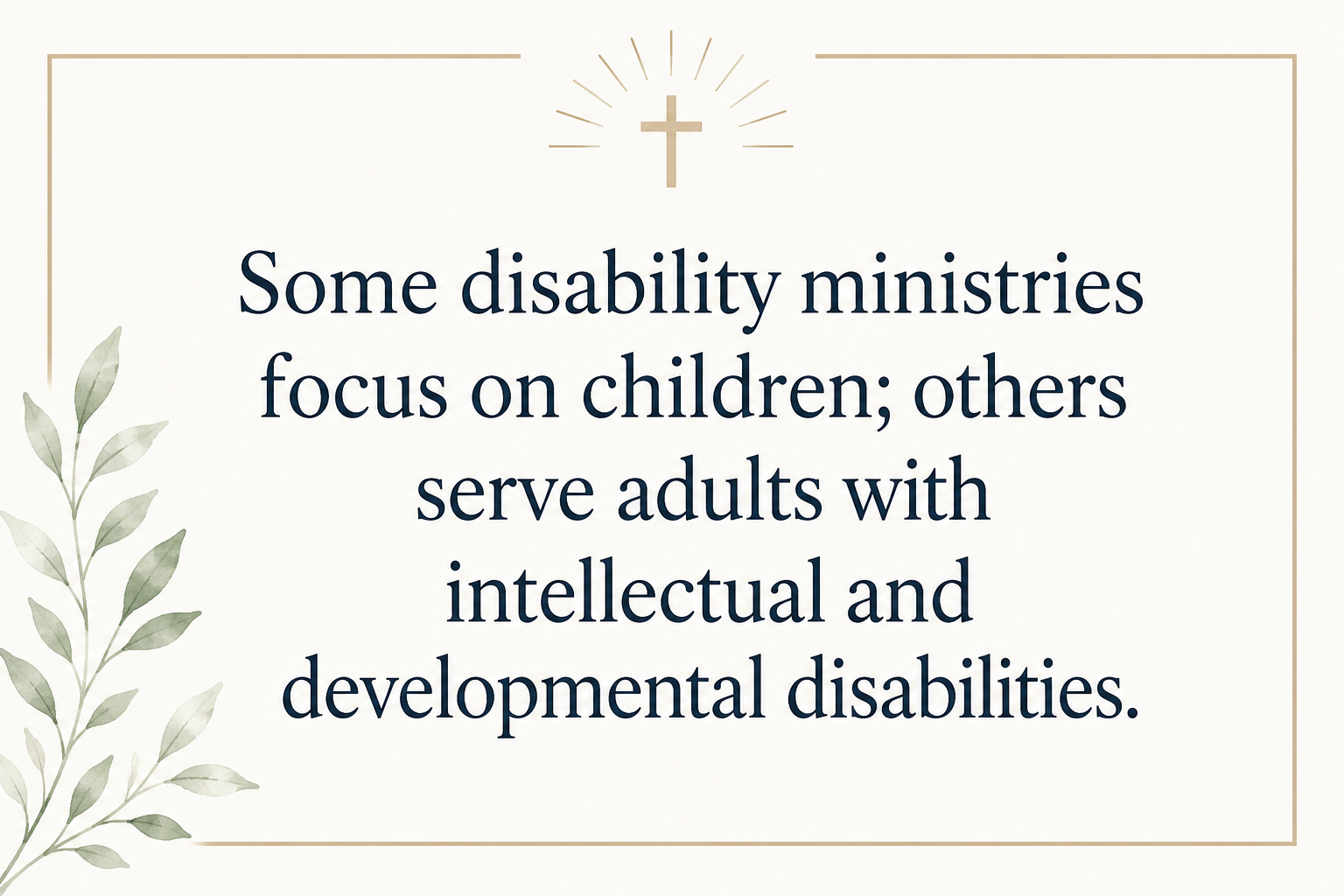
Some disability ministries focus on children; others serve adults with intellectual and developmental disabilities. The policy environment differs, and so should the safeguards. Adult participants may have legal guardians, supported decision-making arrangements, or varying capacities for consent. Ministries that serve adults should be able to explain how they handle guardianship documentation, transportation permissions, medical information, and privacy.
Donors should also listen for whether a ministry understands mandated reporting requirements in its state and trains volunteers accordingly. Mandatory reporting is not merely a legal risk; it is a spiritual duty to protect the vulnerable and refuse complicity with harm.
Enforcement reveals whether policies are real
Many organizations can produce a policy binder. Fewer can describe how policies are enforced when a respected volunteer violates a boundary, when a parent is dissatisfied, or when a staff member fails to document an incident. The ministries that operate with integrity tend to have predictable processes: written incident reports, a clear chain of escalation, and leadership that will remove a volunteer when warranted—even at relational cost.
That willingness is one reason governance matters. At Most Trusted, our verification work places weight on whether boards and senior leaders treat safety as a core responsibility rather than a delegated task that disappears into program staff.
Training must form judgment, not only transfer information
Volunteer training is often reduced to orientation slides and a quick tour of the building. Disability ministry needs more. The goal is formation: shaping volunteers who can make wise decisions under pressure, respond calmly to a meltdown, protect dignity in personal care moments, and communicate respect to families carrying chronic strain.
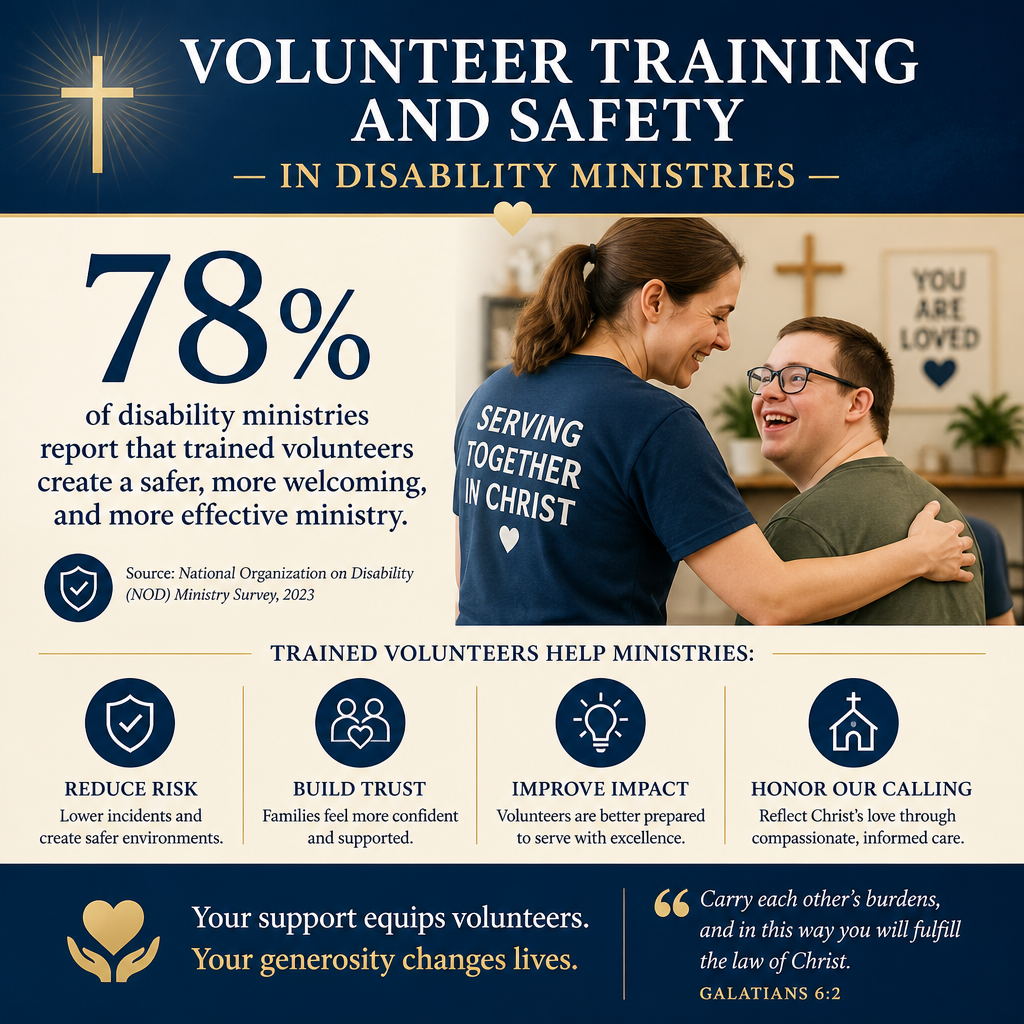
Training also protects volunteers. Many volunteers leave disability ministry not because they lack compassion but because they feel unprepared, unsupported, and afraid of making a costly mistake.
Core competencies donors should look for
Effective training tends to cover several competencies with concrete scenarios:
- Boundaries and appropriate touch (including restroom protocols and one-on-one settings).
- Behavior support and de-escalation (distinguishing willful disobedience from sensory overload or communication frustration).
- Communication and disability etiquette (person-first or identity-first language handled with humility, not ideology).
- Trauma awareness (recognizing that some participants and siblings have trauma histories).
- Medical and allergy basics appropriate to the setting, including seizure response where relevant.
- Reporting (what to document, how quickly, and to whom).
Donors should be wary of ministries that promise inclusion without investing in these competencies. Inclusion without competence can become unsafe for participants and demoralizing for volunteers.
One-on-one buddy models require especially careful training
Buddy ministry can be a beautiful expression of the Body of Christ, particularly when it enables worship participation, friendships across differences, and relief for caregivers. It also creates predictable risks: over-dependence on a single relationship, blurred boundaries, unsupervised moments, and well-meaning volunteers making decisions beyond their authority.
Training for one-on-one support should address authority limits explicitly: buddies are not substitute parents, therapists, or spiritual directors. They serve under supervision, within defined activities, and with clear communication to caregivers and staff.
Serving nonverbal friends requires a theology of patience and precise practice
Nonverbal communication is not the absence of communication; it is communication that requires attentiveness and sometimes alternative methods. Volunteers should learn to ask caregivers about preferred communication systems, watch for cues, and avoid speaking about a person as if they are not present. Dignity is expressed in tone, posture, and patience long before it is expressed in programming.
Some ministries incorporate basic training in AAC awareness or in how to support participants who use picture boards or devices. Donors need not demand technical mastery from every volunteer, but they should expect the ministry to treat communication as central to safety. Miscommunication can escalate behaviors, create unnecessary restraint situations, and lead to avoidable injuries.
Donors should evaluate volunteer safety through The Most Trusted Standard
Most donors are not positioned to audit training manuals or sit in on every volunteer huddle. What donors can do is evaluate whether a ministry has the leadership, financial practices, and transparency that make consistent safety possible over time. This is one reason Most Trusted exists: we help donors give with confidence by assessing ministries against The Most Trusted Standard, a 15-criteria framework across Faith Foundation, Financial Integrity, Governance and Leadership, and Transparency and Effectiveness.
What this means in practice is that volunteer training and safety should not be evaluated in isolation. It is downstream from organizational maturity.
Governance and leadership set the tone for safety
When safety failures occur, they are often framed as individual misconduct. Sometimes they are. Yet many failures are organizational: unclear supervision, undertrained volunteers, undocumented incidents, or leaders who fear reputational damage more than they fear injustice. Donors should look for ministries with boards that understand risk oversight and leaders who will choose truth-telling over image management.
One practical signal is whether the ministry can describe how concerns are escalated beyond program staff. If every problem terminates with the same person who recruited the volunteer, accountability is thin.
Financial integrity affects staffing ratios and training quality
Training takes money: curriculum, staff time, background checks, facility controls, and often insurance. Under-resourced programs are tempted to accept “any willing helper” and to shorten onboarding. Donors should not penalize ministries for investing in administration that directly protects participants. The sector has learned, across many causes, that simplistic overhead policing is harmful. The joint letter commonly known as the Overhead Myth—signed by GuideStar, BBB Wise Giving Alliance, and Charity Navigator—argues that donors should focus on results and accountability rather than arbitrary overhead targets. See BBB Wise Giving Alliance.
Disability ministry is labor-intensive by nature. If a ministry reports extremely low staffing or training expenditures while promising high-touch inclusion, donors should ask how those promises are sustained safely.
Transparency includes how a ministry reports incidents and learns
Serious ministries do not pretend incidents never happen. They acknowledge that complex needs, volunteer turnover, and the realities of human sin make vigilance necessary. Donors can ask whether the ministry tracks incidents, reviews them for patterns, and adjusts training accordingly. A ministry that cannot discuss learning processes may be operating on optimism rather than stewardship.
This is also where donors can connect their giving to the health of the broader ecosystem. Supporting a ministry’s training infrastructure—rather than only visible program moments—can be one of the most strategic gifts a donor makes.
What faithful support looks like for donors and churches
Donors sometimes assume their primary role is funding programming. In disability ministry, faithful support often means funding the conditions that make programming safe: background checks, training hours, paid coordinators who supervise volunteers, and systems that reduce the burden on families. It also means supporting ministries that will say “not yet” when capacity is stretched, rather than expanding inclusion promises beyond what they can safely staff.
For donors who want a wider lens on this field, we encourage engagement with Disability Ministries as a category of Christian work that must hold together welcome, truth, dignity, and prudence. The church is called to honor weaker members and to give them greater honor, not by sentiment but by ordered care (1 Corinthians 12).
Volunteer training and safety are not obstacles to ministry; they are the architecture of trust. Donors who ask careful questions, fund unglamorous safeguards, and prioritize verifiable accountability help disability ministries embody the gospel they proclaim—steadfast in love, and serious about protecting those entrusted to their care.



