
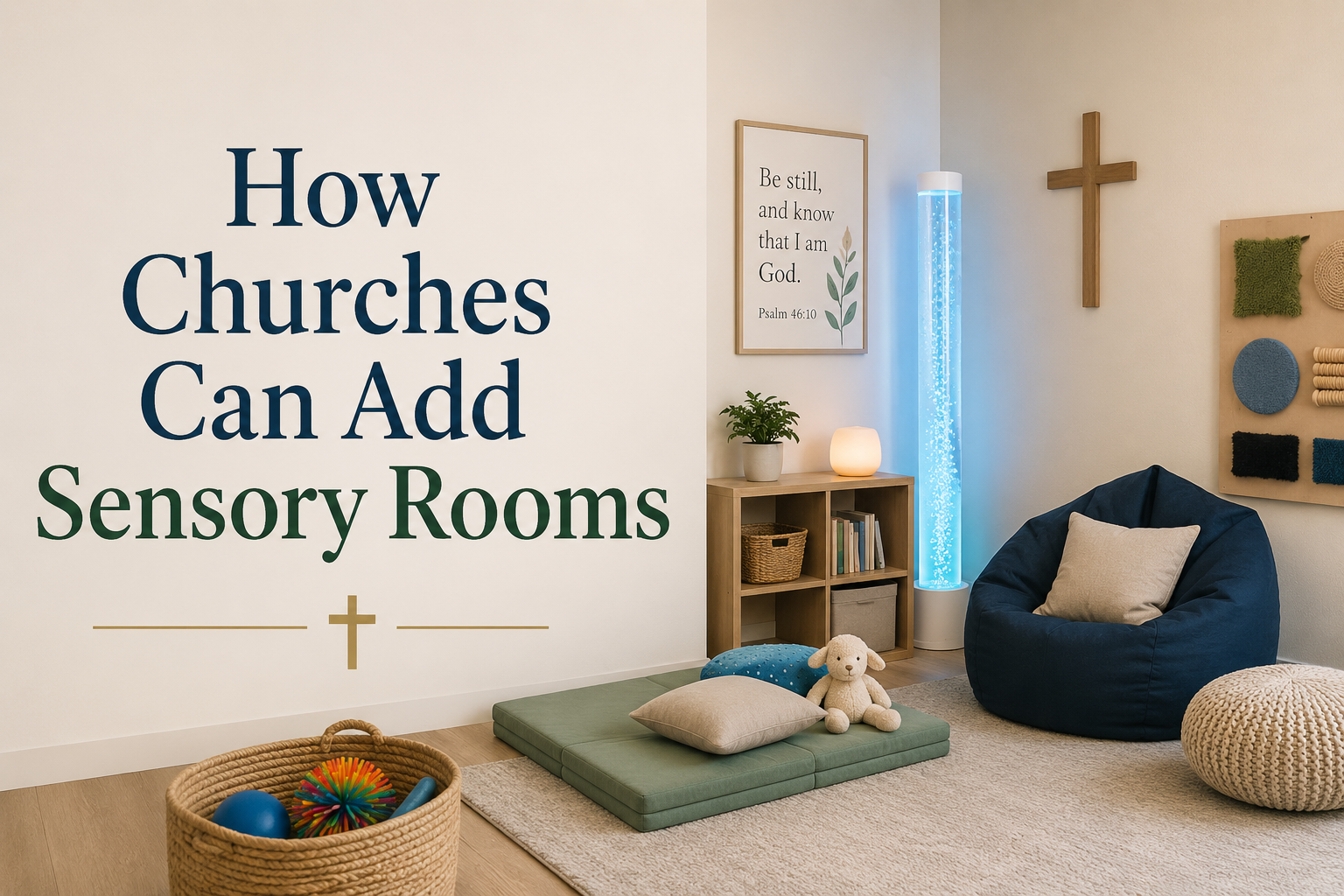
How churches can add sensory rooms is not primarily a facilities question. It is a discipleship question about whether our congregations will make visible room for people whose bodies and nervous systems experience the world differently, and whether we will do so with patience, dignity, and truth.
For Christian donors, sensory rooms can feel deceptively simple: a spare classroom, a few calming tools, a sign on the door. The harder work is ensuring the room is not a quiet way to remove a family from worship, but a carefully governed expression of welcome that is integrated into the church’s ministry, safeguarding, and accountability.
Start with a theology of presence and a definition of the problem
Why sensory support belongs to the church’s public worship
Scripture presents disability and weakness not as inconveniences to be managed but as realities in which the power of Christ is displayed. Paul’s insistence that “the members of the body that seem to be weaker are indispensable” (1 Corinthians 12) is not sentimental. It is a concrete ecclesiology that challenges churches to arrange their life together around those who are easily overlooked.
What this means in practice is that a sensory room should be framed as support for participation, not a parallel track for “those families.” When we treat sensory accommodation as a private workaround, we unintentionally communicate that the family is welcome only if they can be quiet and unobtrusive. A well-designed sensory room exists to reduce barriers so that children and adults can return to worship, small groups, and friendships.
Define the needs you are serving without flattening them
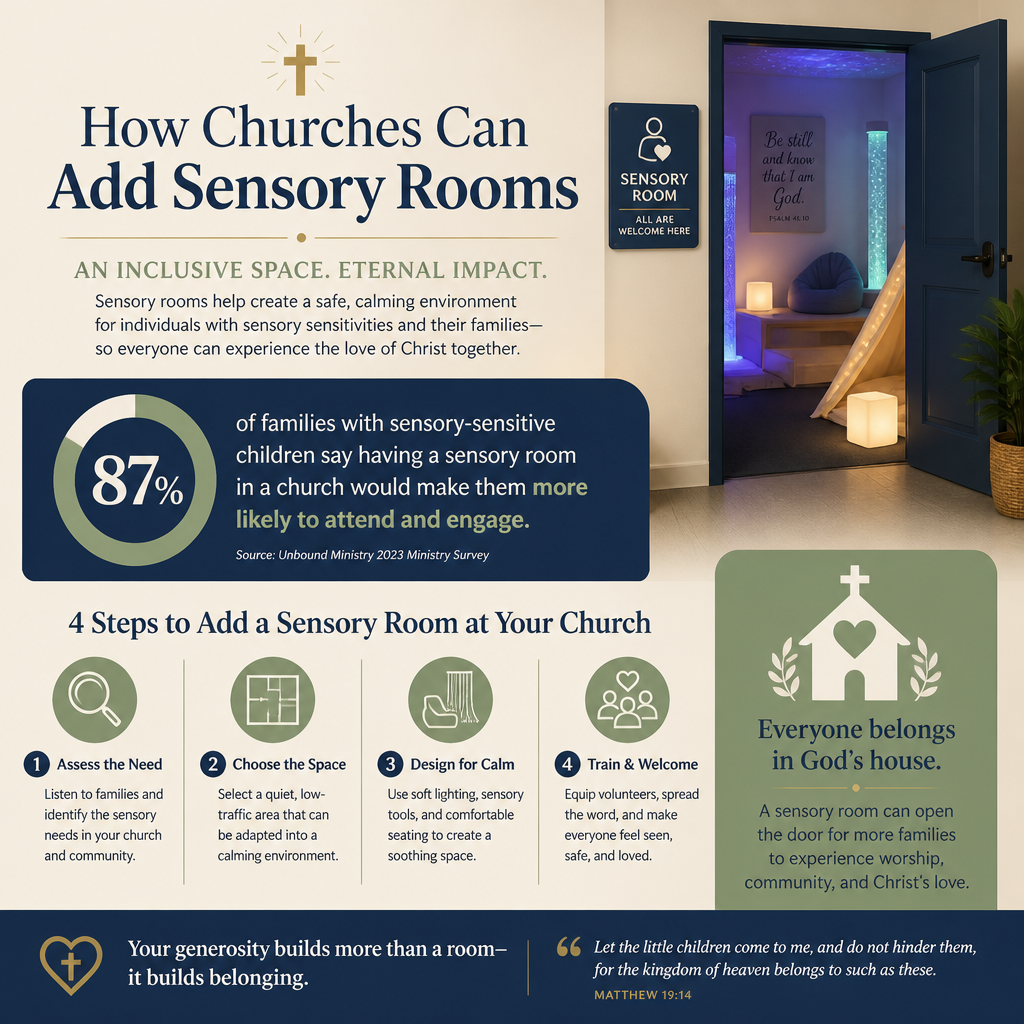
Families seek sensory support for many reasons: autism, ADHD, sensory processing differences, anxiety, PTSD, intellectual disability, traumatic brain injury, and more. Churches should resist overconfident labeling, but they also should not pretend these differences are marginal. In the United States, autism prevalence among 8-year-old children is now estimated at 1 in 31, according to the Centers for Disease Control and Prevention.
That single statistic does not justify a particular room design, but it does establish that sensory needs are not rare. Donors and church leaders should plan accordingly: the question is not whether sensory needs will appear in a congregation, but whether a church will be prepared to respond with competence and pastoral care.
Design the room for regulation and dignity, not novelty
Choose a location that signals welcome without isolating families
Placement communicates theology. A sensory room located near the worship space can make it clear that the goal is participation and return. A room hidden in a distant corridor may unintentionally convey that the church’s priority is keeping disruption away from others.
Many churches also benefit from a “sensory-friendly seat” zone in the sanctuary: aisle access, predictable lighting, and proximity to an exit. A sensory room then serves as a brief decompression space rather than a destination that permanently removes a family from congregational life.
Provide simple, durable tools with clear boundaries
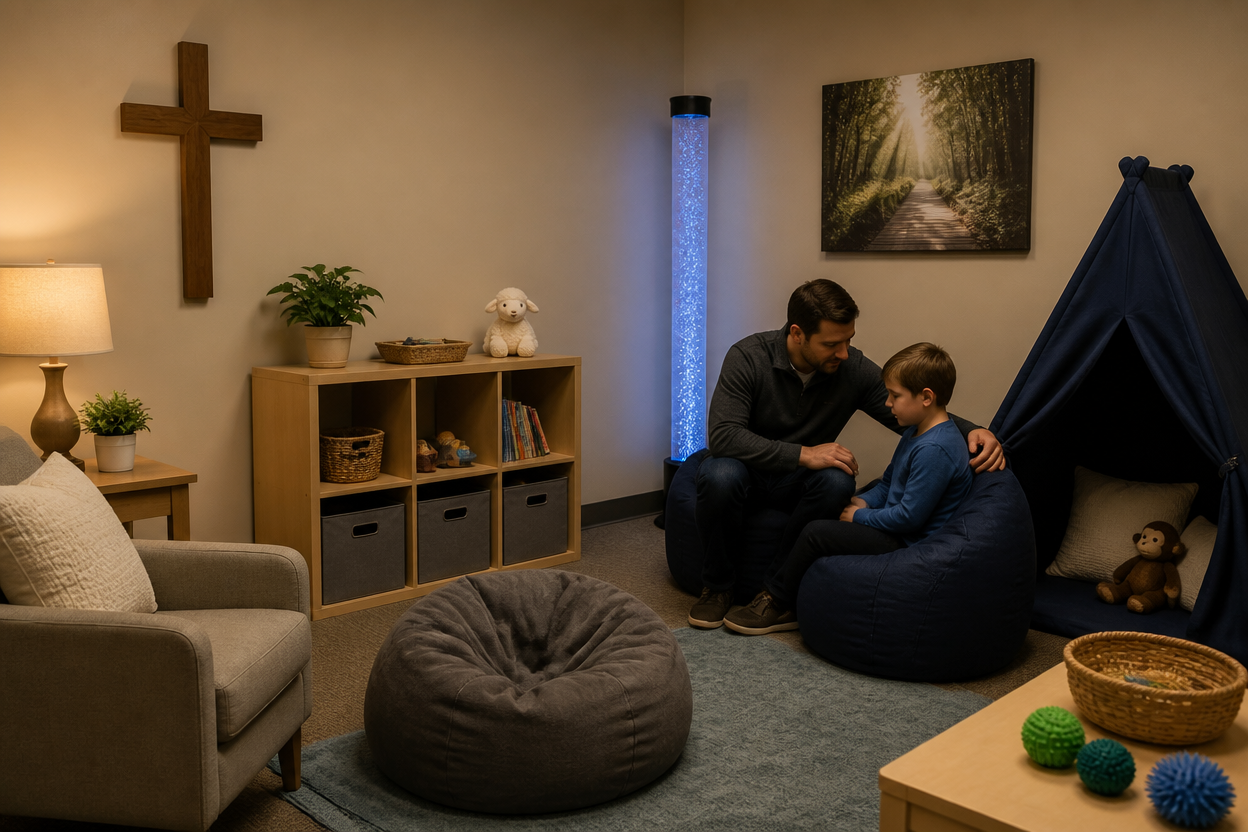
Sensory rooms are often overbuilt. When donors fund them, they can become a showcase of expensive equipment that is difficult to maintain and hard to use safely. The more faithful approach is typically modest and repeatable: tools that are easy to clean, easy to replace, and intuitive for volunteers.
A starter set usually includes:
- Soft seating and a small mat for body breaks
- Dimmable lighting or a lamp option instead of overhead fluorescents
- Noise-reduction supports such as earmuffs and basic visual timers
- A small selection of fidgets that can be sanitized
- Simple visual supports such as a “first then” board and a return-to-worship cue
Boundaries protect dignity. Clear signage should define who may use the room, how long it is intended for use, and what “supported return” looks like. A sensory room that becomes an unsupervised hangout will eventually create safety issues and undermine trust.
Govern the ministry with the same seriousness as any children or care program
Safeguarding is not optional when a room is quiet and private
A sensory room can introduce risk precisely because it is calm and out of public view. Churches should apply the same child protection and vulnerable adult policies they apply elsewhere: screening, training, and supervision expectations that are written and enforced. If the room is intended for a child, it should not become a setting where one unrelated adult is alone with one child.
Many churches already have mature safeguarding frameworks. If not, donors should ask hard questions before funding build-out. The strongest programs treat safety not as a legal burden but as a form of neighbor-love, especially toward those who may have limited communication abilities under stress.
Train volunteers in support, not control
Sensory escalation can be frightening for volunteers and for other families. Training should include basic de-escalation, the difference between meltdown and misbehavior, and the ethical limits of intervention. The goal is not behavioral compliance at any cost. It is regulation, safety, and relational trust.
Churches also should avoid importing therapeutic claims they cannot support. A sensory room is not clinical occupational therapy, and it should not be marketed as such. It is a ministry support space that can complement professional care without competing with it.
Donors who follow disability inclusion work will recognize a wider debate here: how much churches should rely on volunteer-led supports versus partnering with professionals. Christians genuinely disagree about boundaries, liability, and what constitutes appropriate “treatment” in ministry settings. The credible path is clarity: define what the church is doing, what it is not doing, and how families are supported in both directions.
Integrate sensory rooms into the church’s wider accessibility commitments
Make the room part of a pathway, not a standalone project
A sensory room can be a catalyst, but it should not become a substitute for broader inclusion. Many sensory challenges arise from the worship environment itself: volume levels, lighting, crowd density, unpredictability, and long unbroken segments. Some churches have found that modest changes to service rhythms—predictable transitions, advance explanations, clear visual cues—reduce the need for the room without diminishing congregational worship.
It is also wise to build a simple intake and communication process for families: preferred supports, known triggers, and what “success” looks like for that child or adult. This should be handled with discretion. Families do not owe the church a medical dossier in order to belong.
For donors seeking a broader view of ministry practice and needs, we maintain coverage of Disability Ministries that tracks the field’s patterns and common failure points, including where good intentions can inadvertently isolate the people a church is trying to serve.
Measure outcomes that reflect faithfulness, not just room usage
It is easy to measure how often a room is used. It is harder to measure whether the room is accomplishing its purpose: sustained participation in worship, reduced family attrition, increased volunteer confidence, and a congregation that becomes more patient and less anxious around disability.
Churches can track basic indicators without turning families into data points: number of trained volunteers, response time for accommodations, parent feedback, and whether children who use the room are increasingly able to participate in age-appropriate church life. These measures respect the complexity of disability and the reality that progress is rarely linear.
For donors, fund sensory rooms with verification-grade questions
Give to more than a room: fund policies, training, and accountability
Many donors can fund a room faster than a church can steward it. The most responsible gifts include budget for volunteer training, replacement of consumables, cleaning supplies, and signage. They also support the less visible work: background checks, safeguarding refreshers, and a designated ministry lead who is accountable to church leadership.
This is where governance matters. A sensory room should not be built on the preferences of a single champion with no succession plan. It should be integrated into the church’s operating rhythms, with clear ownership and documented practices that survive staff changes.
How Most Trusted fits the donor’s role
Most Trusted exists to help donors give with confidence by evaluating ministries against The Most Trusted Standard, a 15-criteria framework that tests faith commitments, financial integrity, governance and leadership, and transparency and effectiveness. While local churches are not always structured like nonprofits, donors can still apply the same instincts: written policies, credible oversight, meaningful reporting, and outcomes that match the stated mission.
Across our verification work, we observe that the ministries most worthy of donor confidence tend to treat disability inclusion as a long obedience rather than a project. They plan for sustainability, publish clear expectations, and welcome scrutiny because they understand that trust is a form of stewardship.
Donors who want to evaluate broader accessibility practice can also consult our work on Church Accessibility and Disability Inclusion, where we address the operational and theological questions that determine whether inclusion is genuine or merely performative.
FAQs for How churches can add sensory rooms
Should a sensory room be staffed at all times?
Not always, but it should never function as an unsupervised space for children or vulnerable individuals. Many churches staff it during high-use windows such as the worship service and transitions, and keep it locked or restricted at other times. What matters is a written supervision plan aligned with the church’s safeguarding policies, including clear rules against one-on-one isolation with an unrelated adult.
What is a reasonable budget for a church sensory room?
Budgets vary widely based on construction and furniture, but the most faithful starting point is often modest: a clean, calm room, basic sensory supports, and money reserved for training and replacement. Donors should be cautious about gifts that fund expensive equipment without funding the governance that keeps the room safe and consistently available.
A sensory room is a test of what the church believes about belonging
Sensory rooms can become symbols of exclusion if they are designed to protect the congregation from inconvenience. They can also become quiet instruments of mercy when they are governed well and aimed at participation. For Christian donors, the question is not whether a church can build a room, but whether it will sustain a ministry posture that treats people with disabilities as indispensable members of Christ’s body.



