
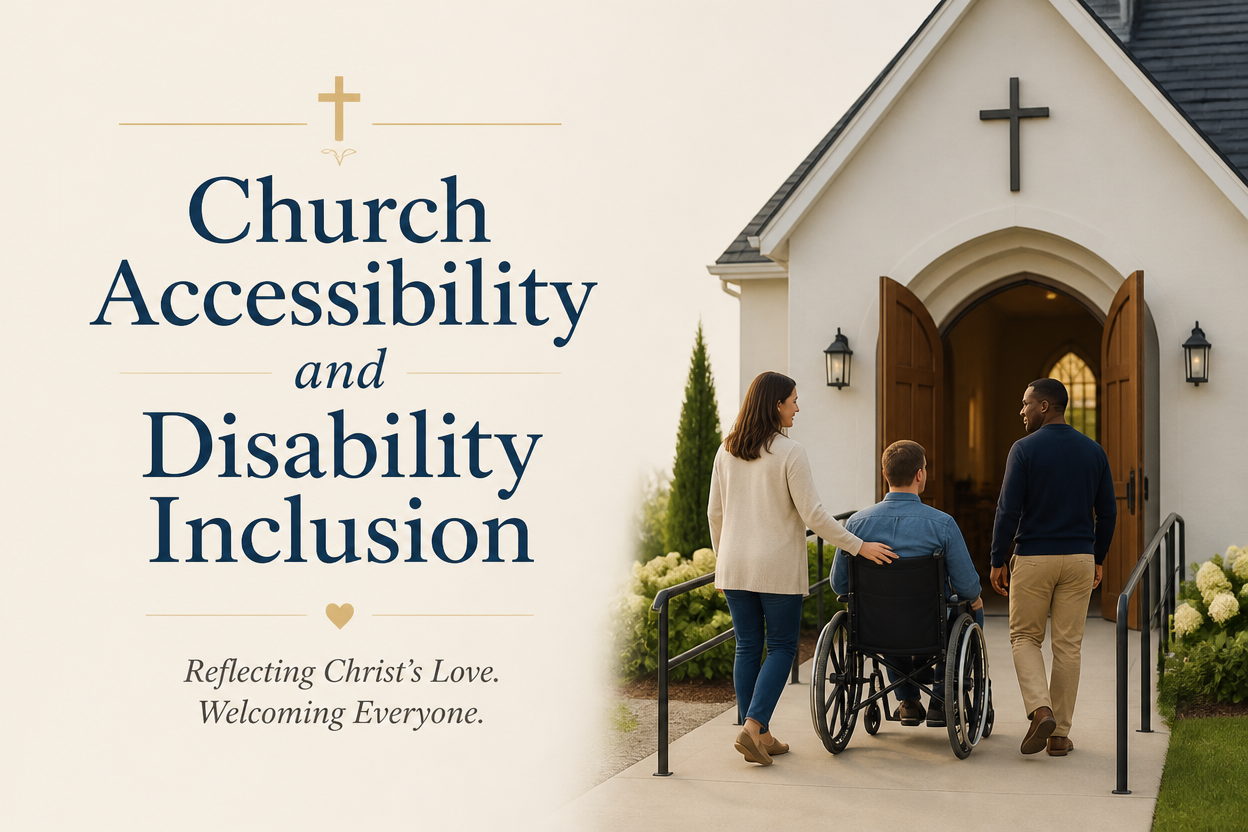
Church accessibility and disability inclusion is not a secondary concern for a faithful congregation; it is a direct expression of what we believe about the image of God, the body of Christ, and the welcome of the kingdom. Donors often sense this instinctively. The harder question is how to support accessibility work that is genuinely dignifying, sustainably maintained, and transparently managed rather than symbolic or reactive.
The New Testament repeatedly frames the church as one body with many members, each needed and honored (1 Corinthians 12:22–26). Accessibility is a practical way of taking that doctrine seriously. It is also an area where good intentions can drift into paternalism, underfunded maintenance, or “one-time projects” that are not matched with training and long-term accountability. Mature giving begins by naming those tensions and funding what actually serves people.
Why accessibility is a theological and pastoral responsibility
Christian communities do not “add” disability inclusion as a program; we either embody the hospitality of God or we do not. Jesus’ pattern is not merely charitable sentiment toward those with impairments, but a reordering of social honor—drawing near, restoring agency, and placing the marginalized within the center of communal life. When a church building, service flow, or leadership culture effectively communicates “you are an exception we will accommodate when possible,” the message contradicts the gospel the church proclaims.
Scripture also resists the assumption that visibility equals value. The members who seem weaker are indispensable, and the parts that lack honor are to receive greater honor (1 Corinthians 12:22–24). Disability inclusion therefore includes architecture and technology, but it also includes how prayer is offered publicly, how volunteers are trained to assist without infantilizing, and whether people with disabilities are welcomed into meaningful service and decision-making.
Accessibility is more than compliance
Many donors assume disability inclusion is primarily an Americans with Disabilities Act question. Legal compliance matters, but the gospel calls for more than minimum viable access. A ramp that technically meets code can still route wheelchair users to a side entrance. A hearing-assist device can exist but be uncharged, untrained, or socially stigmatized. A sensory-friendly space can be advertised but poorly supervised, making it unusable for families who most need it.
Pastorally, the gap between “available in theory” and “usable in practice” is where trust is either built or broken. Churches that serve well usually treat accessibility as part of discipleship: creating a culture where asking for help is normal, and where accommodations are planned, communicated, and reviewed.
Inclusion is a congregational health indicator
Disability inclusion often reveals whether a church makes decisions for the convenience of the majority or for the good of the whole body. It also tests whether the congregation can hold complexity: the needs of children with sensory differences, adults with mobility limitations, older saints losing hearing, and those with intellectual disabilities are not interchangeable. Donors can honor that complexity by funding solutions that emerge from listening and ongoing evaluation, not from generic templates.
What barriers churches actually face
Accessibility barriers are typically a composite of physical design, communication practices, and volunteer readiness. Donors sometimes focus on large construction projects because they are visible and emotionally satisfying. Yet many of the most consequential barriers are small and operational: signage, lighting, predictable routines, training in respectful assistance, and clear pathways for families to request accommodations without embarrassment.
Mobility and facility barriers
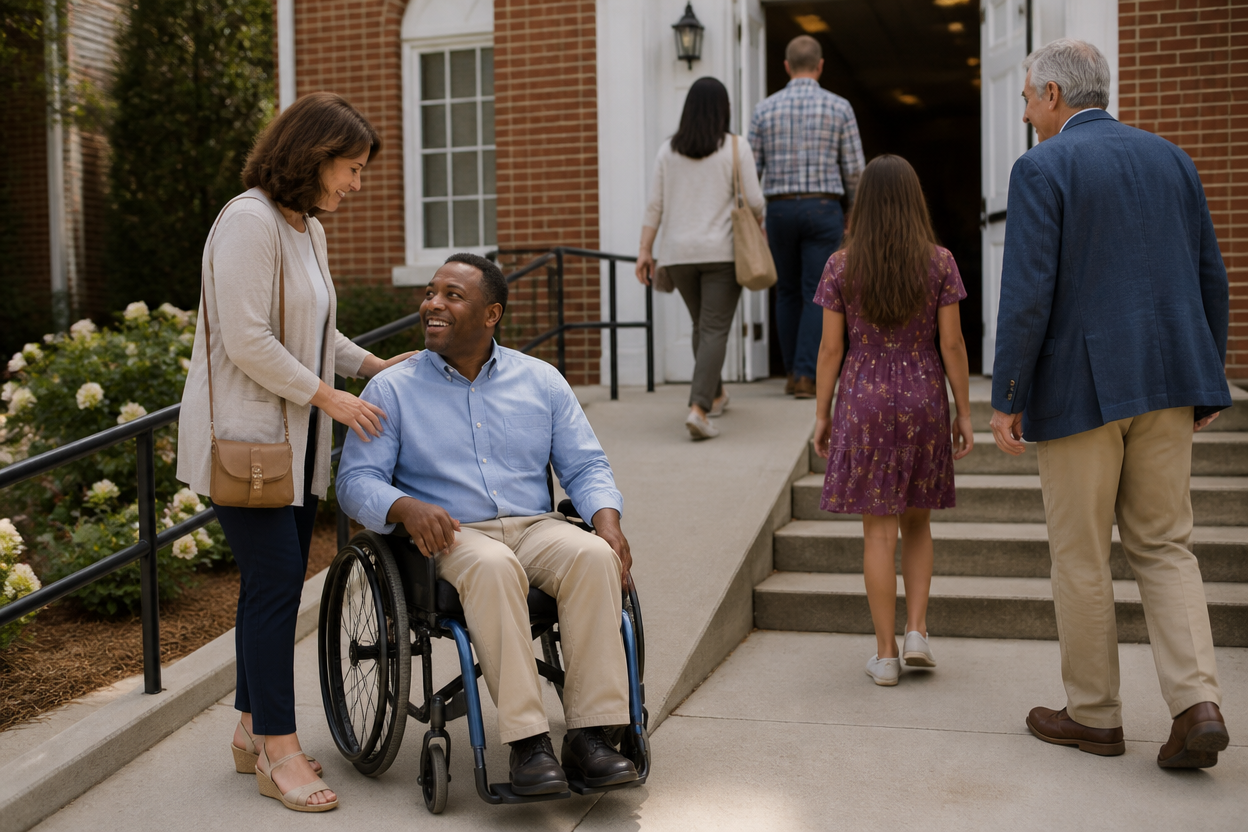
Common obstacles include steps without ramps, steep grades, narrow doorways, heavy doors without power-assist, crowded aisles, stage access limited to stairs, and restrooms that are nominally accessible but practically difficult to use. Parking, curb cuts, and safe drop-off zones matter as much as what happens inside the building. Donors should also think in “arrival-to-departure” terms: can a person participate in worship, communion, classes, and fellowship without being isolated or dependent on a single helper?
Sensory and neurodiversity barriers
For families affected by autism and other sensory processing differences, the barrier is often not a step but an environment: volume levels, lighting flicker, unpredictable transitions, crowded hallways, and an absence of quiet space. Sensory rooms can be helpful, but they are not a magic solution. A well-designed sensory room requires clear policies, trained volunteers, appropriate equipment, and a plan to integrate participants into congregational life rather than sequester them.
Communication and participation barriers
Accessibility includes how information is delivered. Hearing assistance, captioning, clear sight lines, and mic discipline can be the difference between presence and participation. Printed materials that assume perfect vision, digital sign-ups that are not screen-reader friendly, and sermon references that move quickly without context can unintentionally exclude. Many churches also overlook disability inclusion in leadership pathways: whether people with disabilities are invited to serve visibly, asked for feedback, and treated as contributors rather than recipients.
What accessibility upgrades cost and what tends to matter most
Donors regularly ask what church accessibility upgrades cost because they want to give meaningfully rather than symbolically. The honest answer is that cost varies widely by building age, local codes, and scope. What this means in practice is that donors should focus on (a) the specific barriers a congregation is addressing, (b) whether the solution will be maintained, and (c) whether the church is pairing capital improvements with training and accountability.
We also recommend resisting two equal errors: assuming accessibility requires a massive renovation before any progress is possible, and assuming small tweaks are sufficient when structural barriers persist. Wise funding often combines early “quick wins” with a multi-year plan that tackles major constraints over time.
High-impact, lower-cost improvements
Many accessibility gains are achieved through targeted purchases and operational discipline: assistive listening systems, improved signage, better lighting in walkways, sound-level monitoring, reserved seating that is truly integrated rather than isolated, and volunteer training that reduces awkwardness and prevents harm. Churches that do this well treat these upgrades as ongoing ministry costs, not one-off expenses that fade after a dedication Sunday.
Captioning and interpretation can also be substantial improvements, though costs vary depending on whether a church uses live captioning, post-produced content, or a combination. Donors should ask what the church can sustain week after week, not merely what it can pilot for a month.
Facility projects that require serious planning
Bathrooms, entrances, and internal circulation often require professional design and construction. Accessible bathrooms matter because dignity matters; they also matter because without them, a person’s ability to attend is time-limited and conditional. In older buildings, bathroom projects can uncover plumbing, structural, or code issues that raise costs. Donors can add value by funding not only the visible fixtures but also the professional assessment work that prevents expensive rework.
Similarly, ramps, lifts, and door systems must be chosen with maintenance in mind. A broken lift can functionally exclude people while giving the congregation a false sense of inclusion. Donors should ask who will be responsible for inspections, battery replacement, repairs, and volunteer training.
Grounding donor expectations in real prevalence
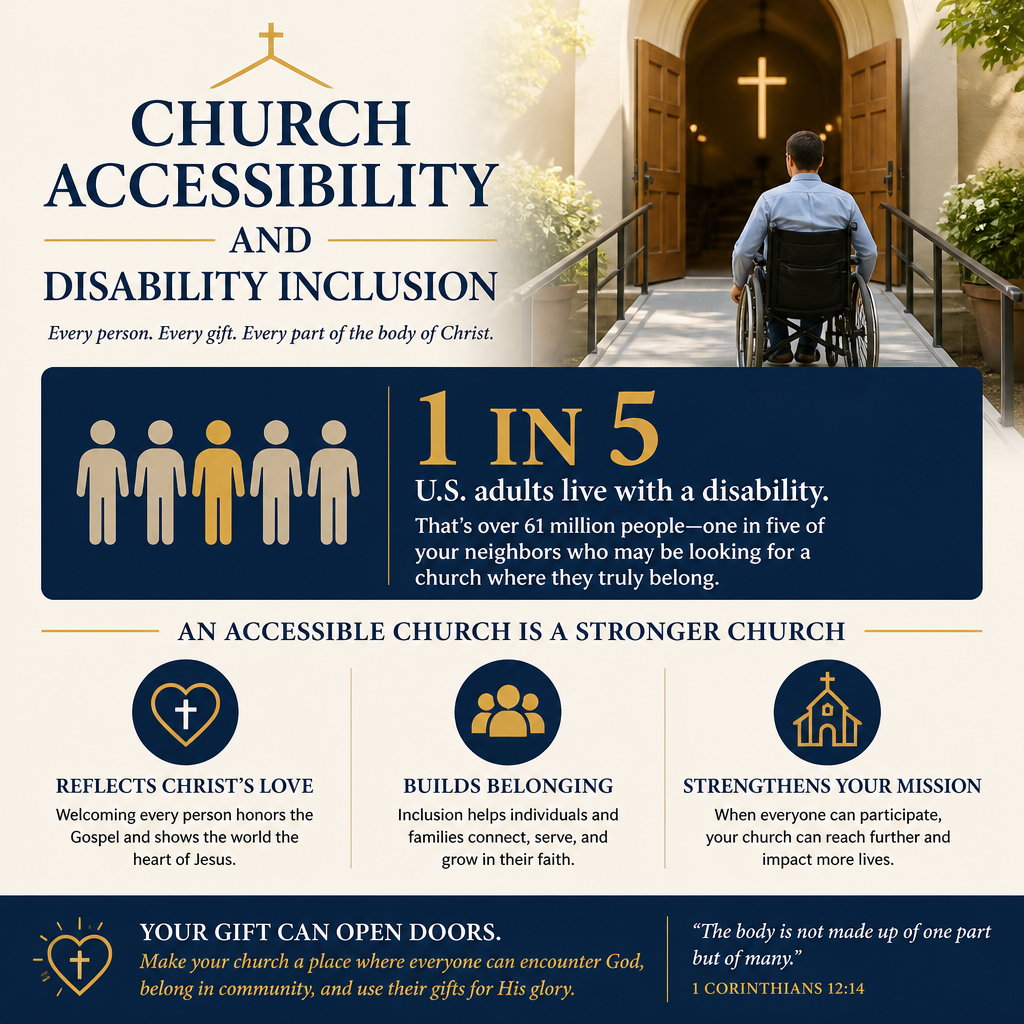
Disability is not rare. The U.S. Centers for Disease Control and Prevention estimates that 1 in 4 adults in the United States has some type of disability.CDC That prevalence suggests two realities donors should hold together: accessibility work will serve more people than most churches initially expect, and needs will be diverse. The goal is not a perfect building that anticipates every scenario; the goal is a church that listens, adapts, and refuses to treat disability as an edge case.
How donors can evaluate disability inclusion ministries with confidence
Donors want their giving to produce real welcome rather than aspirational language. Accessibility projects can be uniquely vulnerable to performative metrics—counting dollars spent or equipment installed while neglecting whether people are truly included. This is where verification and governance matter. Most Trusted exists to help donors give with confidence by evaluating ministries against The Most Trusted Standard, a 15-criteria framework covering faith commitments, financial integrity, governance, and transparency and effectiveness.
Questions that reveal whether inclusion is real
Donors can ask concrete questions that do not require technical expertise. Who was consulted—people with disabilities and caregivers, or only facility staff? What barriers are being addressed first, and why? How will the church know whether changes are working? Is there a feedback loop that is safe for families who have historically been overlooked?
It is also reasonable to ask whether disability inclusion is resourced as an ongoing ministry: background-checked volunteers, clear supervision ratios, written protocols for medical needs, and policies that protect participants while honoring family authority. Churches that treat disability ministry as a discipleship pathway tend to invest in training and leadership development, not only in equipment.
Financial and governance signals donors should not ignore
Accessibility spending sits at an intersection of compassion and capital projects, which can invite weak procurement practices if leadership is rushed or under pressure. Donors should look for basic financial discipline: competitive bids where appropriate, clear budgeting, documented restrictions on designated gifts, and transparent reporting on what was actually delivered. The Evangelical Council for Financial Accountability’s standards provide a well-known benchmark in the Christian nonprofit sector for financial accountability and stewardship.ECFA
Governance matters as well. Strong boards and leadership teams do not treat accessibility as a pet project driven by one advocate; they embed it in planning, risk management, and congregational communication. When leadership changes, the ministry should not collapse. Donors can reasonably ask whether disability inclusion is written into policies, training schedules, and facility plans, not merely announced.
A realistic view of outcomes
Some outcomes are measurable: reduced incidents, increased participation, volunteer retention, and clearer accommodation processes. Other outcomes are intrinsically relational and harder to quantify: whether families experience the church as safe, whether adults with disabilities are known and honored, whether congregational life makes room for those who move or communicate differently. Mature donors should be wary of simplistic success stories, but they should also resist cynicism. Faithful ministry can be both accountable and compassionate.
For donors seeking broader context on how disability-focused work operates across the sector, we also address these questions within Disability Ministries, where accessibility is one expression of a wider theological and practical commitment to inclusion.
Funding accessibility as faithful stewardship
Church accessibility and disability inclusion invites donors into a particular kind of stewardship: funding work that is both materially concrete and spiritually consequential. The church is called to honor the members who are too easily overlooked, not as a project but as family. Giving that advances inclusion is most trustworthy when it is paired with sober attention to governance, sustainability, and the lived experience of people with disabilities and their caregivers.
When donors fund accessibility with that seriousness, they participate in a form of hospitality that aligns with Scripture’s vision of the body: many members, one life, and a shared responsibility to ensure that each member can belong and serve.



