
What non-cash gifts Christian donors can consider is not a peripheral stewardship question; it is often the difference between giving that merely feels generous and giving that is measurably wise. For many believers, non-cash giving is also the clearest way to align the whole of one’s estate, assets, and vocation with the Kingdom of God rather than default patterns of consumption and accumulation.
Scripture treats wealth as spiritually consequential because it shapes what we love, what we fear, and what we trust. Jesus’s warnings about riches are not a rebuke of provision itself, but of the self-sufficiency and distorted security money can produce. Non-cash gifts can help Christian donors practice a more integrated stewardship by placing appreciated assets, property, and long-term planning under intentional discipleship.
Why non-cash giving belongs in mature Christian stewardship
Stewardship is broader than annual cash flow
Many donors make giving decisions as though stewardship begins and ends with a monthly budget line. Yet Scripture presents stewardship as accountability for everything entrusted to us: time, influence, land, labor, and resources. The parable of the talents in Matthew 25 is not a lesson about fundraising techniques; it is a sober account of responsibility before God.
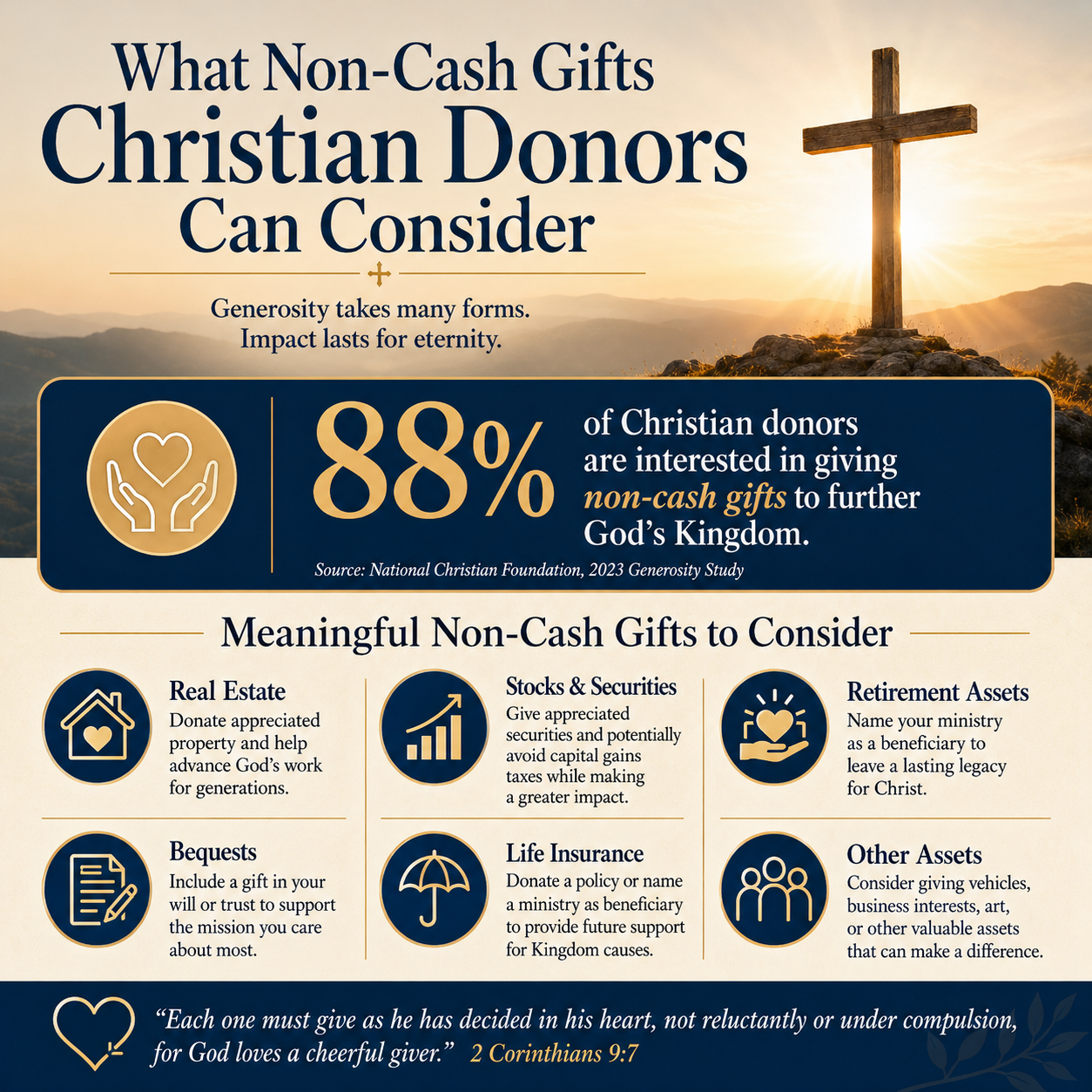
What this means in practice is that a Christian donor’s most impactful gift may not come out of checking at all. Appreciated securities, business interests, real estate, and retirement assets can represent years of God’s provision. Treating those assets as “off limits” to generosity is often less prudence than habit.
Non-cash gifts can protect mission from the volatility of emotion
Cash giving is easily driven by immediate needs, urgent appeals, and genuine compassion. Those motives are not suspect, but they can be unstable. Non-cash giving, by contrast, is usually planned, documented, and aligned with longer-term convictions. It can be a way of giving that is less reactive and more accountable.
Christians genuinely disagree about the right balance between spontaneous generosity and structured giving. The field has had to reckon with cases where spontaneous giving funded programs that were poorly governed or even harmful. Planned non-cash gifts do not eliminate that risk, but they tend to create moments where donors ask better questions about theology, oversight, and effectiveness.

The non-cash gifts that most often fit Christian donor goals
Appreciated securities
For many donors, appreciated publicly traded stock is the simplest non-cash gift. The ministry receives the value of the shares; the donor avoids capital gains tax that would have been triggered by selling the asset first. The trade-off is practical rather than spiritual: donors must coordinate with the ministry’s brokerage process, and some smaller ministries are not prepared to receive stock without an intermediary.
The Internal Revenue Service explicitly recognizes gifts of appreciated property, including securities, as charitable contributions under U.S. tax law, with rules that vary by holding period and valuation method. Donors should treat the mechanics as part of faithful stewardship rather than as an afterthought, and consult qualified counsel for their specific situation. See the IRS guidance on charitable contributions at Internal Revenue Service.
Donor-advised funds as a disciplined giving tool
Donor-advised funds can serve Christian donors who want to give generously now while deciding distribution timing later. A donor typically contributes cash or appreciated assets to the fund, receives the charitable deduction subject to applicable limits, and then recommends grants over time to ministries and churches.
DAFs are not morally neutral simply because they are common. They can be used to delay giving indefinitely, which is hard to reconcile with the urgency of biblical mercy and mission. They can also be used to build a disciplined plan of support for trusted ministries over many years. The National Philanthropic Trust’s annual reporting provides context on DAF usage and flows; see National Philanthropic Trust.
Complex assets that can multiply impact but require stronger diligence
Real estate, land, and non-cash property
Donating real estate can be a meaningful act of stewardship, especially when a property has appreciated significantly or no longer fits a family’s needs. Churches and ministries sometimes receive homes, parcels of land, or commercial property and then sell those assets to fund ministry work. The complexity is real: environmental liabilities, title complications, carrying costs, and restrictions can turn an intended blessing into an administrative burden.
For that reason, donors should ask direct questions about the ministry’s gift acceptance policy. Mature ministries will state clearly what they will and will not receive, how they assess risk, and whether they work with third-party services to liquidate property responsibly. A ministry’s willingness to say “no” to a complicated gift is often a sign of governance maturity.
Closely held business interests
Gifts of privately held business interests can be extraordinarily impactful, but they sit at the intersection of valuation, control, and legal complexity. The donor may be transferring part of a company’s equity; the ministry may receive distributions, a liquidity event benefit, or an interest that must be held for a period of time.
This kind of giving requires high-integrity counsel and a ministry with experienced oversight. Donors should be prepared for a slower process and for the possibility that a ministry will decline the gift. That is not ingratitude; it is a recognition that ministries exist to pursue mission, not to manage complicated holdings as a substitute for prudent fundraising.
Legacy gifts that reflect Christian hope and responsibility
Bequests and beneficiary designations
Christian stewardship does not end at death, and legacy giving can be a sober expression of hope: we entrust resources to God’s purposes beyond our own lifespan. Bequests through a will or trust are among the most common planned gifts. Beneficiary designations on retirement accounts and life insurance can also be significant, sometimes more efficient than leaving those assets through an estate if taxes would otherwise diminish them.
These decisions deserve theological and familial seriousness. Donors should provide for dependents, honor legitimate obligations, and resist the temptation to use giving as a way to manage unresolved family dynamics. Planned giving should feel like clarity, not like leverage.
Charitable remainder trusts and charitable gift annuities
Some donors want to give a meaningful asset while retaining an income stream for a period of years. Charitable remainder trusts and charitable gift annuities are instruments that can serve that purpose, under the right circumstances. They are not primarily “tax strategies”; they are structured ways to balance provision and generosity.
The trade-offs are significant. These vehicles have administrative costs and compliance requirements, and they require careful selection of the sponsoring organization. Donors should expect transparent disclosures, realistic projections, and a clear statement of how the remainder will be used for mission.
How to evaluate ministries before making non-cash gifts
Non-cash gifts can conceal weak accountability
Non-cash giving can increase impact, but it can also increase risk. A complex gift is difficult to unwind if a ministry lacks financial controls, board oversight, or clear reporting. Donors should assume that the higher the complexity of the asset, the higher the burden of diligence.
This is where independent verification matters. Most Trusted exists to help Christian donors give with confidence by evaluating ministries against The Most Trusted Standard, a 15-criteria framework across Faith Foundation, Financial Integrity, Governance and Leadership, and Transparency and Effectiveness. A ministry that receives complex non-cash gifts responsibly will usually show strength across those categories in verifiable ways, not merely in reassuring language.
A practical diligence checklist for non-cash gifts
Before transferring a complex asset, donors can ask questions that reveal whether the ministry is prepared to receive it without compromising mission:
- Does the ministry have a written gift acceptance policy that addresses real estate and non-cash assets?
- Is the board meaningfully engaged in financial oversight, with documented controls and review?
- Does the ministry provide clear, timely financial statements and an annual report that aligns with them?
- Can the ministry explain how it will liquidate, hold, or steward the asset and what costs it expects?
- Will the ministry provide a contemporaneous written acknowledgment appropriate to the gift type?
Donors who want to locate ministries where non-cash gifts are more likely to be handled with rigor should begin with organizations that welcome external scrutiny. Our work in Christian Stewardship Services is built around the conviction that Christian generosity should be guided by truth, not by pressure or ambiguity.
For donors focused specifically on alternatives to cash giving, it is often helpful to compare approaches and readiness across organizations that operate in this space, including how they handle valuation, liquidation, and reporting. We track these patterns within Non-Cash Giving Through Christian Stewardship Services, where donors can orient themselves to common practices and red flags.
FAQs for What non-cash gifts Christian donors can consider
Are non-cash gifts only for wealthy Christian donors?
No. While some non-cash gifts involve complex assets, many are accessible to ordinary households. Appreciated stock from a modest brokerage account, a beneficiary designation that costs nothing today, or a thoughtfully sized bequest can be meaningful. The more important dividing line is not wealth but clarity: donors should understand what they are giving, what it is worth, and whether the ministry can steward it responsibly.
Should we give non-cash gifts to a church or to a nonprofit ministry?
Both can be faithful, depending on calling and accountability. Churches often have limited capacity to handle complex gifts like real estate, while established nonprofit ministries may have dedicated processes and partners. The decisive question is governance and transparency: donors should look for clear policies, documented oversight, and credible reporting, rather than assuming that any Christian organization is prepared for high-complexity assets.
Non-cash giving as disciplined Christian generosity
Non-cash gifts can help Christian donors practice stewardship that is proportionate to the resources God has entrusted to them. They can also expose whether a ministry is structurally prepared to receive generosity without drifting from integrity or mission. The wisest path is not merely to find the most tax-efficient gift, but to give in a way that is true, accountable, and shaped by the priorities of the Kingdom.



