
Non-Cash Giving Through Christian Stewardship Services often begins with a simple conviction: the Lord owns all we steward, and faithful giving should not be limited to what fits in a checkbook. For many Christian donors, the larger portion of net worth sits in appreciated assets, retirement accounts, or property rather than in cash. The question is not merely tactical. It is spiritual and moral: how do we give in a way that is faithful, wise, and verifiably aligned with ministries that handle God’s resources with integrity?
Scripture speaks plainly about wealth’s power to form and deform the heart. Jesus’ warnings about money are not cautions for the irreligious; they are discipleship directives for the covenant community. Non-cash giving can be a way of loosening our grip on accumulated assets while directing them toward the work of the Kingdom. It can also introduce real complexity: valuation questions, tax rules, reputational risk for ministries, and the potential for gifts that burden rather than bless.
Why non-cash giving belongs in mature Christian stewardship
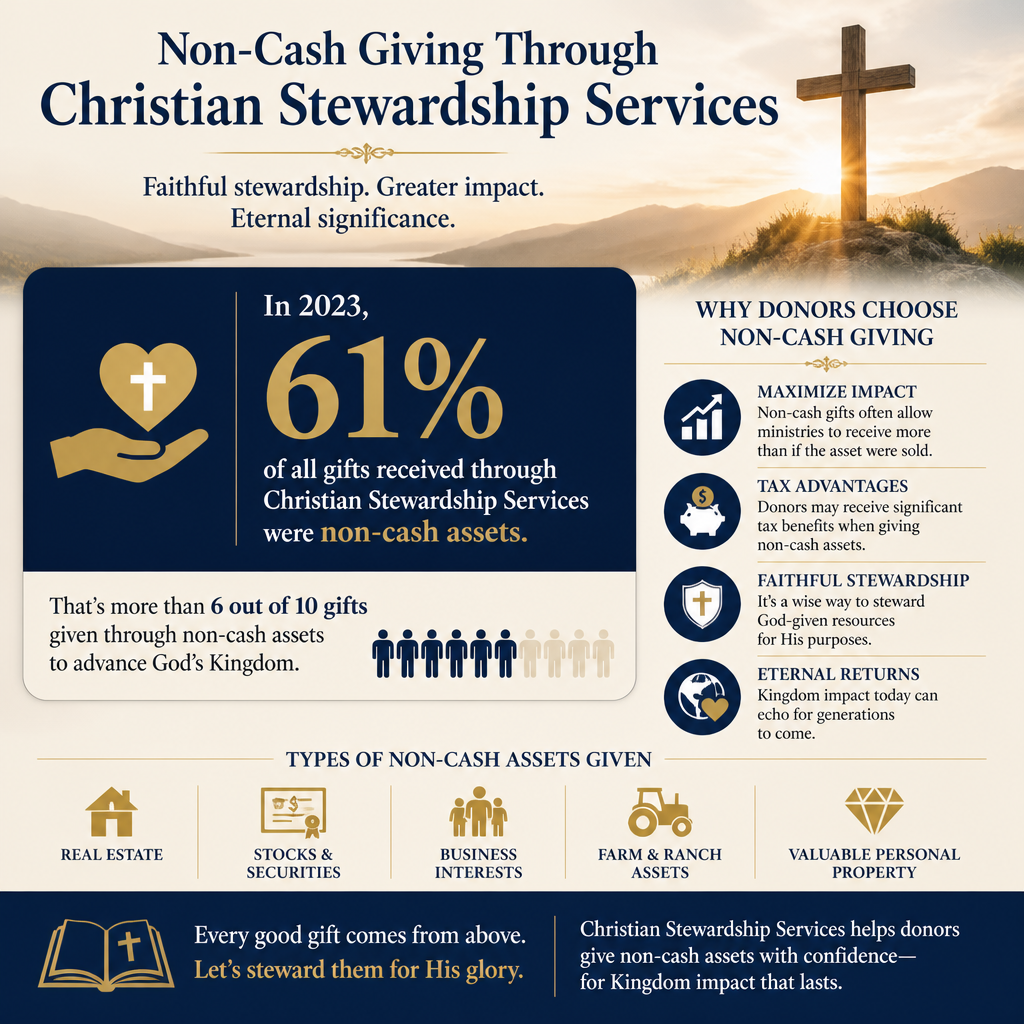
Many donors assume that “generous giving” means cash giving, and anything else is a specialist’s domain. Yet for households with appreciated securities, concentrated stock positions, business interests, or real estate, cash can be the least efficient and sometimes the least thoughtful asset to give. Non-cash giving is not a loophole for the wealthy. Properly practiced, it is a disciplined form of stewardship that can increase the ministry’s net benefit while reducing avoidable loss to taxes.
Appreciated assets illustrate the point. When a donor gives appreciated stock directly to a qualified charity (rather than selling and giving cash), the donor may generally avoid capital gains tax and may generally claim a charitable deduction for fair market value if held long-term, subject to IRS limits. The rules are not identical for every circumstance, and donors should consult qualified tax counsel. Still, the basic principle is clear: giving the asset itself can preserve more value for gospel work than giving the proceeds after a taxable sale.
What donors often miss about where their wealth actually sits
Non-cash giving matters because many Christian households hold significant wealth outside ordinary checking accounts. For example, U.S. households hold a large share of their assets in equities, retirement accounts, and real estate; the Federal Reserve’s Distributional Financial Accounts illustrates how material wealth is commonly embedded in these categories rather than in liquid cash. Federal Reserve
What this means in practice is that a donor can be deeply generous in aspiration and yet constrained in actual giving because the assets are “locked” in forms that feel hard to transfer. Christian stewardship services exist, in part, to help donors give those assets in a compliant and ministry-friendly way.
When complexity becomes a stewardship test
Complexity is not itself a reason to avoid non-cash gifts. It is, however, a reason to treat them with the seriousness they deserve. A gift that arrives without documentation, a clear valuation, or a plan for liquidation can create administrative risk for a ministry. A gift of property with environmental issues or unclear title can become a liability. A gift of closely held business interest can carry restrictions that complicate governance. Christian donors honor the Lord not only by the act of giving, but by giving in a way that is orderly and transparent (1 Corinthians 14:40).

How Christian stewardship services typically handle stock, real estate, and IRA giving
Christian stewardship services are not all identical. Some function as donor-advised fund sponsors, others as gift-acceptance and liquidation partners, and others as planned giving consultants who work alongside a donor’s attorney and CPA. The unifying feature is that they provide a disciplined channel for accepting, processing, and documenting gifts that are not simple cash transfers.
For Christian donors, the main value is often not “making it easy,” though efficiency matters. The deeper value is reducing preventable error: mistaken account titling, avoidable taxable events, incomplete substantiation, or gifts that ministries cannot receive responsibly. Mature donors typically want their generosity to be both fruitful and clean.
Gifts of appreciated stock
Stock gifts usually follow a predictable path: the donor initiates a transfer from a brokerage account to the receiving ministry or to a stewardship service that processes the gift; the recipient acknowledges receipt; and the donor retains records of the date and number of shares transferred. Most ministries liquidate donated shares promptly as part of a risk management policy, though policies vary.
Two practical tensions deserve mention. First, donors often want credit for the “value” of the gift, while ministries must be careful not to provide valuations that belong to the donor and the donor’s advisors. Second, donors may assume the ministry will hold the stock to “maximize return,” but that can conflict with prudent risk controls and the ministry’s cash-flow needs. A disciplined liquidation policy is often a sign of governance maturity, not a lack of faith.
Gifts of real estate
Real estate can be a powerful gift, but it is rarely simple. A ministry that accepts property without a clear gift acceptance policy invites reputational and financial risk. Responsible recipients typically require an appraisal, title review, environmental screening (when relevant), and a clear plan for sale or use. Donors should expect questions. A ministry asking hard questions is often demonstrating care for its mission and for the donor’s intent.
The harder question is whether a given ministry should accept real estate at all. Some organizations have internal capacity; many do not. For ministries without a specialized team, partnering with a stewardship service that can facilitate due diligence and liquidation can reduce risk for both donor and recipient.
Giving from an IRA
For donors age 70½ or older, Qualified Charitable Distributions (QCDs) can be a significant stewardship tool when appropriate. A QCD is made directly from an IRA custodian to a qualified charity and can count toward required minimum distributions while being excluded from taxable income, subject to IRS rules. Because details matter, donors should confirm eligibility and execution steps with their custodian and advisors. Internal Revenue Service
From a pastoral perspective, IRA giving can help Christians treat retirement not as a protected silo but as part of our whole-life stewardship. From an administrative perspective, it underscores the importance of correct payee information and timely processing, since a misdirected distribution can create tax consequences.
Valuation, documentation, and the moral seriousness of transparency
Non-cash giving forces clarity. Cash gifts rarely raise questions about fair market value, but non-cash gifts do. Donors should not interpret documentation requirements as bureaucratic suspicion. Proper substantiation protects the donor, the ministry, and the public witness of Christian charity.
Valuation is not a ministry’s role, but policies are
In most cases, the ministry should acknowledge what it received and when, not the value of the gift. Valuation typically belongs to the donor’s qualified appraisal or market pricing evidence and is governed by IRS rules. Many donors are familiar with the broad outlines: gifts of publicly traded securities can typically be valued based on market quotations; certain non-cash gifts above specified thresholds require additional forms and, in some cases, a qualified appraisal. Donors should work with competent advisors to meet the requirements.
What ministries should do is maintain clear gift acceptance policies, including what they will and will not accept, how they manage liquidation, and how they handle restrictions. A ministry willing to publish those policies signals seriousness about accountability.
Restrictions can honor intent or create mission drift
Many Christian donors want their gift aligned with a particular program, theology, or geography. That desire is often faithful. Yet restricted gifts can also create long-term strain if they do not match a ministry’s strategy, staffing, or operational reality. Donors and ministries serve one another best when restrictions are specific enough to reflect intent but flexible enough to support responsible execution.
Across our verification work at Most Trusted, we observe that ministries meeting The Most Trusted Standard tend to show consistent discipline here: they disclose restrictions clearly, avoid ambiguous promises, and maintain governance processes that protect both donor intent and organizational integrity. Donors should treat those practices not as administrative details but as indicators of moral stewardship.
Public trust is part of Christian witness
The Church does not have the option of treating integrity as secondary. Paul’s emphasis on taking pains to do what is right “not only in the eyes of the Lord but also in the eyes of man” (2 Corinthians 8:21) has direct relevance to charitable administration. Documentation, transparent reporting, and consistent governance are not substitutes for spiritual fruit, but they are part of credible witness in a skeptical age.
How donors can choose ministries and structures worthy of non-cash gifts
Non-cash gifts can be large, and larger gifts demand clearer due diligence. The donor’s calling is not to become cynical, but to become careful. A mature approach assesses both the ministry’s theological faithfulness and its operational integrity, because both shape how resources are received and deployed.
Begin with mission clarity and theological alignment
Christian donors are not merely funding “good work.” We are joining ourselves to a spiritual mission. Before transferring complex assets, donors should read the ministry’s statement of faith, understand how it defines the gospel, and confirm how programs embody that confession. Christians genuinely disagree about secondary matters, but donors should not treat core doctrine as negotiable simply because the mission is compelling.
For donors seeking a disciplined evaluation lens, Most Trusted assesses ministries against The Most Trusted Standard, a 15-criteria framework spanning faith foundation, financial integrity, governance and leadership, and transparency and effectiveness. When a non-cash gift is significant, we recommend pairing prayerful discernment with verifiable evidence.
Look for governance and financial practices that can handle complexity
Non-cash gifts expose weak systems quickly. Donors should expect a ministry to have: a documented gift acceptance policy; segregation of duties; independent financial review or audit appropriate to size; a board that governs rather than rubber-stamps; and clear financial disclosures that allow a donor to understand where funds come from and where they go. No single document proves faithfulness, but patterns over time are instructive.
It is also wise to ask how the ministry approaches the common donor fixation on overhead. The most credible voices in the charity evaluation field have warned that simplistic overhead ratios can distort decision-making and penalize needed investment in systems and people. Charity Navigator
Use Christian stewardship services as a means, not a conscience
A stewardship service can process a stock transfer or facilitate the sale of property, but it cannot decide for a donor what is faithful. Donors should still ask: Will this gift genuinely advance the ministry’s calling? Is the ministry prepared to receive it without distraction or compromise? Are we attempting to direct giving primarily through tax outcomes rather than love of God and neighbor?
This is where the category of “Christian Stewardship Services” belongs in a larger moral frame. Tools are good servants and poor masters. When tools help donors give more, with fewer losses and fewer errors, they can be an expression of prudence. When they become the justification for giving without discernment, they can quietly replace wisdom with technique.
For donors who want to examine the broader landscape of services, policies, and ministry verification practices connected to this work, we encourage engagement with Christian Stewardship Services as a context for making non-cash giving both faithful and accountable.
Giving assets with clean hands and a clear conscience
Non-cash giving is often where Christian generosity becomes both more consequential and more demanding. It asks donors to move beyond convenience, ministries to demonstrate mature governance, and stewardship services to operate with quiet competence. When those elements align, appreciated assets, real estate, and retirement distributions can become instruments of enduring ministry impact—given not only with zeal, but with integrity that withstands scrutiny.



