
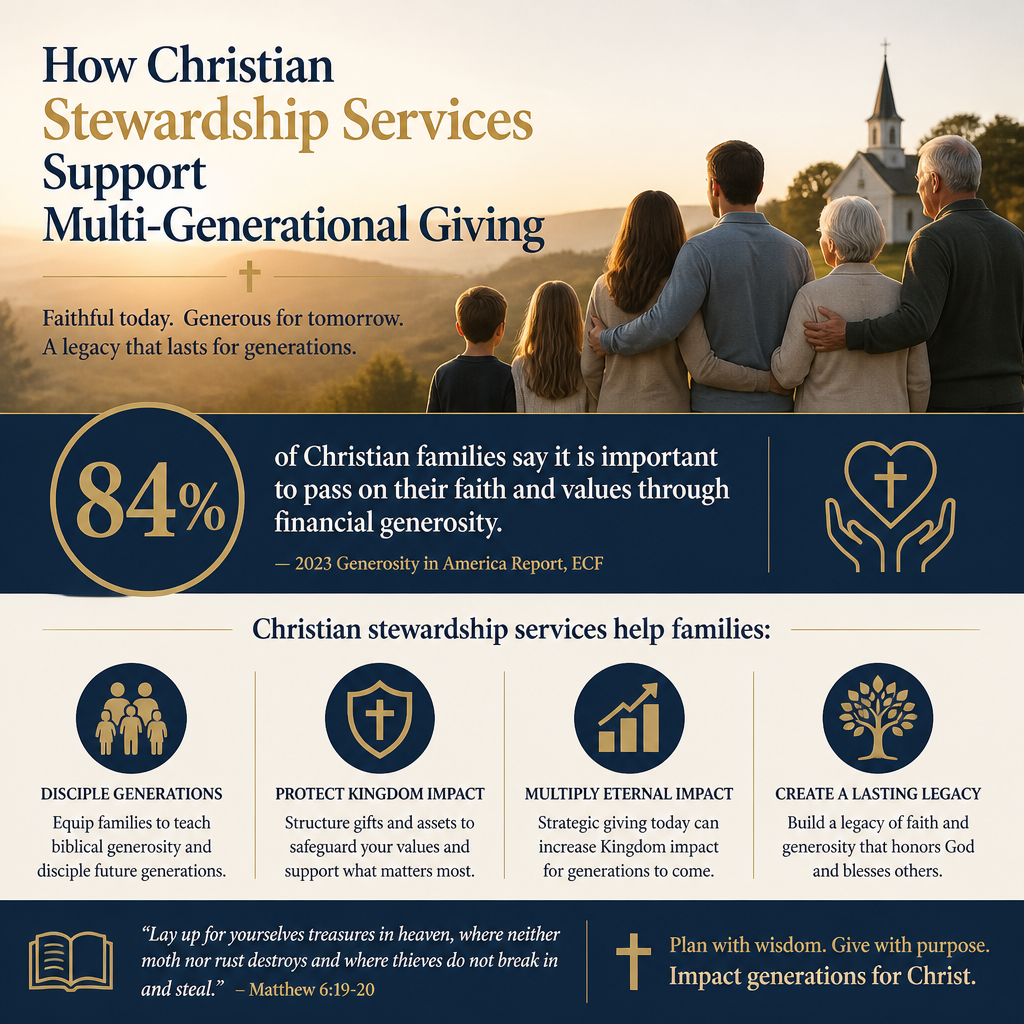
How Christian stewardship services support multi-generational giving becomes clearest when we treat generosity as discipleship rather than merely as estate mechanics. Families do not pass down only assets; they pass down worship patterns, moral imagination, and assumptions about what “counts” as a faithful life. The question is whether a family’s giving will be shaped by the gospel—or by inertia, tax incentives, and unexamined habits.
Scripture frames the matter with unusual clarity. “One generation shall commend your works to another” (Psalm 145:4) is not a sentimental slogan; it is a mandate to transmit a lived faith. Christian stewardship services can help families translate that mandate into prudent structures, durable governance, and wise ministry partnerships without confusing structure with spirituality.
Multi-generational giving is a formation question before it is a financial question
Stewardship language guards against a purely transactional vision of giving
The Bible’s teaching about wealth is not neutral. “The earth is the LORD’s and the fullness thereof” (Psalm 24:1) places every dollar under prior ownership. The family that wants faithful continuity across generations needs more than a will; it needs a shared theology of stewardship that can withstand changing markets, cultural pressures, and differing temperaments among heirs.
Christian stewardship services are most helpful when they treat donor intent as a spiritual commitment, not an ego project. Donor intent can become either a means of long obedience or a mechanism of control. Christians genuinely disagree about where the line falls between responsible guidance and unhealthy grasping, especially when adult children’s convictions diverge. A mature approach acknowledges that tension and builds in practices of listening, prayer, and accountable decision-making alongside legal clarity.
Why wealth transfer raises stakes for Christian families
We are living through an era of significant intergenerational transfer, and the scale can tempt families into urgency without wisdom. The oft-cited “Great Wealth Transfer” estimate projects tens of trillions in assets moving across generations in the coming decades, a figure commonly associated with Cerulli Associates’ research Cerulli Associates. The exact totals and timelines are debated, but the pastoral reality is not: many Christian households are navigating questions of inheritance, responsibility, and calling under real pressure.
What this means in practice is that families need a framework for generosity that does not rely on one charismatic founder. The goal is a durable moral culture—where heirs understand why giving matters, how to evaluate ministries, and how to hold their own hearts steady when money offers them power.

Christian stewardship services reduce friction between heirs by clarifying purpose and process
A shared mission statement is not branding, it is moral direction
Multi-generational giving often falters for ordinary reasons: siblings do not agree on priorities; spouses bring different philanthropic instincts; family meetings become conflict-avoidance exercises; the loudest voice controls allocations. Stewardship services can help families articulate a mission that is explicitly Christian and concrete enough to guide decisions: who we aim to serve, what kind of gospel witness we will fund, what boundaries we will observe, and how we will decide when disagreements arise.
Done well, this is not a search for the perfect sentence. It is a discipline of naming what a family believes God has entrusted to them and how that trust should be discharged. It also makes room for legitimate diversity within orthodoxy: some families will emphasize local church health; others will prioritize global evangelism, mercy ministry, or Christian education. The strength of a mission is less in its comprehensiveness than in its capacity to govern real trade-offs.
Governance mechanisms can preserve unity without flattening conviction
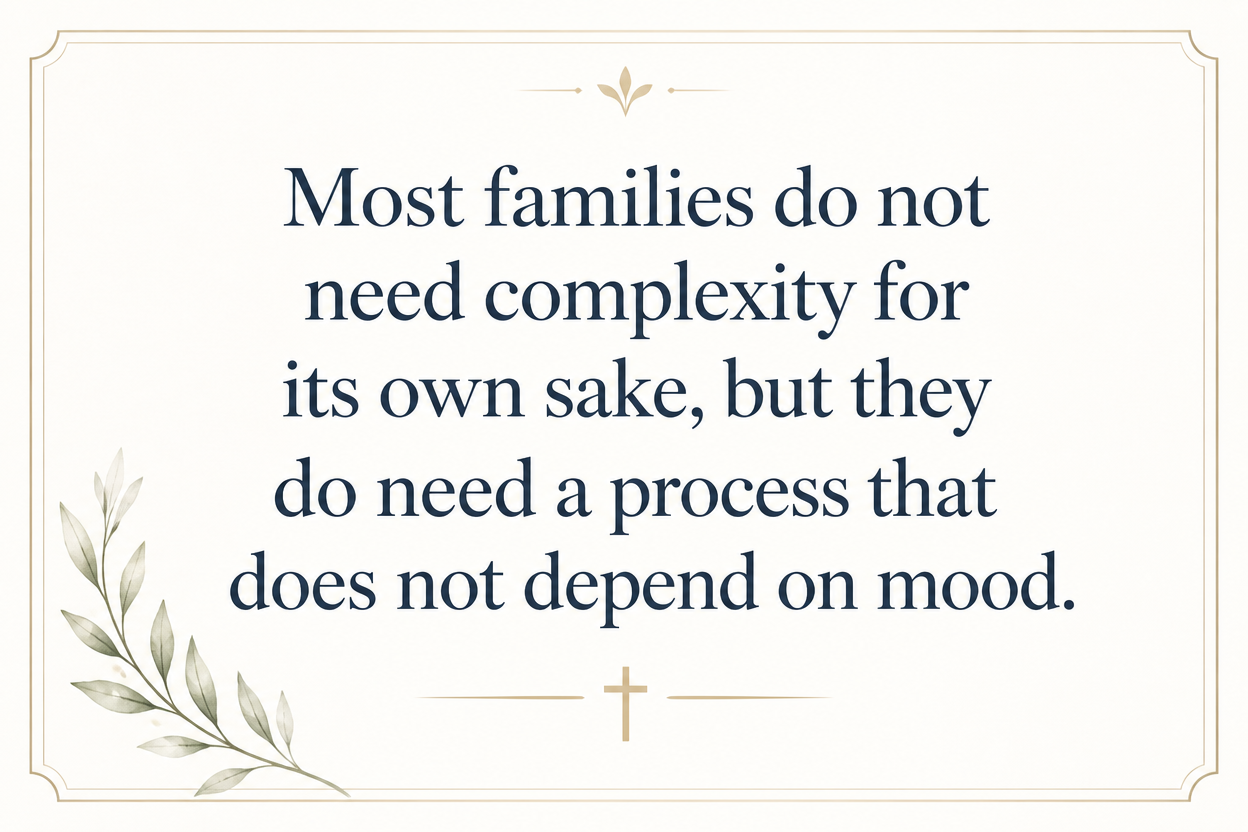
Most families do not need complexity for its own sake, but they do need a process that does not depend on mood. Stewardship services often assist with family councils, grantmaking committees, voting rules, conflict-of-interest policies, and rhythms of review. These are not secular intrusions into spiritual life; they are forms of prudence. “Let all things be done decently and in order” (1 Corinthians 14:40) applies to budgets and boards as much as to worship gatherings.
A common counterargument is that structure can displace the Spirit, turning giving into compliance. That risk is real. The remedy is not formlessness; it is ensuring that process is explicitly subordinated to Christian ends—prayer, accountability, truthful reporting, and a willingness to repent when money becomes identity.
Tools matter, but they must be matched to spiritual and relational realities
Donor-advised funds, family foundations, and bequests each carry distinct trade-offs
Christian stewardship services can help families choose vehicles that fit both their scale and their values. Donor-advised funds can offer administrative simplicity and continuity for heirs, but they can also become warehouses of good intentions if distributions are neglected. Family foundations can cultivate deep engagement and public accountability, but they require sustained governance and an appetite for compliance. Bequests can be powerful expressions of legacy, yet they often fail if heirs perceive them as surprise constraints rather than openly discussed convictions.
Christians should resist the idea that one tool is inherently more spiritual than another. The more important question is whether the tool supports faithful habits: regular generosity, careful discernment, and honest measurement of whether funds are accomplishing what was promised. Those habits are harder to sustain than establishing the initial structure.
Complex gifts require integrity on both sides of the gift
Planned gifts, non-cash assets, and restricted grants can serve ministries well, but they can also create burdens. Stewardship services help donors understand what they are asking of an organization and whether that organization has the capacity to execute. The nonprofit sector has learned, sometimes painfully, that restricted funds can unintentionally distort priorities if not matched to strategy and infrastructure.
For Christian donors, the question is not merely efficiency. It is truthfulness. A gift that forces a ministry into reporting games or underfunded expansion is not a clean win. Good stewardship asks whether the ministry can receive the gift with integrity, and whether the donor can give without covertly dictating outcomes.
Verification strengthens multi-generational giving by protecting trust
Heirs often inherit skepticism, not just resources
Many next-generation givers want to honor their parents’ faith while also demanding higher standards of evidence. That instinct is not cynicism; it can be an expression of Proverbs-level wisdom. Donors have watched moral failures, financial mismanagement, and governance dysfunction harm real people and discredit the gospel. A family’s long-term generosity depends on whether heirs believe the ministries being funded are worthy of trust.
Across our verification work at Most Trusted, we observe that families sustain giving longer when they can point to objective signals of integrity rather than relying on personal relationships alone. Relationships matter, but they are not sufficient controls. This is one reason we evaluate ministries against The Most Trusted Standard, a 15-criteria framework that examines faith commitments, financial integrity, governance, and transparency in a way donors can meaningfully interrogate.
What donors should ask before making a ministry part of a family legacy
Multi-generational giving tends to institutionalize itself: a ministry that becomes “the family ministry” can remain funded for decades. That reality increases the moral obligation to do due diligence. We recommend that families build a standard set of questions that each generation can use without needing to reinvent the process:
- Is the ministry’s theological identity explicit and accountable, not implied?
- Are audited financial statements available, and do they align with public claims?
- Does the board exercise real oversight, including CEO evaluation and conflict controls?
- Is there clear evidence of program outcomes, not only activity metrics?
- Does the ministry communicate honestly about limits, failures, and learning?
These questions are not hostile. They are a form of love for neighbors and a protection for heirs who may not share the founder’s intuition or network. They also reduce the likelihood that a future generation will abandon giving altogether after encountering a single scandal.
Formation practices make generosity transferable across generations
Teach heirs to evaluate ministries, not merely to fund them
Stewardship services support continuity when they treat heirs as apprentices rather than as successors waiting for a handoff. Many families underestimate how difficult it is to teach discernment. Heirs need repeated exposure to wise evaluation: reading a Form 990, understanding the difference between restricted and unrestricted revenue, recognizing governance red flags, and distinguishing compelling storytelling from credible evidence.
For families who want a principled approach, pairing stewardship counsel with disciplined nonprofit verification is often stabilizing. It provides a shared vocabulary. It also gives adult children space to ask hard questions without implying distrust of their parents’ faith. When families anchor their giving in verifiable standards, the process becomes less about personalities and more about integrity.
Rituals of giving keep money from becoming a private god
Deuteronomy repeatedly warns Israel against forgetting the Lord in seasons of abundance (Deuteronomy 8:11–18). Prosperity creates spiritual amnesia with predictable regularity. Families who give across generations tend to develop rhythms that keep gratitude and responsibility close to the surface: annual discernment retreats, shared prayers for grantees, visits that prioritize listening over inspection, and periodic re-examination of whether a giving portfolio still reflects Christian convictions.
Within Legacy and Family Giving Through Christian Stewardship Services, we have seen that “legacy” becomes hollow when it is reduced to memorialization. Christian legacy is not the preservation of a name; it is the preservation of faithfulness. That requires ongoing formation, not merely a legal file.
FAQs for How Christian stewardship services support multi-generational giving
Do Christian stewardship services replace an attorney or financial advisor?
No. Competent legal and tax counsel are essential, especially for planned gifts, trusts, and complex assets. Christian stewardship services typically complement those professionals by focusing on theological coherence, family communication, donor intent, and giving processes that can endure across generations. The best outcomes usually come when each advisor works within clear boundaries and respects the others’ expertise.
How can our family avoid funding ministries that later undermine our trust?
There is no risk-free giving, and Christians should not confuse caution with faith. But families can reduce avoidable risk by requiring basic transparency, reviewing governance and financial practices regularly, and using independent verification when selecting long-term ministry partners. Within Christian Stewardship Services, Most Trusted exists to help donors give with confidence by evaluating ministries against The Most Trusted Standard and presenting evidence that can be tested, not merely admired.
A durable legacy requires both conviction and verification
Multi-generational generosity rarely fails because a family lacked good intentions. It fails because intentions were never translated into shared theology, workable governance, and disciplined trust. Christian stewardship services can help families do that translation with humility, prudence, and clarity.
For donors who want heirs to inherit more than a checkbook, the task is to establish patterns that tell the truth: about God’s ownership, about our susceptibility to self-deception, and about the real-world integrity of the ministries we fund. That combination—conviction anchored in Scripture and verification anchored in evidence—gives families their best chance at faithfulness that endures.



