

How to teach children biblical generosity is not primarily a question of techniques, allowances, or charitable “habits.” It is a discipleship question. Scripture treats money as a rival worship system and generosity as a fruit of grace, not merely a social virtue (Matthew 6:19–24). If we want our children to give with Christian integrity as adults, we must form their loves, not simply manage their spending.
Christian donors feel a particular tension here. Many families have been blessed with the means to give significantly, yet they also see how quickly affluence can produce entitlement, anxiety, and a quiet assumption that “more” is normal. Teaching children generosity in that context requires clarity: generosity is not performative virtue, nor is it guilt-driven redistribution. It is responsive worship—an answer to the God who gives first.
Begin where Scripture begins with the Giver, not the gift
In the biblical account, giving does not begin with human compassion. It begins with the character of God. “For God so loved the world, that he gave” (John 3:16). Paul grounds Christian generosity in the incarnation itself: “Though he was rich, yet for your sake he became poor, so that you through his poverty might become rich” (2 Corinthians 8:9). Children may not yet grasp the economic logic of these texts, but they can absorb the moral center: God’s giving is purposeful, costly, and holy.
Teach stewardship as ownership under God
Psalm 24:1 is one of the clearest formative statements a family can return to: “The earth is the Lord’s and the fullness thereof.” The point is not that children should feel guilty for enjoying material goods. The point is that nothing we hold is autonomous. In practice, stewardship means children learn to ask, “What is this for?” not merely “What is this worth?”
Some Christian parents hesitate to speak in these terms because it can sound severe. Yet the alternative is usually worse: children default to the liturgy of consumer culture, where acquisition is treated as a form of security and identity. Scripture names that drift as spiritual danger, not merely poor manners (Luke 12:15).
Clarify the difference between generosity and impulse
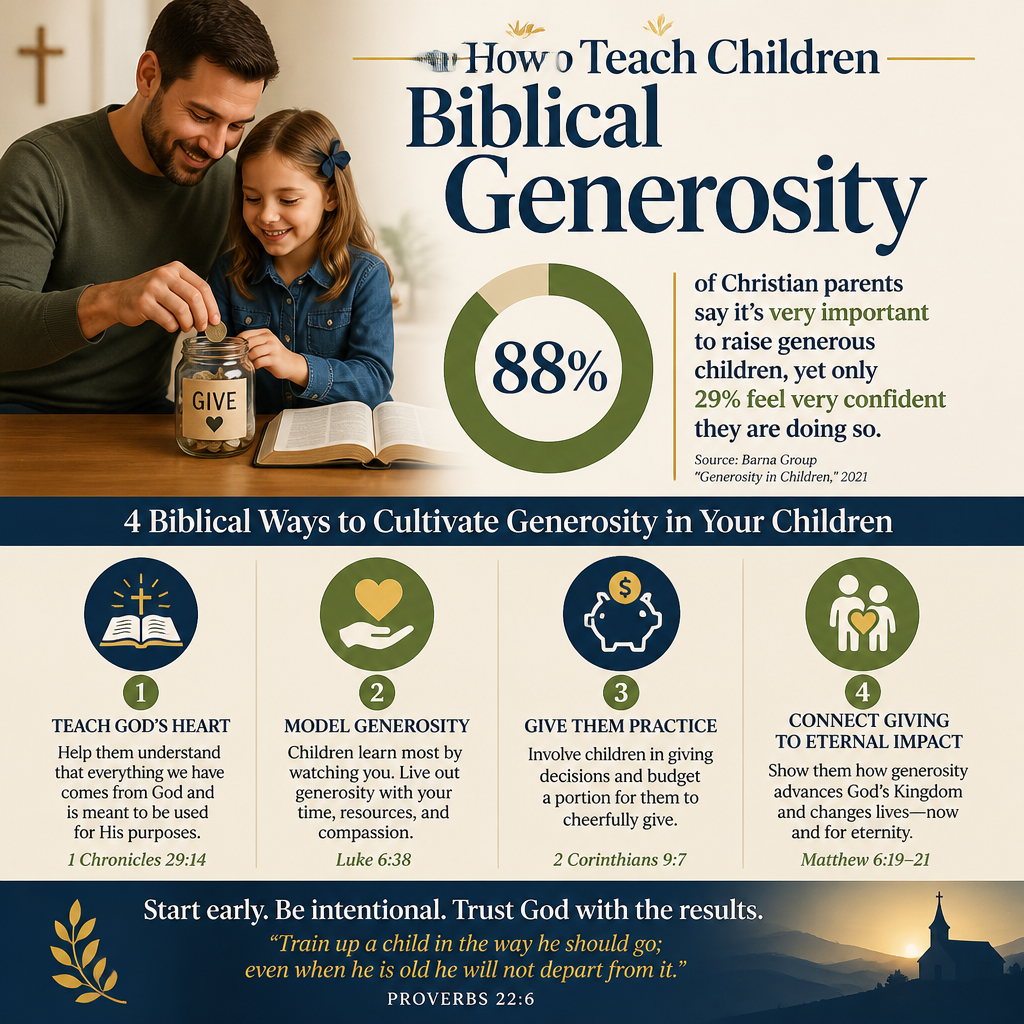
Not all giving is wise, and children notice when adults praise “being generous” without considering consequences. The biblical tradition values discernment: “Each one must give as he has decided in his heart, not reluctantly or under compulsion” (2 Corinthians 9:7). Deciding in the heart implies thought, prayer, and accountability. Teaching children that discernment is part of generosity protects them from naïve giving later—and from cynicism when they discover that some appeals are manipulative.

Make money formation ordinary, concrete, and shared
Deuteronomy 6 assumes formation happens through repeated, ordinary conversation: when sitting, walking, lying down, and rising. Generosity is learned the same way. Families often treat giving as an adult activity handled quietly. That privacy can be prudent, but secrecy can also make giving feel like an abstract moral expectation rather than a practiced part of Christian life.
Put actual decisions in front of children
Children learn stewardship by making real choices with real trade-offs. If a child never has meaningful discretion, they cannot practice giving as a decision of worship. If a child has discretion with no guidance, they learn that money is purely self-referential. The middle path is supervised agency: parents set the boundary conditions, children practice within them, and the family talks openly about why one choice aligns with the Kingdom more than another.
A simple family rhythm is to set aside a portion of birthday money, allowance, or earned income for giving, a portion for saving, and a portion for spending. The percentages matter less than the consistency and the conversation. The aim is to connect money to prayer, gratitude, and responsibility rather than to impulse.
Let giving compete with consumption on purpose
Generosity that costs nothing teaches little. Jesus highlights sacrificial giving in the widow who gives “all she had to live on” (Mark 12:44). We should not romanticize poverty, nor should we pressure children into performative sacrifice. But we can allow giving to become a real alternative to a purchase they want. That is where formation occurs: not in a lecture, but in a choice between two plausible goods.
The harder question is how parents model this without turning family giving into a moral drama. The simplest answer is to treat sacrifice as normal Christian freedom. We are not proving we are good; we are practicing who we belong to.
Teach children to give wisely in a crowded ministry landscape
Christian generosity has always required trust. In the New Testament, Paul carries collections for believers in need and takes pains to avoid reproach in handling funds (2 Corinthians 8:20–21). That concern is not modern cynicism; it is biblical prudence. Children should learn early that faithful giving includes attention to integrity.
Explain why accountability honors both donors and beneficiaries
Some families fear that discussing financial integrity will make children suspicious or stingy. Done poorly, it can. Done well, it teaches that love seeks the true good of the recipient. Christian donors know the disillusionment that can follow a scandal: not only wasted funds, but wounded trust and cynicism toward ministry itself.
Across our verification work at Most Trusted, we observe that ministries that meet The Most Trusted Standard tend to treat accountability as discipleship. They articulate a clear Christian mission, govern with independence, report finances with clarity, and show evidence that programs actually serve people rather than merely sustaining an institution. Those are not merely administrative virtues; they are moral obligations when funds are given in God’s name.
Give children a simple framework for discernment
Children do not need a graduate seminar in nonprofit governance. They do need language for asking basic questions that honor Scripture’s call to honesty and stewardship. A short family checklist can keep the conversation concrete:
- Is the ministry’s Christian purpose clear and consistent with Scripture?
- Can we see who leads it and who holds leaders accountable?
- Do they report finances in a way that is understandable to ordinary donors?
- Do they explain what outcomes they pursue and how they evaluate progress?
- Is there evidence they treat the people they serve with dignity rather than using them as marketing?
What this means in practice is that children can learn to associate generosity with truth. We give freely, but we do not give blindly.
Shape generosity toward the vulnerable without forming a savior posture
Scripture is unambiguous about God’s concern for the poor, the sojourner, the widow, and the fatherless (Deuteronomy 10:18; James 1:27). Yet Christians genuinely disagree about how to help well, especially across cultures and economies. The modern missions and relief landscape has had to reckon with the fact that money and power can distort relationships even when intentions are sincere.
Use the When Helping Hurts insights with age-appropriate clarity
The When Helping Hurts framework, articulated by Steve Corbett and Brian Fikkert, has helped many churches think more carefully about the difference between relief, rehabilitation, and development. It also names a crucial spiritual risk: helpers can harm when assistance becomes paternalism, or when giving undermines local agency and responsibility. Families can translate this for children in simple language: “We want our help to strengthen people, not replace them.”
Children can grasp this when they see examples. Buying supplies for a crisis response may be appropriate relief. Funding a long-term program that trains local leaders, supports families, or builds sustainable livelihoods often requires patience and evaluation. Both can be faithful; the question is what the situation truly requires.
Connect generosity to proximity and prayer
Affluent Christian families can unintentionally teach children that generosity is something done “out there” with no relational cost. Whenever possible, connect giving to some form of proximity: serving alongside a local ministry, writing letters to missionaries your church supports, or meeting a nonprofit leader in person. Proximity is not a guarantee of wisdom, but it tends to humanize both donors and recipients.
Prayer is equally formative. If a child learns to pray for those served by a ministry before giving, money becomes intercession embodied. It also resists the quiet assumption that our dollars are the decisive power.
For families considering how generosity fits into long-term planning, many of these practices intersect naturally with Legacy and Family Giving Through Christian Stewardship Services, where giving is understood as multi-generational formation rather than a series of isolated transactions.
Make family giving a legacy practice, not a personality trait
Some children are naturally tender-hearted. Others are cautious, analytical, or skeptical. The goal is not to produce one “generous type.” The goal is to form Christian maturity: cheerful giving, disciplined stewardship, and truthfulness about money’s temptations. That requires family practices that persist through seasons—especially when children become teenagers and begin to test inherited assumptions.
Introduce children to planned generosity over time
Many Christian donors already practice structured giving: supporting a set of ministries annually, giving to capital needs, or including charitable bequests in estate plans. Children can gradually be introduced to the logic of this approach: we do not only react to emotional stories; we commit to faithful support over time. This is one reason recurring support is so important to healthy ministries: it allows them to plan responsibly and serve consistently rather than chasing attention.
Families can let children participate in an annual “giving review” where the household asks: Which ministries were faithful this year? Where did we see fruit? Where do we need better information? When the family has a common language for these decisions, generosity becomes part of household governance, not an occasional impulse.
Teach discernment without treating ministry as a consumer product
Accountability can drift into a consumer posture: donors demanding to be impressed. Scripture calls for something different—humble stewardship that still insists on honesty. Children should learn that ministries are not vendors and donors are not customers. Yet Paul’s insistence on avoiding reproach shows that financial clarity and responsible governance are not optional for Christian organizations.
Our work at Most Trusted exists because donors should not have to choose between faith and evidence. The Most Trusted Standard offers a practical way to evaluate whether a ministry’s stated Christian commitments, governance, financial integrity, and reporting align with the trust it asks of donors. When children see adults take those questions seriously, they learn that discernment is part of love.
Many families also benefit from connecting these habits to broader stewardship decisions—donor-advised funds, appreciated asset giving, and estate planning—within Christian Stewardship Services, where generosity is integrated with wise administration and long-range faithfulness.
FAQs for How to teach children biblical generosity
Should children tithe from allowance or earnings?
Scripture’s teaching on the tithe emerges in an Old Testament covenant context, while the New Testament emphasizes free, cheerful, proportionate giving (2 Corinthians 9:7). Many Christian families still find a “first portion” practice spiritually formative: children learn that giving is not what happens after desires are satisfied. We recommend treating the practice as training in firstfruits rather than as a rigid rule, and pairing it with age-appropriate conversation about worship, gratitude, and wise discernment.
How do we talk about nonprofit scandals without making children cynical?
Frame the issue the way Scripture does: trust is precious, and leaders are accountable for how they handle resources given in God’s name (2 Corinthians 8:20–21; James 3:1). Avoid implying that “most ministries cannot be trusted,” but also avoid treating accountability questions as unspiritual. Teach children to respond to scandals with grief, prayer, and renewed commitment to truthful stewardship—supporting ministries that demonstrate clear governance, financial transparency, and evidence that their work serves people with dignity.
A durable goal for Christian parents and donors
The measure of success is not that children become sentimental givers or sophisticated analysts. The measure is that they grow into adults who see money as a tool under Christ’s lordship, who give with joy rather than compulsion, and who seek truth as part of love. Biblical generosity, taught patiently over years, becomes a quiet inheritance: a form of worship sturdy enough to withstand affluence, fear, and the shifting narratives of the age.



