

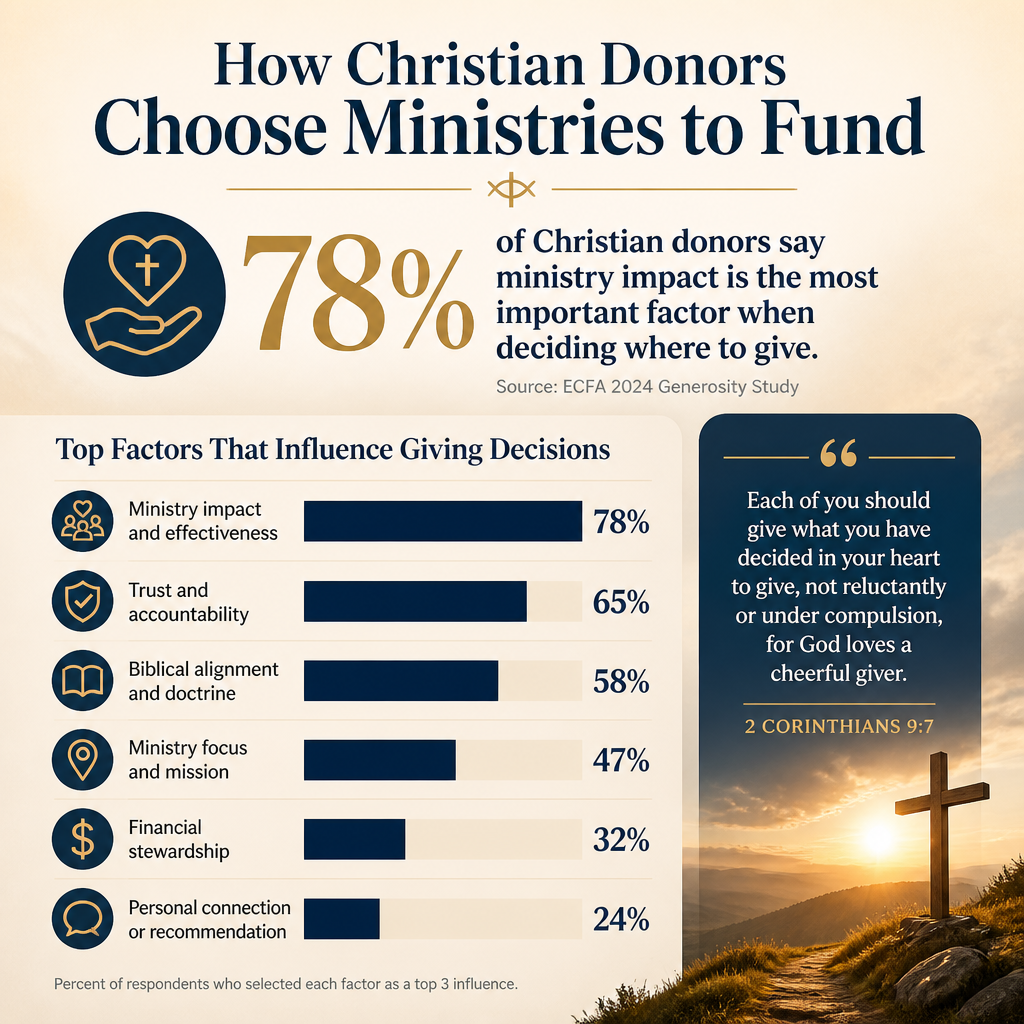
How Christian donors choose ministries to fund is rarely a matter of sentiment alone. It is a spiritual and moral decision about stewardship, truth-telling, and the kind of fruit we are willing to underwrite in Christ’s name.
Scripture treats giving as worship and responsibility. Jesus commends sacrificial generosity, warns against public piety, and consistently exposes money as a diagnostic of the heart (Matthew 6:19–24). What this means for donors is sobering: we are not only deciding where dollars go; we are deciding what we will call “faithful” when the outcomes are unclear, the stories are compelling, and the incentives can distort ministry behavior.
Begin with stewardship before preference
Giving decisions are spiritual decisions with real-world consequences
Christian donors often feel pressure to choose quickly: a friend’s fundraiser, a moving video, an urgent email, a disaster headline. Yet Scripture repeatedly places diligence alongside generosity. “The plans of the diligent lead surely to abundance” (Proverbs 21:5). That diligence is not suspicion; it is love for neighbor expressed through careful stewardship.
A mature donor posture begins with first principles. The question is not only, “Do we care about this cause?” but “Is this ministry’s model faithful, and is it likely to do the good it promises without hidden harms?” Christians genuinely disagree about strategy in some areas—relief versus development, evangelism-first versus integrated approaches, local church primacy versus specialized nonprofits. Still, donors can ask steady, non-negotiable questions about integrity, governance, and honesty.
What many donors underestimate is the moral weight of incentives
Funding shapes behavior. If donor attention rewards the most dramatic stories, ministries may—often without conscious malice—select for the most emotionally potent narratives. If donors punish administrative cost reflexively, ministries may underinvest in the controls that prevent fraud and abuse. The well-known “Overhead Myth” critique, endorsed by leaders across the sector, argues that overhead ratios can be a misleading measure of effectiveness and can pressure nonprofits into unhealthy underreporting of necessary infrastructure Charity Navigator.
Stewardship, then, includes resisting simplistic proxies for faithfulness. Christian donors can seek ministries that tell the truth about both costs and results, even when that truth is less marketable.

Assess faithfulness without confusing it for branding
Orthodoxy is not a marketing line item
Many ministries signal Christian identity through familiar cues: a Bible verse on the homepage, a doctrinal statement, a worship set at events. Some of those cues are meaningful; some are performative. The deeper test is whether the ministry’s faith commitments are coherent, governing, and accountable.
In practice, donors can ask: Is the ministry clear about its theological commitments and ecclesial relationships? Does the board include spiritually mature leaders capable of correction? Are programs shaped by Christian anthropology—especially regarding dignity, family, sexuality, and the nature of the Church—or are they functionally indistinguishable from secular service delivery with religious language added?
Mission drift is often subtle, and donors can either slow or accelerate it
Over time, external funding pressures can push ministries toward what foundations, major donors, or platforms reward. That drift is not always toward “secularization” in an obvious sense; it can be toward shallow triumphalism, an activist posture that sidelines discipleship, or a fundraising style that treats beneficiaries as props.
We encourage donors to view faithfulness as a multi-year pattern. A single campaign can be inspiring; a decade of consistent theological clarity, ethical practice, and accountable leadership is more probative. For readers wanting a broader frame for how stewardship services can support this kind of discernment, we address it within Christian Stewardship Services.
Follow governance and finances because Scripture does
Financial integrity is a spiritual issue, not merely a compliance issue
The New Testament assumes that handling resources publicly requires special care. Paul’s collection for the Jerusalem church includes deliberate safeguards “so that no one should blame us about this generous gift” (2 Corinthians 8:20–21). The point is not cynicism; it is protecting the ministry’s witness and the donors’ trust.
For donors today, this means giving weight to basic indicators: audited financial statements when appropriate to size, independent board oversight, conflict-of-interest policies, clear executive compensation processes, and disciplined reserve practices. These are not distractions from mission. They are part of the moral architecture that keeps mission from being corrupted by power or panic.
Ratios are not enough, but controls matter
Many donors have been trained to scan a single number: “program percentage.” The field has had to reckon with the limits of that approach. The better question is whether the financials tell a coherent story. Are revenue streams unusually concentrated in one donor or one government contract? Is fundraising growing faster than program capacity? Are related-party transactions disclosed? Is the ministry honest about restricted versus unrestricted funds?
When donors treat financial reporting as a form of truth-telling rather than a beauty contest, ministries have room to invest in real accountability. That is one reason Most Trusted exists: to help donors evaluate ministries against The Most Trusted Standard, a 15-criteria framework covering faith foundation, financial integrity, governance and leadership, and transparency and effectiveness.
Evaluate effectiveness with humility and evidence
Outcomes are difficult to measure, but not impossible to examine
Christian donors rightly resist a technocratic mindset that treats people as metrics. Yet the alternative to measurement is not faith; it is often opacity. Mature donors can hold two truths together: the work of God cannot be reduced to spreadsheets, and ministries still have a responsibility to demonstrate that their activities plausibly lead to the outcomes they claim.
In some domains, high-quality evidence exists. For example, the Centers for Disease Control and Prevention summarizes extensive research on Adverse Childhood Experiences and associated long-term risks CDC. Donors supporting child welfare ministries can ask whether programs reflect trauma-informed practice and prioritize stable family-based care when possible. In international relief and development, donors can ask how ministries incorporate established lessons about dependency, local ownership, and asset-based approaches, including the widely referenced When Helping Hurts framework articulated by Steve Corbett and Brian Fikkert Moody Publishers.
Responsible donors ask for a theory of change and evidence of learning
Not every ministry can run randomized controlled trials. Many should not. But nearly every ministry can articulate a defensible theory of change: what problem exists, what the ministry does, why that approach should work, what success looks like, and how leaders will know when they are failing.
- Clarity: the ministry states specific goals in plain language.
- Appropriateness: methods fit the context and do not ignore local church and community capacity.
- Safeguards: policies protect beneficiaries, especially children and vulnerable adults.
- Evidence: the ministry tracks outputs and, where feasible, outcomes tied to its claims.
- Learning: leaders adjust when results contradict assumptions.
Effectiveness is not a badge for the proud; it is a duty of love. When donors fund honest learning, they help build ministries that can endure beyond a charismatic founder or a single viral campaign.
Insist on transparency that protects the vulnerable
Transparency is not total disclosure, but it is verifiable honesty
Some information should not be public: names of at-risk converts, details that endanger persecuted believers, or identifying information about children. Mature transparency is not indiscretion. It is a credible pattern of truthfulness about what can be shared: governance, finances, leadership accountability, program model, and meaningful reporting on results.
Donors can also watch for moral risk factors that rarely appear in glossy newsletters: weak safeguarding policies, unchecked leadership authority, and a culture that spiritualizes questions as “lack of faith.” Those dynamics have harmed real people and discredited real gospel witness. When donors normalize thoughtful questions, they reduce the power of secrecy.
Verification helps donors avoid both naivete and cynicism
Many donors have felt the sting of discovering that a beloved ministry was financially careless, inflated its stories, or concealed misconduct. Others have become so wary that they hesitate to give at all. Neither posture is faithful. Christian stewardship requires both generosity and discernment.
Most Trusted approaches this tension through independent verification. The Most Trusted Standard is designed to give donors evidence that a ministry’s faith commitments, financial practices, governance, and public claims cohere. For donors working through how stewardship services can practically support grantmaking decisions, we address related considerations in How Christian Stewardship Services Support Grantmaking.
FAQs for How Christian donors choose ministries to fund
Should Christian donors prioritize local churches or nonprofits?
Christians have long treated the local church as central to discipleship, worship, and ordinary mercy. Many donors therefore prioritize the church as a baseline commitment. At the same time, specialized nonprofits can serve the Church by building expertise, scale, or reach in areas like refugee resettlement, prison ministry, Bible translation, or medical missions. The more helpful question is whether the recipient—church or nonprofit—demonstrates faithful doctrine, accountable leadership, prudent financial practice, and honest reporting that matches reality.
What red flags should make donors pause before giving?
Common red flags include: opaque or missing financial statements for a sizable ministry; a board that appears captive to a founder; heavy reliance on unverifiable testimonials; vague claims of “changing lives” without any defined indicators; unclear safeguarding practices when serving children; and fundraising that trades in pressure, guilt, or exaggerated urgency. None of these proves wrongdoing, but each warrants careful questions before significant or recurring support.
Choosing with confidence is part of faithful stewardship
Christian donors choose ministries to fund most wisely when generosity is joined to diligence, and conviction is joined to evidence. The goal is not to eliminate risk; it is to give in ways that honor Christ, protect the vulnerable, and strengthen ministries that tell the truth about their work. When donors reward integrity, accountability, and measurable learning, they help shape a charitable ecosystem that reflects the character of the God we proclaim.



