

How Christian donors track ministry grant impact is not primarily a question of technique. It is a question of stewardship before God: whether the resources entrusted to us are being converted into faithful, measurable service of neighbor and credible witness to the gospel. Scripture commends both generosity and discernment, and it refuses to separate the two.
Many donors also carry a sober awareness that “impact” can be manipulated. Numbers can be inflated, stories can be curated, and outcomes can be claimed without clear evidence. At the same time, donors who demand laboratory-grade proof for every ministry outcome will often end up funding only what is easiest to count, not what is most faithful. Mature grantmaking holds both tensions and still acts.
Start with a biblical definition of fruit and faithfulness
Impact is more than activity
Christian ministries are not funded to remain busy. They are funded to do spiritual and practical good—work that can be described, tested, and learned from. Jesus’ teaching assumes fruit can be recognized. “You will recognize them by their fruits” (Matthew 7:16) is not a call to cynicism; it is a call to moral and practical discernment applied to real-world claims.
What this means in practice is that donors should ask ministries to distinguish between inputs (money, staff time), activities (classes taught, visits made), outputs (people served), and outcomes (what changed). The difference is not semantic. If a prison ministry reports “1,200 Bibles distributed,” that is an output. If it can show improved Scripture engagement among participants, reduced disciplinary incidents, or increased church connection post-release, it is at least attempting to measure outcomes.
Some spiritual outcomes resist simple measurement
Christians genuinely disagree about how directly spiritual fruit can be measured and reported. Sanctification is real, but it is not a quarterly metric. A ministry can responsibly track proximate indicators—discipleship participation, church membership, pastoral care follow-through—without claiming it can quantify regeneration.
Grant impact tracking should therefore use a layered approach: measurable program outcomes where possible, credible qualitative evidence where necessary, and theological humility everywhere. Paul’s language of “stewards of the mysteries of God” (1 Corinthians 4:1–2) assumes accountability, but it also assumes some mysteries remain mysteries.

Define impact before you fund it
Begin with a clear theory of ministry change
Effective grant tracking begins before the first dollar is released. Donors should require a clear description of what the ministry believes will change, for whom, and through what pathway. In philanthropic terms, this is a theory of change; in Christian terms, it is a concrete account of how love of neighbor will be practiced in a specific context, with stated aims that can be evaluated.
Across our verification work at Most Trusted, we observe that ministries with stronger impact reporting tend to have stronger program clarity. They can articulate what they do, why they do it, and what “success” looks like beyond goodwill. That clarity protects both the donor and the ministry from drifting into vague activity.
Write impact expectations into the grant relationship
A grant should contain an explicit learning and reporting plan that is proportionate to the grant size and ministry capacity. Donors do not serve ministries by imposing reporting burdens that require hiring new staff simply to satisfy a funder’s preferences. But donors also do not serve ministries by funding with no expectation of evidence.
Where donors want to ground this work in a broader stewardship discipline, many begin by clarifying their own convictions within Christian Stewardship Services, including how they weigh evangelism, mercy ministry, and institutional strengthening across a portfolio. Impact tracking becomes more coherent when it is anchored to a donor’s stated aims rather than a shifting set of reactions to the latest story.
Use evidence that is proportionate and honest
Distinguish credible indicators from marketing metrics
Not all numbers are equal. Attendance can be useful, but it can also be a proxy for popularity rather than transformation. Social media reach is rarely a reliable indicator of ministry effectiveness. Donors should press for indicators that are close to the ministry’s actual promised outcomes.
One helpful discipline is to ask: “If this number improved, would we be confident the ministry is closer to its mission?” If the answer is unclear, it may be a vanity metric. If the answer is clear, it can become part of a stable reporting dashboard that does not change every year.
Prefer evaluation designs that fit the work
Some ministry outcomes lend themselves to stronger evaluation. A job training program can track job placement and retention. A counseling ministry can track validated measures of symptom reduction or functioning when appropriate and ethical. A church-planting network can track churches launched, leaders trained, and congregational stability over time.
Randomized controlled trials are not the only legitimate form of evidence, and they are often infeasible or ethically complex in ministry settings. Still, donors can encourage stronger approaches than testimonial-only reporting. Practical options include pre- and post-assessments, comparison cohorts, follow-up surveys, and external program reviews.
When donors consult the broader field, it is worth remembering that even secular philanthropy has had to reckon with the limits of simplistic impact claims. The “Overhead Myth” statement—signed by leading nonprofit evaluators and charity information organizations—warned against treating low overhead as a proxy for effectiveness and called for more thoughtful assessment of outcomes and organizational health BBB Wise Giving Alliance.
Track the conditions that make impact durable
Governance and financial integrity are impact issues
Many donors try to track impact only at the program level. Yet organizational failures often undo program outcomes. Financial mismanagement, leadership misconduct, and poor governance can collapse a ministry’s work overnight, regardless of how compelling the program model once looked.
Verifiable evidence suggests donors are right to treat accountability as a spiritual issue, not merely a compliance concern. When Paul organized the collection for the church in Jerusalem, he insisted on careful handling “so that no one should blame us about this generous gift” (2 Corinthians 8:20–21). He assumed that transparent administration protects the witness of the gospel.
Transparency is not optional for trust
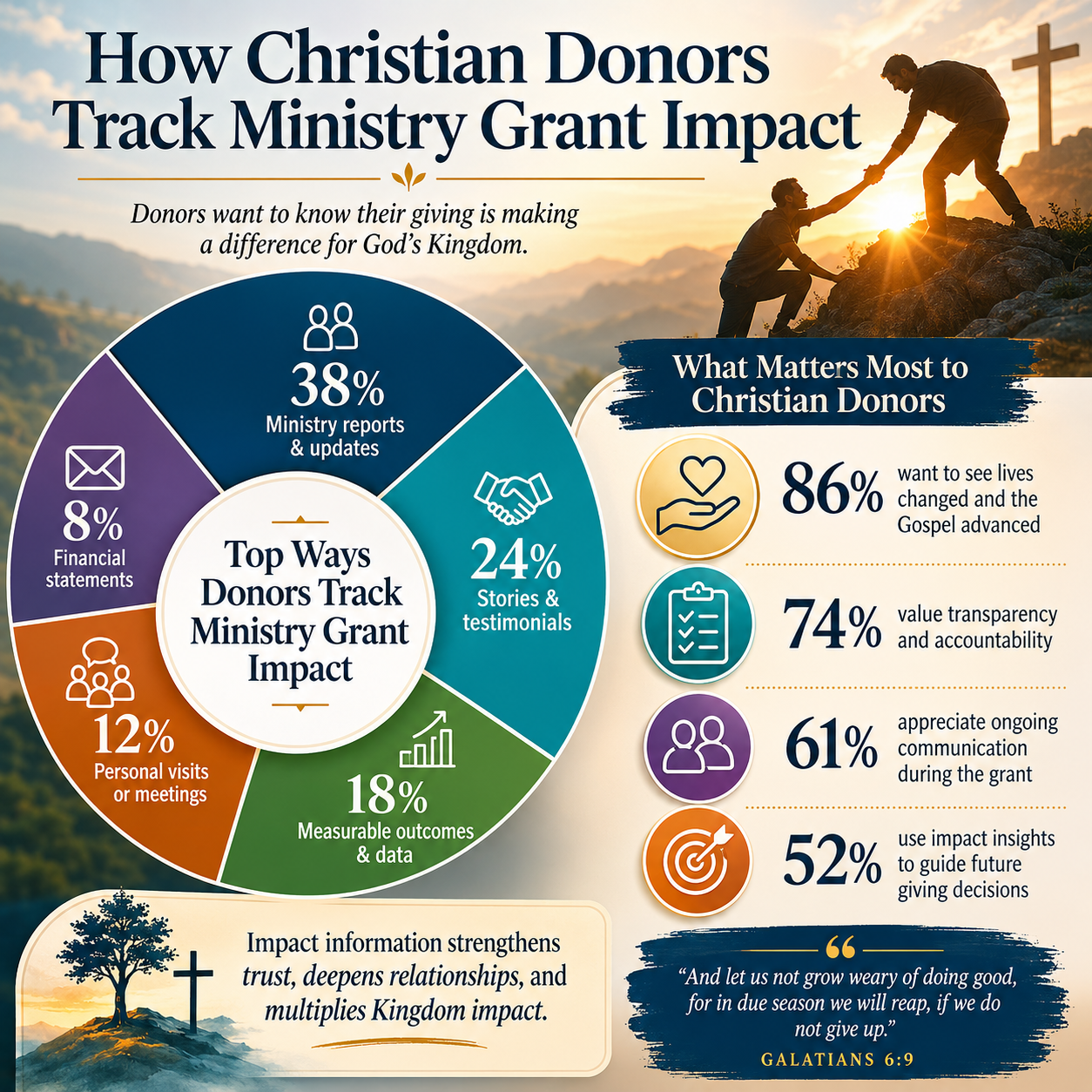
Impact tracking requires access to truthful information. Donors should expect timely financial statements, clear descriptions of programs, and honest reporting about setbacks. Mature ministries can name what did not work and what they learned without collapsing into defensiveness.
In our work, The Most Trusted Standard evaluates ministries across 15 criteria in four areas: Faith Foundation, Financial Integrity, Governance and Leadership, and Transparency and Effectiveness. The point is not to replace prayerful discernment with a checklist. The point is to verify that the ministry’s public claims, internal controls, and operational realities cohere in ways that protect donors and serve beneficiaries.
Build a practical grant impact rhythm
A quarterly cadence with an annual depth review
Most donors need a sustainable rhythm. Quarterly reporting can track key indicators, budget-to-actuals, and major developments. An annual review can go deeper: outcome trends, beneficiary feedback, leadership changes, risk assessment, and program refinement.
What this means in practice is that donors should plan for both measurement and interpretation. Numbers without context are easily misunderstood. Context without numbers is easily romanticized. A good grant relationship includes time for thoughtful conversation about what the evidence is showing and what remains uncertain.
Questions that separate real accountability from noise
The following questions are not exhaustive, but they are often sufficient to clarify whether a ministry’s impact reporting is credible and improving:
- What outcome are you ultimately aiming for, and what indicators tell you you are moving toward it?
- How do you define “served,” and how do you prevent double-counting?
- What does follow-up look like at 3, 6, and 12 months, and what is your response rate?
- What did not work this year, and what changed in response?
- What safeguards exist for finances, child safety, and vulnerable adults, and how are incidents handled?
Donors who want an integrated view of how stewardship services can support disciplined grantmaking can also situate their practice within How Christian Stewardship Services Support Grantmaking. The aim is not to add bureaucracy, but to strengthen fidelity: to ensure a gift reaches its intended purpose and produces the good it promises.
FAQs for How Christian donors track ministry grant impact
Should Christian donors require ministries to provide statistics for everything?
No. Donors should require evidence that matches the nature of the ministry’s claims. When a ministry promises concrete outcomes—meals delivered, counseling provided, job placements, students tutored—clear quantitative reporting is appropriate. When a ministry’s work is primarily relational or discipleship-oriented, donors should still ask for disciplined indicators and credible qualitative evidence, while refusing inflated spiritual claims that cannot be substantiated.
What is a reasonable expectation for grant reports from smaller ministries?
Expect clarity, consistency, and honesty more than sophistication. Smaller ministries may not have evaluation staff or formal data systems, but they can still define outcomes, document who they serve, report finances clearly, and explain what they learned. A proportionate reporting plan protects the ministry from administrative overload while still honoring the biblical demand for trustworthy stewardship (2 Corinthians 8:20–21).
A faithful approach to impact serves both neighbor and witness
Christian donors track grant impact because love is not indifferent to results. We owe vulnerable neighbors more than sincere intention, and we owe the gospel witness more than avoidable scandal. The mature path is neither naive trust nor suspicious control, but a disciplined partnership marked by clarity, verification, and the humility to learn.



