
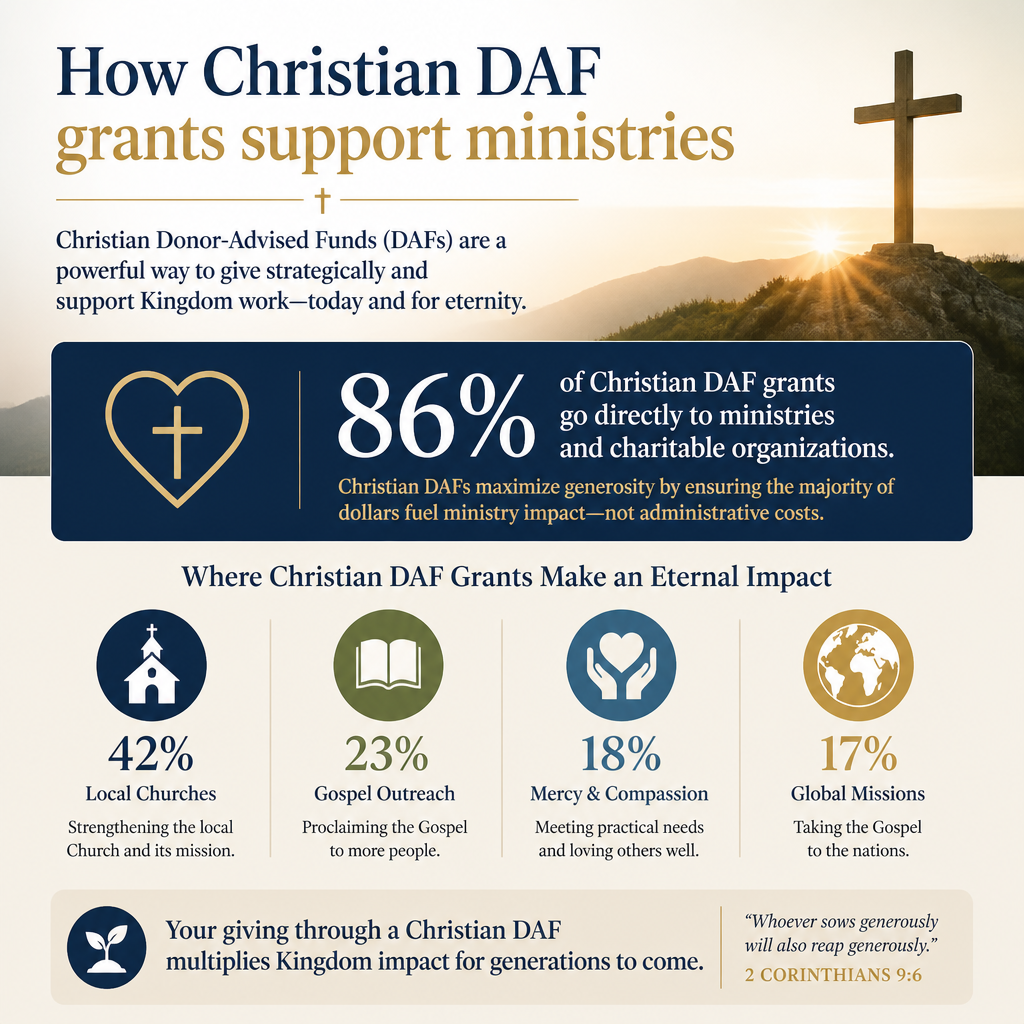
How Christian DAF grants support ministries is ultimately a question about whether our giving is formed by the church’s moral imagination or by the financial habits of late modern life. A donor-advised fund can either become a convenient parking place for charitable intent or a disciplined instrument for timely, accountable generosity that strengthens the church’s work.
DAFs sit at an intersection that Scripture treats with gravity: wealth, trust, and responsibility. “It is required of stewards that they be found faithful” (1 Corinthians 4:2). Faithfulness is not only the decision to give, but the manner of giving: the speed with which we respond to need, the clarity with which we understand impact, and the integrity with which we avoid incentives that quietly deform ministry.
What a DAF grant is and what it is not
A DAF is a giving account with real spiritual implications
A donor-advised fund is an account at a sponsoring organization where donors can contribute assets, receive an immediate charitable deduction, and then recommend grants to qualified nonprofits over time. The structure can serve Christian donors well, particularly when gifts involve appreciated securities, complex assets, or irregular income.
The stronger claim is not that DAFs are “better” giving, but that they can support better giving when paired with clear convictions. A DAF can protect donors from impulsive decisions driven by a compelling story, a crisis headline, or personal proximity. It can also protect ministries from erratic funding patterns that make planning difficult and can unintentionally pressure leaders toward fundraising theater.
The contested question is payout and timeliness
DAFs have drawn scrutiny because donors receive a tax benefit immediately while grants may occur later. The National Philanthropic Trust reports that DAF grant payout rates have historically exceeded those of private foundations, but payout rates vary by sponsor and by year. For example, its 2024 Donor-Advised Fund Report cites a 2023 payout rate above 20% across reporting sponsors, a figure often used to argue that many DAF dollars move relatively quickly to charities (National Philanthropic Trust).
Christians genuinely disagree about how much delay is morally permissible. Some donors see patience as prudence: time to discern, evaluate, and learn a ministry’s real track record. Others see delay as a quiet refusal to let need make a claim on us. A mature approach names the tension and then builds habits that keep generosity from becoming indefinite intention.

How DAF grants practically strengthen ministries
Stability and planning are not luxuries for gospel work
Most ministries operate with a combination of restricted program funding, volatile year-end giving, and genuine uncertainty about next quarter’s revenue. When DAF grants are made in predictable patterns—monthly, quarterly, or tied to measurable milestones—leaders can make better staffing decisions, commit to longer program horizons, and invest in the less visible work of compliance, safeguarding, and evaluation.
What this means in practice is that the same dollar can accomplish more when it arrives with fewer surprises. It also means the ministry can resist unhelpful incentives, such as overpromising outcomes or chasing donor preferences that do not match its calling.
DAFs support complex giving without forcing complexity onto ministries
DAFs are especially useful for donors who want to give appreciated assets. Giving stock directly can avoid capital gains taxes and increase net resources for ministry, while sparing the church from needing to receive, liquidate, and account for those assets itself. The IRS confirms that donors can deduct the fair market value of long-term appreciated securities donated to qualified charities, subject to limitations, which is one reason these gifts can be efficient (Internal Revenue Service).
For ministries, this can reduce administrative friction and keep staff time focused on mission rather than transactional complexity. For donors, it can make significant, non-cash generosity more feasible.
Where DAF giving can drift from faithful stewardship
The moral hazard of indefinite deferral
Scripture treats wealth as spiritually hazardous not because money is inherently evil, but because it readily becomes a rival trust. A DAF can become a spiritual compromise if it trains us to prefer control over relinquishment. If a donor takes the deduction, feels the satisfaction of “having given,” and then postpones grants for years, the DAF has functioned as a buffer between the donor and the claims of love of neighbor.
The harder question is not whether a donor intends to give. It is whether the donor has formed a rule of life that makes giving concrete, timely, and proportionate to capacity. This is especially pressing for donors with significant assets who can easily mistake administrative setup for generosity itself.
DAFs do not remove the need for discernment about ministries
A DAF sponsor may conduct basic due diligence to ensure grantees are legally qualified, but that is not the same as verifying theological fidelity, governance health, or truthful reporting. Christian donors often assume that a familiar name or a compelling story is sufficient. Yet the field has had to reckon with repeated failures: charismatic leadership without accountability, financial opacity, and inflated claims of impact.
Across our verification work at Most Trusted, we observe that ministries with strong internal controls and transparent reporting are also more consistent in program execution over time. This is not a guarantee of spiritual fruit, but it is a sign of integrity. It is also one reason our evaluations are structured around The Most Trusted Standard, a 15-criteria framework that examines faith foundation, financial integrity, governance and leadership, and transparency and effectiveness.
Making DAF grants that honor both prudence and urgency
Build a grantmaking policy before emotion sets the agenda
Many donors use DAFs precisely because they want to be thoughtful. Thoughtfulness is best protected by decisions made in advance. A simple policy can keep giving from becoming reactive without becoming cold.
We recommend establishing a written plan that addresses at least these elements:
- A target annual payout percentage from the DAF, with a baseline schedule for recurring grants
- Categories of giving that reflect calling: local church, mercy and justice, missions, and theological formation
- A process for responding to crises without abandoning longer-term commitments
- Clear criteria for what counts as credible reporting and governance for larger grants
- A review rhythm for continuing support, including reasons to reduce or end funding
This kind of policy does not replace prayer. It keeps prayer from being reduced to an after-the-fact blessing of whatever the loudest need or most persuasive fundraiser puts in front of us.
Consider how restrictions shape ministry behavior
DAF donors often like restricted gifts because they feel precise. Restrictions can be appropriate when tied to well-defined projects or when a donor has legitimate concerns about stewardship. Yet restrictions can also undermine leadership if they force programs to contort around donor preferences or if they leave core operating needs unfunded.
The philanthropic sector has repeatedly cautioned donors against simplistic overhead policing. The “Overhead Myth” letter, signed by leaders including GuideStar (now Candid), BBB Wise Giving Alliance, and Charity Navigator, argues that focusing narrowly on overhead ratios can mislead donors and harm nonprofits by discouraging necessary investment in infrastructure (Candid).
For Christian donors, the theological question is whether we are funding the appearance of ministry or the actual conditions that allow ministry to be faithful over time: qualified staff, appropriate safeguarding, financial controls, and honest evaluation.
Verifying ministries before recommending DAF grants
Why verification matters for donors with concentrated giving power
DAFs tend to concentrate decision-making: a smaller number of households may direct larger grants. That concentration can be a gift to the church when paired with disciplined diligence. It can also magnify harm when donors fund ministries that are not truthful, not accountable, or not rooted in historic Christian faith.
Verification is not cynicism. It is a form of love for the ministry, for intended beneficiaries, and for the broader witness of the church. In our work, we are looking for more than whether a ministry is legally compliant. We are asking whether it is structurally trustworthy.
How The Most Trusted Standard informs grant decisions
The ministries that meet The Most Trusted Standard tend to share recognizable characteristics: a clear statement of faith that is not merely ornamental, board governance that is active rather than symbolic, financial reporting that is timely and intelligible, and public communication that matches reality. These are not fashionable preferences. They are basic markers that help donors avoid being manipulated by storytelling or lulled by familiarity.
For donors seeking a wider context on stewardship practices that align with Christian conviction, we place DAF decisions within the broader work of Christian Stewardship Services. For donors who want to think specifically about operational patterns, controls, and the mechanics that affect trust, we also maintain perspective within How Christian Stewardship Services Manage Donor-Advised Funds.
FAQs for How Christian DAF grants support ministries
Can we use a DAF to give to our local church?
Often yes, provided the church is recognized as a qualified charitable organization and the DAF sponsor’s policies permit it. Many sponsors will not approve grants that provide a personal benefit, satisfy a pledge in a way the sponsor deems impermissible, or fund certain types of international activity without proper intermediaries. The practical counsel is to confirm the church’s status and the sponsor’s rules, then set recurring grants that reflect the church’s central role in Christian discipleship and mission.
Should we wait to grant from our DAF until we have fully evaluated a ministry?
For significant or ongoing support, patience is usually prudent. For urgent relief or time-sensitive needs, delaying may cause real harm. A disciplined approach distinguishes between baseline commitments to trusted ministries and exploratory grants that are smaller until reporting, governance, and doctrinal clarity are established. The goal is not perfect certainty, but a level of evidence appropriate to the size and strategic importance of the grant.
A DAF is a tool, but stewardship is a vocation
DAF accounts can support ministries well when they are governed by clear commitments: timely generosity, truthful evaluation, and a willingness to relinquish control for the sake of love. Christians do not give merely to feel responsible. We give because the gospel trains us to hold resources as stewards, not owners. When DAF grants are made with both prudence and urgency, they can strengthen the church’s work and guard the credibility of Christian witness in a skeptical world.



