
How Christian stewardship services set up a DAF is not merely an administrative question. It is a question of moral architecture: how a Christian donor orders wealth toward the love of God and neighbor without surrendering to the subtle formation of consumer habits and tax-first thinking.
A donor-advised fund can serve genuine generosity. It can also tempt donors toward distance and delay—outsourcing discernment to a dashboard and mistaking account activity for charity. Scripture presses stewardship into the open. “It is required of stewards that they be found faithful” (1 Corinthians 4:2). The question is what faithfulness looks like when giving is mediated through a financial vehicle.
What a DAF is and why Christian donors use one
A DAF is a charitable account with a legal sponsor
A donor-advised fund is an account held at a sponsoring organization, typically a public charity. The donor makes an irrevocable charitable contribution to the sponsor, receives a charitable deduction (subject to IRS rules), and then recommends grants over time to eligible charities. The sponsor has legal control and bears regulatory responsibility, while the donor retains advisory privileges.
Most DAF sponsors resemble financial institutions in their user experience, even when they are legally charities. That resemblance matters. Christian donors should recognize that the “ease” of giving can quietly shift the meaning of giving—from a practiced virtue to a recurring transaction.
Common reasons Christian donors choose a DAF
DAFs are often used to simplify giving across multiple ministries, consolidate recordkeeping, and support long-term commitments. They also allow donors to separate the timing of a charitable gift from the timing of grantmaking—useful when income is uneven, when a business sale creates a high-income year, or when donors want to build a multi-year giving plan.
DAFs have grown rapidly in American philanthropy. That growth has intensified debate about payout rates, transparency, and whether funds are deployed to active ministry or left in accounts for long stretches. Those are not merely policy questions; they are questions about whether giving is ordered toward love and mercy, or toward control.

How Christian stewardship services differ from mainstream DAF sponsors
They frame giving as discipleship, not only philanthropy
Christian stewardship services exist because Christians are not only trying to “do good”; we are seeking faithfulness before God. Many donors want giving that is explicitly aligned with theological convictions, church commitments, and a coherent view of vocation and wealth.
This framing is not window dressing. A stewardship service that treats generosity as formation will ask different questions than a platform built mainly for convenience: What obligations do we have to our local church? How do we avoid funding harm overseas? How do we weigh evangelism, mercy, and justice? Christians genuinely disagree about some of these judgments, but mature stewardship insists we make them openly rather than by default.
They may integrate values screens and ministry due diligence
Some Christian stewardship services offer guidance on whether a recipient organization is consistent with core Christian convictions or is likely to steward donations with integrity. This matters because the American nonprofit marketplace includes sincere ministries alongside organizations with thin governance, weak financial controls, or exaggerated impact claims.
At Most Trusted, our work is not to “pick winners” but to verify whether ministries meet The Most Trusted Standard, a 15-criteria framework assessing faith commitments, financial integrity, governance, and transparency. Donors use that kind of verification to reduce avoidable risk while keeping the donor’s theological discernment in its proper place.
The practical steps Christian stewardship services take to set up a DAF
Step one is sponsor selection and account design
Christian stewardship services begin by establishing the DAF at a sponsoring charity, either within their own structure or through a partner sponsor. The sponsor relationship determines legal control, grant policies, investment options, and administrative fees. Donors should ask direct questions about these items because policies vary, and differences are not trivial.
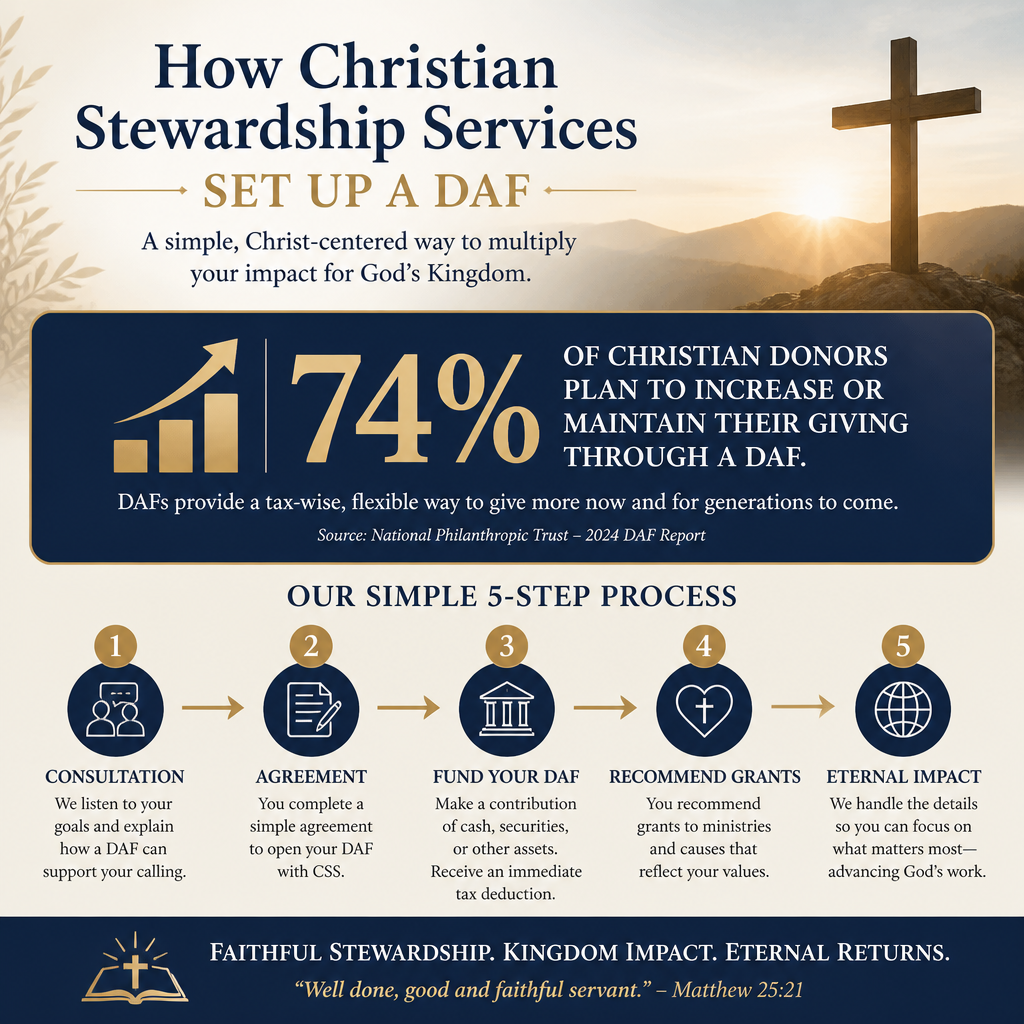
Account design usually includes naming the account, specifying primary advisors (often spouses), setting successor advisors, and defining what happens at death. For donors who want giving to outlast them, successor design is not ancillary; it is the difference between a durable plan and a generous intent that fades after probate.
Step two is funding the account with appropriate assets
Once established, the donor contributes assets. Cash is straightforward, but many DAFs are funded with appreciated securities, complex assets, or business interests where permitted. For Christian donors, the primary question is not only tax efficiency; it is whether the asset transfer supports a faithful giving plan rather than becoming the plan itself.
Because we are not providing legal or tax advice, we encourage donors to coordinate with qualified counsel, especially when contributing non-cash assets. A stewardship service should be comfortable working alongside a donor’s CPA and attorney, and should not treat professional oversight as an obstacle to speed.
Step three is grantmaking workflow and compliance
After funding, the donor recommends grants. The sponsor must ensure recipients are eligible public charities and that grants are not used for impermissible private benefit. This is one place where Christian stewardship services can add meaningful value: by building disciplined processes that honor both the law and the moral meaning of a gift.
A clear, accountable grantmaking workflow commonly includes:
- Verification that the recipient is an eligible charitable organization
- Review of restrictions or purposes attached to the grant
- Documentation and receipts suitable for the donor’s records
- Clear timelines for processing and disbursement
- Policies for international grants and equivalency determination where relevant
DAFs are not designed to replace relationship. Many donors still give directly to their local church or to a small ministry where personal accountability is part of the gift. The DAF should serve those relationships, not displace them.
Where discernment matters most for Christian donors using DAFs
A DAF can unintentionally encourage delay
The most significant spiritual hazard of a DAF is not fraud; it is inertia. A donor receives the tax benefit at contribution, but ministry impact depends on grants actually going out. The sector has wrestled publicly with this tension. When donors are sincere but busy, “later” can become a long-term pattern.
Philanthropic research institutions have tracked the rise of DAFs and the questions it raises for charitable distribution. For a sober overview of the broader DAF landscape, see the National Philanthropic Trust’s reporting on donor-advised funds at National Philanthropic Trust.
Ministry verification is not optional stewardship
Christian donors often assume that shared language implies shared integrity. It does not. Good governance, financial controls, and truthful reporting are forms of neighbor-love because they protect donors and beneficiaries alike.
Across our verification work at Most Trusted, we observe that ministries most prepared to bear larger gifts tend to show consistent board oversight, clear conflict-of-interest practices, transparent financial reporting, and measurable clarity about what their programs do and do not accomplish. Those are not secular demands imposed on Christian work; they are practical expressions of honesty.
For donors evaluating how their giving aligns with stewardship services and donor-advised fund practices, we address adjacent considerations under How Christian Stewardship Services Manage Donor-Advised Funds.
How to choose a Christian stewardship service for a DAF
Ask for policies, not promises
Serious stewardship services welcome specific questions because mature donors do not outsource responsibility. Policies reveal what happens when there is conflict, confusion, or pressure. Ask how the service handles grant restrictions, international giving, anonymous grants, and complex gifts. Ask what the sponsor will not do, and why.
Donors should also scrutinize how impact is represented. The “Overhead Myth” conversation has helped donors understand that simplistic overhead ratios can mislead, and that effectiveness and integrity require richer evidence than a single percentage. The original signatories include Charity Navigator, Candid, and the BBB Wise Giving Alliance; their joint letter and resources are available via Charity Navigator.
Insist on theological clarity and financial integrity together
Some services are strong on Christian language but thin on verifiable accountability. Others are administratively competent but treat theology as a branding layer. Christian donors should not accept that trade-off. A DAF is only as faithful as the posture it forms and the ministries it funds.
Most Trusted exists because donors deserve confidence that a ministry’s stated commitments correspond to observable practices. For donors wanting a broader view of how we approach ministry verification and what accountable Christian giving requires, see Christian Stewardship Services.
FAQs for How Christian stewardship services set up a DAF
Can a DAF replace giving to our local church?
A DAF can be a tool for planned generosity, but it should not automatically replace direct giving to a local church. Many churches can receive grants from DAFs, but the deeper question is formative: regular, committed giving is part of belonging to a local body. For many donors, a wise pattern is to keep primary church giving direct and use the DAF for additional ministry support, complex gifts, or multi-year commitments.
How do we reduce the risk of funding a Christian ministry with weak governance?
Begin with verifiable documents: current financial statements, board governance policies, and transparent descriptions of programs and outcomes. Pay attention to whether the ministry acknowledges limits and trade-offs rather than relying on promotional certainty. Donors can also use independent verification work—such as Most Trusted’s assessment against The Most Trusted Standard—to identify ministries that demonstrate consistent financial integrity, responsible governance, and transparent reporting.
A DAF should serve generosity, not substitute for it
A Christian stewardship service can set up a DAF with administrative competence and legal care. The harder work is ensuring the vehicle serves a living practice of generosity—grants that go out, ministries that can be trusted, and a heart that remains free from the illusion that control is the same as faithfulness. Stewardship is measured over time, in actual giving, under the searching light of God who “weighs the heart” (Proverbs 21:2).



