

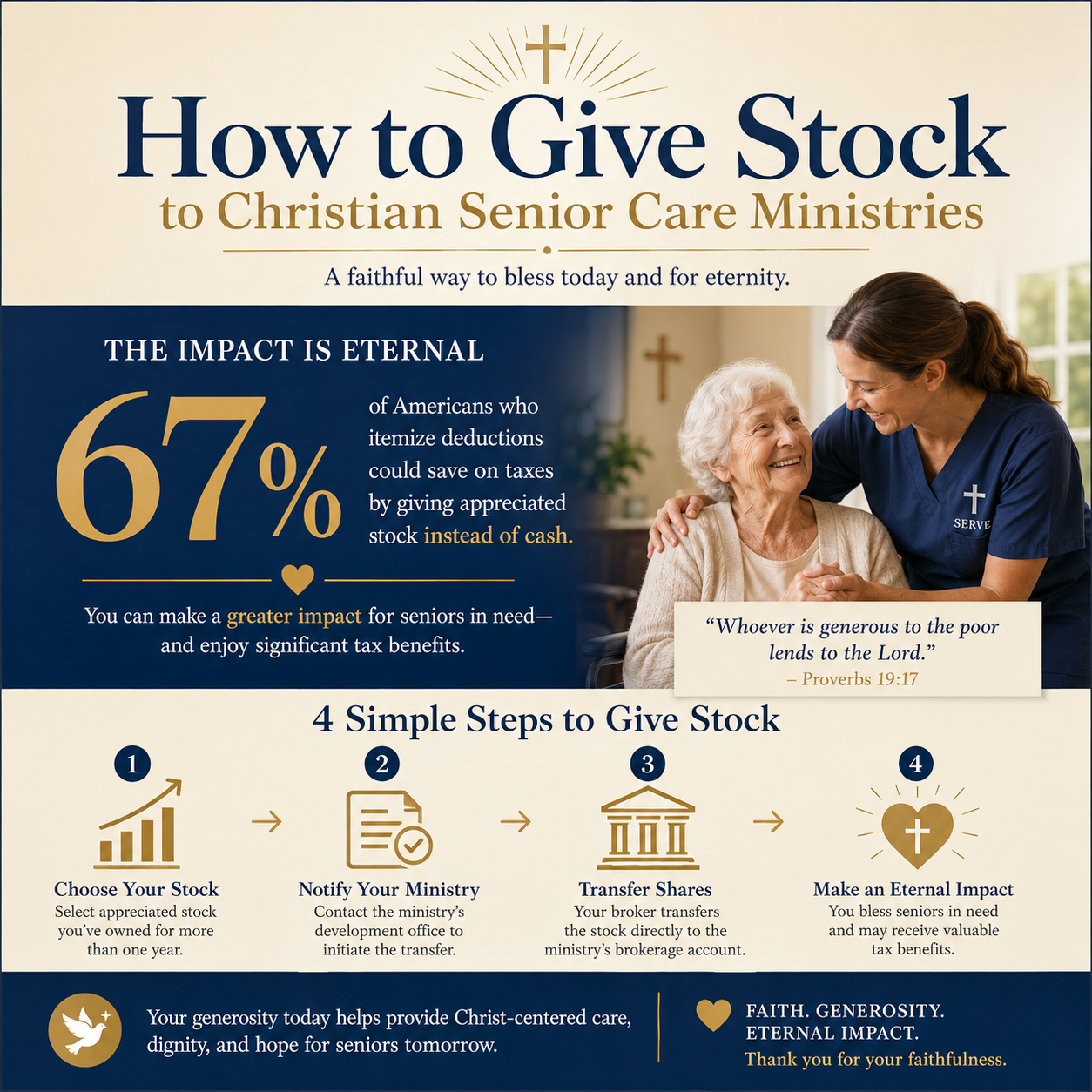
Giving stock to Christian senior care ministries is one of the most effective ways to translate long-term stewardship into near-term mercy. For donors who hold appreciated securities, stock gifts can increase the resources available for faithful elder care while often reducing the tax friction that accompanies cash giving.
Senior care ministry is rarely simple work. It involves ongoing staffing, clinical compliance, housing and food costs, and the quiet spiritual labor of presence when a resident is anxious, lonely, or nearing death. The donor question is not merely, “Can we give?” but “Can we give in a way that is both wise and worshipful?” Scripture’s call to honor older saints is not sentimental; it is moral seriousness. “Do not cast me off in the time of old age,” the psalmist prays (Psalm 71:9). Christian senior care seeks to answer that prayer with embodied fidelity.
Why stock gifts often fit senior care ministry needs
Most Christian senior care ministries operate with cost structures that do not flex quickly. Skilled nursing and assisted living depend on stable staffing ratios, regulatory requirements, and physical plant maintenance. A meaningful stock gift can function as working capital, strategic reserve, or a targeted contribution for benevolence funds that keep lower-income residents from being displaced.
Appreciated assets can carry more ministry capacity than cash
When a donor gives appreciated stock held long-term, the ministry typically receives the fair market value, and the donor may avoid capital gains tax on the appreciation while claiming a charitable deduction if they itemize, subject to IRS rules. That combination often allows a larger gift at the same out-of-pocket cost compared to selling the stock and giving the proceeds. The IRS outlines the treatment of capital gains and charitable contributions in its guidance and publications, including IRS resources.
What this means in practice is that appreciated securities can be a disciplined way to fund ordinary, faithful care: meals, memory care programming, chaplaincy, transportation, and end-of-life support that honors the dignity of those who bear God’s image.
Senior care ministries often benefit from fewer restricted gifts
Many donors prefer to designate gifts to a building project or a visible program. In senior care, however, the less visible categories are frequently the most decisive for quality: staff retention, training, compliance, and benevolence. Stock gifts are particularly helpful when they are either unrestricted or designated to a clearly governed fund that supports ongoing resident care rather than capital-only projects.

How to give stock cleanly and securely
Mechanics matter because securities transfers are reversible only with difficulty, and unclear instructions can delay a gift for weeks. The goal is to move shares directly to the ministry’s brokerage account and document the gift in a way that is straightforward for both donor and ministry.
Use a direct transfer through your broker
A typical stock gift is completed via a DTC transfer (Depository Trust Company) from the donor’s brokerage to the charity’s brokerage. The ministry should provide:
- Brokerage firm name and DTC number
- Account name and account number for receiving shares
- Exact ticker symbol and share quantity instructions
- A designated contact for gift notification
- Any gift designation language if the ministry supports it
Donors should also notify the ministry when initiating the transfer, because brokerage transfers do not always include identifying details. Without notice, the ministry may receive “mystery shares,” delaying receipting and proper designation.
Keep the documentation disciplined
For non-cash charitable contributions above certain thresholds, donors may need additional substantiation. IRS guidance addresses documentation expectations for non-cash gifts, including when Form 8283 is required and when a qualified appraisal is or is not necessary for publicly traded securities. Donors and advisors should consult relevant IRS instructions and publications at irs.gov and align with counsel for their specific circumstances.
For the ministry, the acknowledgement letter should confirm receipt of the shares and the date received, without stating a dollar value for publicly traded securities. Donors generally determine the deductible amount based on applicable rules and the mean of high and low trading prices on the date of the gift.
Choosing a senior care ministry with governance worthy of trust
Stock gifts are often larger and more consequential than routine cash donations. That scale places pressure on governance, internal controls, and executive decision-making. Mature donors increasingly recognize that a tender mission does not automatically produce disciplined administration.
What we examine under The Most Trusted Standard
Most Trusted exists because Christian donors deserve verifiable confidence, not marketing assurances. In our verification work, we evaluate ministries against The Most Trusted Standard, a 15-criteria framework that considers faith commitments, financial integrity, governance and leadership, and transparency and effectiveness. Strong senior care ministries tend to show documented board oversight, clear conflict-of-interest practices, audited or review-level financial reporting where appropriate to scale, and transparent communication about outcomes and constraints.
Christians genuinely disagree about how much weight to place on program ratios, administrative spending, and fundraising costs. The field has had to reckon with what Charity Navigator, GuideStar, and the BBB Wise Giving Alliance called the “overhead myth,” warning donors not to treat low overhead as a proxy for impact. That statement remains one of the clearest correctives to simplistic giving metrics, and it is available through the BBB Wise Giving Alliance at give.org.
Questions that reveal real operational maturity
Before transferring appreciated stock, donors can request concise answers to questions that map to stewardship rather than public relations:
How does the ministry fund benevolence? Senior care ministries often serve residents with limited resources; benevolence policies reveal whether compassion is governed and sustainable.
How are clinical and spiritual priorities integrated? Chaplaincy, worship, and pastoral care should be more than a brochure line; they should be integrated into resident life with accountability.
What is the board’s role in risk oversight? Senior care includes regulatory, staffing, and liability exposure. Mature boards document oversight without drifting into either micromanagement or neglect.
Does the ministry communicate candidly about constraints? Transparency is not only about reporting strengths. It includes naming staffing shortages, reimbursement pressures, and facility limitations with moral clarity.
For donors exploring the wider landscape, our coverage of Christian Senior Care Ministries provides a way to think about mission fit and verification considerations without reducing elder care to a single metric.
Designating stock gifts for maximum spiritual and practical fruit
Designation can be a form of love when it reflects the ministry’s actual needs and avoids unintended strain. The harder question is not whether a designation is allowed, but whether it aligns with the ministry’s capacity and the donor’s intent.
Unrestricted, restricted, and the responsibility to be precise
Unrestricted gifts generally allow leadership to meet the most urgent needs, including staffing and resident support. Restricted gifts can be appropriate when the project is clearly defined, time-bound, and budgeted, and when the restriction does not create long-term obligations without long-term funding.
Across our verification work, we observe that restrictions can unintentionally produce a “two-bucket” problem: impressive capital projects alongside underfunded operations. Senior care is sustained by daily faithfulness, not only by ribbon-cuttings.
Common senior care designations that tend to be well-governed
While each ministry differs, several designation types commonly align with the realities of elder care when governed well:
Benevolence and resident assistance funds that have published eligibility criteria and board oversight.
Chaplaincy and spiritual formation funding when the ministry can show staffing plans and ministry integration.
Memory care programming where training, staffing ratios, and resident safety protocols are explicit.
Capital maintenance reserves when the ministry maintains clear capital planning rather than reactive repairs.
Donors who want to compare giving methods and constraints across approaches will find the broader category of How to Give to Christian Senior Care Ministries helpful for situating stock gifts alongside donor-advised funds, qualified charitable distributions, and estate commitments.
Timing, valuation, and pastoral wisdom in the donor decision
Because securities fluctuate, the timing of a stock gift is not only a financial decision. It can become a spiritual test: whether we are seeking a perfect moment or a faithful one. Prudence is not the same as delay, and urgency is not the same as impulsiveness.
Year-end giving and transfer lead times
Brokerage transfers can slow down in late December. If a donor is seeking to complete a gift within a tax year, initiating the transfer early and confirming the receiving account details is a practical act of stewardship. Ministries should be able to state what date counts as “received” for their records, which is typically tied to when shares are in the charity’s account.
Concentrated positions and ministry risk
Some donors hold a concentrated stock position that has appreciated significantly. Donating a portion can reduce portfolio concentration while funding ministry. On the ministry side, receiving a concentrated position can create risk if shares are not sold promptly under a board-approved gift acceptance policy. Donors may reasonably ask whether the ministry sells gifted stock upon receipt, and whether exceptions are governed rather than improvised.
For donors who want their gift to serve residents rather than market speculation, clarity on liquidation policy is not suspicion; it is responsible love of neighbor.
FAQs for How to give stock to Christian senior care ministries
Should we give stock directly or sell and give cash?
If the stock is appreciated and held long-term, giving shares directly is often more tax-efficient than selling and donating cash, because the donor may avoid capital gains tax while still claiming a charitable deduction if they itemize, subject to IRS limits and rules. The ministry typically receives the value of the shares it can liquidate for mission use. Donors should confirm details with their tax advisor and consult the IRS at irs.gov for current guidance.
How can we verify that a Christian senior care ministry will handle a stock gift with integrity?
We recommend asking for the ministry’s gift acceptance policy, governance safeguards around liquidating securities, recent financial statements, and clarity on how designated funds are overseen. At Most Trusted, our verification work against The Most Trusted Standard focuses on the kinds of controls and transparency practices that reduce “trust us” decision-making and increase accountable stewardship.
Giving stock as stewardship that honors the aged
Christian senior care is a ministry of presence sustained by operational excellence. Giving appreciated stock can be a disciplined way to fund that presence—strengthening staffing, benevolence, and spiritual care without unnecessary tax erosion. When donors pair generosity with verification, clear documentation, and well-chosen designations, the gift can serve older saints with the dignity Scripture requires and the integrity mature stewardship demands.



