

When Christians ask how to donate to Christian senior care ministries online, they are rarely asking only about convenience. They are asking how to honor father and mother in a digital age, how to practice wise stewardship, and how to ensure that urgent compassion is not separated from accountable governance.
Senior care sits at the intersection of the church’s historic works of mercy and the modern realities of aging: cognitive decline, isolation, medical complexity, and families stretched thin. Online giving can widen the circle of care, but it also increases the donor’s responsibility to verify what is actually being funded and how faithfully a ministry operates.
Begin with a theological frame and a clear purpose
Christian senior care is not optional in Scripture
The command to honor parents is not a sentimental theme; it is moral formation. Jesus rebuked religious leaders who used technicalities to avoid supporting their parents (Mark 7:9–13). The early church is equally direct that the household has first responsibility to care for its own, and that the church should protect the truly vulnerable (1 Timothy 5:3–8). Online giving should begin with clarity about what responsibility belongs where: family, church, and specialized ministry.
Many faithful donors support senior care because they have watched a friend’s mother decline, or they have walked through dementia care and understand the quiet cost. Others give because they are preparing, humbly, for their own later years. A mature approach names both motives without suspicion and directs them toward a defined purpose.
Choose one primary outcome you are funding
Christian senior care ministries do not all do the same work. Some provide housing. Some fund trained caregivers. Some operate chaplaincy programs in long-term care facilities. Some offer respite and support for family caregivers. Others focus on elder poverty relief through food, repairs, or transportation. Before entering payment details, decide what you are actually trying to make more likely. “Helping seniors” is too broad to verify.

Verify the ministry before you click give
Online giving increases the need for verification, not the opposite
Online donation tools make it easy to give in moments of emotion. That can be a grace when compassion is rightly ordered, and a vulnerability when it is not. The same mechanics that allow a faithful ministry to receive support efficiently also allow weak governance, confusing financial reporting, or vague program claims to persist longer than they should.
Across our verification work at Most Trusted, we observe that strong ministries tend to communicate in concrete terms: who is served, what services are provided, what safeguards exist, and how spiritual care is offered without coercion. The ministries that meet The Most Trusted Standard also tend to document their leadership accountability and financial practices clearly enough that an informed donor can evaluate them.
What to review in ten minutes
Donors often assume that meaningful due diligence requires hours. It does not. In many cases, ten focused minutes can surface whether a ministry is likely to be trustworthy.
- Doctrinal clarity: Is the ministry’s statement of faith public, specific, and consistent with orthodox Christian teaching?
- Leadership accountability: Are board members named? Is there evidence the board governs rather than rubber-stamps?
- Financial transparency: Are recent audited financial statements, annual reports, or IRS Form 990s available?
- Program specificity: Are programs described with measurable activities, not only inspiring language?
- Safeguarding and care standards: For in-person services, are there policies for caregiver screening and elder protection?
It is also worth remembering a widely affirmed correction in the nonprofit field: percentage-based “overhead” judgments can mislead donors. The joint letter commonly known as the “Overhead Myth,” signed by leaders at Charity Navigator, GuideStar, and the BBB Wise Giving Alliance, warned that administrative and fundraising ratios alone do not measure impact or integrity Charity Navigator. Christian donors should care about efficiency, but even more about whether a ministry is truthful, governed well, and delivering real care.
Use secure payment methods and understand what you are authorizing
Give through channels that protect both donor and ministry
When donating online, security is not a technical afterthought; it is part of stewardship. A ministry should offer a secure donation page that uses HTTPS and reputable payment processing. Donors should avoid giving sensitive information through email, unsecured webforms, or unfamiliar third-party links forwarded through social media.
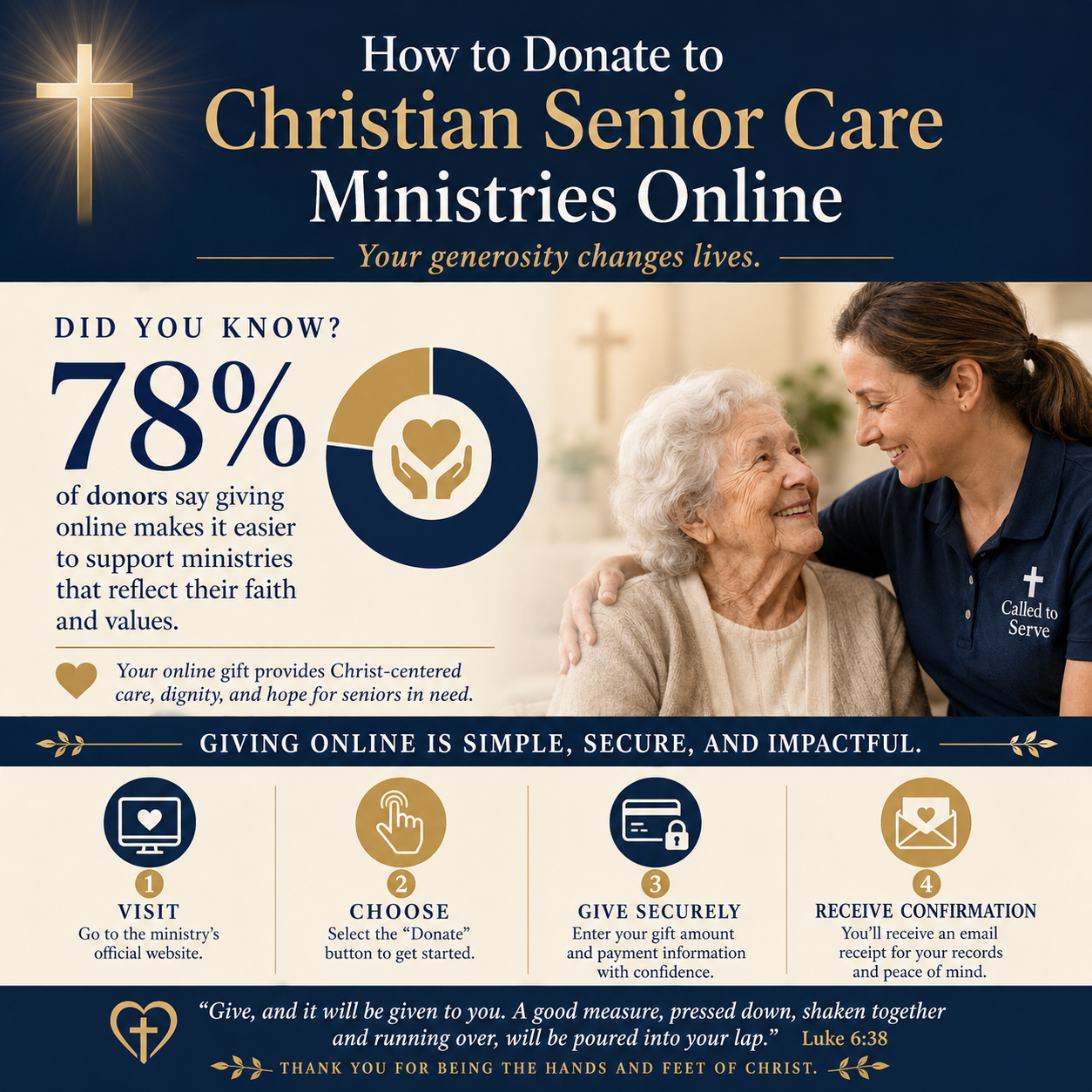
Credit cards often provide stronger consumer protections than debit cards, and bank transfers can be appropriate when executed through a secure portal. Some donors prefer digital wallets for convenience; that can be acceptable, but it should not bypass the basic requirement that the donation is being processed by the ministry or a known and reputable platform.
Know the difference between one-time and recurring gifts
Recurring giving is one of the most stabilizing forms of support for senior care ministries. It helps leadership plan staffing, caregiver training, and pastoral care with less volatility. Yet recurring gifts also require clarity about what you are authorizing, how easily you can cancel, and whether the ministry will notify you before material changes to processing or terms.
As a baseline practice, donors should retain email receipts, confirm the legal name of the receiving organization, and ensure that the donation is directed to the intended program when designations are offered. Designated giving can strengthen alignment, but it can also create tension if a ministry’s real needs shift. Sophisticated donors often designate with restraint and evaluate whether the ministry’s leadership has earned trust to allocate funds where they are most needed.
Evaluate impact claims with mature realism
Senior care impact is often qualitative and still verifiable
Christian senior care ministries sometimes hesitate to quantify outcomes because caregiving is deeply personal. But “personal” does not mean “unverifiable.” A credible ministry can still report concrete indicators: number of seniors visited, hours of respite provided, caregiver-to-resident ratios in operated facilities, chaplaincy coverage, staff training hours, or documented care plans.
The harder question is spiritual care. We should want ministries to offer prayer, Scripture, worship, and pastoral presence with integrity. We should also expect them to avoid manipulative reporting that equates exposure to religious activities with spiritual fruit. Scripture itself resists simplistic metrics. Faithfulness is the standard, but faithfulness should leave a paper trail: clear theology, trained chaplains, accountability, and honest communication.
Understand what the research says about elder vulnerability
Online donors often underestimate how vulnerable many seniors are to isolation. A large national study found that about one-quarter of adults age 65 and older are considered socially isolated, a condition associated with higher risks for adverse health outcomes National Institute on Aging. Ministries that address isolation through visitation, transportation, or community-building are not offering “extras.” They are intervening in a real risk factor with tangible consequences.
This also clarifies why governance matters. Where people are vulnerable, power imbalances exist. Christian compassion must be paired with safeguards, reporting mechanisms, and leadership oversight that takes allegations seriously. A ministry’s digital giving page may be the first place a donor engages, but the deeper question is whether the organization’s culture is ordered toward truthful care.
Give in ways that strengthen the church’s long-term witness
Coordinate your online giving with local responsibility
Christians genuinely disagree about how much senior care should be carried primarily by families, by local churches, or by specialized ministries. The New Testament insists on family responsibility and also makes space for organized care by the church, particularly for those without support (1 Timothy 5). The modern environment adds complexity: geographic dispersion, medical specialization, and economic pressure. A wise donor does not pretend those tensions are not real.
What this means in practice is that online giving should strengthen, not replace, embodied responsibility. Donating to a ministry that supports family caregivers may be an act of obedience to honor parents, even when the donor cannot be physically present. Supporting a Christian community that provides dignified housing and pastoral care may be an act of love toward seniors whose families are absent or overwhelmed. The point is not to choose between charity and responsibility, but to align them.
Use independent verification to give with confidence
Because donors are not positioned to audit ministries personally, third-party verification can serve the church by increasing clarity and reducing avoidable risk. Most Trusted evaluates Christian nonprofits against The Most Trusted Standard, a 15-criteria framework across Faith Foundation, Financial Integrity, Governance and Leadership, and Transparency and Effectiveness. The goal is not cynicism. The goal is to help generosity become more faithful and more durable.
Many donors will want a broader view of how this field is organized and what to look for across different models of care. Our page on Christian Senior Care Ministries situates common program types and verification concerns in one place, especially for donors who are comparing several approaches.
For donors focused on practical giving decisions across this category, How to Give to Christian Senior Care Ministries outlines patterns we consistently see in credible organizations, along with questions that can be asked without suspicion and answered without defensiveness.
FAQs for How to donate to Christian senior care ministries online
Should we give a recurring monthly gift or a one-time gift to senior care ministries?
Both can be faithful. Recurring gifts typically help senior care ministries plan staffing, training, and pastoral coverage with less volatility, which can strengthen care quality over time. One-time gifts can be appropriate for capital needs, emergency assistance, or a defined project. The best approach is to match the gift type to the ministry’s model and to confirm that recurring terms are clear and easy to change.
What online red flags should we watch for when donating to Christian senior care ministries?
Common red flags include vague program descriptions, missing leadership and board information, unclear financial reporting, pressure-driven appeals that discourage questions, and donation pages that do not appear secure. We also recommend caution when a ministry makes sweeping impact claims without describing the actual activities and safeguards that produce those outcomes.
Giving online with reverence and accountability
Online giving to Christian senior care ministries should be marked by the same virtues Scripture commends in every act of stewardship: truthfulness, wisdom, and love ordered toward the vulnerable. The digital channel is not the moral problem. The moral question is whether our giving strengthens faithful care and trustworthy leadership. When donors verify before they give, they help ensure that compassion is not only immediate, but enduring.



