
What makes Christian senior care ministries faith-based is not a cross on the wall or a chapel on campus. It is whether the ministry’s care for older adults is governed by Christian confession, shaped by Christian moral reasoning, and practiced as a work of mercy ordered toward the dignity of the person made in the image of God.
Donors feel the weight of this question because senior care sits at the intersection of vulnerability and trust. Families are making decisions under pressure, older adults may have diminished power to advocate for themselves, and the care environment can hide both excellence and neglect. A ministry can speak the language of faith while operating with the functional ethics of a generic service provider. Mature Christian giving asks for more than religious branding; it asks for verifiable evidence of Christian substance.
Faith based begins with theological governance not religious atmosphere
Mission clarity that can be audited
A faith-based senior care ministry can usually name, in plain language, what it believes and how those convictions govern care. This begins with a doctrinal statement or confessional alignment, but it does not end there. The question donors should ask is whether the ministry’s board, executive leadership, and clinical or care leadership can articulate how doctrine affects policy: admissions, end-of-life decisions, staff formation, spiritual care, and treatment of residents who do not share the faith.
Across our verification work at Most Trusted, ministries that meet The Most Trusted Standard tend to show alignment between stated faith commitments and governing documents. We look for consistent evidence: bylaws, board minutes at the level of principle (not private resident details), employee faith expectations where relevant, and a clear account of how the ministry avoids coercion while still providing distinctly Christian care.
Church connection that is more than symbolic
Some of the healthiest models are meaningfully connected to local churches: board representation, pastoral oversight for spiritual care, volunteer integration, and accountable partnerships for referrals. The harder question is that church connection can be used to bypass scrutiny. A ministry can borrow credibility from a denomination or a local congregation while operating without strong independent governance. Faith-based authenticity is strengthened, not weakened, by professional accountability.

Faith based care is spiritual and clinical without confusing the two
Spiritual care that respects conscience
Christian senior care becomes hollow when “spiritual care” is reduced to optional programming. At the same time, spiritual care becomes abusive when it is coercive, transactional, or tied to access and privileges. Faith-based ministries should be able to describe a theology of presence: prayer offered, never forced; chaplaincy that serves residents in fear, grief, and repentance; worship that is invitational; and a posture toward families that is truthful about suffering.
Scripture’s mandate is not sentimental. Jesus identifies visiting the sick with service rendered to him (Matthew 25:36). That framing makes spiritual care a moral responsibility, but it also heightens the obligation to protect the vulnerable from manipulation. Older adults in care settings may comply outwardly to preserve peace; ministries must design practices that honor dignity and agency.
Clinical excellence as a moral obligation
Christian distinctiveness does not excuse mediocre care. In senior care, spiritual devotion without operational competence can become a form of negligence. Donors should treat clinical and operational indicators as part of faithfulness, not merely “secular” details. Regulators also recognize this: in the United States, nursing homes that participate in Medicare are inspected and assigned a five-star quality rating by the Centers for Medicare and Medicaid Services, which reports health inspections, staffing, and quality measures for each facility (Centers for Medicare and Medicaid Services).
Not every Christian senior care ministry operates a Medicare-certified nursing facility; many focus on home care, assisted living, or pastoral support. But the principle holds across models: Christian love must be competent love. Where care is provided, we should expect transparent evidence of staffing practices, incident reporting, training, and a culture that welcomes scrutiny.

Faith based ministries tell the truth about aging suffering and death
A theology of personhood under cognitive decline
The central moral test in senior care is whether a ministry continues to treat a person as a person when the person can no longer reciprocate. Dementia and severe frailty expose whether “dignity” is rhetorical or real. Christian doctrine grounds dignity in creation, not productivity: the image of God is not lost to cognitive decline. That conviction should shape policies on restraint, meaningful activity, family communication, and the refusal to treat residents as tasks to be managed.
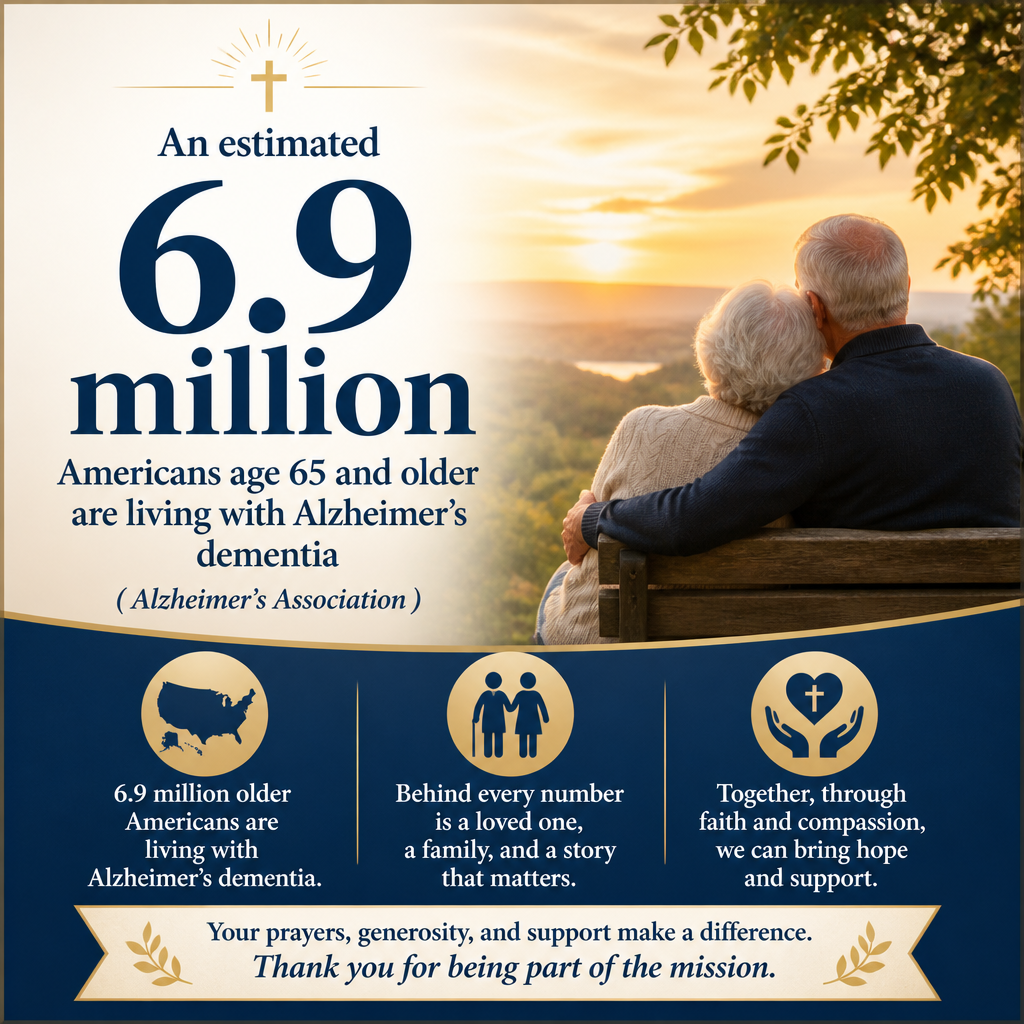
The prevalence of dementia underscores why this is not a marginal question. An estimated 6.9 million Americans age 65 and older are living with Alzheimer’s dementia (Alzheimer’s Association). For donors, this is a reminder that faith-based senior care is often, in practice, dementia care. Ministries should be candid about what they can and cannot provide, and about how they protect residents who cannot protect themselves.
End of life ethics with pastoral seriousness
Christians genuinely disagree about some end-of-life decisions, and senior care ministries face these disagreements in real time: feeding decisions, pain management, hospice timing, and questions about medical futility. A faith-based ministry should not hide its ethical framework, nor should it treat contested questions as simple slogans. The most credible ministries are transparent about how they reason, who is involved in decisions, and how families are supported when they fear either abandonment or prolongation of suffering.
Donors should also ask whether spiritual care staff and clinical staff collaborate without undermining one another. Pastoral presence must not be used to pressure families into decisions that are not medically sound. Clinical practice must not crowd out the ministry’s obligation to accompany people through fear, guilt, reconciliation, and the hope of resurrection.
Faith based is visible in governance finances and accountability
Stewardship that treats donor funds as sacred trust
Senior care is expensive, and the sector can tempt organizations toward opacity: complex fee structures, related-party real estate arrangements, and the quiet shifting of costs to families. A Christian ministry should treat financial clarity as part of discipleship, because Scripture treats money as a measure of the heart’s allegiance. That means donors should expect audited financial statements where scale warrants them, clear explanations of revenue sources, and policies that prevent private benefit.
Our team’s work at Most Trusted exists for this reason: donors should not have to choose between compassion and due diligence. The Most Trusted Standard evaluates ministries across faith commitments, financial integrity, governance, and transparency and effectiveness. A ministry may be sincerely Christian and still fall short in controls; sincerity does not replace accountability.
Transparency that matches the vulnerability of the people served
Because residents can be hidden from public view, senior care requires especially strong mechanisms for reporting concerns. Faith-based ministries should publish clear grievance processes for residents and families, whistleblower protections for staff, and board-level oversight of quality and safety. Donors should look for evidence that the ministry invites external evaluation rather than resisting it.
- Clear written policies for abuse prevention, mandatory reporting, and boundary violations
- Board oversight of quality metrics, not only fundraising and facilities
- Independent financial review appropriate to the organization’s size and complexity
- Transparent fee schedules and plain-language explanation of what is and is not covered
- Documented staff training in both care competencies and spiritual care boundaries
When donors review ministries in the broader field of Christian Senior Care Ministries, these governance and stewardship indicators often separate ministries that are merely religious in appearance from ministries that are institutionally faithful.
Faith based identity is tested by who is welcomed and how power is handled
Care offered without turning residents into projects
Christian senior care ministries often serve people who are lonely, financially strained, estranged from family, or carrying unresolved spiritual wounds. That vulnerability can be treated as an opportunity for recruitment rather than compassion. A ministry is meaningfully faith-based when it can explain how it protects residents from being turned into fundraising narratives, conversion targets, or volunteer “experiences.” Christian love seeks the good of the neighbor, not the emotional payoff of the giver.
For donors, this is where careful questions matter: How are photos and stories used? Is consent meaningful for cognitively impaired residents? Are there clear boundaries for volunteers and visiting groups? Do chaplains report to leadership structures that protect residents, not just the ministry’s reputation?
Justice and mercy in admissions and financial policies
Senior care ministries face unavoidable trade-offs. Serving low-income seniors may require subsidy; offering high levels of clinical care may require selective admissions; maintaining financial solvency can collide with a desire to accept residents who cannot pay. A faith-based ministry does not pretend these tensions are not real. It states its criteria plainly, explains how decisions are made, and demonstrates a consistent effort to protect the poor without destabilizing the mission.
What this means in practice is that donors should evaluate a ministry’s model, not only its intentions. Some ministries provide direct care; others fund care, train caregivers, or mobilize churches to support homebound seniors. The category How Christian Senior Care Ministries Work reflects this diversity, and donors should expect ministries to be precise about what outcomes they are accountable for.
FAQs for What makes Christian senior care ministries faith-based
Is offering chapel services enough to be faith-based?
No. Chapel services can be a meaningful expression of Christian care, but they do not by themselves establish a faith-based identity. A ministry is credibly faith-based when Christian conviction governs leadership, policy, and ethics, and when spiritual care is offered with integrity and without coercion. Donors should look for governance documents, staff formation, and clear protections for resident dignity.
How can donors evaluate faith-based claims without intruding on private resident care?
Donors can ask for evidence at the level of governance and systems: doctrinal alignment, board oversight, audited or reviewed financials, abuse-prevention policies, grievance processes, and transparent reporting about quality and incidents in aggregate. Verification work, including Most Trusted’s evaluation against The Most Trusted Standard, is designed to assess credibility without demanding access to confidential clinical information.
Giving with confidence requires both theological clarity and measurable accountability
Faith-based senior care is not a marketing category; it is a moral claim. Ministries make that claim credibly when their theology shapes their governance, their spiritual care honors conscience, their clinical standards are treated as a form of love, and their finances and reporting withstand scrutiny. Donors should reward ministries that can demonstrate both Christian conviction and institutional integrity, because older adults deserve care that is not only compassionate in intent but faithful in practice.



