

Knowing how to pray for seniors served by Christian ministries is not sentimental work; it is intercession at the place where mortality, dependency, and dignity meet. Many donors sense the weight of that intersection. We fund care because we believe bearing one another’s burdens is part of the church’s ordinary obedience, yet we also know that late-life ministry can be under-resourced, under-scrutinized, and sometimes poorly governed.
Scripture does not treat aging as an administrative problem. It treats older men and women as neighbors to honor, image-bearers to protect, and disciples to build up. The question is how our praying can match that biblical seriousness while also strengthening the ministries we support—spiritually, ethically, and operationally.
Pray with a theology of honor, not a theology of decline
Ask God to renew dignity where society reduces people to needs
The Christian vision of aging refuses the modern habit of measuring a life by productivity. Older adults may carry diminished strength, impaired memory, or chronic pain, yet they do not carry diminished worth. A faithful prayer practice begins by asking God to restore and safeguard dignity in the daily routines of care: bathing, feeding, toileting, medication management, and the thousand small moments where respect can be either reinforced or quietly erased.
We recommend praying that staff and volunteers would see each resident as someone entrusted to them by God, not as a task list. Where care settings become rushed, residents can experience a kind of invisible humiliation. Asking for patience and gentleness is not a vague virtue request; it is a practical petition for moral clarity under pressure.
Pray Scripture that names the calling of old age
Psalm 71 holds together realism and hope: “Do not cast me off in the time of old age” (Ps. 71:9), and later, the psalmist asks to live long enough to “proclaim your might to another generation” (Ps. 71:18). Pray that seniors served by Christian ministries would not only be cared for but also commissioned—given voice, spiritual agency, and opportunities to bless others.
Proverbs speaks of “gray hair” as “a crown of glory” when found “in a righteous life” (Prov. 16:31). Pray that ministries would make holiness and discipleship visible in the final decades, resisting the quiet assumption that spiritual growth is for the young.
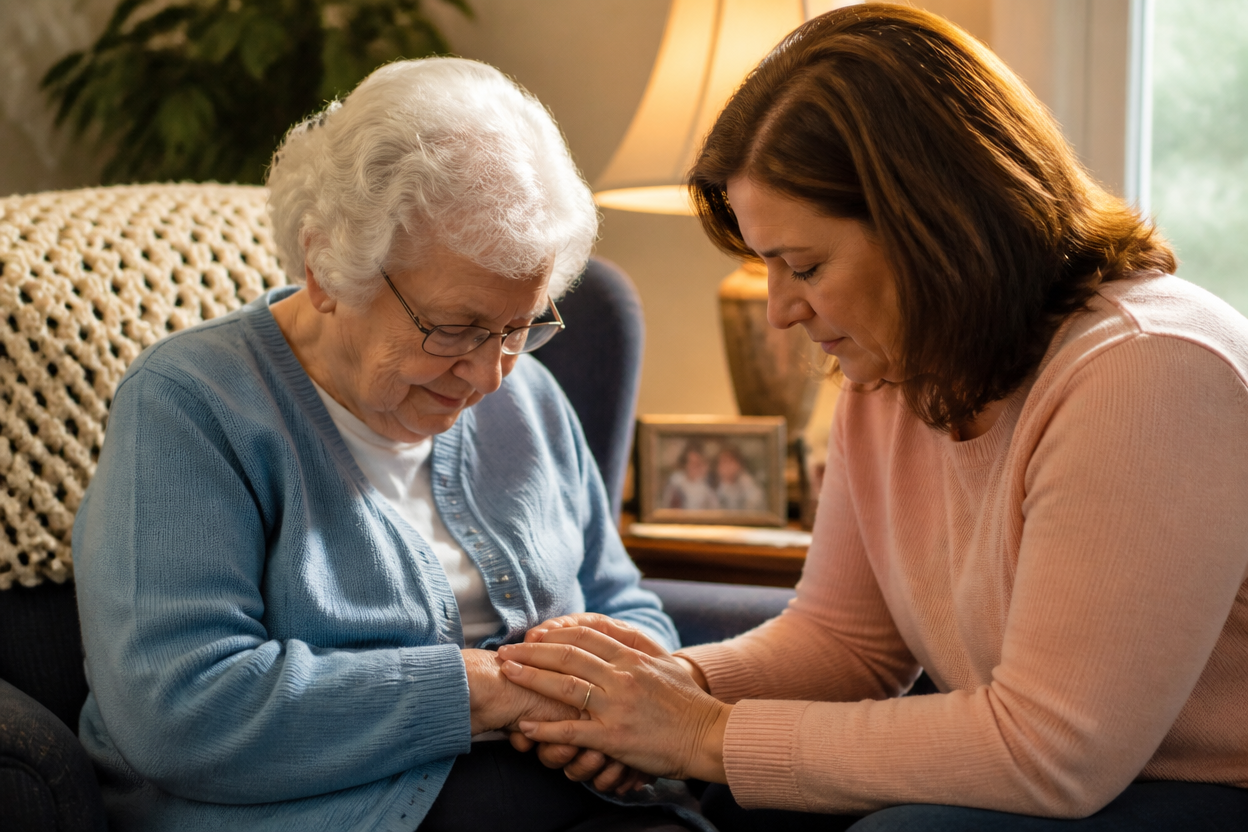
Pray for wise, trauma-aware spiritual care
Intercede for souls carrying grief, fear, and unresolved guilt
Aging often gathers losses into a narrow span: friends die, mobility shrinks, familiar homes are left behind, and independence recedes. Some seniors face a new fear of being a burden; others confront regrets and moral injury they kept hidden for decades. Christian senior care ministries frequently become a last “pastoral mile” where confession, reconciliation, and assurance of grace are urgently needed.
Pray for chaplains, pastors, and spiritual care teams to speak the gospel with precision: that Christ’s atonement is sufficient, that repentance is welcomed, and that forgiveness is not a theory. Pray that ministries would resist manipulative emotional pressure and instead cultivate clear, patient ministry of Word and sacrament in whatever ecclesial tradition they serve.
Pray for presence that does not infantilize
Good spiritual care is neither entertainment nor a thin layer of religion added to clinical services. It is attentive presence. Pray that staff and volunteers would avoid the subtle condescension that sometimes creeps in—speaking to adults as though they were children, flattening complex lives into simplified stories, or assuming cognitive limitations are spiritual limitations.

Where dementia is present, pray for faithfulness when reciprocity is limited. Many caregivers experience spiritual fatigue when gratitude is rare and progress is not measurable. Ask God to sustain love that is not contingent on affirmation, echoing the steadfastness of God himself.
Pray for caregivers under strain and for staffing that reflects Christian ethics
Ask God to protect caregivers from moral injury and burnout
Senior care is labor-intensive by design. Even when leaders plan well, front-line caregivers can face chronic time pressure, grief accumulation, and the weight of decisions made with limited resources. The United States is also facing a demographic shift that increases demand for elder care; the share of Americans age 65 and older is rising and will continue to rise in coming years, according to the U.S. Census Bureau (U.S. Census Bureau).
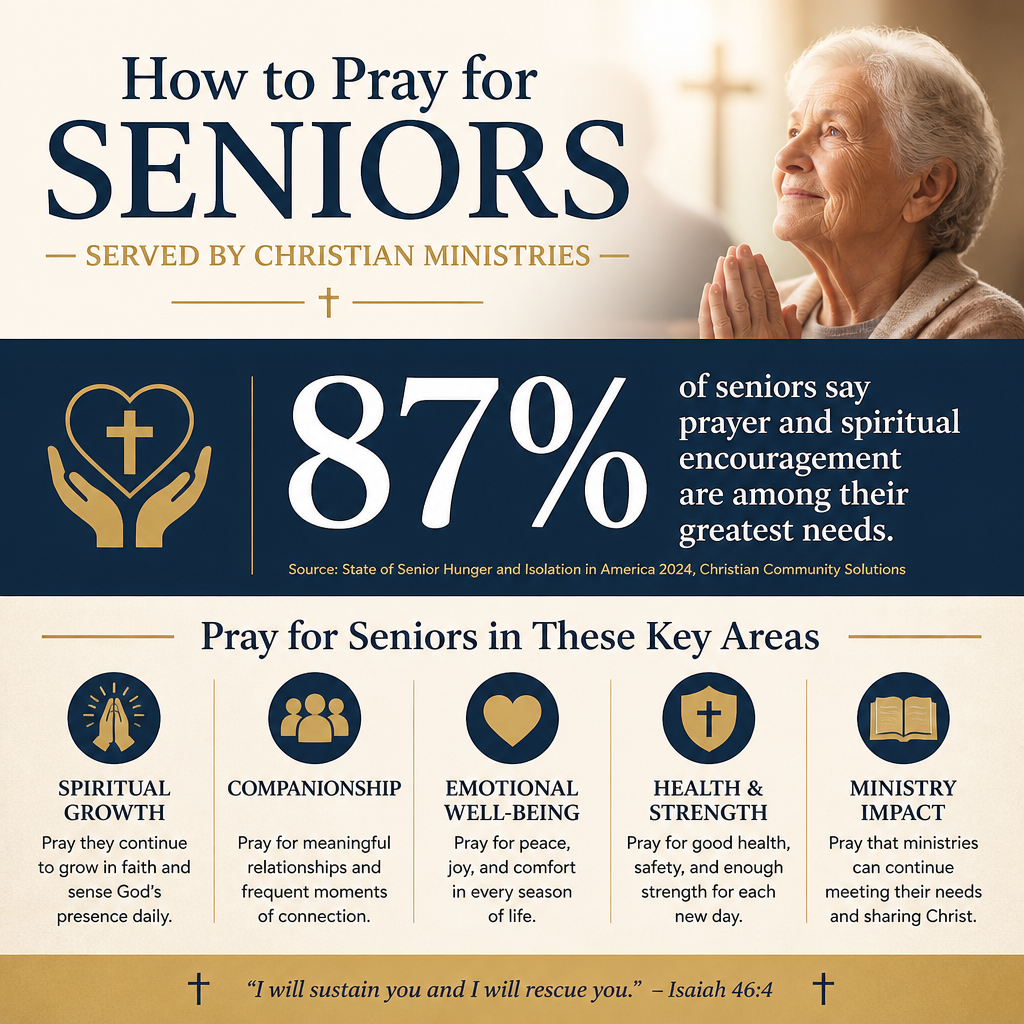
Pray that Christian ministries would not normalize exhaustion as a sign of faithfulness. Ask for leaders who protect margins, train supervisors well, and cultivate humane staffing patterns where possible. Pray, too, for emotional resilience: that caregivers would have spaces to grieve, to debrief, and to receive pastoral support.
Pray for fair wages, ethical labor practices, and a culture of safety
Christians genuinely disagree about the boundary between ministry sacrifice and institutional obligation. Yet Scripture’s warnings against withholding what is due to workers are not ambiguous (James 5:4). Pray that boards and executives would face budget realities without shifting the cost to the lowest-paid staff, and that donors would be willing to fund the unglamorous necessities that protect people.
What this means in practice is praying for measurable safeguards: proper background checks, supervision standards, incident reporting, and training in elder abuse prevention. The risk is not theoretical. Older adults are vulnerable to abuse, and responsible ministries treat prevention as a spiritual duty as well as a legal one. Pray that any hint of misconduct would be surfaced quickly, handled transparently, and reported appropriately.
Pray for governance, financial integrity, and truth-telling
Ask God for board courage and executive humility
Late-life care ministries can be deeply holy work, and they can also be complicated institutions: regulated environments, complex staffing, and families under stress. Those realities make governance more—not less—important. Pray that boards would not function as ceremonial supporters but as accountable stewards who ask hard questions about safety, finances, and mission drift.
Across our verification work at Most Trusted, we observe that ministries that meet The Most Trusted Standard tend to pair evident compassion with documented controls: conflict-of-interest policies that are actually used, audited financials or credible external review when appropriate, and leadership that welcomes oversight. Pray for leaders who want the light, not leaders who merely endure it.
Pray against the donor temptations that distort senior care
Donors can unintentionally reward what is easy to market rather than what is faithful to deliver. In senior care, the unphotographable work is often the most important: competent nursing, stable staffing, compliance, and pastoral consistency. Pray that we as donors would resist the “overhead” reflex that pressures ministries to underinvest in systems and personnel.
The broader nonprofit field has tried to correct this misunderstanding. Charity Navigator, Candid (GuideStar), and the BBB Wise Giving Alliance publicly warned that “overhead ratios” are poor proxies for impact and can harm organizations by discouraging necessary investment (Charity Navigator). Pray that Christian senior ministries would be free to budget honestly and communicate candidly, even when the truth is less inspiring than a simplified story.
Pray as responsible partners who give with discernment
Intercede for ministries you can name and evaluate
Prayer is not a substitute for due diligence. Christian love is not gullibility, and spiritual language can be used to cover managerial negligence. The charitable sector has had to reckon with the fact that harm can occur inside mission-driven organizations, sometimes for years, when boards fail and donors do not ask questions.
We recommend pairing intercession with verifiable attention. When evaluating a ministry’s senior care work, praying donors can ask: Is the ministry clear about its faith commitments and pastoral practice? Does it publish meaningful financial information? Is governance documented? Are outcomes and limitations described without inflation? This is the kind of scrutiny that honors both seniors and the gospel.
- Pray for clarity about which senior care ministries you are called to support, not merely which stories move you.
- Pray for the families who must make decisions under time pressure, guilt, and financial constraint.
- Pray for transparency when a ministry faces a serious incident, complaint, or regulatory action.
- Pray for local churches to remain present, so seniors are not outsourced from congregational life.
- Pray for renewal of joy, friendship, and worship within care communities, not only clinical stability.
Pray within the communion of saints across generations
Many donors are funding ministries that serve people they may never meet. Prayer bridges that distance without romanticizing it. Pray for older believers to be strengthened to finish well, and pray for younger believers to learn from their faith. The church is meant to be intergenerational, and senior care ministries can either reinforce segregation or become places where the body of Christ remembers its own shape.
For readers following the broader field, our coverage of Christian Senior Care Ministries tracks the distinct models ministries use—residential care, home-based supports, hospice chaplaincy partnerships, and church-based visitation—each with its own moral and operational pressures.
FAQs for How to pray for seniors served by Christian ministries
How should we pray for seniors with dementia or limited communication?
We pray first for comfort and protection: freedom from pain, fear, and neglect. We also pray for faithful presence—caregivers who speak respectfully, touch gently, and tell the truth even when residents cannot validate it. Scripture does not make personhood contingent on cognitive capacity; praying for dignity and peace is appropriate even when communication is minimal. We also intercede for families carrying anticipatory grief and for chaplains tasked with offering assurance without manipulation.
How can donors pray when we are uncertain a ministry is well-run?
We pray for light: for facts to surface, for wise oversight, and for any wrongdoing to be stopped quickly and handled transparently. We also pray for our own discernment to be free of cynicism on one side and naivety on the other. The responsible path is to combine intercession with verification—asking for policies, financial disclosures, and clear governance. Our work at Most Trusted is built for that purpose, and our broader editorial framework in Faith and Stewardship in Christian Senior Care addresses how Christian donors can practice scrutiny as an expression of love.
A prayerful donor posture that honors the elderly and strengthens the church
Christian prayer for seniors served by Christian ministries is not an alternative to responsible giving; it is the spiritual discipline that keeps responsibility from turning into suspicion and keeps compassion from turning into sentimentality. When we pray for dignity, wise spiritual care, protected caregivers, accountable governance, and truthful communication, we are asking God to make our giving an instrument of love that does not avert its eyes. That is how the church honors older saints—and how donors help ministries endure with integrity.



