
How churches can partner with Christian senior care ministries is no longer a peripheral question for serious Christian stewardship. As congregations age, and as family systems strain under economic and caregiving pressures, the church is being asked to recover a distinctly Christian way of honoring older saints without confusing sentiment with faithful care.
Scripture does not treat aging as an inconvenience to be managed. The command is concrete: “Honor your father and your mother” is embedded in the moral law (Exodus 20:12), and the church is instructed to treat older men as fathers and older women as mothers (1 Timothy 5:1–2). Yet partnership is complex. Senior care ministries range from residential communities to home-based support, dementia care, pastoral visitation programs, and benevolence funds. Some are explicitly evangelistic; others emphasize spiritual formation and companionship. Churches that partner well do more than raise money; they build relational, pastoral, and accountability-bearing bridges.
Start with a theology of aging that resists both neglect and nostalgia
Aging is a discipleship question, not only a service gap
Churches tend to approach elder care as a pragmatic problem: transportation, meals, ramps, and care plans. Those matters are real, but Christian senior care begins earlier, at the level of doctrine and formation. If the congregation is only mobilized when a crisis arrives, partnership will default to reactive giving and fragile volunteer systems.
Christian tradition has insisted that the body matters and that weakness does not erase dignity. Paul’s teaching that the “members of the body that seem to be weaker are indispensable” (1 Corinthians 12:22) cuts against a modern efficiency ethic that quietly sidelines the frail. The church’s witness is not that we can prevent decline, but that we will not abandon those who decline.
The harder tension is deciding what the church must do directly
Christians genuinely disagree about where institutional church responsibility ends and where family responsibility begins. Scripture speaks to both: children and grandchildren are to “repay” what they have received (1 Timothy 5:4), and the church is warned against taking on obligations that properly belong to the household. At the same time, the church is commanded to ensure that vulnerable people are not left without care (1 Timothy 5:3–16). Wise partnership starts by naming this tension rather than pretending it does not exist.
What this means in practice is that churches should not partner with ministries simply to outsource discomfort. Partnership is strongest when the church remains pastorally present and the ministry supplies specialized competence the church does not possess.

Map the actual needs in your congregation before choosing a partner
Needs assessment protects dignity and stewardship
Many churches begin with a ministry they like and then search for a use for it. The better order is the reverse: identify the needs among older adults and caregivers in the congregation and community, and then discern which Christian senior care ministries are equipped to serve those needs with integrity.
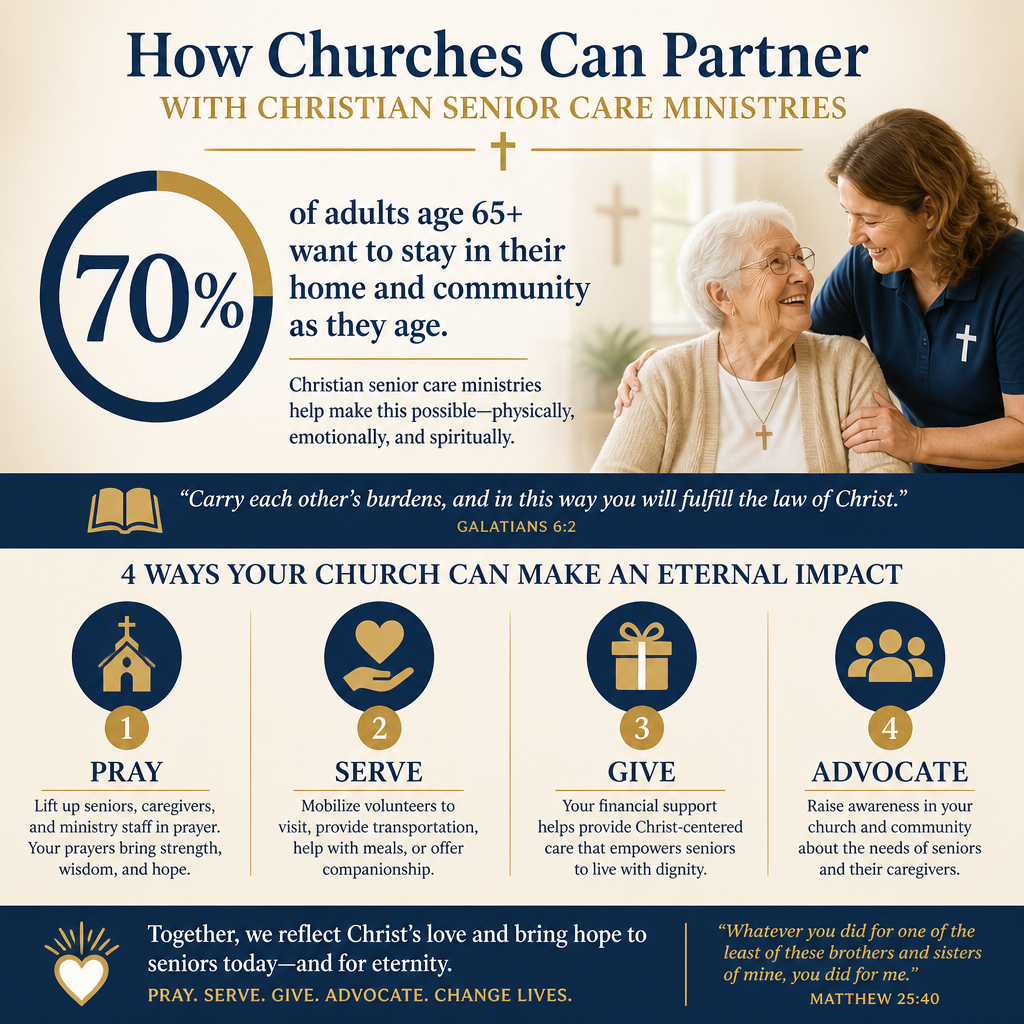
Some needs are obvious: transportation to medical appointments, respite for caregivers, home modifications, or meals. Other needs are quieter and often more spiritual: isolation, grief, fear of being a burden, unresolved family estrangement, or the shame that can accompany cognitive decline. The National Institute on Aging notes that social isolation and loneliness are associated with increased risks for health problems in older adults, including depression and cognitive decline (National Institute on Aging).
Caregivers often carry the heaviest load
If partnership only serves seniors, it will miss the hidden population of adult children and spouses who are absorbing care hours, coordinating appointments, and managing finances. In the United States, family caregivers provide the majority of long-term care; AARP and the National Alliance for Caregiving estimate that tens of millions of Americans provide unpaid care each year (AARP). Churches that want to honor older saints must also protect the caregivers from burnout, spiritual exhaustion, and financial collapse.
When churches treat caregiver strain as a normal Christian duty with no pastoral support, they inadvertently train members to suffer alone. A strong partnership includes respite options, support groups, pastoral check-ins, and guidance on ethical decisions that families often face without preparation.
Choose partnerships that can be verified, governed, and held accountable
Ministry fruit is not a substitute for stewardship controls
Senior care is emotionally compelling. Donors and churches can drift toward “good intentions” as a decision criterion, especially when the mission touches parents, grandparents, or longtime church members. Mature stewardship requires more. Financial controls, governance practices, and transparent reporting matter precisely because the work is tender and the people served are vulnerable.
At Most Trusted, our verification work emphasizes that strong ministries tend to combine theological clarity with operational sobriety. The Most Trusted Standard evaluates ministries across Faith Foundation, Financial Integrity, Governance and Leadership, and Transparency and Effectiveness. Churches do not need to replicate a full due diligence process, but they should refuse partnerships that cannot answer basic questions about oversight, conflicts of interest, or the actual use of restricted gifts.
What to look for in a prospective senior care ministry partner
A church can set clear expectations without adopting a suspicious posture. The goal is not cynicism; it is fidelity. At minimum, churches should expect to see:
- Current financial statements and a clear explanation of how donor funds are allocated
- An independent board with real authority and documented meeting practices
- Written safeguarding policies for vulnerable adults, including reporting procedures
- Measurable program outcomes appropriate to the ministry’s scope
- A public posture of transparency that does not rely on sentiment to secure trust
Donors have also had to relearn that “low overhead” is a misleading proxy for health. The 2013 Overhead Myth letter, signed by GuideStar, Charity Navigator, and the BBB Wise Giving Alliance, argued that overhead ratios can punish investments in staff and systems that protect effectiveness (Candid GuideStar). Senior care ministries often require trained staff, background checks, compliance practices, and facility maintenance. Churches should not pressure partners into fragility by rewarding only the appearance of cheapness.
Build partnership models that combine church presence with ministry competence
Healthy partnership is more than sending checks
The church’s comparative advantage is not primarily technical care. It is covenant community: presence, prayer, sacramental life, and the long obedience of mutual responsibility. The ministry’s comparative advantage is often specialized competence: memory care expertise, social work systems, housing operations, or coordinated home services. Partnership works when each party does what it is designed to do, and neither pretends to be the other.
For donors and church leaders seeking a wider lens, we maintain coverage of Christian Senior Care Ministries that reflects the range of models in the field and the stewardship questions they raise. The aim is not to collapse distinct ministries into a single template, but to help supporters ask better questions before giving or formalizing relationships.
Concrete partnership forms churches can sustain
Many churches attempt grand initiatives that collapse under volunteer fatigue. A sustainable partnership usually begins with a narrow, repeatable commitment and scales only after stability is proven. Examples include:
Pastoral integration. Establish a regular cadence of pastoral visits, communion, and prayer support for seniors served by the ministry, especially those without family nearby.
Care coordination. Train deacons or a care team to coordinate transportation, meals, and home maintenance in collaboration with the ministry’s staff, with clear boundaries and confidentiality practices.
Respite and caregiver support. Host caregiver support groups, provide short respite coverage, and connect caregivers to counseling when needed. The church can normalize asking for help as an act of humility rather than failure.
Targeted benevolence. Establish a restricted fund for seniors facing housing instability, medical debt, or emergency home repairs, administered with documented criteria and oversight.
Volunteer pipelines with training. Require training and background checks appropriate to vulnerable adult work. Informal goodwill is not adequate protection.
These models honor the church’s calling while respecting regulatory and clinical realities. Senior care ministries operate in a space where compliance requirements, liability, and professional standards are not optional. Churches should treat those constraints as part of loving the vulnerable well.
Protect trust through transparency, safeguarding, and clear moral boundaries
Vulnerable adults require explicit safeguarding practices
Churches are increasingly alert to child protection, but vulnerable adult safeguarding is often underdeveloped. Cognitive impairment, dependency, and isolation create conditions where financial exploitation and abuse can occur, sometimes by those who appear trustworthy. Partnership should require written safeguarding policies, documented training, and clear reporting channels. If a ministry cannot describe how it handles allegations, the church should not proceed.
Governance is not an abstraction here. The more intimate the care, the more costly a failure becomes. Donors who fund senior care are not only supporting compassion; they are underwriting systems of trust. That trust must be protected with structures that can withstand pressure and temptation.
Clarity about the gospel should match clarity about outcomes
Christian senior care ministries differ in how they express evangelism, discipleship, and pastoral care. Some operate as explicitly Christian housing communities; others provide services to a broad public with a Christian ethos and chaplaincy. Churches should clarify expectations early: What does spiritual care look like? How is religious freedom respected for residents? How does the ministry avoid coercion while maintaining a credible Christian witness?
Within the wider conversation of Faith and Stewardship in Christian Senior Care, we have found that the most durable partnerships are those in which theology, governance, and measurable effectiveness reinforce one another. When one of those elements is vague, the partnership tends to drift into either hollow professionalism or unaccountable zeal.
FAQs for How churches can partner with Christian senior care ministries
Should a church prioritize local senior care ministries or national ones?
Local partnerships often allow for deeper pastoral presence, volunteer engagement, and direct accountability. National ministries may provide stronger specialization, broader infrastructure, and consistent training systems. The right choice depends on the needs identified in the congregation, the ministry’s verifiable governance and financial practices, and whether the church can sustain a real relationship rather than a symbolic affiliation.
What are the first due diligence questions a church should ask before partnering?
Churches should begin with governance, finances, and safeguarding. Ask for current financial statements, the identity and independence of the board, written vulnerable adult protection policies, and a clear description of how the ministry measures outcomes appropriate to its work. If the ministry cannot provide basic documentation or treats reasonable questions as disloyalty, the church should pause before asking donors to invest their trust.
A partnership worthy of the church’s calling
Churches partner well with Christian senior care ministries when they refuse both extremes: neglect that hides behind family responsibility, and nostalgia that substitutes emotion for accountability. The biblical call is steady, not flashy: to honor older saints, to protect the vulnerable, and to practice stewardship that can withstand scrutiny. Donors who give toward senior care deserve the confidence that their generosity is building durable, faithful care rather than temporary relief.



