
What compassion means in Christian senior care is not primarily a question of sentiment. It is a question of presence, dignity, and truth: whether we will honor older adults as image-bearers when frailty, confusion, or dependence makes them easy to overlook. For Christian donors, the question is also one of stewardship—whether our giving strengthens ministries that practice mercy without drifting into negligence, coercion, or quiet harm.
Scripture refuses to treat the elderly as marginal. “Do not cast me off in the time of old age” is not a private fear but a prayer the church is meant to hear (Psalm 71:9). The command to “honor your father and your mother” does not expire when a parent becomes difficult to care for (Exodus 20:12). The New Testament’s insistence on showing “honor” to the vulnerable is not an abstract ethic; it is a measurable pattern of life (Romans 12:10). Compassion, in Christian senior care, is the concrete expression of that honor under real constraints.
Compassion begins with theological clarity about personhood
Image-bearing does not diminish with cognitive loss
Many of the hardest decisions in senior care are made at the intersection of dignity and decline. Dementia, stroke, Parkinson’s disease, chronic pain, and depression all complicate what “care” looks like on a Tuesday afternoon. Christian compassion starts by refusing the secular assumption that personhood is earned by productivity, independence, or mental sharpness.
The world often measures a life by output; the church must measure by covenant faithfulness and inherent worth. When cognition fades, compassion does not fade with it. Ministries that practice Christian senior care well build cultures where an older adult is not treated as a problem to be managed but as a neighbor to be loved—sometimes in silence, sometimes in confusion, sometimes in grief.
Honor is more than safety and more than comfort
It is possible to deliver technically competent care while still failing compassion. A facility can be clean and well-staffed and yet communicate, subtly but consistently, that residents are interruptions. Conversely, it is possible to speak warmly about “loving seniors” while ignoring policies that allow preventable falls, medication errors, or understaffing.
Christian compassion insists on both: tenderness and rigor. In donor terms, we are not choosing between spiritual warmth and operational excellence. We are insisting that genuine mercy takes shape in dependable systems, truthful reporting, and accountable leadership.

Compassion in practice is presence, not paternalism
Listening is a spiritual discipline in institutional settings
Senior care often functions on schedules: medication passes, meals, therapies, bathing rotations, shift changes. Compassion is not opposed to schedules, but it does resist the subtle moral drift that treats efficiency as the highest good. Presence requires time—time to notice a change in mood, time to hear a fear repeated for the fifth time, time to allow an older adult to express preferences that complicate the plan.
This is where Christian donors can misunderstand the field. We may prefer ministry narratives that emphasize uplifting stories, but daily compassion is frequently repetitive and unspectacular. Faithfulness in this work is measured in consistency: showing up again, responding again, explaining again, and doing it without contempt.
Agency matters, even when choices are constrained
Compassion includes protecting elders from abuse and exploitation, but protection can slip into paternalism. The goal is not to make choices for older adults whenever it is convenient; it is to preserve agency wherever it is possible and to safeguard interests where capacity is diminished.
In Christian senior care ministries, this can mean simple but weighty practices: honoring meal preferences within dietary limits, offering meaningful spiritual participation rather than passive “chapel programming,” and building care plans that include family voices without surrendering the resident’s dignity. When donors evaluate ministries in this space, we recommend paying attention to whether the ministry treats residents as participants or merely as recipients.
Compassion requires moral realism about money, staffing, and oversight
Understaffing is a spiritual issue, not only a budget issue
Few realities strain compassion more than chronic understaffing. Christian senior care cannot be reduced to ratios, but ratios do matter because care is delivered by human beings with limited time and attention. When a caregiver is responsible for too many residents, even a good-hearted person becomes hurried, and hurried care becomes rough care.
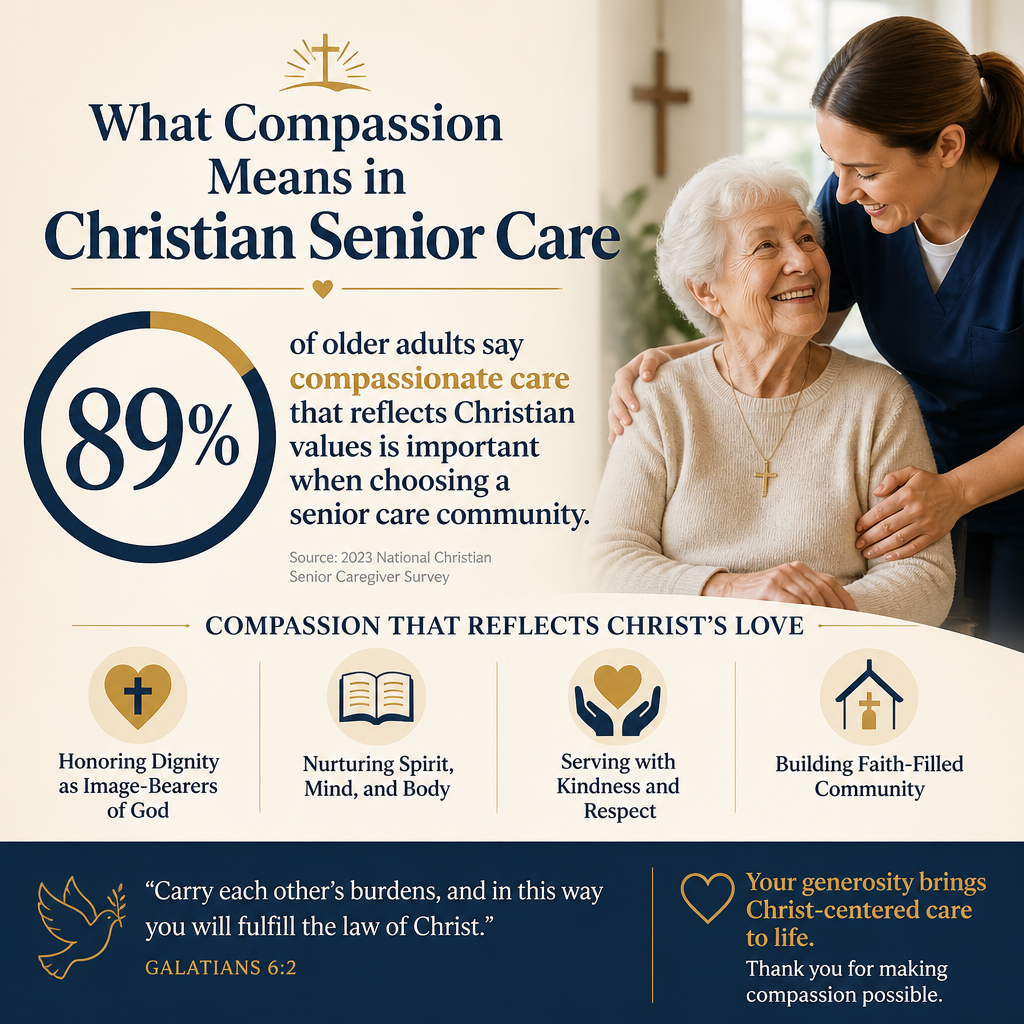
The broader labor market has made this more visible. In a 2024 report, the American Health Care Association and National Center for Assisted Living described persistent workforce challenges in long-term care and the difficulty providers face in recruiting and retaining staff (AHCA/NCAL). Donors should resist simplistic conclusions—workforce pressures are real, and many leaders are working responsibly—but we should also resist romanticizing ministries that cannot demonstrate a credible staffing plan.
Compassion must be governable
Because the work is emotionally charged, senior care ministries can become vulnerable to “trust us” dynamics: founders whose calling is unquestioned, boards that defer rather than govern, and donors who assume spiritual sincerity guarantees operational integrity. Scripture does not permit that assumption. The pastoral letters insist on character and reputation, but they also assume accountability (1 Timothy 3).
This is one reason Most Trusted exists. We help donors give with confidence by evaluating ministries against The Most Trusted Standard, a 15-criteria framework that examines faith commitments, financial integrity, governance, and transparency with the seriousness this work demands. Compassion that cannot be audited, explained, and supervised will eventually become compassion that cannot be trusted.
Compassion is spiritually serious care at the end of life
Hospice and palliative care can be faithful expressions of mercy
Christians genuinely disagree about some end-of-life decisions, and careful donors should respect that complexity. Yet the core Christian conviction is stable: we do not abandon people when suffering intensifies. Palliative care, at its best, is not the pursuit of death; it is the pursuit of comfort, clarity, and dignity amid serious illness.
Many families encounter hospice only in crisis, and their questions are not theoretical. What does it mean to keep someone comfortable without hastening death? How do we handle feeding, hydration, sedation, and pain management? Ministries serving seniors need policies that are clinically sound and morally coherent, and they need pastoral care that can walk families through grief without manipulation.
Loneliness is not a side issue
Older adults can be surrounded by people and still be profoundly alone. Compassion includes community: meaningful relationships, spiritual companionship, and an environment where an older adult is known. In 2023, the U.S. Surgeon General warned that loneliness and social isolation carry serious health risks, linking them to increased risk of premature mortality and other adverse outcomes (U.S. Department of Health and Human Services).
Christian senior care ministries are uniquely positioned to respond because the church has language for belonging that is not consumeristic. But donors should ask whether the ministry’s programming is genuinely relational or merely performative. A calendar full of activities can still leave residents unseen if staffing and culture do not support attentive relationships.
How donors can recognize compassionate Christian senior care ministries
Compassion leaves a paper trail
In senior care, compassion is not measured only by the warmth of a brochure. It shows up in policies, training, incident reporting, and family communication. It shows up in the willingness to acknowledge failures and correct them. It shows up in whether leadership can explain, plainly and consistently, how resident safety, spiritual care, and financial stewardship fit together.
Across our verification work, we observe that ministries with the clearest compassion are often the most transparent about constraints. They do not treat donors as an audience to be managed. They treat donors as partners who deserve truthful information, including the costs and trade-offs of providing dignified care.
Practical due diligence that respects the ministry and the resident
For donors seeking to support Christian Senior Care Ministries, it is reasonable to ask questions that connect moral intention to operational reality. A short list of donor-facing indicators can clarify whether compassion is being practiced or merely claimed:
- Clear safeguards against abuse, neglect, and financial exploitation, including reporting pathways and training
- Evidence of stable governance: an active board, conflict-of-interest policies, and accountable executive leadership
- Staffing practices that prioritize continuity of care and adequate supervision
- Pastoral and spiritual care that is offered consistently and without coercion
- Financial reporting that is complete, timely, and intelligible to donors
Some donors hesitate to ask these questions because they fear sounding suspicious. Yet Scripture commends wise stewardship. Trust is not the enemy of accountability; it is strengthened by it.
The broader context of giving also matters. The “Overhead Myth” letter—signed by major charity evaluators—argued that donors should not treat low administrative cost as a proxy for effectiveness, because organizations need healthy infrastructure to deliver outcomes responsibly (Candid GuideStar). Senior care is a clear example: training, compliance, clinical oversight, and supervision are not distractions from compassion. They are often the means by which compassion becomes reliable.
For donors who want a deeper grounding in how faith commitments and stewardship converge in this field, Faith and Stewardship in Christian Senior Care is a helpful lens. Compassion is not only what we feel for older adults; it is what we are willing to fund, govern, and sustain on their behalf.
FAQs for What compassion means in Christian senior care
Is compassion mainly about providing spiritual care, or physical care too?
Christian compassion refuses that division. Scripture holds together the care of body and soul, and Jesus’ own ministry demonstrates both proclamation and tangible mercy. In senior care, spiritual care without competent physical care becomes sentiment; physical care without spiritual seriousness can become sterile. Donors should look for ministries that integrate pastoral presence with credible clinical and safety practices.
What should donors prioritize when evaluating a Christian senior care ministry?
We recommend prioritizing verifiable governance, transparent finances, and demonstrable care practices, alongside a clear Christian faith foundation. Compassion is more trustworthy when it is accountable: when leadership can explain staffing, safeguards, and outcomes; when the board governs actively; and when donors can see how resources translate into dignified care. Verification frameworks such as The Most Trusted Standard exist to help donors make those judgments without reducing ministry to marketing claims.
Compassion worthy of the elderly and worthy of the gospel
Compassion in Christian senior care is the disciplined commitment to honor older adults as image-bearers through decline, dependence, and the approach of death. It requires tenderness, but it also requires structures that prevent harm and sustain faithfulness over time. For Christian donors, supporting this work is not only an act of kindness; it is a form of stewardship that should be as serious as the lives it aims to protect.



