
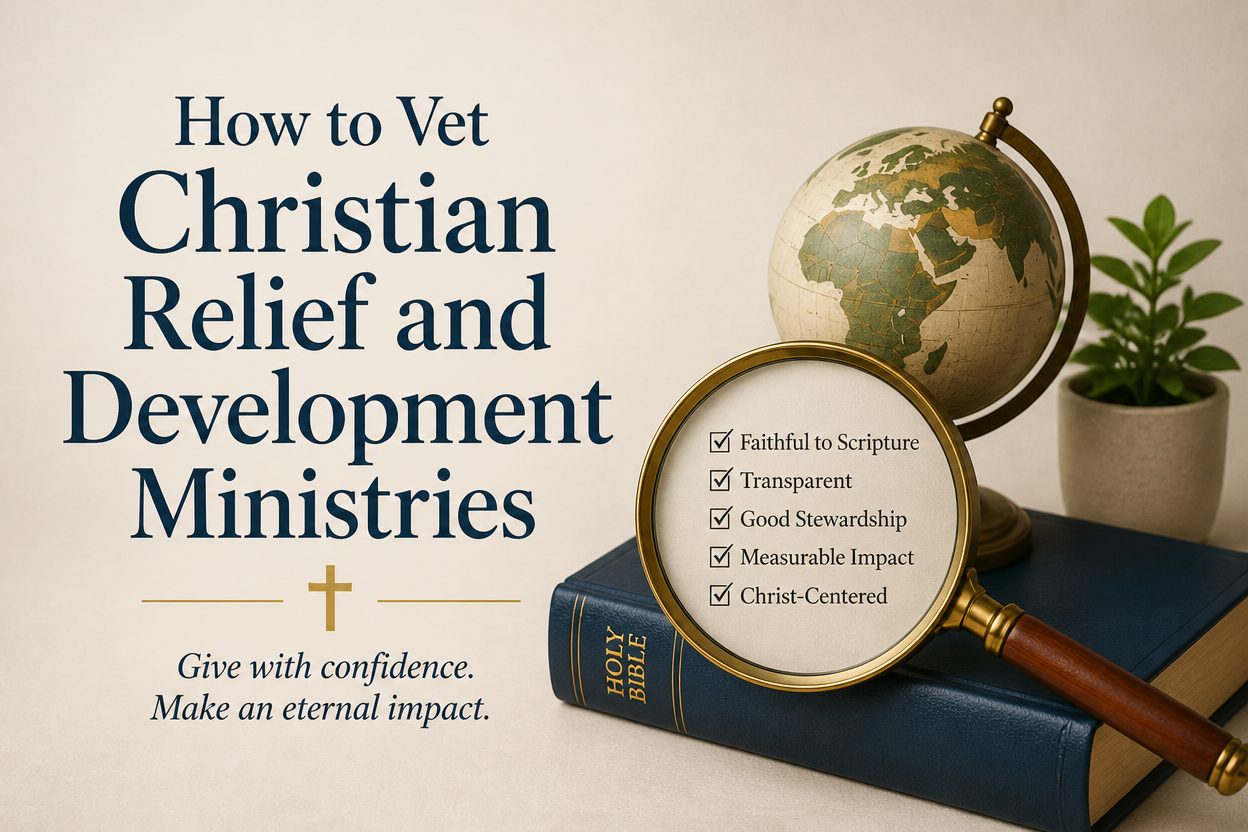
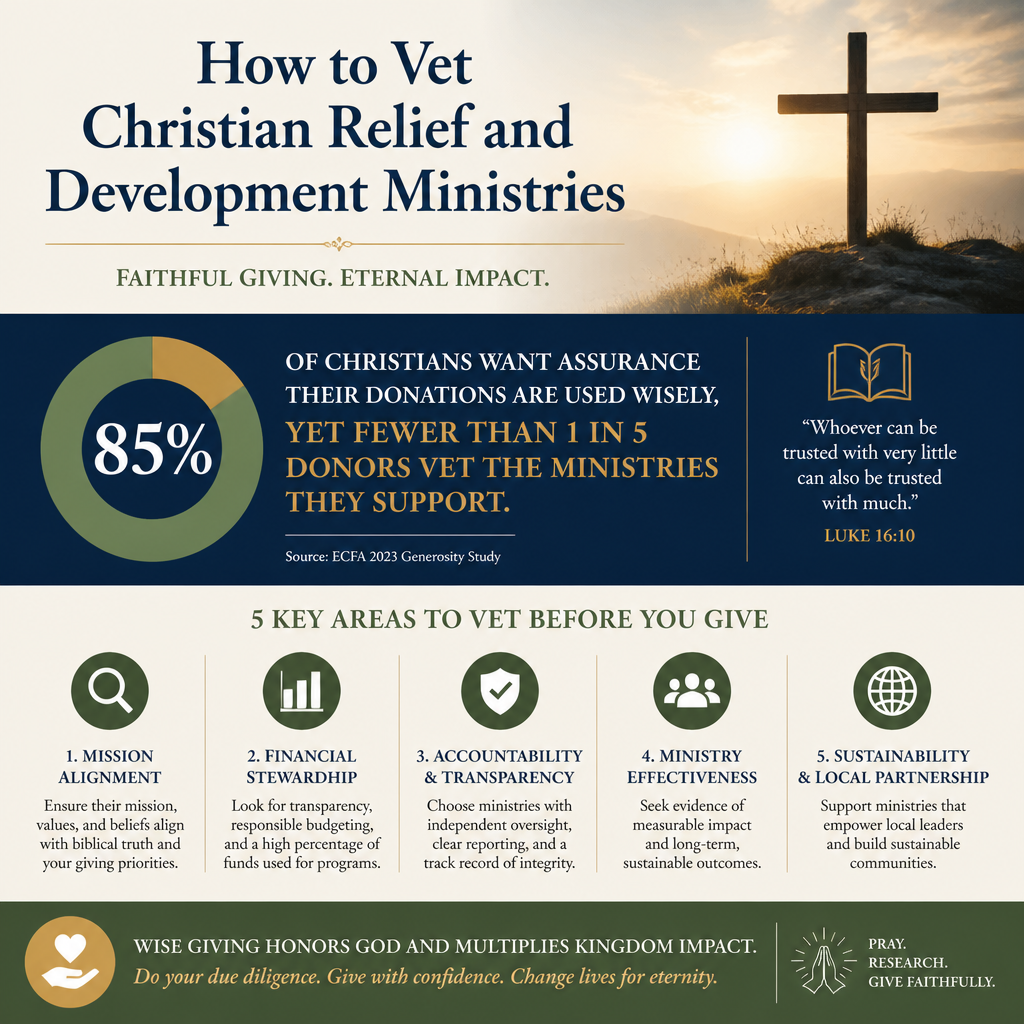
Learning how to vet Christian relief and development ministries is a stewardship question before it is a research exercise. Christian donors are not only asking whether a program “works,” but whether an organization’s methods, theology, and use of power align with the character of Christ. Scripture consistently binds mercy to justice and integrity, warning against gifts that ease our conscience while neglecting truth in the inner life of institutions (Proverbs 11:1; Isaiah 1:17).
The modern relief and development field also carries real complexity. Christians genuinely disagree about where to draw the line between urgent compassion and long-term transformation, between evangelistic clarity and culturally competent partnership, between measurable outcomes and faithful presence. A serious vetting process does not pretend these tensions are simple; it asks whether a ministry recognizes them, governs itself wisely within them, and can offer verifiable evidence for the claims it makes.
Start with the ministry’s theological clarity and spiritual posture
Confessional commitments should be explicit and operational
Many organizations can affirm a statement of faith. The more revealing question is whether that faith meaningfully shapes decisions: who is served, how staff are formed, how the ministry speaks about human dignity, and what kinds of outcomes it treats as success. Mature Christian relief organizations can articulate how the imago Dei informs safeguarding, how the Great Commandment shapes service delivery, and how the Great Commission is pursued without coercion or manipulation.
We recommend looking for clear, public theological commitments and a credible relationship to the church. This does not require that every program be run by clergy, but it does require that the ministry can explain how it remains accountable to Christian doctrine rather than to donor appetite or political fashion. When a ministry’s public language becomes indistinguishable from secular humanitarian branding, donors should ask what has been gained and what may have been surrendered.
Beware of spiritualized marketing and crisis-driven fundraising
Relief work invites urgent appeals. Yet Christian organizations are called to truthfulness, especially when images of suffering can be used to move money quickly. A prudent donor evaluates whether the ministry’s communications are accurate, dignifying, and careful with claims of impact. If a ministry routinely frames giving as a transactional guarantee of divine favor, or portrays communities as helpless props in a donor’s spiritual story, the concern is not merely aesthetic. It is theological.
Across our verification work at Most Trusted, the ministries that meet The Most Trusted Standard tend to communicate with a restraint that reflects both compassion and accountability: they name real needs, admit limits, and avoid exaggerated promises that cannot be verified.

Test financial integrity with more than a ratio
Read the Form 990 and audited statements with donor questions in mind
For U.S.-based nonprofits, the IRS Form 990 remains one of the most practical tools a donor can use, especially when paired with audited financial statements. Donors should check whether the organization is consistent over time: stable revenue patterns, reasonable reserves, and spending that aligns with stated mission. Large swings are not automatically disqualifying—disaster response can be volatile—but the organization should be able to explain volatility with clarity.
We recommend examining executive compensation, related-party transactions, and whether the organization relies heavily on restricted funds it may not be able to use for core operations. If the ministry has an audit, donors should read the auditor’s opinion and any notes about internal controls or going-concern risks. Absence of an audit is not always evidence of wrongdoing, but for larger organizations it is often a meaningful gap in financial discipline.
Avoid simplistic overhead judgments
Christians sometimes default to the idea that the “best” charity is the one with the lowest overhead. The sector has had to correct that assumption. In 2013, Charity Navigator, GuideStar, and the BBB Wise Giving Alliance issued a joint letter warning donors against using overhead ratios as the primary measure of effectiveness, since underinvestment in administration can weaken outcomes and accountability Charity Navigator.
What this means in practice is that donors should ask whether administrative spending is serving integrity: competent finance staff, strong safeguarding systems, responsible monitoring and evaluation, and compliant international operations. Underfunding those functions can produce the appearance of efficiency while increasing risk to the very people the ministry exists to serve.
Evaluate governance and leadership as a spiritual and practical safeguard
Board strength is a ministry protection, not bureaucracy
Governance is not a technical footnote. It is one of the primary safeguards against moral failure, financial misuse, and mission drift. Donors should look for a board that is independent, meaningfully engaged, and willing to challenge senior leadership. Warning signs include boards dominated by insiders, long-tenured boards with minimal turnover, and organizations where the founder’s authority is functionally unchecked.
For donors exploring the broader landscape of Christian Relief and Development Ministries, governance is one of the most reliable differentiators between ministries that endure with integrity and ministries that depend on charisma, urgency, and donor emotion. A faithful board understands that Christian witness is damaged not only by overt scandal, but also by patterns of unaccountable power that create predictable harm.
Safeguarding policies should be public and credible
Relief and development work often involves vulnerable adults and children, cross-cultural power imbalances, and field environments where reporting can be difficult. Donors should expect clear safeguarding policies: child protection, prevention of sexual exploitation and abuse, whistleblower protections, conflict-of-interest rules, and a transparent process for handling allegations. The presence of a policy is only the beginning. The ministry should also show evidence of implementation: training, reporting pathways, and governance oversight.
Internationally, donors should pay attention to whether the organization aligns with established humanitarian safeguarding expectations. For example, the CHS Alliance promotes safeguarding and accountability practices in humanitarian response CHS Alliance. Not every Christian ministry will formally affiliate, but mature organizations should be conversant with the norms the wider field has developed after painful failures.
Ask whether the approach respects local agency and avoids predictable harms
Relief that becomes dependency is not neutral
Christians have long wrestled with the relationship between compassion and wisdom. In the contemporary conversation, the When Helping Hurts framework, articulated by Steve Corbett and Brian Fikkert, has reshaped how many Christian donors and ministries think about unintended consequences—especially paternalism, dependency, and the displacement of local solutions Moody Publishers. Donors do not need to agree with every application of the framework to take its warning seriously: good intentions do not guarantee good outcomes.
We recommend asking concrete questions about local partnership. Who sets priorities? Who holds resources? Who is paid? What role do local churches play, and are they strengthened or sidelined? A ministry that cannot speak clearly about local ownership may still be doing sincere work, but the risk of doing harm rises when agency is consistently externalized.
Disaster response requires disciplined ethics
In crises, speed matters. Yet speed can also become a moral excuse for bypassing safeguards and local coordination. Donors should look for evidence that the organization coordinates with local authorities and reputable networks, tracks distribution, and can account for goods and cash. In conflict or fragile states, donors should also ask whether the organization has a responsible approach to security, anti-corruption controls, and do-no-harm analysis.
One practical test is whether the ministry can describe its exit strategy. Relief that never transitions to recovery and development may continue to meet real needs, but long-term presence without a plan can crowd out local markets and perpetuate dependency. Responsible organizations can explain when they move from free distribution to livelihoods, cash programming, or local procurement, and why.
Demand transparency and evidence that matches the claims
Effectiveness is more than stories, but never less than truth
Christian donors should not be asked to choose between compassion and evidence. A ministry can tell stories and also provide verifiable reporting: what was done, where, for whom, at what cost, with what observed results. The right level of rigor depends on the intervention; not every program can be evaluated like a clinical trial. But every ministry should be able to show a coherent theory of change, basic monitoring, and honest reporting about what did and did not work.
We recommend particular caution when a ministry’s outcomes are framed in absolute terms (“permanent transformation,” “ending poverty,” “whole communities saved”) without clear definitions and measured indicators. The larger the claim, the higher the burden of proof. In our work, organizations that meet The Most Trusted Standard tend to publish enough detail that a serious donor can test statements against documents, third-party reporting, and internal consistency.
A short vetting checklist donors can actually use
- Public documents: Form 990, audited financials, board list, and key policies are accessible and current.
- Governance: The board is meaningfully independent, has term limits or rotation, and oversees risk and ethics.
- Safeguarding: Clear child protection and abuse prevention policies, with reporting pathways and training.
- Local partnership: Decisions and resources are shared with local leaders and institutions, not centralized.
- Truthful communication: Fundraising avoids exaggeration, respects dignity, and matches claims to evidence.
Donors who want a more category-specific framework for decision-making can also consult How to Give Wisely to Christian Relief and Development Ministries, where the giving questions tend to be more applied and comparative.
FAQs for How to vet Christian relief and development ministries
Is it unspiritual to ask hard questions about a Christian charity?
Scripture commends generosity, but it also commends prudence and honesty. The New Testament pattern includes careful administration of gifts to avoid blame and to honor the Lord in the handling of funds (2 Corinthians 8:20–21). Asking for audited financials, governance clarity, and safeguarding policies is not suspicion; it is moral seriousness about stewardship and witness.
Should we prioritize evangelism or measurable development outcomes?
Christians genuinely disagree about emphasis, and different ministries are called to different forms of faithfulness. The responsible donor question is whether the ministry’s stated aim is coherent and whether its methods are ethically sound. A ministry that emphasizes evangelism should still demonstrate honest reporting and non-coercive practice; a ministry that emphasizes development should still show a clear Christian identity and a theology of human dignity. We recommend avoiding organizations that blur categories in order to broaden donor appeal.
Giving that honors Christ requires verification, not mere confidence
Vetting is not an attempt to control outcomes that belong to God. It is a commitment to truth in how resources are entrusted to human institutions. Christian relief and development ministries handle money, power, and vulnerable lives in the name of Christ; those realities deserve more than sentiment.
Most Trusted exists to serve donors who want confidence grounded in evidence. When ministries are evaluated against The Most Trusted Standard—across faith foundations, financial integrity, governance and leadership, and transparency and effectiveness—donors are better positioned to give with conviction, humility, and lasting fruit.



