
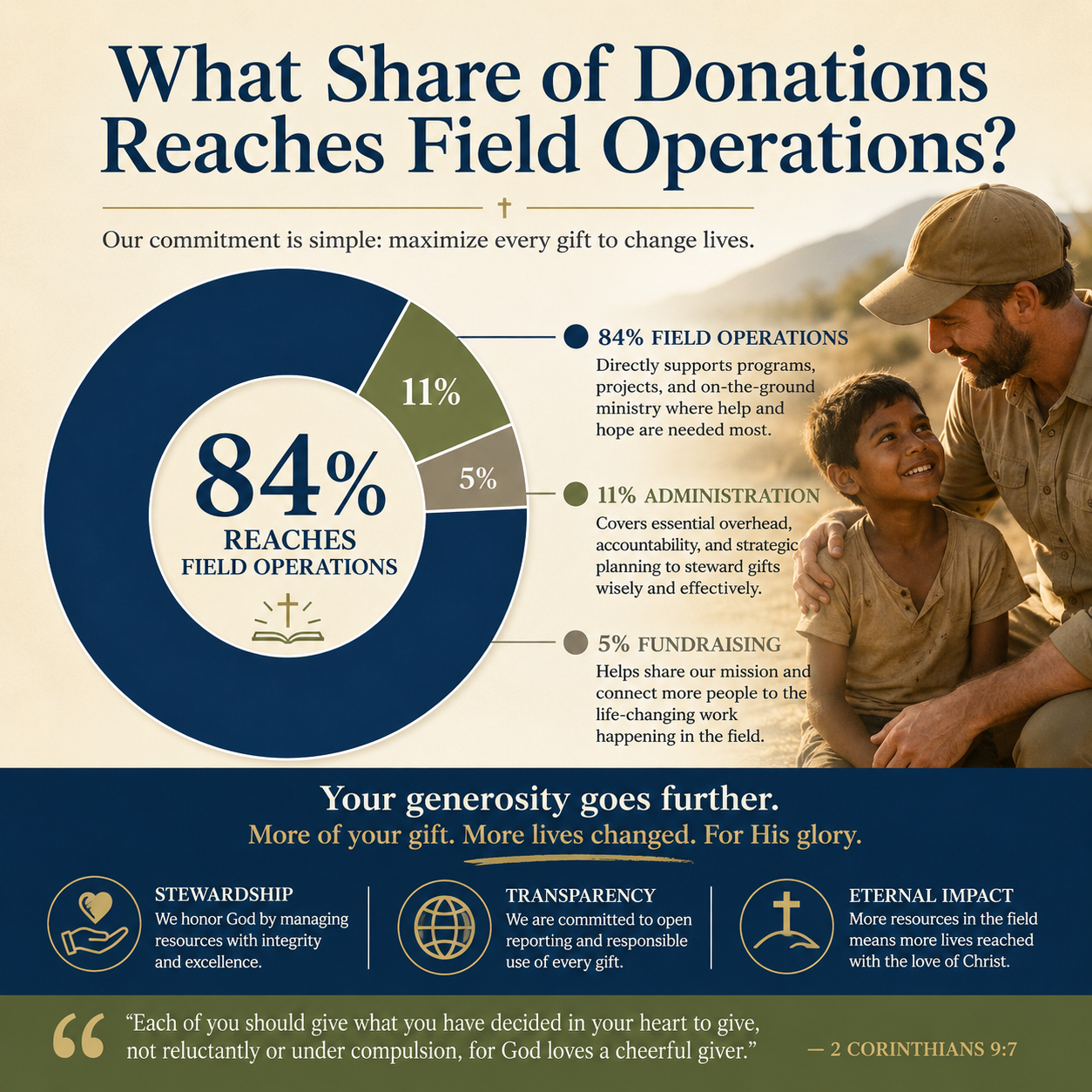
When Christian donors ask what share of donations reaches field operations, they are usually asking a stewardship question: will this gift materially serve vulnerable neighbors in Christ’s name, or will it be absorbed by fundraising, administration, and institutional self-preservation? The question is legitimate. It is also incomplete, because a ministry can spend heavily on “programs” and still do harm, and it can carry responsible overhead and still serve with uncommon effectiveness.
Across the Christian relief and development landscape, the best answer is not a single percentage. It is a disciplined, evidence-based view of what outcomes are being produced, what safeguards are in place, and whether spending patterns make sense for the work described. That is why Most Trusted evaluates ministries against The Most Trusted Standard, a 15-criteria framework that treats financial integrity as necessary, but not sufficient, for faithful impact.
Why the field operations percentage is a real question and a limited one
Stewardship is biblical, not suspicious
Scripture treats stewardship as a moral category, not an optional preference. Jesus commends faithfulness with entrusted resources (Matthew 25:14–30) and condemns religious performance that ignores justice and mercy (Matthew 23:23). Christian donors are right to ask whether a ministry’s spending aligns with its stated mission, and whether leaders handle the church’s gifts with the sobriety they deserve.
In practice, “field operations” often functions as shorthand for program services: food distributions, agricultural training, disaster response, medical care, Bible translation logistics, or community development work carried out in-country. Those costs matter because they are where relief and development are visibly delivered.
Program ratios can mislead in both directions
Christians genuinely disagree about how much weight to place on overhead ratios. Some donors treat a high program percentage as near-proof of integrity. Others have seen ministries that report strong ratios while underinvesting in child protection, fraud prevention, evaluation, or staff care—areas that rarely read as “program” but can determine whether the work is safe and durable.
Philanthropic research organizations have urged donors not to reduce nonprofit quality to overhead ratios alone. Charity Navigator, GuideStar (now Candid), and the BBB Wise Giving Alliance jointly argued that fixation on overhead can distort incentives and punish necessary capacity-building, a dynamic commonly summarized as the “overhead myth.” See their joint letter at Candid.
How ministries define field operations and why definitions matter
Field operations is not a standard accounting label
“Field operations” is not a required line item in U.S. nonprofit reporting. Most U.S.-based ministries report expenses on IRS Form 990 in broad categories: program services, management and general, and fundraising. The Form 990 instructions explain these functional categories and how nonprofits should allocate shared costs; see IRS. Donors comparing ministries need to know what is being grouped into “program” and whether allocations are reasonable.
For example, a ministry may allocate a large portion of communications costs to “program” if communications are directly tied to program delivery or education. Another may allocate most to fundraising. Both approaches can be legitimate or questionable depending on the underlying activity and documentation.
Relief, development, and discipleship often share infrastructure
Christian relief and development frequently integrates spiritual care with material assistance: trauma counseling that includes prayer, community health work delivered through local churches, or pastoral training paired with livelihoods programs. That integration complicates simplistic accounting expectations. It is also one reason donors should read narratives and notes, not only percentages.
For a broader view of the ministry types and operating realities involved, see Christian Relief and Development Ministries, where we frame common models of work and the accountability questions they raise.
What a responsible share reaching the field can look like
Healthy ranges depend on the model of work
A ministry that funds local partners may show different cost patterns than one that directly employs field staff and runs logistics. A disaster-response organization may carry standby capacity that looks like overhead until the moment a crisis hits. A development organization focused on multi-year community transformation may invest more in monitoring, evaluation, safeguarding, and training than a short-term distribution model.
Rather than aiming for a single “right” percentage, mature donors ask whether spending patterns are coherent with the ministry’s strategy and risks. If a ministry claims deep, long-term change but invests almost nothing in evaluation or field oversight, the ratio may be flattering while the substance is thin.
Capacity spending can be faithful spending
The Christian desire for simplicity—“send more to the field”—can unintentionally reward ministries that underinvest in governance, controls, and effectiveness. In contexts where fraud risk is real and supply chains are complex, weak internal controls can turn sacrificial gifts into leakage. In cross-cultural work, inadequate staff training can produce paternalism or dependency rather than neighbor-love.
The When Helping Hurts framework, articulated by Steve Corbett and Brian Fikkert, has reshaped how many Christian organizations understand the harms that can come from unexamined aid. It presses donors and ministries to prioritize dignity, local agency, and long-term flourishing rather than short-term emotional payoff; see When Helping Hurts.
How to evaluate the share reaching the field without being captive to a ratio
Start with audited financials and clear functional expenses
Most donors are not forensic accountants, but several checks are reasonable and accessible. The ministries that meet The Most Trusted Standard tend to make core documents easy to find and interpret: audited financial statements (when appropriate to size and complexity), a recent Form 990 (for U.S. nonprofits required to file), and a transparent explanation of how program dollars translate into services delivered.
Where audited financial statements exist, donors should confirm that an independent auditor issued an opinion and that any significant findings are addressed. Where an audit is not present, the ministry should offer proportionate financial transparency for its scale and risk profile.
Ask questions that connect money to outcomes and safeguards
A strong ministry can answer field-operations questions with specificity, not marketing. The point is not to interrogate, but to discern. The following prompts are often more revealing than asking for a single percentage:
- How does the ministry define “field operations” and “program services,” and what costs are included?
- What safeguards protect vulnerable beneficiaries, including children, from harm and exploitation?
- How does the ministry select, vet, and monitor local partners and vendors?
- What evidence shows that programs are effective for the intended population over time?
- How are conflicts of interest handled in procurement, governance, and hiring?
These questions belong within a broader understanding of how Christian ministries should use donations, including administrative and fundraising practices that honor both truthfulness and neighbor-love. For related guidance, see How Christian Relief and Development Ministries Use Donations.
Common red flags when ministries emphasize field operations percentages
Unverifiable claims and selective transparency
A ministry that publicly promises “nearly all donations go to the field” but does not publish a Form 990, audited statements, or a credible annual report is asking donors to substitute trust in brand for trust grounded in evidence. Selective transparency is not transparency. Donors should expect clear documentation, consistent reporting across years, and explanations that do not shift when questioned.
Similarly, watch for ministries that highlight a program ratio but remain vague about what was accomplished, who benefited, and how the ministry knows. Programs that cannot be described concretely are difficult to evaluate, and they often resist accountability.
Underinvestment in governance, safeguarding, and evaluation
Some of the most consequential expenses in Christian relief and development are not visible in photographs. Background checks, safeguarding training, case management protocols, third-party monitoring, cybersecurity for sensitive beneficiary data, and rigorous evaluation all cost money. Ministries that treat these as optional may present attractive ratios while exposing people to harm.
The harder question is whether the ministry’s financial choices match a theology of love that is patient, truthful, and protective of the vulnerable. In that sense, “what share reaches the field” is inseparable from “what kind of work is happening in the field, and is it worthy of the Name it bears.”
FAQs for What share of donations reaches field operations
Is there a biblical or recommended percentage that should go to field operations?
Scripture commands faithful stewardship and warns against dishonesty, but it does not set a numeric program percentage. We recommend treating field-operations share as one indicator among several: financial integrity, governance strength, transparency, and demonstrable effectiveness. A ministry with a slightly lower program ratio may still be the more faithful choice if it is safer, better governed, and more effective over time.
How can donors verify what actually reaches field operations?
Start with documents a ministry can stand behind: audited financial statements when appropriate, a current IRS Form 990 for U.S. filers, and an annual report that connects expenditures to specific activities and outcomes. Then look for consistency across years and clarity about definitions and allocations. In our verification work at Most Trusted, the ministries that merit confidence tend to welcome these questions and answer them with evidence rather than reassurance.
Giving with confidence requires more than a ratio
Christian donors should care about what share of donations reaches field operations, because love of neighbor should be practiced with integrity. But Christian donors should also care about whether the work is wise, safe, truthful, and effective, because the people served are not an abstraction and the gospel cannot be honored through careless methods. The most trustworthy ministries usually do not promise perfection; they offer transparency, accept scrutiny, and demonstrate that their spending serves durable, Christ-honoring outcomes.



