
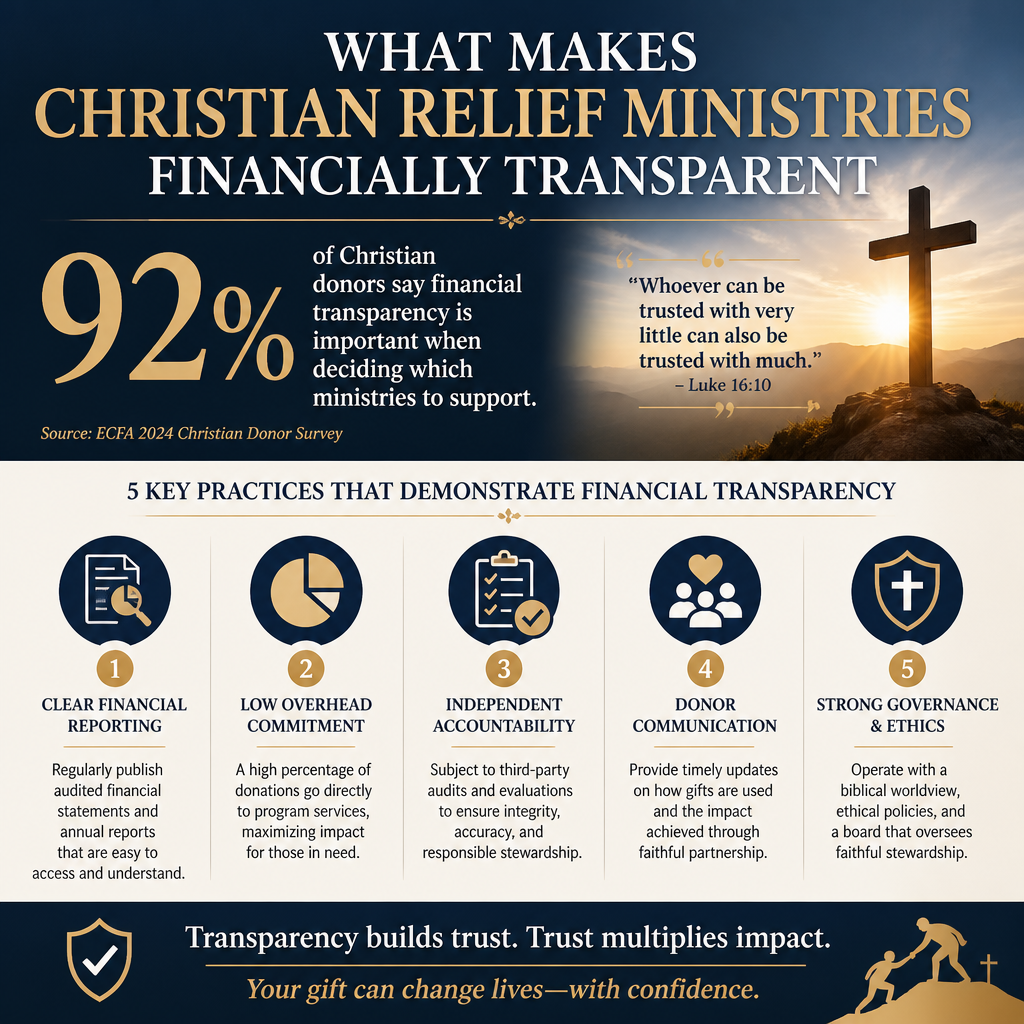
What makes Christian relief ministries financially transparent is not a marketing claim about “low overhead,” but a pattern of verifiable disclosures that allow donors to trace how funds are received, governed, spent, and evaluated. For Christian donors, the question is spiritual as well as financial: Scripture treats hiddenness around money as a warning sign, and honest administration as a form of discipleship (2 Corinthians 8:20–21). The ministries most worthy of confidence make it difficult to misunderstand what they do with the resources entrusted to them.
Financial transparency is also not a single document. A PDF audit can coexist with unclear restricted-gift practices, conflicted boards, or selective reporting on outcomes. In our verification work at Most Trusted, we see that transparency is strongest where ministries treat donors not as a revenue source to be managed, but as fellow stewards who deserve evidence. That evidence rarely arrives all at once; it comes through consistent habits that can be checked.
Transparency begins with clear, comparable financial statements
A relief ministry operating in unstable environments will always face complexity: currency volatility, emergency procurement, partner subgrants, and security constraints can make “simple” accounting impossible. What donors can still reasonably expect is that the ministry produces standard financial statements, explains its accounting choices, and makes those statements accessible without friction. Transparency starts where the numbers can be compared across years and reconciled to independent filings.
Audits and reviews matter, but scope matters
An independent audit is not a guarantee of integrity, but it is an important baseline because it requires an external firm to test controls and confirm that statements are fairly presented. Larger U.S.-based nonprofits are also required to file IRS Form 990, which gives donors a consistent window into governance, key compensation, and program versus administrative spending. Donors can read that form directly through the IRS’s nonprofit search tools at IRS.
We also watch for what is omitted. Some ministries publish an audit but not the accompanying financial statements; others publish statements but do not disclose whether the auditor issued an unmodified opinion. A transparent ministry anticipates these questions and reduces interpretive gaps rather than widening them.
Explanations should match the realities of relief work
Relief accounting often includes pass-through funds to local partners, in-kind donations, government grants, and restricted gifts. A ministry that is financially transparent will name these categories plainly and explain the mechanics: what is counted as program expense, how partner vetting and monitoring costs are categorized, and how the organization manages foreign exchange and fraud risk. Donors do not need every internal detail, but they should not be forced to guess what a large line item represents.

Restricted gifts and designations are handled with disciplined honesty
Christians give to relief ministries with concrete intentions: a widow in a church might give “for clean water,” a business owner might underwrite a specific disaster response, a family might sponsor an agricultural program. Financial transparency is tested when donor intent meets operational reality. Emergencies change. Ports close. Local partners lose access. Programs evolve. The question is whether the ministry treats restrictions as binding stewardship or as flexible branding.
Policies on restricted giving are written and visible
Transparent ministries publish clear policies on how they handle restricted gifts, including what happens if a project becomes impossible or is fully funded. Donors should be able to find an explanation of whether gifts are legally restricted, internally designated, or treated as general support, and how the ministry communicates changes. Mature organizations also disclose how often they redirect funds and the governance process for doing so.
This is not merely legal compliance. The apostolic pattern is “to avoid any criticism of the way we administer this liberal gift” (2 Corinthians 8:20–21). That standard is not suspicion of donors; it is reverence for God and respect for the church.
Appeals and project claims are constrained by reality
Relief fundraising can drift into emotionally compelling but operationally misleading promises. Some ministries imply that a designated gift will be used only for a named activity in a named location, even when the organization’s own systems cannot track spending at that level. Financial transparency requires restraint: ministries should describe giving opportunities in ways their accounting can actually substantiate, and they should avoid implying a one-to-one relationship between a donor’s gift and a specific outcome when funds are pooled.
When donors want a wider view of how ministries think about giving practices across the sector, we keep this discussion connected to How Christian Relief and Development Ministries Use Donations, where the central questions are not only what percentage goes where, but whether the use aligns with truthfulness and impact.
Governance disclosures show who has authority and who benefits
Relief work attracts strong leaders. It also attracts risk: charismatic authority, founder influence, and the pressure of crisis environments can weaken oversight. Financial transparency is not only about expenditures; it is also about whether the ministry discloses who governs it, how decisions are made, and how conflicts are prevented.
Board independence and conflicts of interest are disclosed
A transparent relief ministry makes it easy to identify its board members, their roles, and whether the board includes independent members who can provide real oversight. It also publishes a conflict-of-interest policy and demonstrates its enforcement through disclosure practices. On Form 990, donors can see whether the organization reports adopting and monitoring such policies and whether transactions with interested persons exist; the form is imperfect, but it is a meaningful artifact when read carefully.
Executive compensation is presented without defensiveness
Christians genuinely disagree about what constitutes appropriate executive pay in ministry. Some argue that “market” comparisons are necessary for competence; others warn that the church should be a counterculture in how it treats money. A transparent organization does not hide behind either slogan. It discloses compensation in the ways required by law, explains its process for setting pay, and shows that its board—not the executive—controls the decision.
We also encourage donors to resist simplistic judgments based on one figure. Compensation can signal self-dealing, but it can also reflect the demands of governing a complex, international operation. Transparency does not resolve every moral question; it creates the conditions for an honest one.
Program reporting connects spending to results without overstating certainty
Relief ministries often feel a tension donors should name directly: the pressure to demonstrate “impact” can push organizations toward oversimplified metrics, while the realities of fragile states and long-term development make causality difficult to prove. Financial transparency matures when a ministry connects spending to outputs and outcomes in a way that is both measurable and modest about limits.
Outcome claims are accountable to methods
Transparent ministries define what they measure, how they measure it, and what they cannot measure. If a ministry claims that a water program reduced disease, donors should be able to see whether that claim comes from baseline and endline surveys, clinic data, third-party evaluation, or a more limited proxy such as “people served.” The best organizations also report what did not work and what they changed as a result.
In development practice, the debate over what counts as “success” is real. The When Helping Hurts framework, articulated by Steve Corbett and Brian Fikkert, reshaped many Christian organizations by arguing that well-intentioned aid can undermine dignity and local capacity when it is not carefully designed When Helping Hurts. Financial transparency is stronger when a ministry can show that its spending decisions are informed by this kind of hard-earned wisdom rather than by donor preference alone.
The overhead debate is treated with maturity
Some donors still look for a single “overhead ratio” as a proxy for faithfulness. The sector has increasingly pushed back, because an extremely low administrative ratio can indicate underinvestment in controls, monitoring, staff training, and safeguarding. The Overhead Myth statement from Charity Navigator, GuideStar, and the Better Business Bureau warns donors not to use overhead alone as a measure of charity performance Charity Navigator.
What this means in practice is that transparent relief ministries disclose their administrative and fundraising costs and then explain what those costs actually purchase: audit quality, field security, partner due diligence, fraud prevention, program evaluation, and safeguarding. Donors deserve to know when a ministry is investing in the unglamorous work that keeps people safe and funds protected.
Practical markers donors can verify quickly
Many donors do not have time to read an audit line by line. Financial transparency should still be legible. Across our evaluation work using The Most Trusted Standard, ministries that practice real transparency tend to make verification easy rather than burdensome.
What to look for on a ministry website
- Recent audited financial statements or, where appropriate, an independent financial review, posted without requiring an email submission.
- Access to IRS Form 990 for U.S. organizations, or the closest national equivalent for organizations headquartered elsewhere.
- A clear statement on restricted gifts and what happens when needs change.
- Board and leadership listings, including governance policies such as conflicts of interest.
- Program reports that connect expenditures to outputs and outcomes, including candid limits.
How Most Trusted frames transparency in Christian terms
Most Trusted exists because donors are right to want more than sentiment. We evaluate Christian nonprofits against The Most Trusted Standard, a 15-criteria framework that includes financial integrity, governance, and evidence-based transparency. Our posture is not suspicion; it is stewardship. The Christian donor is not merely funding activity but participating in witness, and witness is damaged when money is handled in ways that cannot endure light.
For donors seeking a broader lens on organizations working in this space, Christian Relief and Development Ministries is where we keep the core distinctions in view: emergency relief versus long-term development, direct implementation versus partner models, and the different transparency risks each model carries.
FAQs for What makes Christian relief ministries financially transparent
Is an audited financial statement enough to prove a relief ministry is trustworthy?
An audit is a meaningful baseline because it tests whether financial statements are fairly presented and whether controls exist, but it is not sufficient by itself. Donors should also look for disciplined handling of restricted gifts, clear governance disclosures, accessible Form 990 reporting where applicable, and program reporting that connects spending to results without exaggeration.
Should Christian donors avoid ministries with higher overhead percentages?
Not automatically. Overhead can include necessary investments in fraud prevention, partner monitoring, safeguarding, and evaluation—especially in high-risk environments. Donors should examine whether the ministry explains its administrative and fundraising costs plainly and whether those costs correspond to accountable practices, rather than treating a single ratio as a moral verdict.
Financial transparency is a ministry of truth
Christian relief ministries operate where suffering is immediate and the needs are morally urgent. That urgency does not lessen the obligation to administer gifts in ways that withstand scrutiny; it heightens it. The ministries most worthy of donor confidence do not ask the church to trust them blindly. They provide durable evidence that their finances, governance, and reporting are ordered toward truth, neighbor-love, and faithful stewardship before God.



