
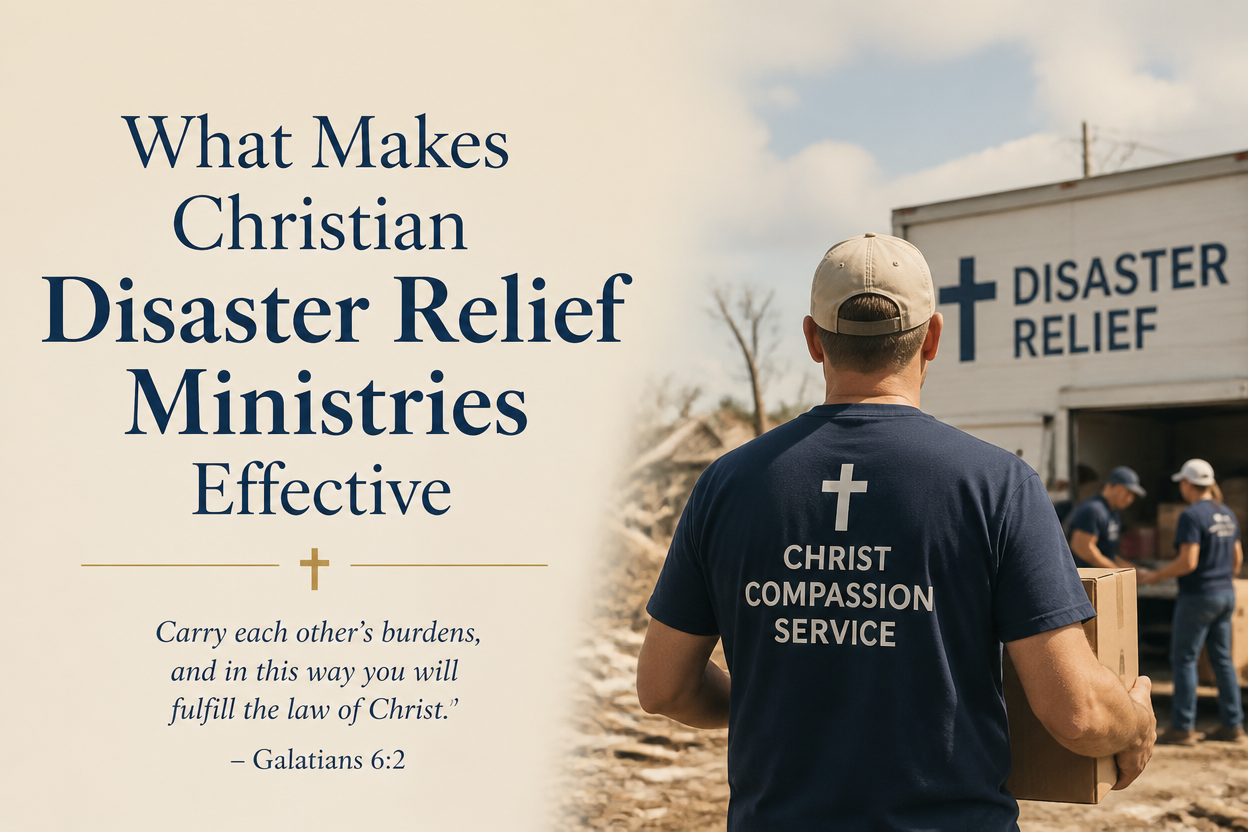
What makes Christian disaster relief ministries effective is not first their speed, visibility, or emotional resonance. It is whether, under pressure, they deliver competent help that protects the vulnerable, strengthens local institutions, and honors Christ in both means and ends. Donors feel the weight of these moments because disaster giving is often urgent, public, and spiritually charged; it is also a setting where good intentions can unintentionally intensify harm.
Scripture frames this with clarity. The Good Samaritan’s mercy was practical, funded, and accountable: he bound wounds, transported the injured man, and arranged follow-up care (Luke 10:33–35). Mercy that stops at sentiment is not the biblical model. At the same time, the field has had to reckon with hard realities: supply dumps can undermine local markets, inexperienced volunteer surges can drain responders, and a ministry’s “bold faith” does not substitute for safeguarding, financial discipline, or professional logistics.
Effectiveness begins before the storm with readiness and humility
Pre-positioned capacity matters more than a fundraising spike
Disasters compress time. Ministries that perform well typically invest long before a crisis: trained staff, vetted partners, supply chains, memoranda of understanding, and pre-defined decision rights. In practice, that readiness is unglamorous—warehouse contracts, procurement policies, and contingency plans—but it is what allows a ministry to serve without improvising on the backs of traumatized communities.
Public giving patterns reinforce why this matters. Americans’ charitable giving tends to rise in response to high-profile events, which can create strong incentives for rapid, highly visible distributions even when they are not the most responsible intervention. In 2023, total charitable giving in the United States was an estimated $557.16 billion, reflecting the scale of funds that can mobilize in moments of heightened attention Giving USA. Effective ministries resist the pressure to spend for optics and instead align resources with assessed needs and local capacity.
Humility shows up as coordinated action, not independent branding
Coordination is not merely bureaucratic courtesy; it is a form of neighbor-love that reduces duplication and closes gaps. When relief agencies operate in isolation, the result is often too much of one thing and too little of another—bottled water in one location, no fuel or tarps in another. Effective ministries participate in local and national coordination mechanisms, listen to civil authorities, and treat local churches and community organizations as essential counterparts rather than distribution channels.

Good relief protects people through safeguards and principled triage
Safeguarding is a relief competency, not a compliance add-on
Disaster environments increase vulnerability: displacement, disrupted schooling, family separation, and economic desperation raise the risk of exploitation. Ministries that are effective treat safeguarding as part of relief quality—clear child protection protocols, background checks appropriate to the setting, incident reporting, and survivor-centered responses. Donors should not accept “we are a Christian organization” as a substitute for verifiable safeguards.
Christ’s warning about causing “one of these little ones” to stumble is not rhetorical (Matthew 18:6). In relief contexts, that translates into refusing shortcuts that place children, women, and marginalized people at greater risk. The more chaotic the environment, the more the ministry must lean on pre-established policies and trained leadership rather than ad hoc judgment.
Triage requires moral clarity and transparent criteria
Every crisis forces hard choices: which neighborhoods first, which needs now, which needs later, and which needs belong to other actors. Effective ministries make these decisions with explicit criteria—severity, access, vulnerability, and feasibility—then communicate them honestly. Triage is not favoritism when it is principled; it is stewardship under constraint.
Christians genuinely disagree at times about whether evangelism should be integrated with aid in acute disaster response. Responsible ministries do not weaponize vulnerability, and they do not hide their Christian identity. They communicate clearly: aid is not conditioned on participation, and spiritual care is offered with dignity, consent, and appropriate timing.
Relief that helps rather than harms follows a development logic
Early relief should not create long-term dependency
Immediate distributions are often necessary. Yet the field has learned that repeated “free goods” distributions—especially when local markets are functioning—can suppress local commerce and hinder recovery. The When Helping Hurts framework, articulated by Steve Corbett and Brian Fikkert, has helped many Christian ministries examine how paternalism, dependency, and the savior posture can quietly shape even generous programs When Helping Hurts.
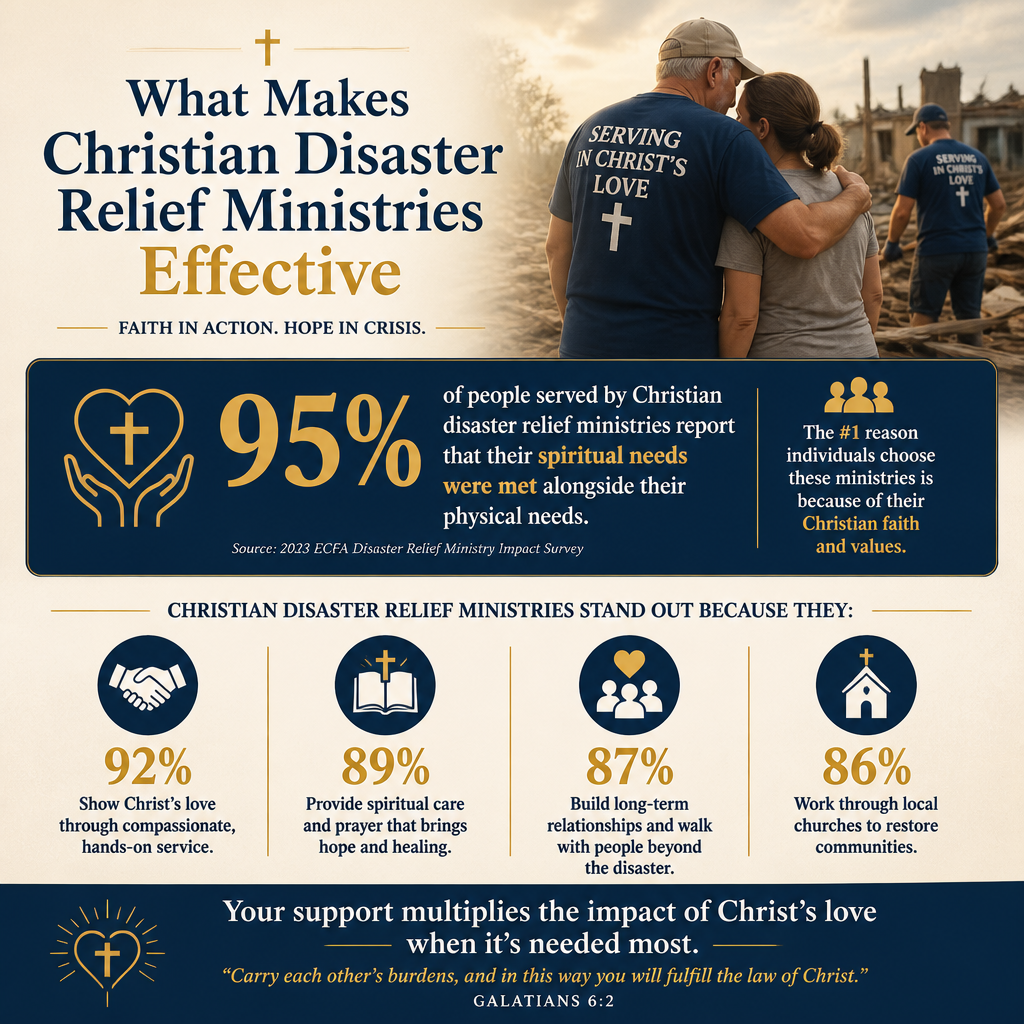
Effective ministries pivot from relief to recovery with discipline: cash or vouchers when appropriate, support to restore livelihoods, and reconstruction models that include community voice and accountability. This is not less compassionate; it is a more durable compassion that treats people as agents, not projects.
Local church partnership is strongest when it is mutually accountable
Christian donors often prioritize church-based distribution because the local church remains when cameras leave. That instinct is frequently sound. But effectiveness depends on how partnership is structured. Healthy models include shared planning, clear financial controls, mutual reporting, and realistic expectations about what a local congregation can safely manage in crisis.
What this means in practice is that donors should ask not only, “Does this ministry work with churches?” but also, “How does it ensure churches are resourced, protected, and not pressured into roles they cannot sustain?” When ministries treat local pastors as merely a logistics network, they can unintentionally burden spiritual leaders already carrying trauma in their own families.
Measurable outcomes and financial integrity belong together
Donors should resist simplistic overhead assumptions
Relief work has real administrative costs: warehousing, audits, insurance, staff training, and monitoring. The sector has long warned donors against equating low overhead with high impact. Charity Navigator, Candid, and the Better Business Bureau Wise Giving Alliance jointly addressed this as the “Overhead Myth,” arguing that administrative spending can be essential for strong performance and accountability Charity Navigator.
The harder question is not “How low are overhead costs?” but “Are costs appropriate to the work, and are they governed well?” A ministry moving large volumes of goods without strong controls is not efficient; it is exposed. In disaster settings, weak controls invite diversion, fraud, and reputational damage that erodes trust in Christian witness.
Evidence should be commensurate with claims
Effective ministries make specific claims and are willing to be examined. If a ministry says it provided “safe shelter,” donors should be able to see standards for shelter quality and protection. If it says it “helped families recover,” donors should be able to see the definition of recovery—restored housing, income stabilization, school re-enrollment, or documented access to essential services.
Across our verification work at Most Trusted, we observe that ministries with strong reporting habits tend to avoid inflated numbers. They distinguish between outputs (meals served, kits distributed) and outcomes (reduced malnutrition risk, restored water access, families returned to stable housing). They also name what did not go as planned, because honesty is part of credibility.
Governance and transparency determine whether urgency stays accountable
Boards and executives must be built for crisis decisions
Disaster response concentrates authority. Procurement decisions get made quickly, partners are selected under uncertainty, and public communications can move faster than internal review. Effective ministries have governance that can handle this: delegated authority with documented limits, conflict-of-interest policies that are enforced, and board-level oversight that does not disappear when operations intensify.
Donors sometimes assume that a compelling founder or a strong spiritual brand is enough to carry an organization through crisis. But Scripture commends structures that support integrity: “provid[ing] for honest things, not only in the sight of the Lord, but also in the sight of men” (2 Corinthians 8:21). In relief, that includes audited financials, prudent reserves, and transparency around restricted gifts.
Donor clarity requires a framework, not a feeling
Disaster giving is vulnerable to manipulation precisely because compassion is a virtue. Mature donors respond by using a consistent due diligence lens. The Most Trusted Standard is designed for this purpose: a 15-criteria framework spanning faith foundation, financial integrity, governance and leadership, and transparency and effectiveness. It is not a substitute for prayerful discernment; it is a tool to ensure generosity is paired with prudence.
When considering a ministry’s role in crisis response, donors can ask a short set of questions that often reveals the difference between competence and marketing:
- Can the ministry explain its coordination with local authorities and credible relief networks?
- Does it have clear safeguarding policies appropriate to disaster environments?
- Are financial statements, audits, and restricted-fund practices readily available and comprehensible?
- Does it define success beyond distribution counts, with evidence proportionate to its claims?
- Is there a credible plan for transition from relief to recovery that strengthens local capacity?
Many donors also want a wider view of how relief fits within Christian humanitarian work over time. Our broader coverage of Christian Relief and Development Ministries places disaster response within the longer arc of recovery, resilience, and community renewal.
FAQs for What makes Christian disaster relief ministries effective
Should Christian disaster relief focus on evangelism or humanitarian aid first?
Effective Christian disaster relief does not treat humanitarian aid and Christian witness as competitors, but it does order them wisely. In acute response, ethical practice requires that aid is never conditioned on participation in religious activity and that spiritual care is offered with consent and appropriate timing. Ministries that serve well are clear about their identity, avoid coercion, and demonstrate the gospel through competent, dignifying care while creating appropriate space for pastoral ministry in the recovery phase.
What should donors look for when choosing a disaster relief ministry?
Donors should look for verifiable readiness, safeguarding, coordination, financial integrity, and transparent reporting. Practically, that includes audited financials, clear restricted-gift practices, defined program standards, and evidence that the ministry works through accountable partnerships rather than isolated branding. Our analysis across How Christian Disaster Relief Ministries Respond reflects a consistent pattern: the strongest ministries are those that can explain not only what they did, but why they did it, how they protected people, and what changed because of it.
Giving that honors urgency without surrendering stewardship
Christian disaster relief ministries are most effective when compassion is joined to competence, and urgency is joined to accountability. The Good Samaritan did not merely feel pity; he acted with cost, care, and follow-through. Donors can honor that model by supporting ministries that are prepared before the storm, protective of the vulnerable during the storm, and committed to rebuilding after the storm with integrity that withstands scrutiny.



