
Why Christian relief and development ministries focus on livelihoods is ultimately a question about what kind of change Christian donors are asking their giving to pursue. Emergency relief saves lives. Livelihoods protect lives after the crisis has passed by strengthening families, local economies, and the daily capacity to provide. The shift is not away from compassion; it is toward a more complete form of neighbor love that takes time seriously.
Scripture’s concern is not limited to a moment of rescue. The law’s provisions for gleaning were not an abstract ideal; they were an economic mechanism that preserved dignity and sustained the poor through work in community (Leviticus 19:9–10). The church’s call to do good “especially to those who are of the household of faith” (Galatians 6:10) does not narrow mercy; it clarifies responsibility and durability. Livelihood programs sit at that intersection: mercy that continues when the donor’s attention moves on.
Relief meets immediate suffering but livelihoods address the next season
Christian compassion cannot stop at the moment of stabilization
When families lose crops, jobs, or safe housing, the first moral obligation is to keep people alive. Food distributions, emergency medical care, temporary shelter, and clean water interventions are not optional acts of Christian mercy; they are basic obedience to the command to love our neighbor. Most mature ministries begin here when a community is in acute distress.
What this means in practice is that relief is often necessary but rarely sufficient. Crises expose underlying fragility: limited assets, unstable labor markets, lack of access to credit, and political vulnerability. If those conditions remain unchanged, the same households will return to crisis again, and donors will fund the same emergency repeatedly. Livelihoods work aims at the “after” of relief: income, savings, market access, and resilience.
The field has learned that giving can either strengthen or replace local capacity
Christians genuinely disagree about how strongly to emphasize self-sufficiency language in the context of poverty, and the caution is warranted. The biblical vision is not rugged individualism. It is mutual responsibility in a covenant community, where those with means bear burdens and those without means are not despised. Yet the development field has also had to reckon with the unintended consequences of prolonged relief: dependency, distortion of local markets, and the weakening of local initiative.
The When Helping Hurts framework, articulated by Steve Corbett and Brian Fikkert, has reshaped how many Christian ministries think about the difference between relief, rehabilitation, and development. Their central warning is not that relief is wrong, but that applying relief tools to non-relief problems can damage people and communities by communicating that outsiders are the primary agents of change. That critique is now widely debated and refined, but it remains a necessary guardrail for donors who want their gifts to heal rather than harm.

Livelihoods align with the biblical insistence on dignity, work, and community
Work is not a punishment but a sphere of stewardship
Before sin enters the world, human work is presented as a calling: to cultivate, keep, and name (Genesis 2:15). After the fall, work becomes difficult and often exploited, but it does not become meaningless. Christian relief and development ministries that focus on livelihoods are not baptizing a secular productivity ethic. They are acknowledging that the ability to provide for one’s family is a form of dignity, and that poverty is often experienced as humiliation as much as it is experienced as scarcity.
Paul’s instruction that “if anyone is not willing to work, let him not eat” (2 Thessalonians 3:10) has been misused to shame the poor. In its context, it confronts idleness and disorder within a community that had resources and responsibilities. It does not erase the many biblical commands to protect those who cannot work, who are exploited in work, or who are excluded from work. Done well, livelihood work is not moralizing. It removes barriers and expands participation.
Scripture’s economic imagination includes both generosity and enabling productivity
The gleaning laws are a useful example for donors because they combine private sacrifice with a durable mechanism. Landowners gave up profit, but the poor gathered with agency. The result was not charity as spectacle; it was provision through a social order. Many livelihood programs aim for a modern equivalent: restoring access to inputs, tools, land tenure clarity, vocational skill, or market linkage so that families can earn ongoing income rather than receiving indefinite transfers.
In our verification work at Most Trusted, we often see that the ministries that meet The Most Trusted Standard can describe this theological rationale without romanticizing poverty. They acknowledge that markets can exploit, that corruption can block progress, and that trauma changes what “opportunity” means for a household. But they still pursue a vision in which families are not permanently positioned as recipients while outsiders remain permanent providers.
Livelihood programs are measurable in ways that help donors steward wisely
Effective livelihood work does not hide behind inspiring stories
Christian donors rightly want fruit that can be examined. Livelihood work lends itself to outcome tracking: income stability, school attendance, household savings, food security, business survival, and reduced reliance on negative coping strategies such as selling productive assets. The existence of measurable outcomes does not guarantee integrity, but it creates the possibility of accountability that pure narrative appeals cannot provide.
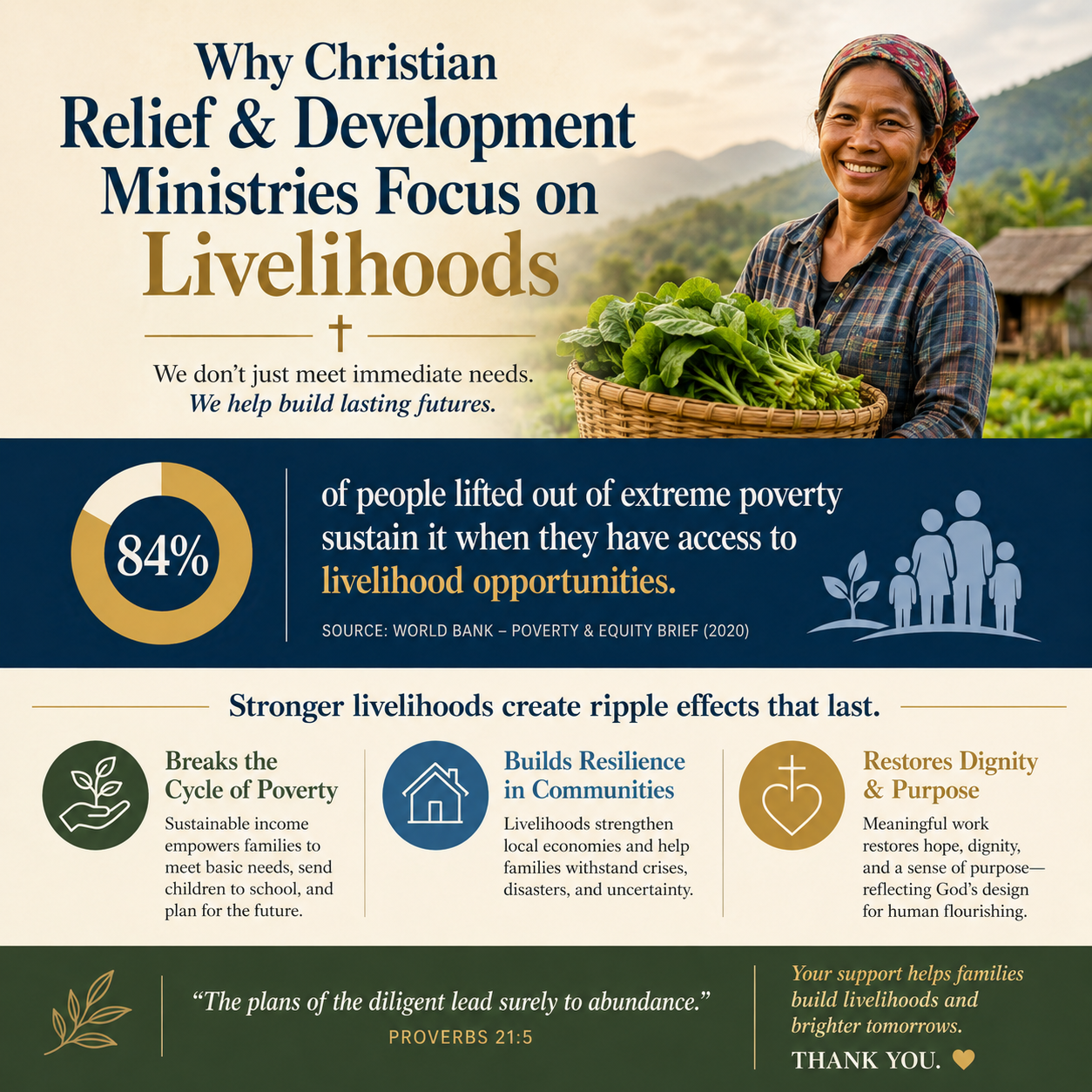
The harder question is how ministries measure without reducing people to metrics. Sophisticated ministries track indicators that reflect household well-being and resilience, not simply program throughput. They also name what they cannot claim. If a ministry provides training but cannot reliably verify sustained income gains, it should not market its program as “lifting families out of poverty.” Responsible claims protect donors from exaggerated impact language and protect beneficiaries from being used as proof points.
Donors should expect both evidence and humility about attribution
Livelihood change is influenced by factors no ministry controls: rainfall, commodity prices, conflict, inflation, local governance, and household health. Strong evaluation distinguishes between outputs (what was delivered), outcomes (what changed), and attribution (how confidently the program caused the change). The best ministries adopt a disciplined approach to learning and iteration rather than locking into a single model.
Donors can also recognize the broader credibility shift in the sector around reporting. The joint “Overhead Myth” letter argued that administrative ratios are a poor proxy for effectiveness and called donors to focus on results, governance, and transparency rather than simplistic overhead shaming Charity Navigator. Livelihood ministries are often positioned to respond to that call because their interventions, by nature, demand longitudinal thinking and clearer outcome definitions.
- Clear theory of change that explains how activities plausibly lead to household resilience
- Outcome indicators tracked over time, not only at program completion
- Safeguards against harm, including child protection and debt risk controls
- Local partnership that shares authority rather than importing all decisions
- Transparent reporting that includes setbacks as well as progress
Livelihoods are also where common development failures become morally costly
The risks include harm, not merely inefficiency
Livelihood interventions can fail in ways that are not neutral. Microcredit can over-indebt households if repayment is prioritized over welfare. Cash-for-work can unintentionally exclude the disabled or caregivers. Agricultural input programs can leave farmers exposed to price swings. Women’s economic programming can trigger backlash in households if it ignores local power dynamics. Christian donors should not assume that a livelihood label guarantees a humane outcome.
There is also the question of theological framing. If a ministry implies that poverty is primarily a function of poor choices, it will design programs that shame rather than serve. If it implies that poverty is only structural, it may underinvest in personal agency and household-level strategy. Scripture refuses both reductions. It names sin in hearts and sin in systems, and it calls the church to patient, costly action in response.
Short-term wins are easier to market than long-term resilience
Many donors are familiar with the simplicity of “meals served” or “wells drilled.” Livelihood work often yields slower, less photogenic progress: improved savings behavior, diversified income sources, strengthened producer groups, better access to local markets, and reduced vulnerability to shocks. Ministries face fundraising pressure to translate that into a compelling narrative without overselling certainty.
This is one reason we advise donors to look for ministries that can explain trade-offs candidly. Programs that are honest about what takes time and what is contested are often more trustworthy than programs that promise transformation on a predictable schedule. For readers considering the broader landscape of How Christian Development Ministries Create Long-Term Change, livelihood work is one of the most revealing areas to examine because it requires both theological clarity and operational discipline.
What donors should examine when a ministry says it focuses on livelihoods
Integrity questions are not cynical questions
Christian donors are stewards. Asking how a ministry chooses participants, sets goals, and reports outcomes is not suspicion; it is responsibility. When livelihood programs involve grants, loans, or assets, the risk of mismanagement rises. When they involve training, the risk of inflated claims rises. When they involve business development, the risk of importing inappropriate models rises. These are not reasons to avoid livelihood work; they are reasons to verify it.
Most Trusted exists to help donors give with confidence by evaluating ministries against The Most Trusted Standard, a 15-criteria framework across Faith Foundation, Financial Integrity, Governance and Leadership, and Transparency and Effectiveness. Livelihood programs touch all of these. A ministry’s theology shapes its view of dignity and dependence. Its financial controls shape whether assets are stewarded without diversion. Its governance shapes whether accountability exists when programs drift. Its transparency shapes whether donors can distinguish aspiration from evidence.
Markers of maturity donors can reasonably expect
Across our verification work, several patterns tend to separate mature livelihood ministries from those still developing basic safeguards. First, mature ministries can describe their local decision-making: who sets priorities, who holds power, and how grievances are handled. Second, they have a defined approach to sustainability that does not rely on vague language about “empowerment.” Third, they can show how discipleship, church partnership, or spiritual care is integrated without coercion or manipulation.
Donors who want a wider view of how this fits within the broader ecosystem of Christian Relief and Development Ministries should also pay attention to sequencing. The strongest organizations do not treat livelihoods as a fashionable add-on. They connect relief, rehabilitation, and longer-term economic strengthening in a coherent strategy that fits the context, the risks, and the local church’s presence.
FAQs for Why Christian relief and development ministries focus on livelihoods
Does focusing on livelihoods mean a ministry is reducing direct aid?
Not necessarily. Many ministries maintain strong relief capacity while adding livelihood work to reduce repeat crises. A credible organization can explain when it uses relief, when it shifts to rehabilitation, and how it avoids applying emergency tools to chronic poverty. Donors should expect that explanation, especially in contexts with recurring shocks such as drought or displacement.
How can donors evaluate livelihood impact without being misled by big claims?
We recommend looking for a clear theory of change, outcome measures tracked over time, and transparent reporting that includes limitations. Strong ministries distinguish outputs from outcomes and avoid claiming they “lifted families out of poverty” without credible evidence. Verification also matters: governance, financial controls, and truthful communications are as important as the program model itself.
Why livelihoods remain a central test of long-term Christian witness
Christian relief will always be necessary in a world marked by disaster, conflict, and injustice. But the church’s calling is not only to keep people alive today; it is to seek the good of communities over time, honoring dignity and strengthening households so they can endure. Livelihood-focused ministry is one of the clearest places where compassion, stewardship, and truth-telling must hold together, and where donors can insist on both mercy and rigor.



