
How Christian development ministries fight poverty long-term is ultimately a question about what kind of change we believe the gospel produces in human communities. Donors are right to ask for outcomes that last beyond a shipment, a season, or a crisis appeal, because Scripture does not treat mercy as a momentary gesture but as a sustained love of neighbor ordered toward justice, dignity, and restored relationship.
Long-term poverty reduction is also morally complex. It touches broken systems, local agency, spiritual formation, and the realities of trauma and conflict. Mature Christian development has learned that speed can be the enemy of depth, and that measurable good can still be misdirected if it crowds out local responsibility or creates dependency.
Long-term change begins with a Christian account of the human person
Poverty is more than a lack of money
Many ministries now frame poverty as a web of material, relational, and spiritual factors rather than a single deficit. This is not a rhetorical move; it is a theological one. Scripture describes human flourishing as covenantal and communal—right relationship with God and neighbor—so long-term interventions must attend to more than income.
The When Helping Hurts framework, articulated by Steve Corbett and Brian Fikkert, helped a generation of Christian practitioners name this clearly: poverty is often “the result of relationships that do not work, that are not just, that are not for life, that are not harmonious or enjoyable.” The implications are demanding. A project can raise short-term consumption while weakening agency, trust, and local problem-solving.
Effective development protects dignity and agency
Christian donors often feel a tension between urgency and restraint. The New Testament does not permit indifference to suffering, yet it also assumes the importance of work, shared responsibility, and mutuality within the body (Ephesians 4; 2 Thessalonians 3). Many development ministries aim for “with” rather than “to” or “for,” because the goal is not merely transfer but restoration of agency.
What this means in practice is that credible long-term work tends to be slower, more locally led, and less photogenic than emergency relief. It also tends to require patient capital: multi-year commitments that allow communities to set priorities, adapt programs, and learn from failure without being whiplashed by annual fundraising cycles.

From relief to development requires disciplined transitions
Relief is essential, but it is not a permanent mode
Relief is indispensable in acute crises—war, displacement, famine, natural disaster. But when relief continues after the immediate emergency has passed, it can begin to displace local markets and undermine community initiative. The field has had to reckon with this repeatedly, and responsible ministries now treat the transition from relief to development as a core design question, not an afterthought.
Christians genuinely disagree about where that line sits in particular contexts, because suffering is rarely cleanly categorized. Still, the long-term objective is clear: move from providing goods to strengthening the capacity of households, churches, and local institutions to provide for themselves and their neighbors.
Cash and local markets have changed the conversation
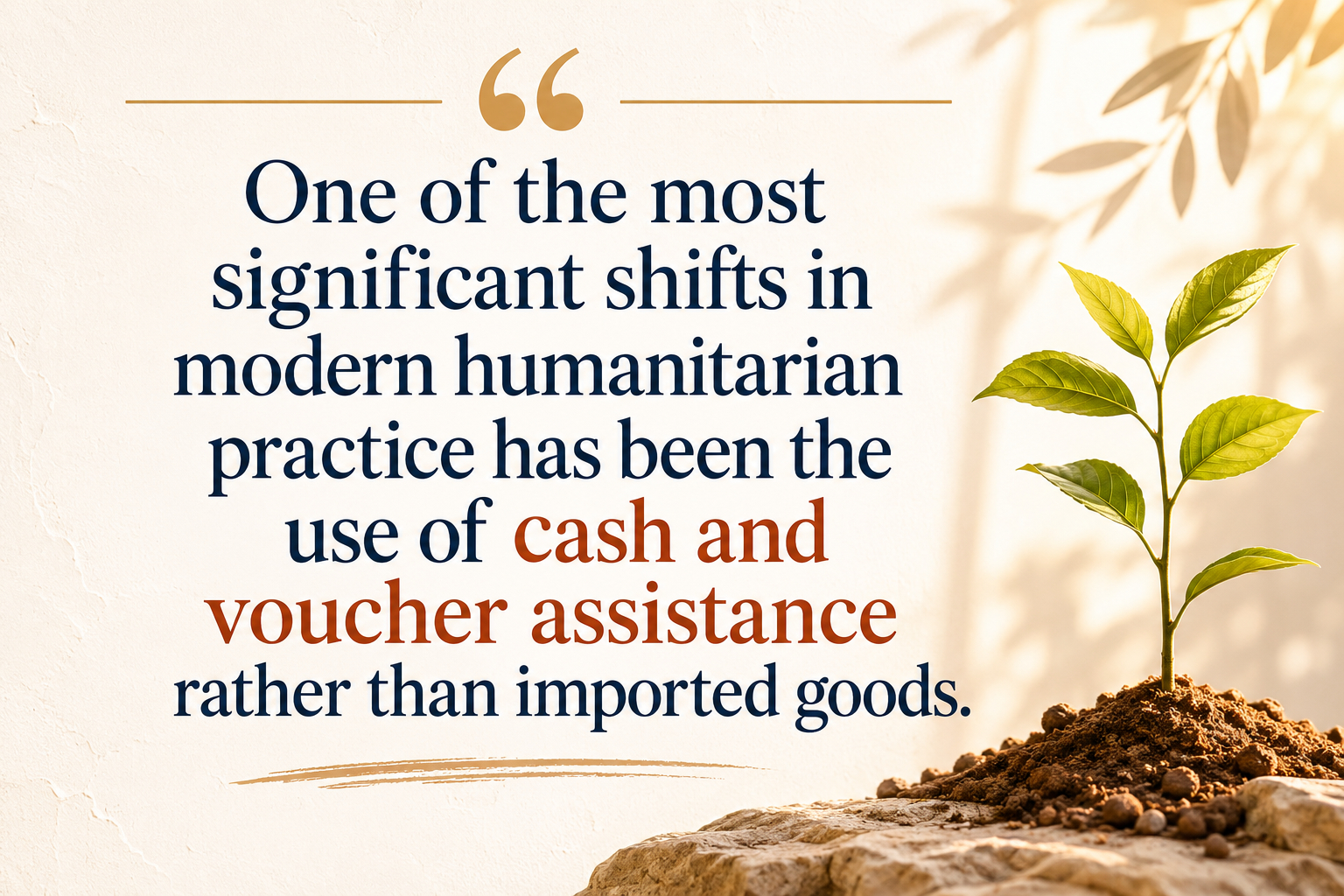
One of the most significant shifts in modern humanitarian practice has been the use of cash and voucher assistance rather than imported goods. The evidence base is substantial. A 2016 review commissioned by the UK Department for International Development found that cash transfers are often more cost-efficient than in-kind aid and can improve a range of outcomes when well designed UK Foreign, Commonwealth and Development Office.
This is not a claim that “cash always works.” In conflict settings, markets may not function, security risks may be high, and household dynamics can be complex. But the broader principle matters for donors: long-term poverty work increasingly aims to strengthen local economies rather than bypass them.
Evidence of durable impact tends to look unglamorous
Household resilience is a more honest outcome than a single metric
Donors frequently ask for a single number that proves long-term impact. Sometimes that is appropriate, but poverty is rarely reduced by one intervention. More credible reporting often shows a pattern: improved food security, diversified income, increased savings, better health access, safer housing, and strengthened community institutions.
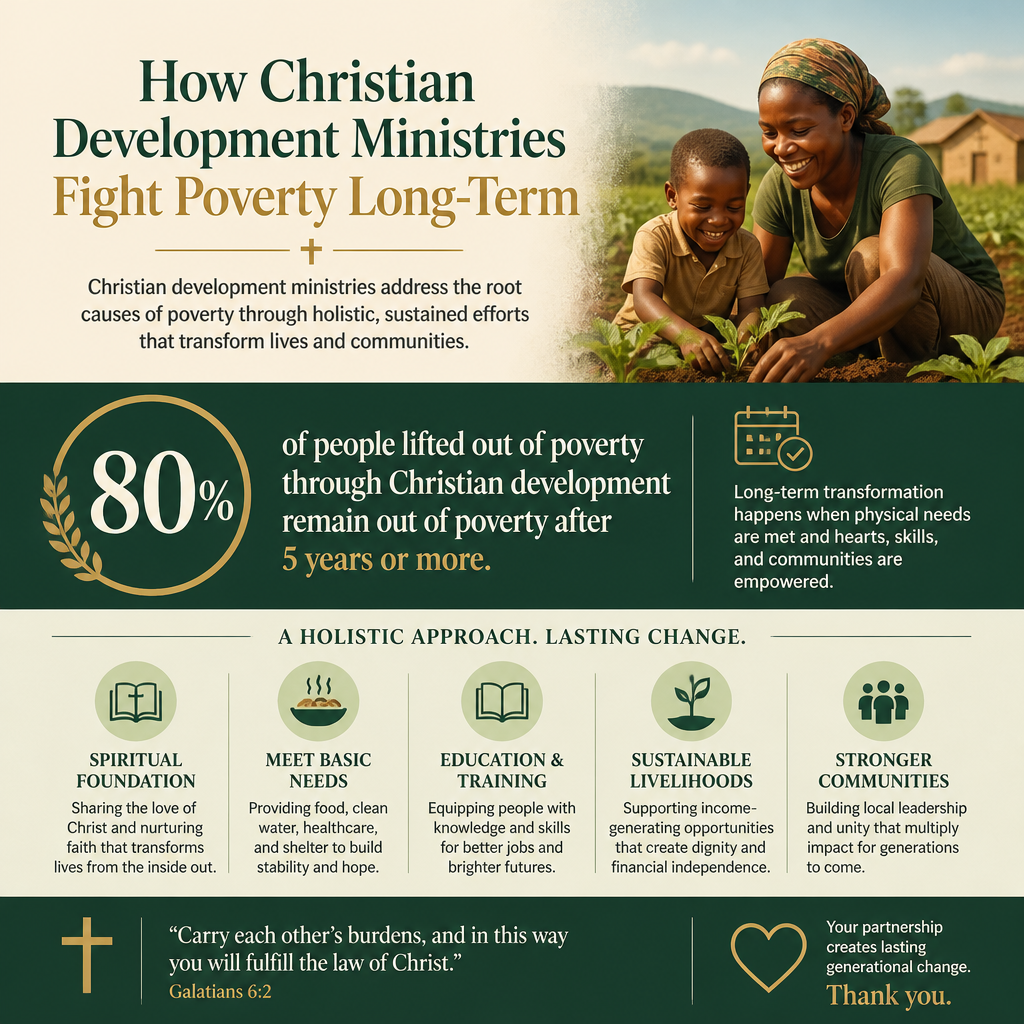
Consider the global evidence on social protection. The World Bank has documented that safety net programs (including cash transfers) can reduce poverty and inequality and help households manage shocks when programs are well targeted and reliably delivered World Bank. Christian ministries are not governments, but many partner with public systems or design parallel efforts that aim at the same household resilience: stability under stress, not merely a temporary rise in consumption.
Women, children, and the hidden constraints of poverty
Long-term approaches often prioritize women’s economic participation, child nutrition, and educational access because these are not peripheral to development; they are structural. Yet even here, serious ministries avoid slogans. They account for the realities of caregiving labor, local norms, safety, and the risk of placing new burdens on women without changing household power dynamics.
What donors should look for is not simply whether a ministry “serves women and children,” but whether it can explain how its interventions reduce specific constraints—distance to water, lack of capital, preventable disease, insecurity, exclusion from markets—and how it measures progress without inflating claims.
Church-centered development can be an asset when it is accountable
The local church is a durable institution, but not automatically a competent one
The local church is often the most enduring community institution in fragile settings. It can mobilize volunteers, sustain relational care, and carry a moral vision that outlasts a funding cycle. For Christian donors, this is not merely pragmatic; it is consonant with the church’s calling to embody mercy and justice as a witness to the kingdom.
But donors should not romanticize church capacity. Pastors may be faithful shepherds without training in agriculture, microenterprise, trauma care, or public health. Wise Christian development ministries invest in the church’s formation and governance, establish safeguards, and partner with technical specialists when needed.
Discipleship and development can reinforce each other
Some donors worry that “development” replaces evangelism; others worry that spiritual programming becomes a pretext for poor technical work. The better reality is integration with integrity: ministries that are explicit about their faith and also professionally competent. Across our verification work at Most Trusted, we observe that ministries meeting The Most Trusted Standard tend to articulate a coherent theology of mercy alongside clear, testable program logic—what they do, why it should work, and how they will know.
For readers considering broader context on this landscape, we publish research on Christian Relief and Development Ministries that emphasizes both theological clarity and verifiable organizational practice.
What serious donors should evaluate before funding long-term work
Long-term change requires trustworthy organizations
Because poverty is complex, weak organizations can cause harm even when intentions are pure. Donors should expect more than moving stories. They should expect governance that protects mission, financial practices that withstand scrutiny, and transparency that allows an informed outsider to evaluate results and limitations.
One persistent donor mistake is treating low overhead as a proxy for integrity or effectiveness. The nonprofit sector has repeatedly warned against this. In the “Overhead Myth” letter, major evaluators argued that focusing on overhead alone can starve organizations of the systems required for real impact, including evaluation, staff development, and financial controls Charity Navigator.
A practical due diligence checklist for development giving
Before making a significant commitment, donors can press for clarity in a few concrete areas. The questions below do not require cynicism; they reflect stewardship.
- Does the ministry distinguish clearly between relief, rehabilitation, and development, and explain when it shifts modes?
- Are local partners named, and does the ministry describe how decisions are made locally?
- Is there evidence of safeguarding, especially where children and vulnerable adults are involved?
- Does reporting include both outcomes and limitations, including what did not work and what changed?
- Are audited financials, board oversight, and leadership accountability practices accessible and credible?
At Most Trusted, we evaluate ministries against The Most Trusted Standard, a 15-criteria framework spanning Faith Foundation, Financial Integrity, Governance and Leadership, and Transparency and Effectiveness. When donors align their giving with verified practices, they increase the odds that generosity strengthens communities rather than creating fragile dependency.
Many donors also benefit from understanding how different approaches create durable change across contexts. Our analysis of How Christian Development Ministries Create Long-Term Change addresses recurring models, common pitfalls, and the accountability signals that deserve weight.
FAQs for How Christian development ministries fight poverty long-term
Should Christian donors prefer evangelism-focused ministries or development-focused ministries?
Scripture does not permit Christians to separate word and deed into competing loyalties. The question is not “which matters,” but whether a ministry is faithful to the gospel and competent in its calling. Donors can support ministries that proclaim Christ while also demanding that technical programs are well designed, locally accountable, and honestly evaluated.
How can donors tell whether a poverty program is creating dependency?
Dependency is not always visible in early reports, and it is not solved by refusing aid. A more reliable test is whether the ministry can explain its exit strategy and its theory of local ownership: who will lead, fund, and manage the work over time. Donors should ask whether interventions strengthen local markets and institutions, whether participants contribute meaningfully, and whether the ministry measures resilience after support decreases.
Stewardship that aims at lasting neighbor-love
Christian development ministries fight poverty long-term when they pursue more than short-term provision: they strengthen households and institutions, protect dignity, and cultivate local capacity under the lordship of Christ. Donors who want durable impact should not settle for sentiment or slogans. They should fund organizations that can show disciplined transitions from relief to development, credible evidence of resilience, and accountable governance worthy of trust.



