
Why monthly giving helps Christian relief and development ministries is not a marketing question. It is a question of whether our giving practices match the realities of hunger seasons, staffing cycles, supply chains, conflict, and the slow work of rebuilding communities. Scripture consistently ties faithfulness to steadiness: the righteous “is ever lending generously” (Psalm 37:26), not only when a crisis makes headlines.
One-time gifts have a clear place in Christian compassion. They can respond to a disaster, a sudden displacement, or an urgent medical need. But much of relief and development is less visible: training farmers before the rains, keeping clinics stocked, maintaining child protection systems, and supporting local churches as they accompany families over years. Monthly giving strengthens that long horizon, provided the ministry is trustworthy and transparent about how recurring funds are governed and used.
Monthly support steadies ministries between emergencies
Disasters are episodic but vulnerability is daily
Donor attention tends to spike after earthquakes, hurricanes, and wars. The needs that follow are more enduring: temporary shelter turns into long-term housing, trauma care turns into ongoing mental health support, and emergency distributions must eventually give way to livelihoods. A ministry funded primarily by episodic surges often faces whiplash—hiring, scaling, and then retrenching—precisely when communities need consistent presence.
Monthly giving creates a baseline that helps ministries plan with sobriety. It supports the less photogenic work: compliance, safeguarding, partner capacity-building, and measurement. Christian donors rightly care about overhead; the field has also had to reckon with the damage done when donors treat overhead as a moral failure rather than a necessary condition for competence. The “Overhead Myth” open letter—signed by Charity Navigator, Candid, and the BBB Wise Giving Alliance—warned that overhead ratios can mislead donors and pressure nonprofits into underinvesting in the very capacities that protect beneficiaries and improve outcomes Charity Navigator.
Predictable revenue enables responsible stewardship
Cash flow is not a secular concern; it is a stewardship concern. Joseph’s grain storage in Genesis is not a proof text for modern budgeting, but it does show that faithfulness includes prudent preparation for foreseeable scarcity. When revenue is predictable, ministries can negotiate contracts ethically, reduce costly last-minute procurement, and retain qualified staff without panic.
Across our verification work at Most Trusted, we observe that stronger ministries tend to communicate clearly about how recurring gifts support core operations and how they prevent unrestricted funds from becoming a “slush account.” Donors do not need perfection; they need intelligibility, accountability, and evidence that leaders treat recurring generosity as a trust to be guarded.

Monthly giving aligns with development that takes time
Many outcomes are seasonal and multi-year
Relief is often immediate; development is often iterative. Agricultural programs follow planting and harvest cycles. Water access requires maintenance and local management structures, not simply drilling. Economic strengthening usually involves training, coaching, and access to savings mechanisms over time. When funding is short-term, programs can drift toward what is easiest to report quickly rather than what is most faithful to communities’ long-term resilience.
The When Helping Hurts framework, articulated by Steve Corbett and Brian Fikkert, has reshaped many Christian organizations’ approach to poverty by insisting that material aid must be paired with relational, capacity-building work that honors dignity and avoids dependency Christianbook. Monthly giving is not a guarantee of wise practice, but it better fits that framework than sporadic giving that pressures ministries toward constant emergency framing.
Faithful partnership requires more than a transaction
Christian donors often want more than a receipt; they want partnership in mercy that reflects the character of God. Monthly giving can become a disciplined act of solidarity—modest, repeated, and realistic. The goal is not to bind consciences to a particular mechanism. The goal is to adopt patterns of giving that allow ministries to tell the truth about how change happens and what it costs to pursue it well.
Christians genuinely disagree about how much of a ministry’s work should be relief versus development, and in what sequence. Some contexts require prolonged relief because markets are destroyed or violence is ongoing. Other contexts can move toward economic strengthening quickly. Monthly giving provides flexibility for leaders to respond to realities on the ground without reinventing their budget every time the news cycle turns.
Recurring gifts can strengthen accountability when paired with verification
Regular giving should raise our expectations, not lower them
A recurring donation is a vote of confidence repeated every month. That should not translate into complacency. It should translate into higher expectations for governance, audited financials, theological clarity, safeguarding, and transparent reporting. Trust is a Christian virtue, but it is not naïveté; the New Testament regularly warns against leaders who misuse authority and resources.
Most Trusted exists because mature donors want to give with confidence, not suspicion. We evaluate ministries against The Most Trusted Standard, a 15-criteria framework across Faith Foundation, Financial Integrity, Governance and Leadership, and Transparency and Effectiveness. Monthly giving works best when donors can verify that a ministry’s spiritual commitments and institutional practices align, especially in cross-cultural contexts where power imbalances can quietly distort good intentions.
What recurring donors should look for
Monthly giving is easiest to set up; it is harder to maintain wise vigilance. A recurring donor is not responsible for day-to-day management, but should remain responsible for discernment. Practical indicators include:
- Audited financial statements or a clear explanation of why an audit is not yet feasible
- Board independence and documented oversight of executive leadership
- Specific descriptions of programs, partners, and decision-making processes
- Safeguarding policies for children and vulnerable adults, with enforceable procedures
- Evidence that impact claims are measured and not inflated for fundraising
For donors who want a wider view of what effective faith-based work entails across contexts, see Christian Relief and Development Ministries. The goal is not to make donors cynical; it is to make giving proportionate to the seriousness of the work.
Monthly giving helps ministries avoid harmful fundraising incentives
Sporadic funding can reward urgency over truthfulness
When revenue depends on spikes, organizations can face subtle pressure to keep supporters emotionally activated. That can lead to distorted storytelling, simplified causality, or an overreliance on images that undermine dignity. The problem is not fundraising itself; Paul fundraised for famine relief. The problem is when fundraising incentives begin to shape program choices and communications more than faithful service does.
Recurring giving can reduce that pressure by lowering the organization’s dependence on constant crisis framing. It can allow communications teams to report with more realism: progress and setbacks, complexity and constraints, local leadership and community agency. That kind of truthfulness is not a luxury in Christian ministry; it is part of integrity.
It can also protect program quality
Program quality is vulnerable when funding is uncertain. Staff turnover rises. Training gets delayed. Monitoring visits are reduced. Partnerships become transactional. Ministries that serve in fragile states and disaster-prone regions often face higher operating costs because security, logistics, and compliance demands are real. Monthly giving does not eliminate those costs; it helps ministries face them without cutting corners that endanger beneficiaries.
Donors often ask whether recurring donors are “locked in.” They are not. Most monthly gifts can be adjusted or stopped. But the habit of regular giving can cultivate a steadier donor posture: less reactive, more prayerful, and more accountable to evidence.
Monthly giving fits the donor’s own formation in generosity
Regular giving resists impulse and supports discipline
Christian generosity is not only an outcome; it is a practice that forms us. Jesus’ teaching on money is so persistent because money reliably competes with God for our trust. Regular giving can act as a quiet counter-liturgy to consumerism: a repeated decision that our security is not finally in accumulation.
Many donors ask how much to give. Scripture commends both proportionality and sacrifice, but it does not reduce generosity to a single formula. What monthly giving offers is a disciplined rhythm. It also creates room to respond to extraordinary needs with extraordinary gifts, instead of exhausting generosity on irregular surges.
It can increase total giving, but motive matters
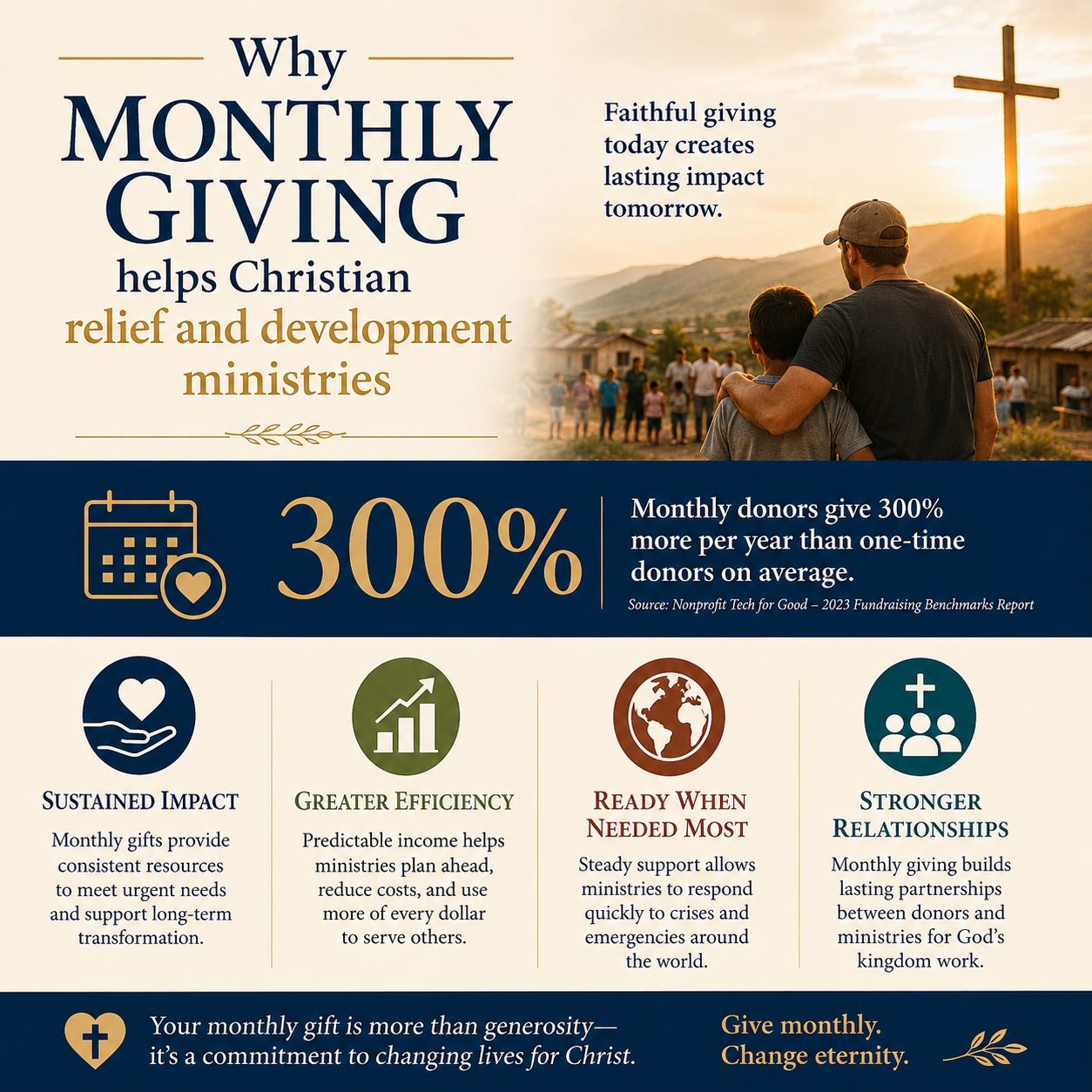
Studies in charitable behavior often find that recurring givers tend to give more over time than one-time givers, though results vary by sector and donor profile. A national snapshot of giving patterns consistently shows that recurring habits shape outcomes; for example, Giving USA reports that total U.S. charitable giving is strongly influenced by sustained donor participation, not only major gifts Giving USA. For Christian donors, the more searching question is motive: whether monthly giving is a way to outsource compassion, or a way to sustain faithful partnership.
For donors deciding how to structure support across different priorities, Giving Strategies for Christian Relief and Development provides a broader frame for considering recurring support alongside emergency giving, church-based partnerships, and long-term commitments.
FAQs for Why monthly giving helps Christian relief and development ministries
Does monthly giving reduce flexibility to respond to disasters?
Monthly giving usually increases flexibility. It provides baseline support for staff, systems, and local partnerships that make disaster response faster and more responsible. Many donors maintain monthly support for core work and then add a separate one-time gift when a major emergency occurs. The key is ensuring the ministry is transparent about how it allocates restricted and unrestricted funds.
How can we verify that a ministry uses monthly gifts responsibly?
Verification should include both spiritual and institutional signals: clear doctrinal commitments, credible governance, audited or review-level financial reporting where feasible, safeguarding policies, and honest impact communication. Most Trusted’s verification evaluates ministries against The Most Trusted Standard so donors can distinguish between recurring need and recurring trustworthiness.
Monthly giving as a durable form of partnership
Christian relief and development is rarely a straight line from gift to outcome. It is a contested space where urgency, complexity, and moral responsibility converge. Monthly giving helps because it supports steadiness—steady presence with communities, steady investment in competence, and steady accountability that treats trust as something to be warranted. For donors who want their generosity to endure beyond the news cycle, recurring support can be a fitting expression of faithfulness.



