

To practice stewardship when supporting Christian ministries is to treat giving as a moral act under the lordship of Christ, not merely a financial transaction. Scripture does not allow us to separate generosity from wisdom. “It is required of stewards that they be found faithful” (1 Corinthians 4:2). Faithfulness includes open-handed sacrifice, but it also includes discernment, accountability, and a refusal to finance harm in the name of compassion.
Christian donors feel this tension acutely. Needs are real, crises are urgent, and stories are powerful. Yet the modern relief and development ecosystem is complex: aid can strengthen local institutions or quietly erode them; strong marketing can mask weak governance; and a sincere ministry can still drift into financial opacity. Stewardship is not cynicism. It is love ordered by truth.
Stewardship begins with a biblical understanding of money and mission
We give as worship, not as consumption
Jesus spoke about money with unusual frequency because money reliably reveals what we trust. Stewardship is therefore not first a technique but a spiritual posture: we receive resources as gifts from God, and we release them in obedience to God for the good of neighbor and the glory of Christ. This is why the New Testament frames generosity as “grace” (2 Corinthians 8–9), not as a mere budget line.
That posture guards donors from a consumer mindset. Many Christian donors have been trained, often unintentionally, to “buy impact” the way one buys a product: quick results, clean narratives, and emotional certainty. But faithful giving is frequently slower and less glamorous. It funds unphotographed work: training local leaders, strengthening systems, paying for audits, and sustaining pastors, counselors, and field staff who stay when attention moves on.
We aim at love of neighbor, not just relief of symptoms
Christians genuinely disagree about the best methods for development, especially across cultures, and the field has had to reckon with failure. The When Helping Hurts framework, articulated by Steve Corbett and Brian Fikkert, has shaped contemporary Christian thinking by arguing that certain forms of outside help can unintentionally reinforce dependency and undermine local agency. That critique is not a call to withdraw from mercy; it is a call to practice mercy with humility, local partnership, and attention to long-term outcomes.
For donors, the harder question is not whether a ministry’s intentions are sincere. The harder question is whether its model respects the dignity, initiative, and social fabric of the people it serves, especially when poverty is not only a lack of material goods but also a web of broken relationships.

Discern what the ministry actually does and why it does it
Clarity of program is a stewardship issue
Many ministries describe their work in language that is both inspiring and vague: “transforming communities,” “bringing hope,” “empowering the vulnerable.” Christian donors should insist on plain descriptions. What is the intervention? Who delivers it? Who receives it? Over what time horizon? What is the evidence that the intervention is appropriate in that context?
This is especially important in Christian Relief and Development Ministries, where complex systems sit behind simple stories. Food assistance, for example, can save lives in a famine. It can also distort local markets if deployed without attention to timing, sourcing, and coordination. Good stewardship does not demand perfection; it demands seriousness about consequences.
Look for a coherent theology of ministry practice
Relief and development programs inevitably embody a theology, whether explicit or not. Some ministries practice evangelism and mercy as integrated callings; others treat proclamation as a slogan attached to otherwise generic aid. We should ask whether a ministry’s practices fit its stated Christian convictions: how it speaks about the image of God in those it serves, how it treats local churches, and how it avoids coercion while remaining unashamed of the gospel.
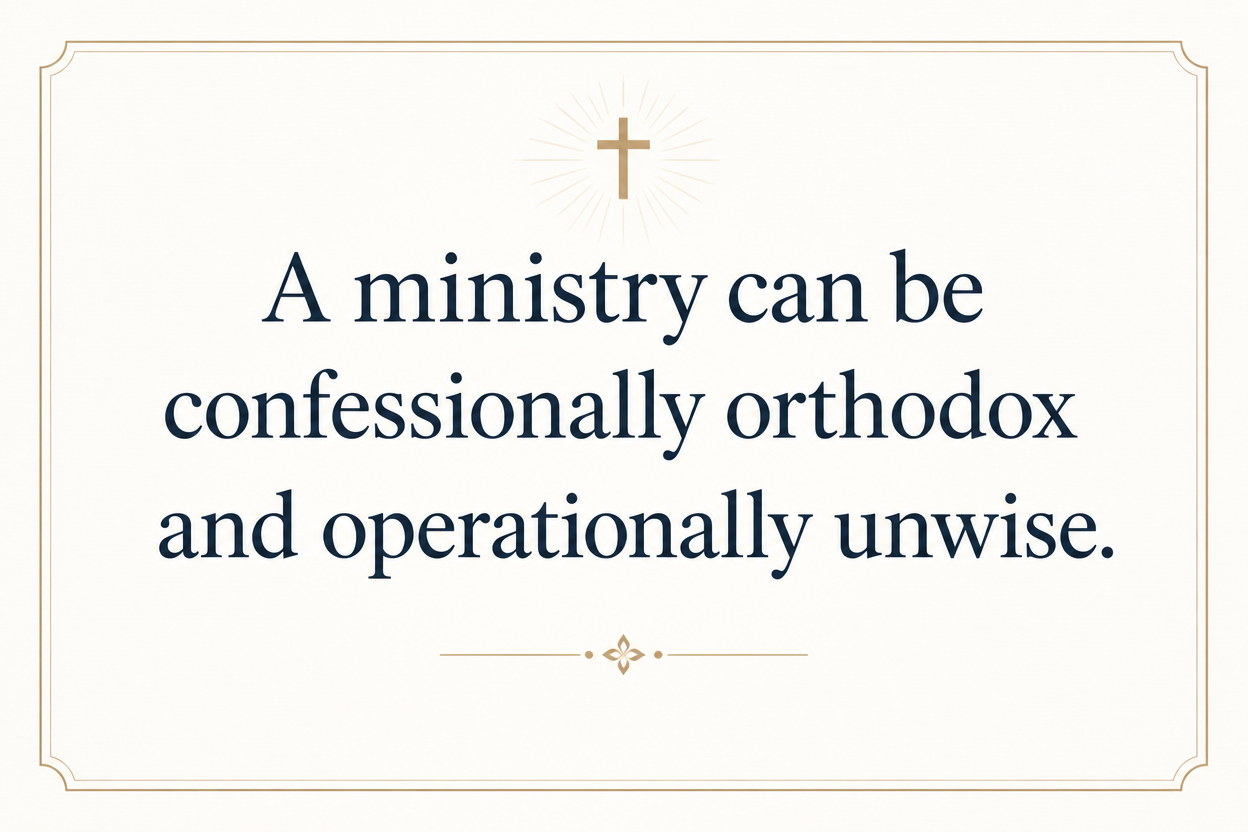
Donors also should be wary of false binaries. A ministry can be confessionally orthodox and operationally unwise. Another can be operationally strong but theologically thin. Stewardship means evaluating both, because Christian faithfulness is not only right doctrine but also right love expressed in competent action.
Evaluate financial integrity without falling for simplistic ratios
Transparency is not optional for those handling sacred gifts
Financial stewardship includes basic questions: Are audited financials available? Is the audit performed by a reputable independent firm? Are major revenue sources explained? Are related-party transactions disclosed? Ministries that handle donor funds as a sacred trust usually make these items easy to find and clear to interpret.
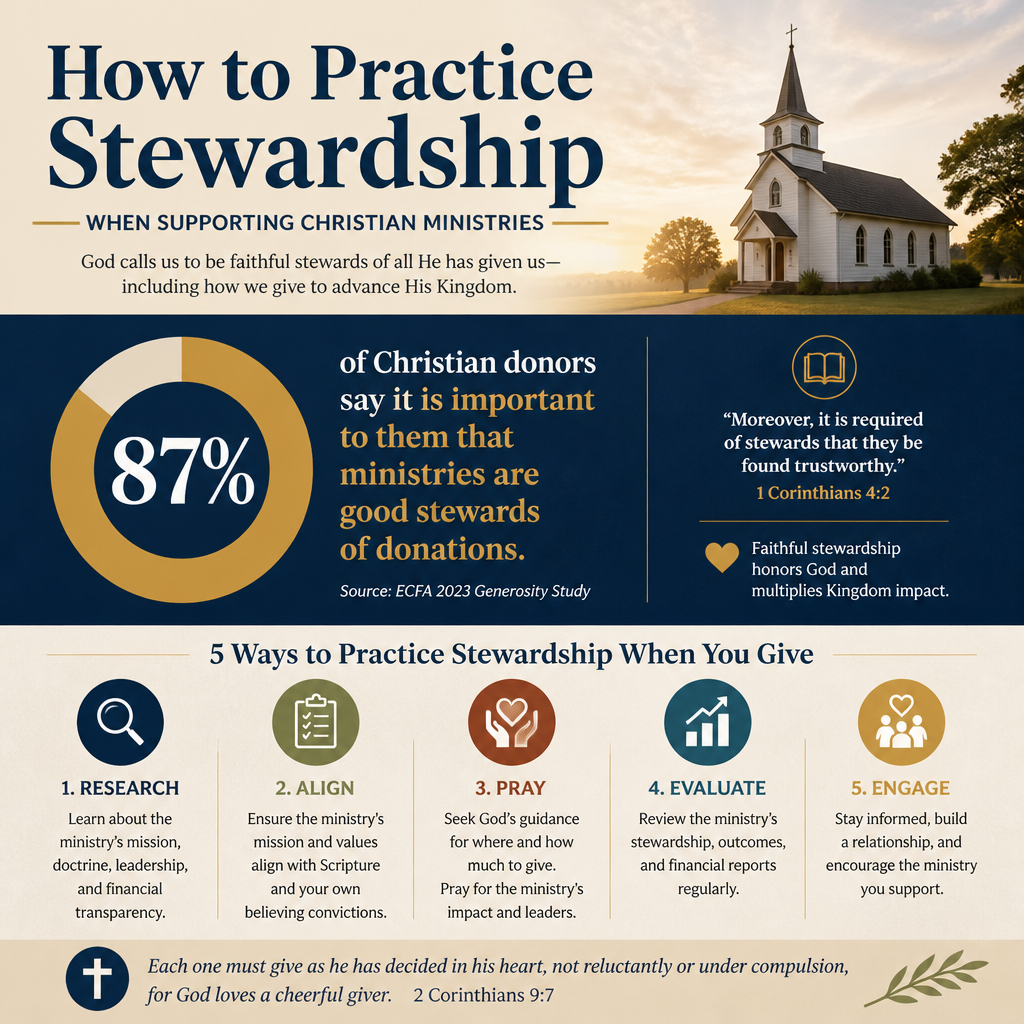
In the United States, many nonprofits also file Form 990, which can be a useful window into governance and finance. It is imperfect and requires interpretation, but it is one of the few standardized documents donors can consult. The Internal Revenue Service provides the framework for nonprofit reporting through its exempt organizations guidance (IRS Charities and Nonprofits).
Overhead ratios are an unreliable moral scorecard
Christians often want a clean metric that can settle the question quickly: “How much goes to programs?” The sector has repeatedly warned against treating overhead as a proxy for virtue. The “Overhead Myth” letter—signed by Charity Navigator, Candid (formerly GuideStar), and the BBB Wise Giving Alliance—argues that fixation on overhead can pressure organizations to underinvest in leadership, evaluation, and infrastructure, ultimately weakening results (Charity Navigator).
Stewardship asks a better set of questions: Is spending aligned to mission? Are compensation and benefits reasonable and disclosed? Does the ministry invest appropriately in safeguarding, monitoring, and financial controls? In relief and development, the cost of doing work well—logistics, security, compliance, trained staff—can be substantial. Low overhead can be either efficiency or fragility; donors must distinguish between the two.
Consider governance, leadership, and the ministry’s posture toward accountability
Boards and leadership culture often predict future integrity
Many donor disappointments are not caused by a single fraudulent transaction but by a culture that resisted scrutiny. Board independence, conflict-of-interest policies, term limits, and documented oversight are not bureaucratic niceties; they are practical expressions of accountability before God and neighbor. Healthy ministries tend to welcome hard questions because they understand that power must be constrained.
Across our verification work at Most Trusted, we observe that ministries that meet The Most Trusted Standard tend to show consistent patterns: they publish clear leadership information, describe board oversight plainly, disclose key policies, and demonstrate that financial decisions are reviewed rather than merely authorized.
Safeguarding and ethical risk are part of donor stewardship
In ministries serving children, displaced people, or survivors of trauma, safeguarding failures can cause lifelong harm. Donors should ask whether the ministry has background screening, staff training, incident reporting processes, and clear boundaries around volunteer engagement. A ministry’s transparency about safeguarding is not a sign of distrust; it is a sign of maturity about the realities of ministry in a broken world.
Donors should also consider reputational and operational risks: cross-border compliance, local partner due diligence, and how the organization responds to credible criticism. A posture of defensiveness is rarely a virtue in leadership. Repentance and reform are Christian distinctives; institutions should embody them.
Practice a disciplined approach to giving that strengthens the church and the vulnerable
Build a giving practice, not a series of reactions
Emergency appeals will always come, and many are legitimate. Yet reactive giving can unintentionally reward the loudest storyteller rather than the most faithful steward. Mature donors often set a baseline of planned giving and then reserve a portion for crises. This creates steadiness for ministries and reduces manipulation by urgency.
A disciplined approach can be simple, but it should be explicit. For many donors, that means deciding in advance how to weigh local church giving, global missions, and relief and development. It also means choosing a smaller number of ministries to know well, rather than scattering gifts so widely that no accountability relationship can form.
Questions that signal seriousness without cynicism
Donors do not need to become auditors, but a short set of questions can prevent avoidable mistakes. We recommend asking:
- What specific outcomes does the ministry seek, and how are they measured and reported?
- Are audited financials and key policies available and current?
- How does the ministry work with local churches and local leadership in the communities served?
- What safeguarding measures exist for children and other vulnerable populations?
- How does the ministry handle failure, criticism, or program changes?
For donors who want a structured way to evaluate these questions consistently, Most Trusted exists to provide independent verification. We assess ministries against The Most Trusted Standard, a 15-criteria framework that examines faith foundation, financial integrity, governance and leadership, and transparency and effectiveness. This kind of third-party scrutiny does not replace prayerful discernment, but it can anchor discernment in verifiable evidence rather than impressions.
Many donors also benefit from learning within a community of practice: a church missions committee, a family foundation, or a trusted advisory group. Wise counsel is a biblical category, and giving decisions are rarely purely individual decisions in Scripture. The pattern is deliberation, prayer, and accountability.
For further reflection on giving as a Christian discipline, see Biblical Stewardship in Christian Relief and Development Giving, where we examine how biblical categories—faithfulness, justice, mercy, and integrity—map onto real donor choices.
FAQs for How to practice stewardship when supporting Christian ministries
Is it unspiritual to ask for financial reports and evidence of effectiveness?
No. Scripture commends accountability in handling funds given for ministry. Paul took pains to administer gifts “honorably not only in the Lord’s sight but also in the sight of man” (2 Corinthians 8:20–21). Requesting clear financial reporting and credible evidence is a way of honoring both donors and beneficiaries, especially when the vulnerable bear the cost of institutional failure.
Should we prioritize ministries with the lowest overhead?
Not necessarily. Overhead levels can reflect efficiency, but they can also reflect underinvestment in essential controls, staff development, safeguarding, and evaluation. A more faithful approach is to ask whether spending is aligned to mission, whether controls are strong, and whether the ministry is transparent about its finances and results. The goal is not to minimize support costs; the goal is to fund competent, accountable work that endures.
Stewardship that protects both gospel witness and neighbor love
Practicing stewardship in support of Christian ministries means giving with a whole Christian mind: generous, prayerful, and accountable. It means honoring urgency without surrendering discernment, and celebrating compassion without financing models that harm people or conceal the truth. When donors insist on integrity, clarity, and humility, they strengthen not only particular programs but the credibility of Christian witness itself.



