
How Christians balance local church and relief ministry giving is not a question of sentiment; it is a question of theology, accountability, and love of neighbor. Mature Christian donors often feel the tension because Scripture binds us both to the gathered church and to the urgent needs of the vulnerable, and it does so without granting us the comfort of simple formulas.
Christians genuinely disagree about proportions and priorities, and the disagreement is not always a sign of bad faith. It is often the result of different ecclesiologies, different callings, and different assessments of what actually helps rather than merely relieves our consciences. The harder question is how to practice a pattern of giving that is faithful, sustainable, and verifiable.
The church is not one cause among many
The ordinary means of grace and the ordinary budget
The New Testament assumes the existence of local congregations with real material responsibilities. Paul’s letters treat the church not as a voluntary association but as a body with worship, teaching, discipline, care for the needy, and support for those who labor in preaching and teaching (1 Timothy 5:17–18). That theological reality has financial implications: giving to the local church is not primarily philanthropy. It is participation in the life of Christ’s body.
In practice, local church giving funds the “ordinary” that sustains faith over decades: pastoral care in crisis, the formation of children, sacraments, counseling, benevolence, and the slow work of discipleship. Relief and development ministries often do essential work, but they normally do not replace the pastoral office, the gathered worship of God’s people, or the mutual obligations of covenant community.
When the local church is weak, donors feel it first
Many donors feel torn because they see the local church struggling: declining attendance, shallow formation, and internal conflict. Those realities can tempt donors to direct giving away from the church toward more visibly “effective” interventions. Yet Scripture does not present the church’s weakness as permission to abandon it. The church in Corinth was riddled with moral and doctrinal failure, and Paul’s remedy was reform and fidelity, not exit.
What this means in practice is that healthy giving often starts with sober assessment: Is our local church marked by faithful preaching, accountable leadership, and tangible care for people? If not, the answer may include renewed engagement, difficult conversations, or even joining a different congregation. It rarely includes treating the church as optional.

Relief and development giving belongs to Christian obedience
Works of mercy are not peripheral
Alongside the church’s gathered life, Scripture presses Christians outward. The prophets condemn worship divorced from justice (Isaiah 1:17). Jesus ties mercy to discipleship with unnerving directness (Matthew 25:31–46). James refuses to separate “pure religion” from care for the vulnerable (James 1:27). Relief and development ministries can become one of the most concrete ways donors obey these texts at scale, especially where needs exceed the capacity of any single congregation.
The modern world also confronts donors with disasters and displacement at a speed and scope earlier generations rarely faced. Earthquakes, famine, war, and forced migration can require specialized competencies: supply chain management, medical capacity, child protection systems, and long-term livelihoods work. Supporting such ministries can be faithful precisely because it is not improvised. It is ordered service.
The field has had to reckon with unintended harm
Relief and development is not morally neutral simply because it is compassionate. The field has learned, often painfully, that aid can distort local economies, weaken local institutions, and reinforce dependency when it is not designed with a clear theory of change and deep local partnership. The When Helping Hurts framework, articulated by Steve Corbett and Brian Fikkert, has reshaped Christian practice by insisting that poverty is not only a lack of material goods but also broken relationships, including distorted relationships with God, self, others, and creation.
Donors should not be cynical about these warnings, but neither should they ignore them. The best relief and development ministries can explain how they avoid common failures: how they prevent harmful giveaways, protect children and vulnerable adults, partner with local churches appropriately, and measure outcomes beyond activity counts.
A workable order of priorities for mature Christian donors
Begin with covenant responsibility, then widen the circle
A credible pattern for most Christian households starts with the local church because it is the primary community of worship, discipleship, and accountability. From there, many donors widen their giving to include relief and development, particularly where the local church is already engaged or where needs are unusually acute.
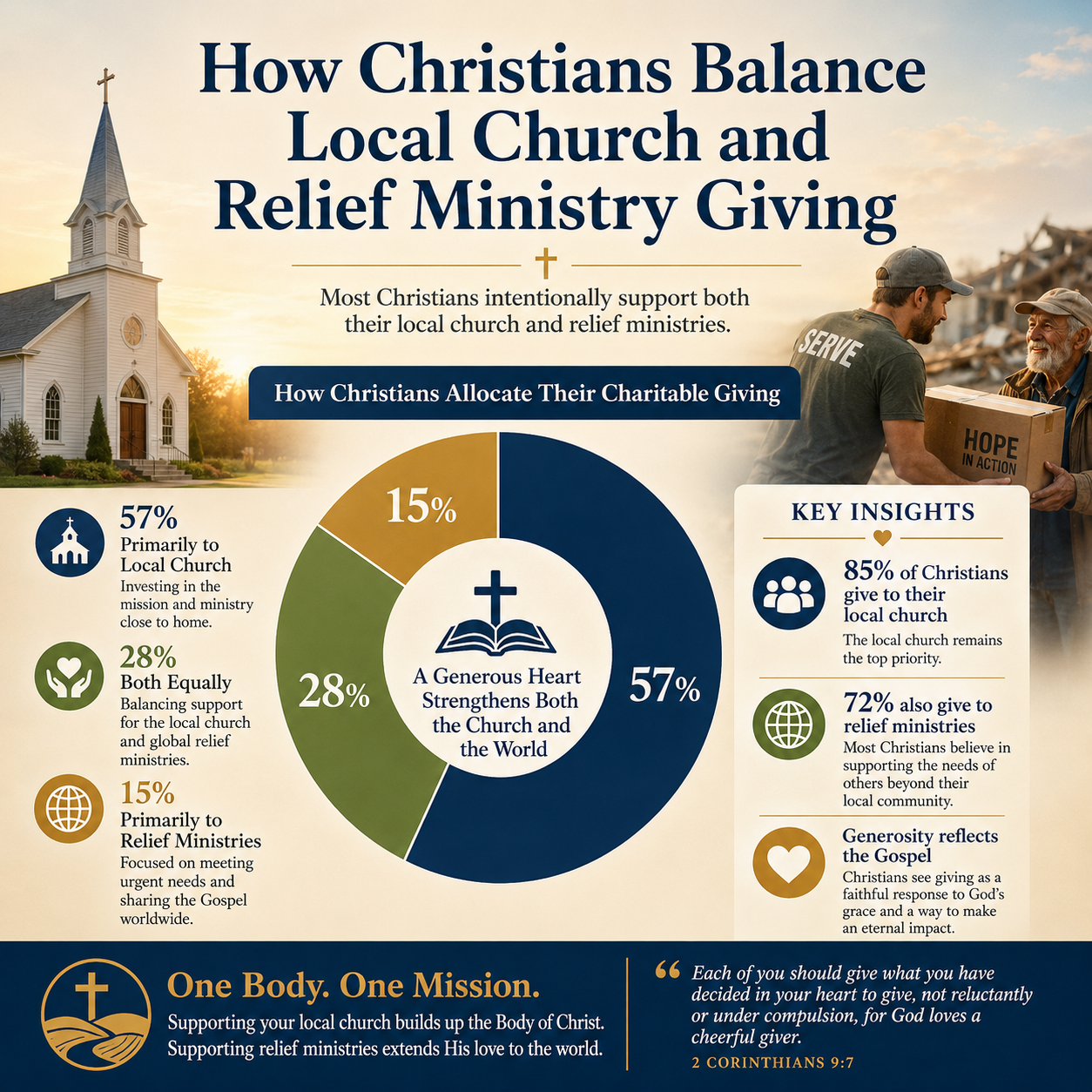
This order is not a claim that the church is always more “effective” than a specialized ministry. It is a claim about spiritual responsibility: Christians are ordinarily accountable to a particular congregation, with particular leaders, in a particular place. That accountability is itself a form of stewardship.
Use a discernment grid that is spiritual and practical
Some donors ask for a percentage rule. Scripture gives principles more than ratios. The tithe in the Old Testament and the generosity of the New Testament church press toward substantial giving, but they do not settle the question of how to distribute gifts across institutions and needs. What we can offer is a disciplined way of thinking that respects both theology and evidence.
- Faithfulness: Does the ministry’s doctrine and practice align with historic Christian confession and ethics?
- Accountability: Are leaders governed and constrained by structures that prevent abuse and drift?
- Proximity: Is our giving connected to real relationships and oversight, not merely distant sentiment?
- Competence: Does the ministry have demonstrated capacity in relief, development, or both?
- Fruit: Can it describe outcomes credibly, including failures and what it learned?
Many donors find that this kind of grid brings clarity without pretending to remove the need for prayer and judgment. It also honors the fact that different seasons of life change what “sustainable generosity” looks like.
Verification matters because both categories carry risk
Local churches and parachurch ministries can both fail
Christian donors sometimes assume the local church is automatically safe and the external ministry is where risk lives. The opposite assumption is also common: donors trust a well-branded relief organization more than a small congregation. Both assumptions are naïve. Churches can suffer from financial opacity, weak governance, and unaddressed misconduct. Relief and development ministries can suffer from exaggerated reporting, unclear theology, or mission drift driven by restricted funding incentives.
Because these risks are real, many donors now treat giving as a moral act that includes due diligence. Not to control outcomes as if we were sovereign, but to practice the vigilance Scripture commends when it warns against deceit and calls leaders to be “above reproach” (1 Timothy 3:2).
How The Most Trusted Standard serves donors without replacing discernment
Most Trusted exists because donors should not have to choose between theological seriousness and professional rigor. Our team evaluates Christian nonprofits against The Most Trusted Standard, a 15-criteria framework across four domains: Faith Foundation, Financial Integrity, Governance and Leadership, and Transparency and Effectiveness. We do not ask donors to outsource conscience to a badge. We do insist that credibility can be examined, and that ministries should welcome scrutiny as a form of neighbor-love toward donors and beneficiaries.
Across our verification work, we observe that ministries that meet The Most Trusted Standard tend to handle complexity without defensiveness. They can name trade-offs, describe safeguarding practices, explain how funds are restricted or unrestricted, and show how local partners are empowered rather than displaced. That posture is especially important in relief contexts, where urgency can create shortcuts, and in development contexts, where results take years and are easy to overstate.
Donors seeking a broader view of the landscape can situate their relief and development decisions within Christian Relief and Development Ministries, where the central tensions and categories of work become easier to compare. For donors working through first principles, Biblical Stewardship in Christian Relief and Development Giving provides the moral vocabulary that keeps evaluation from collapsing into mere technique.
Practical ways to balance giving without moral fatigue
Build a plan that can endure crises and ordinary months
Christian generosity often fails not because donors lack compassion, but because they lack a durable plan. Disaster headlines can create reactive giving that is sincere yet unstable. A plan protects both the church and relief work from being funded only when emotions are high. It also guards households from oscillating between guilt-driven bursts and long droughts.
Many mature donors separate their giving into at least two commitments: an ongoing baseline to the local church, and a designated channel for relief and development that can be directed to specific crises when needed. This is not about insulating ourselves from feeling. It is about refusing to let the news cycle dictate our theology.
Ask better questions of both kinds of recipients
Local churches and relief ministries should be able to answer serious questions without treating donors as adversaries. For churches, donors might ask how benevolence is administered, whether budgets and financial statements are available to members, and what safeguards exist for minors and vulnerable adults. For relief and development ministries, donors might ask how local partners are selected, how distributions avoid market harm, and what independent audits or evaluations exist.
Where donors encounter resistance to basic transparency, the issue is not merely administrative. It is spiritual. Scripture consistently treats hiddenness around money and power as a danger zone. Healthy institutions do not promise perfection; they practice accountability.
FAQs for How Christians balance local church and relief ministry giving
Should Christians always give to the local church first?
Most Christians should treat giving to a local congregation as a primary obligation because the church is the ordinary context of worship, discipleship, and mutual care. That said, exceptional circumstances exist: missionaries without stable church access, believers in settings where churches are persecuted or corrupt, or seasons where a donor is in transition between congregations. Even then, the goal is typically to restore local church accountability rather than to replace it with causes.
How can donors evaluate relief ministries when outcomes are hard to measure?
Relief and development outcomes are often complex and long-term, so donors should look for evidence of disciplined practice rather than simplistic metrics. Credible ministries can explain their theory of change, show how they partner with local institutions, disclose financial statements and audits, and report results with appropriate humility. Third-party verification can strengthen confidence, which is why Most Trusted evaluates ministries against The Most Trusted Standard with attention to governance, financial integrity, and transparency.
A faithful balance is rarely a single number
Christian donors honor Christ when they refuse the false choice between the local church and the suffering neighbor. The church is the appointed community where God forms his people, and relief and development ministries can be instruments of mercy that extend that love beyond the congregation’s immediate reach. A mature balance is built through theology, disciplined planning, and careful verification, so that generosity remains both joyful and accountable.



