
How Christian medical ministries operate hospitals and clinics is not primarily a question of logistics. It is a question of whether a ministry can hold together clinical excellence, spiritual integrity, and public accountability under sustained pressure. Donors who care about mercy ministry often carry two concerns at once: the desire to relieve suffering in Christ’s name, and the fear of funding something that is ineffective, unsafe, or ethically compromised.
The New Testament’s call is clear that care for the sick belongs near the center of Christian discipleship. Jesus’ healing ministry was not incidental to his proclamation of the Kingdom; it was a sign of that Kingdom’s authority and compassion. Yet operating a hospital is different from organizing a mobile clinic or supporting individual patients. Hospitals and clinics are institutional realities—regulated, capital-intensive, and vulnerable to the moral hazards that attend power, money, and urgency.
Hospitals and clinics are spiritual works and regulated institutions
Mercy that remains accountable
Christian medical hospitals and clinics often begin with a theological conviction: every human being bears the image of God and therefore deserves competent, dignified care (Genesis 1:27). Many explicitly frame their work in terms of Matthew 25—visiting the sick as service rendered to Christ. That conviction fuels endurance when work is hard and the need does not relent.
What this means in practice is that the ministry operates under two authorities at once. It serves Christ and the neighbor, and it must also comply with clinical standards, licensing rules, infection control protocols, and patient privacy requirements. Strong ministries do not treat regulation as a secular nuisance. They treat it as a form of neighbor-love: the discipline that protects patients from preventable harm.
Different models under the same banner
Not every “Christian medical ministry” owns or runs a full hospital. Some operate primary-care clinics. Others run specialty centers, nursing schools, community health programs, or referral networks that pay for surgeries at partner hospitals. Still others deploy short-term surgical teams that operate within a host-country facility. Donor discernment improves when the operating model is clear, because the risks and measures of effectiveness change by model.
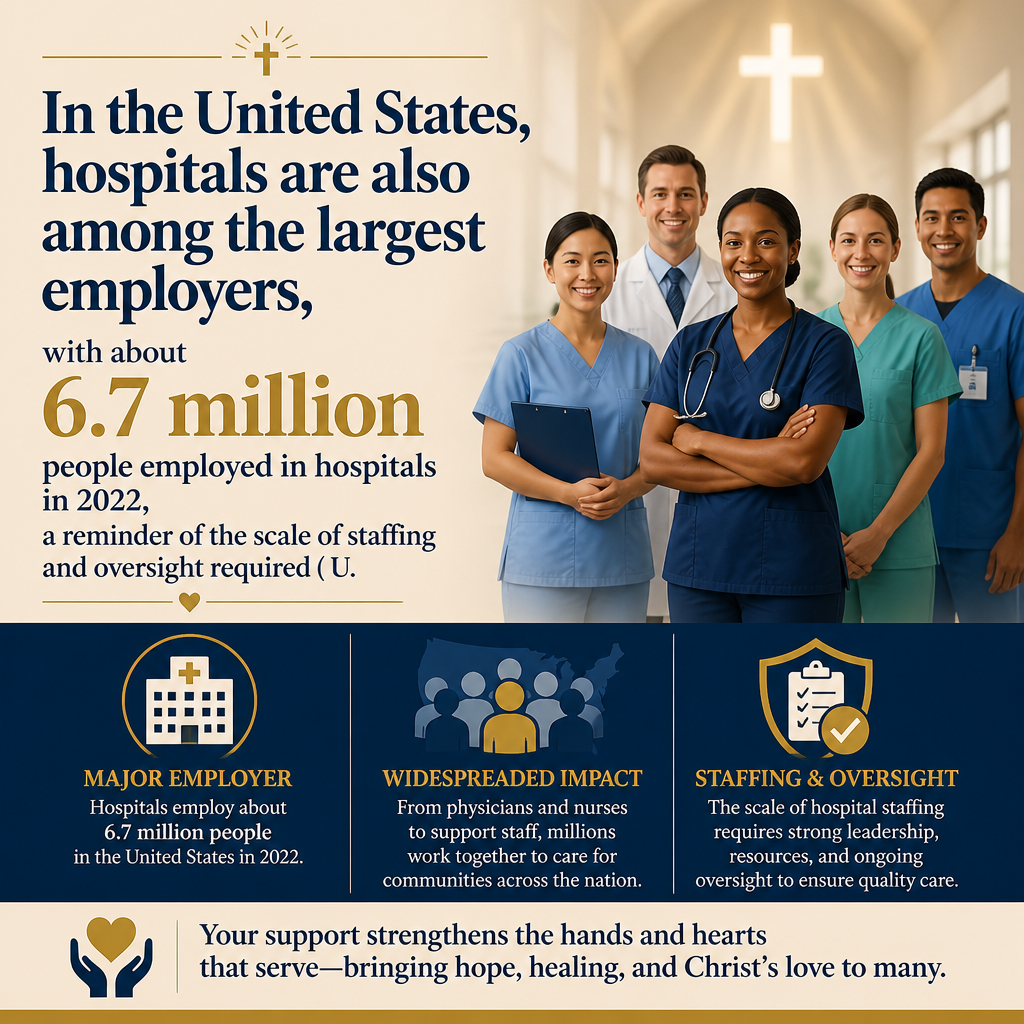
Across the broader landscape of healthcare delivery, hospitals are among the most complex organizations to run well. In the United States, hospitals are also among the largest employers, with about 6.7 million people employed in hospitals in 2022, a reminder of the scale of staffing and oversight required (U.S. Bureau of Labor Statistics).

How the care delivery system actually works
Clinical care is a chain, not a single act
Donors often picture care as a single event: a diagnosis, a procedure, a life saved. Hospitals and clinics function as a chain of interdependent steps: triage, diagnosis, treatment, pharmacy, lab services, nursing care, discharge planning, follow-up, and recordkeeping. Weakness at any point can negate strength elsewhere. A clinic that offers compassionate prayer but dispenses counterfeit medication, or mishandles sterilization, is not practicing Christian mercy. It is exposing the vulnerable to harm.
A reliable Christian medical ministry therefore invests in “invisible” systems: supply chains that reduce stockouts, quality assurance processes, staff training, maintenance for imaging and sterilization equipment, and secure patient records. These are not overhead distractions. They are the ordinary means by which competent care becomes repeatable.
Workforce formation and retention are often the limiting factor
In many contexts the central constraint is not desire or compassion; it is trained staff who can stay. Health systems globally face significant workforce shortages. The World Health Organization has projected a shortfall of 10 million health workers by 2030 (World Health Organization). Ministries that operate hospitals and clinics must therefore think like long-term institutions: creating pipelines for nurses and clinicians, supporting continuing education, and building a culture in which ethical practice is normal and enforced.
Some ministries partner with Christian nursing schools or medical training programs. Others provide scholarships tied to service commitments. These can be wise strategies, but they create governance obligations: clear scholarship policies, non-discriminatory hiring where required by law, and safeguards against coercion or favoritism.
Financing and stewardship in high-cost mercy work
Hospitals cannot be run on episodic generosity
Hospitals and clinics require stable cashflow: payroll, utilities, medication procurement, equipment maintenance, insurance, waste disposal, and emergency reserves. A ministry that depends solely on seasonal fundraising will feel financial stress in ways that reach patients directly—delayed salaries, medication shortages, deferred maintenance, and compromised quality. Mature Christian donors should expect a disciplined financial strategy that includes diversified revenue: patient fees scaled to ability, grants, local partnerships, and philanthropic support.
Christians genuinely disagree about fees in Christian healthcare. Some argue that charging any fee compromises mercy; others argue that modest fees protect dignity and sustainability and reduce dependency. The ethical question is not settled by a slogan. It is settled by evidence of how the ministry protects access for the poor and how it prevents financial practices that exploit desperation.
What donors should look for in hospital economics
Across our verification work at Most Trusted, financially sound medical ministries tend to do three things well: they budget realistically, they disclose their cost structure plainly, and they can explain how philanthropy translates into accessible care without romanticizing scarcity. Donors should not demand artificially low administrative costs. The “Overhead Myth” letter—signed by GuideStar, Charity Navigator, and the BBB Wise Giving Alliance—clarified that overhead ratios are poor indicators of impact and can incentivize underinvestment in capacity (Candid GuideStar).
For donors evaluating a ministry’s financial integrity, these are concrete questions worth asking:
- How does the ministry set patient fees, and what safeguards ensure the poor are not turned away?
- Does the ministry maintain reserves appropriate to payroll, supply chain risk, and emergencies?
- Are audited financial statements available, and do they disclose related-party transactions?
- Is there a clear separation between fundraising claims and clinical reporting?
- How does the ministry measure and report charity care, subsidies, or uncompensated care?
These questions are not suspicious. They are a form of stewardship. Jesus’ teaching on money assumes accountability to God for what has been entrusted (Luke 16:10–12).
Faith witness at the bedside without coercion or confusion
Spiritual care that honors conscience
Christian hospitals and clinics often include chaplaincy, prayer with patients who desire it, and pastoral care for families and staff. This can be a profound expression of the gospel, particularly where fear and grief are constant companions. Yet healthcare also creates vulnerability. Patients may feel unable to refuse religious engagement when they depend on a clinician for pain control, discharge decisions, or access to medication.
Trustworthy ministries establish clear boundaries: spiritual care is offered, not imposed; consent is meaningful; and clinical decisions are not contingent on religious response. The credibility of Christian witness is not preserved by pressure. It is preserved by humility, integrity, and sacrificial competence. In practice this means training staff on appropriate evangelism ethics in clinical settings and having complaint pathways that are safe for patients to use.
Ethical tensions do not disappear in Christian settings
Christian medical work must also reckon with contested questions: end-of-life care, reproductive health, HIV prevention, and conscientious objection among staff. Some donors assume “Christian hospital” answers every ethical question in the same way. It does not. Ministries may share a confession of Christ while landing differently on protocols and partnerships, especially across cultural contexts and legal environments.
The donor’s task is not to demand simplistic uniformity, but to fund ministries that are transparent about their ethical commitments and accountable in how they implement them. That transparency includes clear statements of faith, clinical policies that reflect those commitments, and governance structures that can adjudicate hard cases rather than improvising under pressure. For readers comparing models across the field, Christian Medical Ministries provides a wider view of the approaches donors encounter.
Governance, transparency, and what verification can and cannot do
Hospitals require real governance, not honorary boards
A hospital is a high-risk environment: financial risk, clinical risk, reputational risk, and moral risk. Weak governance can quietly normalize shortcuts—unreported adverse events, inflated outcomes, conflicted procurement, or leadership unaccountability. Strong boards do more than bless a vision. They oversee strategy, ensure legal compliance, require independent financial review, and hold leaders accountable for culture and ethics.
In medical settings, oversight should include clinical quality mechanisms: credentialing, peer review, infection control policies, incident reporting, and pathways for patients to raise concerns. Donors rarely see these systems in a glossy newsletter, but they are among the most important indicators of whether a ministry’s compassion is disciplined by competence.
How The Most Trusted Standard helps donors give with confidence
Most Trusted exists because donors should not have to choose between generosity and due diligence. We evaluate ministries against The Most Trusted Standard, a 15-criteria framework across Faith Foundation, Financial Integrity, Governance and Leadership, and Transparency and Effectiveness. For Christian medical hospitals and clinics, that means asking questions such as: Is the faith commitment explicit and consistent? Are finances independently reviewed and clearly disclosed? Does governance reduce conflicts of interest? Does the ministry report outcomes in a way that is honest about limits and trade-offs?
Verification is not a substitute for prayerful discernment, and it cannot eliminate every risk. But it can narrow uncertainty, highlight patterns that predict health, and identify red flags that donors would rarely detect on their own. For additional context on practical delivery models and what donors should expect, How Christian Medical Ministries Deliver Care situates hospitals and clinics alongside other approaches.
FAQs for How Christian medical ministries operate hospitals and clinics
How can donors tell whether a Christian hospital is providing high-quality care?
Donors should look for evidence of clinical governance and transparency: credentialing standards, continuing education, infection control policies, and incident reporting. Publicly available audited financials and clear reporting on services provided are also meaningful indicators. Where local accreditation systems exist, a willingness to pursue and maintain them often signals seriousness about patient safety.
Should Christian medical ministries charge patients at all?
Scripture commands generosity and protection of the vulnerable, but it does not prescribe a single payment model for healthcare. Fees can either exploit or sustain; the difference is policy and accountability. Donors can ask whether there is a clear charity-care policy, whether the poorest patients are protected from denial of care, and whether the ministry can explain how fees, subsidies, and philanthropy work together to keep care accessible.
Stewardship that strengthens mercy
Christian medical ministries that operate hospitals and clinics carry a sacred trust: to treat the sick with dignity and competence, and to bear witness to Christ without manipulating vulnerability. Donors serve that trust when they fund ministries that pair compassion with systems, theology with ethics, and vision with transparent accountability. The strongest giving does not merely expand activity; it strengthens institutions that can endure, protect patients, and honor the Lord in the details.



