
How Christian medical ministries respond to local health needs is ultimately a question of discipleship expressed through systems. The sick do not experience “health” as an abstract category; they experience clinics that open on time, medicines that are in stock, referrals that are honored, and care that treats them as image-bearers rather than problems to be managed.
For Christian donors, the question is not whether compassion matters. Scripture settles that. Jesus tied faithfulness to visiting the sick (Matthew 25), and the early church treated care for the vulnerable as a public witness to the gospel. The harder question is how a ministry discerns what a community actually needs, then responds in ways that are clinically responsible, locally accountable, and spiritually coherent.
Local health needs are not generic needs
Listening that is more than courtesy
The most faithful medical ministries begin with a disciplined posture of listening. “Local health needs” are shaped by epidemiology, transportation, language, trust in institutions, cultural expectations, and the capacity of nearby public systems. A mobile clinic model that is appropriate in a rural county after a hospital closure may be counterproductive in an urban neighborhood where the primary barrier is insurance navigation or specialist access.
In the United States, persistent gaps in access remain. About 1 in 12 people lacked health insurance in 2023, and that single fact intersects with a cascade of practical barriers: delayed care, unmanaged chronic disease, and financial stress that compounds medical risk. Ministries that respond well do not simply provide episodic charity; they build care pathways that account for the real constraints patients face.
Community benefit and mission drift
Christians genuinely disagree about how explicitly evangelistic a medical ministry should be in clinical settings. Some donors want direct proclamation; others prioritize a quiet but unmistakable Christian presence. The most credible ministries are transparent about their approach and careful not to use medical vulnerability as leverage. In our verification work at Most Trusted, we consistently find that clarity on mission protects both patients and staff: patients know what to expect, and clinicians are not pressured into performative spirituality or ethical corner-cutting.
Christian medical response requires clinical competence
Care quality is a moral issue
Good intentions do not substitute for medical competence. Christian love takes form through safe prescribing, appropriate triage, and clear referral thresholds. A ministry that provides free care but lacks clinical governance can create harm: missed diagnoses, fragmented records, or well-meaning distribution of medications without follow-up.
In global contexts, this is why reputable ministries increasingly align with widely recognized standards for medical missions and short-term engagement. The When Helping Hurts framework, articulated by Steve Corbett and Brian Fikkert, has helped many Christian organizations name a central risk: doing for others what they can and should do for themselves can undermine dignity and local capacity. That framework is not a medical protocol, but it has reshaped how many ministries think about “help” as a long-term system rather than a moment of relief.
Examples of mature response models
Several longstanding Christian health organizations illustrate patterns we see across strong local responses. Samaritan’s Purse is known for rapid deployment in disasters and for field hospitals that are staffed with licensed clinicians and logistical teams; its strengths are speed, scale, and supply-chain capacity when local infrastructure collapses. Americares, while not explicitly a church ministry, is a useful comparison point in how it structures pharmaceutical distribution and disaster response with strong attention to quality and compliance.
In community-based care, Christian Community Health Fellowship has historically supported networks of faith-based clinics serving underserved populations. These models tend to respond to local need through primary care, dental care, behavioral health integration, and patient navigation rather than through episodic “event medicine.”
Partnership with local systems is not optional
The local clinic and the local church
Christian medical ministries often operate at the intersection of the local church and the local health system. That intersection is both a gift and a tension. Churches can provide trusted relationships, volunteer capacity, and holistic support that health systems struggle to offer. Yet churches can also unintentionally become gatekeepers if care is tied to membership or if cultural expectations signal that some neighbors are less welcome.
A strong ministry names these risks and designs around them. That includes clear nondiscrimination policies, a patient-first intake process, and partnerships that prevent the clinic from becoming an island. When ministries collaborate with county health departments, federally qualified health centers, pregnancy care networks, and hospital charity programs, continuity improves and the ministry’s impact becomes more durable.
Referral networks and the economics of “free” care
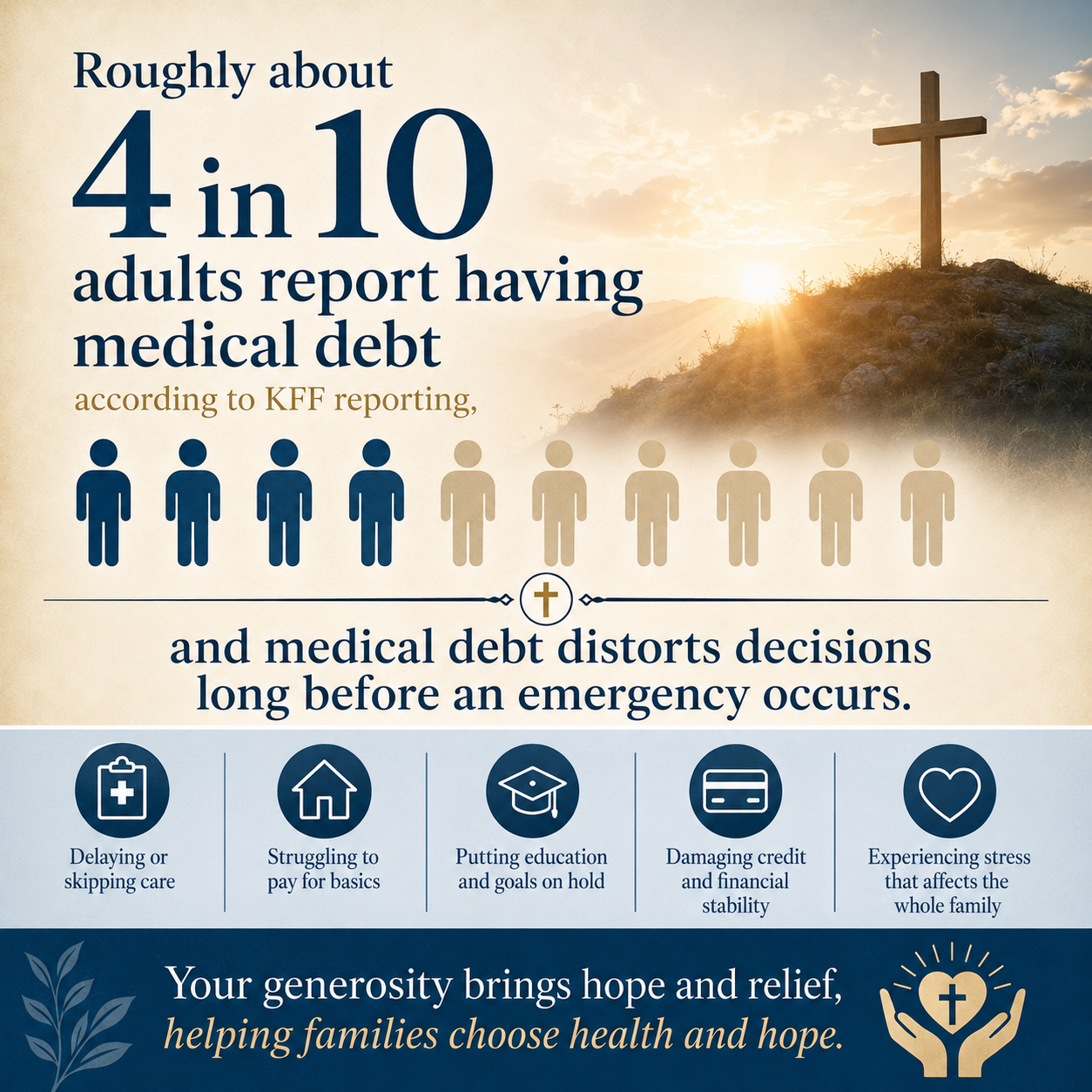
Healthcare is not a single service; it is a chain. Primary care that cannot refer for imaging, oncology, obstetrics, or surgery can only carry patients so far. In the United States, financial pressure is one of the chief reasons patients delay care. Roughly about 4 in 10 adults report having medical debt, according to KFF reporting, and medical debt distorts decisions long before an emergency occurs.
When Christian medical ministries respond well, they treat referral capacity as part of their mission. Some negotiate discounted specialty care, build pro bono specialist panels, or employ case managers who can secure charity care, transportation, and follow-up. The ministry’s faithfulness is expressed in the unglamorous work of closing loops: test results communicated, next appointments scheduled, medications reconciled.
Donor trust depends on governance and transparency
What donors should be able to verify
Local responsiveness is not only a clinical question; it is a stewardship question. Donors are right to ask how decisions are made, how funds are handled, and whether reported outcomes match reality. A ministry can be spiritually earnest and still be financially careless or administratively opaque.
At Most Trusted, we evaluate ministries against The Most Trusted Standard, a 15-criteria framework spanning Faith Foundation, Financial Integrity, Governance and Leadership, and Transparency and Effectiveness. Medical ministries that meet these expectations tend to show a consistent pattern: they document policies, disclose leadership structures, provide understandable financial reporting, and explain how programs are evaluated without overstating results.
- Clear clinical oversight, including licensed leadership and written protocols
- Financial statements and reporting that are accessible to non-specialists
- Defined safeguarding practices for vulnerable patients
- Evidence of local partnership rather than parallel systems
- Outcome reporting that is sober, specific, and appropriately limited
The temptation to overpromise impact
The field has had to reckon with the pressure to publish impressive numbers: “patients served,” “medications distributed,” “decisions for Christ.” Counts can be useful, but they can also disguise weak continuity of care, poor follow-up, or spiritual practices that are not ethically appropriate in clinical settings. The best reporting names both fruit and limits. It distinguishes between outputs and outcomes, and it does not treat a patient encounter as a fundraising asset.
As donors, we should also reject simplistic heuristics about charity efficiency. The Overhead Myth letter, signed by Charity Navigator, Candid, and the BBB Wise Giving Alliance, argued that focusing narrowly on overhead can mislead donors and discourage needed investment in staff and systems (Charity Navigator). In healthcare, that warning is particularly relevant: quality requires training, compliance, equipment maintenance, and data stewardship.
How donors can support local responsiveness without distorting it
Funding that strengthens the whole care pathway
Donors sometimes unintentionally push ministries toward what photographs well rather than what serves well. A sustainable local response often depends on expenses that are not emotionally compelling: electronic health records, malpractice coverage, interpreter services, medication reconciliation, patient transportation, and staff formation.
What this means in practice is that wise giving often looks like patient capital. Multi-year commitments help clinics retain clinicians and case managers. Unrestricted gifts, when given to a trustworthy organization, provide flexibility to respond to shifting local patterns, whether that is a spike in respiratory illness, a rise in fentanyl-related overdoses, or the collapse of a nearby safety-net provider.
Choosing ministries with disciplined accountability
Donors do not need to become medical administrators, but donors should expect verifiable signals of health. A credible ministry can answer questions about licensing, partnerships, complaint processes, and referral outcomes without defensiveness. It can describe how it learns from failures. It can show that its Christian identity shapes the way it treats patients, staff, and data.
Those seeking a broader view of this field may find it helpful to begin with Christian Medical Ministries, especially when comparing different models of care across domestic and global contexts. The questions donors ask should adjust to the model: disaster deployment, long-term primary care, hospital-based missions, maternal health, or community health worker programs each carry distinct risks and accountability requirements.
For donors focused specifically on delivery models and real-world operations, How Christian Medical Ministries Deliver Care provides additional context for evaluating how ministries translate compassion into responsible practice.
FAQs for How Christian medical ministries respond to local health needs
How can donors tell whether a medical ministry is addressing the right needs locally?
We recommend looking for evidence of sustained local input and partnership: relationships with local clinics, public health agencies, and community leaders; a clear description of who is served and why; and program choices that match local barriers such as transportation, language access, or referral scarcity. A ministry should be able to explain what it stopped doing when it proved ineffective and what it changed based on patient feedback.
Should Christian medical ministries combine evangelism with clinical care?
Christians genuinely disagree about the best practice, and context matters. What should be non-negotiable is ethical clarity: care must not be conditioned on religious response, and spiritual conversation should respect patient vulnerability and consent. Donors can look for transparent policies, staff training, and a theology of dignity that treats patients as neighbors to be served, not targets to be counted.
A faithful response is both compassionate and accountable
Christian medical ministries respond to local health needs most credibly when mercy is joined to competence, and zeal is joined to restraint. The church’s calling to visit the sick is not satisfied by proximity alone; it requires truthfulness, safety, and humility before complex systems. Donors serve that calling best when we fund what strengthens local care over time and when we insist on the kind of transparency that protects both patients and witness.



