
Christian legal services need unrestricted giving because the work is both immediate and slow: immediate in the moment a family receives an eviction notice or a survivor files for a protective order, and slow in the careful legal steps required to seek justice without causing new harm. Restricted funding can support a single case type or a narrow program line, but it often cannot sustain the capacity that makes faithful legal ministry possible: trained staff, ethical oversight, trauma-informed practice, and the patient work of counsel. For Christian donors who want their giving to serve both truth and mercy, this is not a minor budget preference. It is a question of whether a ministry can keep its commitments when the next urgent call comes.
The biblical witness assumes that justice is not optional for God’s people. The Lord “loves righteousness and justice” (Psalm 33:5). Isaiah condemns worship that coexists with oppression and calls God’s people to “seek justice” and “correct oppression” (Isaiah 1:17). In that light, Christian legal ministries are not merely technical service providers. They are one way the church bears witness that the law is meant to protect the vulnerable and restrain wrongdoing. Unrestricted giving is often what allows that witness to remain credible under real-world pressure.
Unrestricted funding preserves the integrity of counsel and the dignity of clients
Legal ministry requires discretion, not merely activity
Legal work is governed by professional duties that do not bend to donor preferences. Attorneys must avoid conflicts of interest, maintain confidentiality, and provide competent representation within the bounds of the law. A restricted grant that requires a ministry to take a set number of cases, or to prioritize a particular outcome, can unintentionally push against those duties. Even when restrictions are well-intentioned, they can create perverse incentives: selecting cases that “fit the grant” instead of cases that best serve the neighbor in front of the ministry.
Unrestricted giving is not a blank check for improvisation. It is a practical way to protect the integrity of counsel. It allows leadership to allocate resources based on actual legal need, ethical obligations, and changing conditions in the community—especially when crises arrive without warning.
Dignity is often defended in the unglamorous hours
Many of the most consequential legal interventions happen outside the spotlight: preparing for a hearing, translating documents, coordinating with social services, ensuring safe communication with a survivor, or reworking a plan when a client relapses or becomes unreachable. Donors understandably prefer to fund visible outcomes, but the dignity of clients is frequently preserved in the careful, unseen work that makes outcomes possible.
Across our verification work at Most Trusted, we observe that ministries that meet The Most Trusted Standard tend to describe unrestricted support not as “administration,” but as the disciplined infrastructure that protects clients from shortcuts. When legal counsel involves vulnerable people, shortcuts are not merely inefficient. They can be morally compromising.

Restrictions can intensify the starvation cycle in frontline legal aid
The capacity problem is structural, not motivational
Many Christian legal ministries operate within a broader legal-aid ecosystem that is chronically overstretched. The result is not primarily a lack of compassion. It is a lack of capacity—licensed attorneys, trained advocates, safe systems, and time. This is one reason unrestricted support matters: it builds durable capacity rather than funding only episodic interventions.
The wider field has named this dynamic. In “The Nonprofit Starvation Cycle,” Ann Goggins Gregory and Don Howard describe how funders’ pressure to minimize overhead leads nonprofits to underinvest in capacity, producing weaker outcomes and reinforcing the same pressure.Stanford Social Innovation Review
Legal services face unpredictable demand and time-sensitive deadlines
In legal ministry, unpredictability is not an inconvenience; it is the environment. Courts set deadlines. Opposing parties file motions. Families face immediate consequences. A ministry that is funded only to deliver a narrow set of activities can find itself unable to respond when demand shifts or when a case requires more intensive work than expected.
Consider the realities many low-income households face. Harvard’s Joint Center for Housing Studies has documented that millions of renter households are cost-burdened, paying a large share of income toward rent—a condition that increases vulnerability to eviction and housing instability.Harvard Joint Center for Housing Studies A donor may care deeply about preventing homelessness, but prevention often depends on rapid legal response, not only on program categories. Unrestricted giving is frequently what keeps intake lines open, staff retained, and casework moving when court calendars accelerate.
Unrestricted giving funds what restricted grants routinely exclude
Compliance, supervision, and training are ministry responsibilities
Some donors hesitate at the phrase “unrestricted” because it can sound like “unaccountable.” Mature ministries do not treat it that way. They treat it as delegated responsibility: leadership must steward flexible resources toward the ministry’s mission, while maintaining clear internal controls and reporting. The harder question is that many of the costs that protect clients and preserve ethical practice are precisely the costs restricted gifts often do not cover.
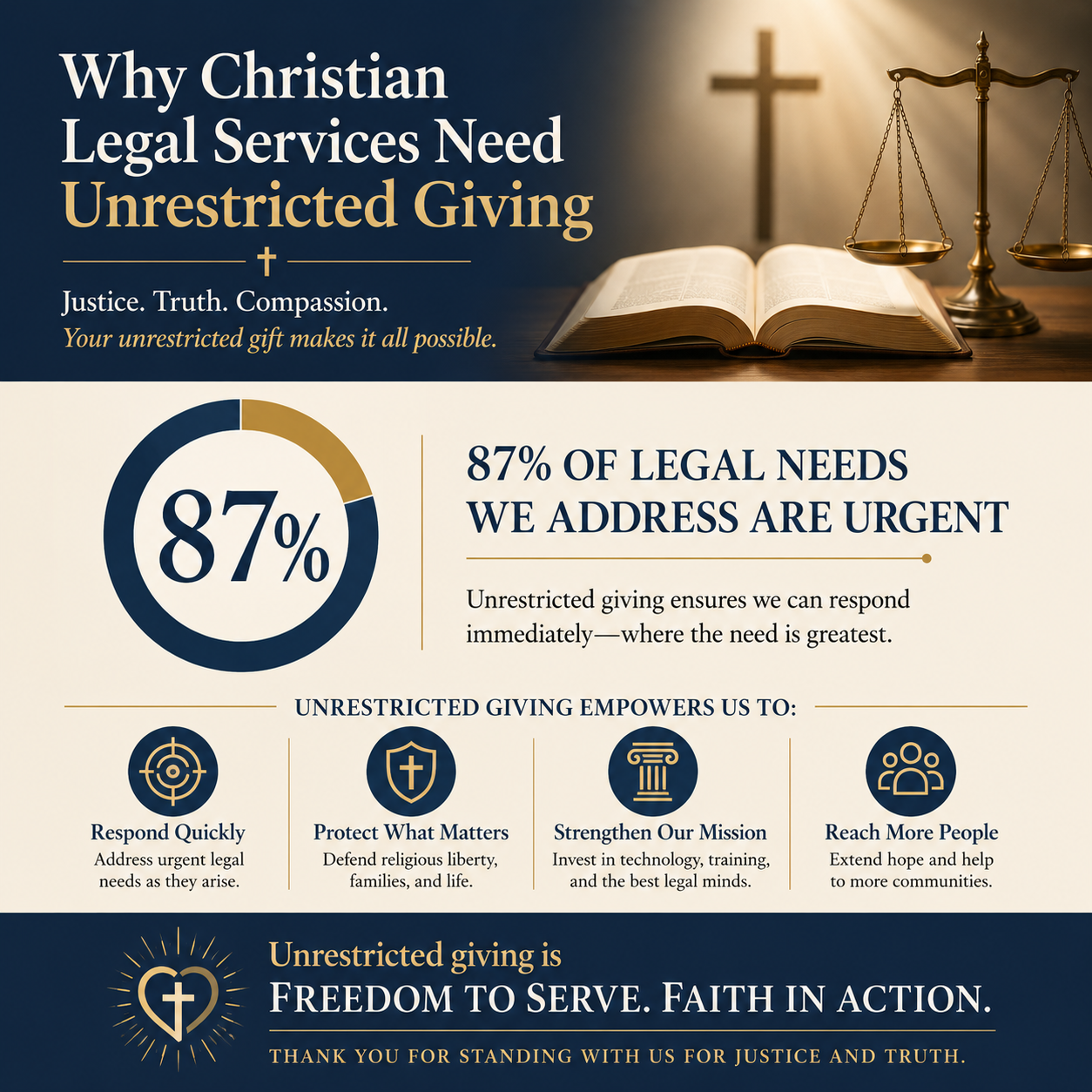
In legal services, those costs include:
- Professional supervision and case review to ensure competent representation
- Continuing legal education and training in trauma-informed advocacy
- Secure technology for client confidentiality and document management
- Translation and interpretation for clients with limited English proficiency
- Volunteer screening and appropriate oversight when pro bono counsel is involved
Christians genuinely disagree about how much discretion a donor should preserve for a ministry. Yet most sophisticated donors also recognize that responsibility cannot be exercised without adequate tools. Unrestricted giving is often what supplies those tools.
Truth-telling about overhead serves donors and clients
The philanthropic sector has had to reckon with how “overhead” framing can distort wise stewardship. The “Overhead Myth” letter—signed by Charity Navigator, GuideStar, and the BBB Wise Giving Alliance—argues that overemphasis on overhead can starve nonprofits of the very investments that produce results.Charity Navigator This does not mean overhead is irrelevant. It means the question is whether the ministry’s spending is aligned with mission, well-governed, and transparent.
For Christian legal services, the moral stakes are high. Underinvesting in supervision or case systems is not like underinvesting in office furniture. It can increase the risk of missed deadlines, mishandled evidence, or inconsistent counsel—failures that can directly harm neighbors seeking help.
Unrestricted support strengthens accountability when it is tied to verification
Flexibility and accountability are not opposites
Unrestricted giving becomes concerning when a donor lacks visibility into governance, financial controls, or the truthfulness of public claims. It becomes wise when a donor has credible reasons to trust the ministry’s leadership and reporting. This is where independent verification serves the church: it helps donors support the work without demanding micromanagement that undermines the work.
Most Trusted evaluates ministries against The Most Trusted Standard, a 15-criteria framework covering Faith Foundation, Financial Integrity, Governance and Leadership, and Transparency and Effectiveness. The point is not to replace prayerful discernment. It is to strengthen it with verifiable signals: board oversight that functions, financial statements that make sense, conflict-of-interest policies that are real, and public communication that does not overpromise.
What donors should look for before giving unrestricted funds
Responsible flexibility rests on responsible leadership. Before offering unrestricted support to a Christian legal ministry, donors can look for evidence that the ministry has the structures necessary to steward discretion well. This includes clear mission articulation, independent board governance, audited or professionally reviewed financials when appropriate to size, and honest reporting that does not treat clients as marketing assets.
Donors seeking a broader view of how this field operates can review Christian Legal Services Ministries, where we track patterns that tend to distinguish durable, accountable legal ministries from those built around urgency alone.
Unrestricted giving equips ministries to pursue justice without losing mercy
Justice work is vulnerable to drift in either direction
Christian legal ministries walk a narrow path. On one side is harshness: treating clients as problems to be solved, or treating legal victory as the only good. On the other side is sentimentality: avoiding hard counsel, avoiding boundaries, or confusing compassion with permissiveness. Scripture refuses both. “What does the Lord require of you but to do justice, and to love kindness, and to walk humbly with your God?” (Micah 6:8). Legal ministry at its best reflects that integrated calling.
Unrestricted funding can help a ministry remain on that path because it funds the leadership time and organizational maturity required for humility: supervision, accountability, repentance when necessary, and the ability to say no to cases the ministry cannot handle well. These are not signs of weakness. They are signs of fear of the Lord.
Practical implications for donors who want faithful impact
Many donors prefer restricted gifts because they want to ensure their giving produces concrete outcomes. That concern is not misguided. The answer, however, is often better verification and clearer reporting, not narrower restrictions. When donors force all value into a program line, ministries can become brittle. When donors fund the whole mission with accountability, ministries can serve people as they actually are, not as a grant category defines them.
For donors thinking carefully about how ministries handle gift designations, budgeting, and reporting practices, How Christian Legal Services Use Donations addresses common funding models and the stewardship questions they raise.
FAQs for Why Christian legal services need unrestricted giving
Is unrestricted giving less accountable than restricted giving?
Not necessarily. Restricted giving can feel more accountable because it is easier to track to a specific activity, but accountability in Christian ministry depends more on governance, financial controls, truthful reporting, and ethical practice than on restriction alone. Unrestricted giving is appropriate when a ministry demonstrates credible oversight and transparency, and when it reports outcomes and learning without exaggeration.
Should donors ever restrict gifts to Christian legal services?
Sometimes. Restrictions can be wise when they align with a ministry’s demonstrated strategy, cover the full cost of the work, and do not pressure staff to take cases or pursue outcomes that conflict with ethical duties. Many legal ministries still need some flexible funding to cover supervision, systems, and unpredictable demand. For many donors, a balanced approach is to make a meaningful unrestricted gift and then add a smaller, carefully designed restricted gift that the ministry itself has invited.
A form of trust that strengthens the work
Christian legal services need unrestricted giving because justice ministry is not a set of predictable transactions. It is covenantal work carried out in contested spaces, under deadlines, with human beings who bear God’s image and often carry profound harm. Restricted gifts can support worthy efforts, but unrestricted support often makes those efforts resilient, ethically governed, and available when the next neighbor knocks.
For donors, the aim is neither blind trust nor controlling suspicion. It is disciplined stewardship: verifying a ministry’s foundations, then funding it in a way that allows faithful leaders to do the work with competence, humility, and staying power.



