
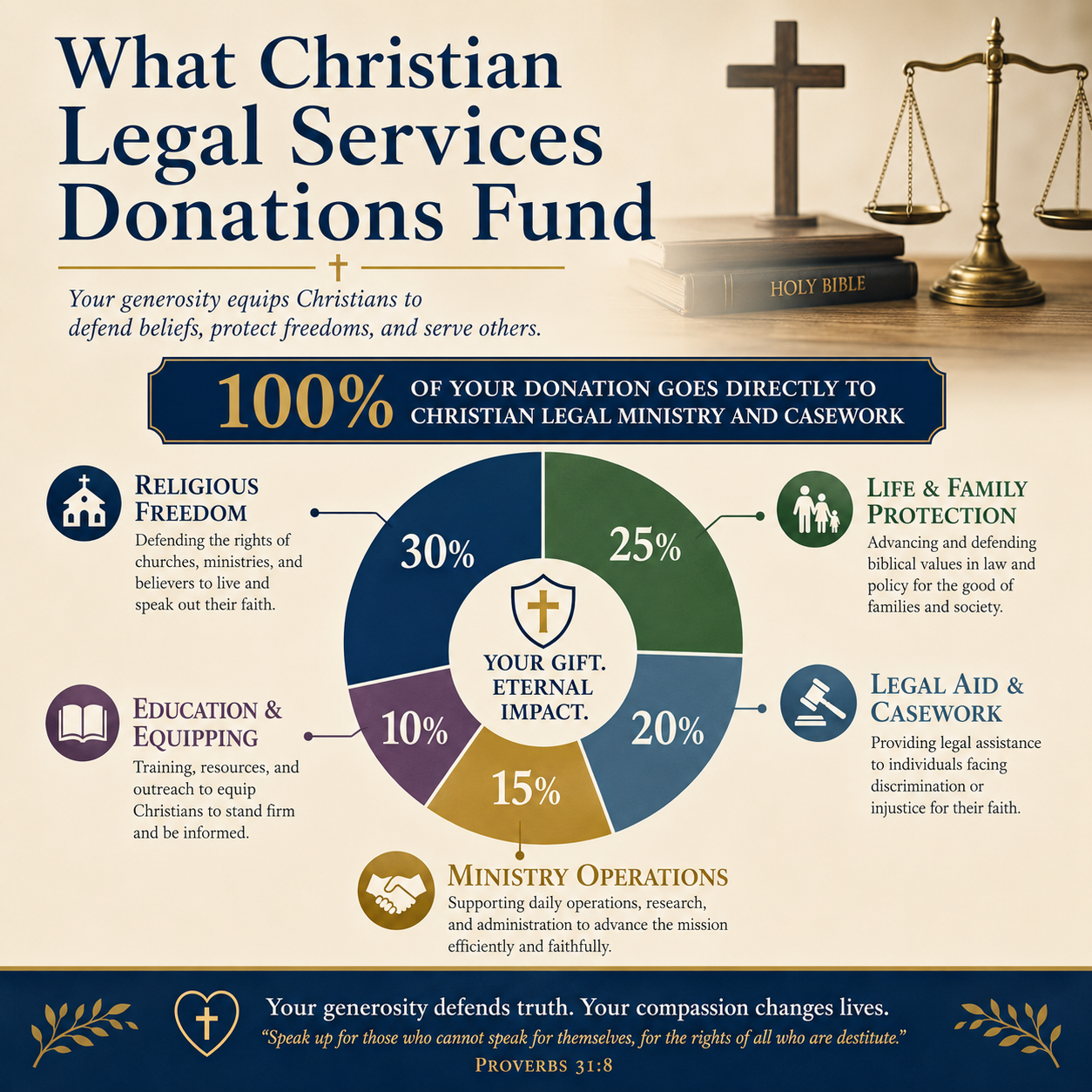
What Christian legal services donations fund is not an abstract question about “overhead” versus “program.” It is a question about whether the church will sustain patient, competent, and morally serious advocacy for neighbors whose legal problems can destroy a family, a livelihood, or a future in a single hearing.
Legal need is often invisible to donors because it is paperwork-heavy, slow, and shaped by systems most people only encounter in crisis. Yet Scripture consistently treats justice as a core obligation of God’s people: “Give justice to the weak and the fatherless; maintain the right of the afflicted and the destitute” (Psalm 82:3). Christian legal ministries exist where that mandate meets the real constraints of courts, housing markets, immigration systems, and family law.
1. Client representation and casework are the core cost
Attorney time is the ministry, and it is labor-intensive
For most Christian legal aid and legal services ministries, donations primarily underwrite professional time: licensed attorneys, accredited representatives where applicable, and trained paralegals who can carry cases from intake to resolution. A single matter can require interviews, document collection, legal research, negotiations, filings, court appearances, and follow-up. This is not optional “administration.” It is the work itself.
In practice, much of the impact comes through high-volume, high-stakes civil legal issues: eviction defense, domestic violence protective orders, child custody, consumer debt, benefits denials, and immigration relief. The stakes are measurable. The U.S. Department of Housing and Urban Development’s 2024 Annual Homeless Assessment Report attributes roughly 36% of adult homelessness to people in families, reminding donors that housing instability is not confined to single adults and that preventing displacement can be family preservation work HUD.
Expertise must match the arena
Christian donors sometimes assume legal ministries can rely mainly on well-meaning volunteers. Volunteers matter, but courts and agencies have standards. Competent representation requires continuing legal education, supervision, malpractice coverage, and specialized knowledge that changes with new legislation and case law. The ministries most worthy of confidence treat professional formation as a stewardship obligation, not a luxury.

2. Intake, triage, and pastoral care keep the work faithful and sustainable
Wise triage protects clients from false promises
A significant portion of donations goes to intake systems: phone lines, online forms, language access, conflict checks, and case prioritization. These processes are morally weighty. Legal ministries cannot ethically take every case. They must decide where help is feasible, where urgency is highest, and where referral is the most honest next step.
The scale of unmet need is one reason triage matters. The Legal Services Corporation’s 2022 Justice Gap report found that low-income Americans received inadequate or no legal help for 92% of their substantial civil legal problems Legal Services Corporation. Christian legal ministries operate inside that gap. Without disciplined intake and referral pathways, good intentions become a form of harm.
Trauma-informed care and spiritual integrity are not add-ons
Many clients arrive in crisis: survivors of abuse, families facing eviction, immigrants navigating complex procedures, people crushed by predatory lending. Donations often fund training in trauma-informed client communication, partnerships with counselors, and policies that protect clients from spiritual coercion. Christian legal services should never treat the vulnerable as a conversion project. The credibility of our witness depends on serving with the humility of Christ, who never exploited need.
3. Community education and prevention extend justice beyond the courtroom
Clinics, workshops, and self-help tools reduce downstream harm
When donors ask what funds “impact,” prevention is frequently the most underappreciated answer. Christian legal services often operate legal clinics, “know your rights” workshops, and document-prep sessions that keep problems from becoming catastrophes. This can include landlord-tenant education, expungement information, debt counseling in coordination with legal advice, and family preparedness planning.
These efforts are not merely economical; they are an expression of prudence. Scripture commends wisdom that anticipates danger rather than ignoring it (Proverbs 22:3). For families living paycheck to paycheck, a small legal intervention early can avert a cascade of late fees, job loss, school disruption, and displacement.
Partnerships with churches require careful boundaries
Many ministries train pastors and church care teams to recognize legal issues and refer appropriately. Done well, this strengthens the local church’s mercy ministry without asking pastors to play attorney. Done poorly, it can blur roles, create confidentiality risks, or pressure clients. The ministries we regard as strongest articulate boundaries clearly, including what can be shared, how consent is documented, and when to refer outside the church network.
4. The less visible costs are often the most decisive
Compliance, confidentiality, and risk management protect the vulnerable
Christian donors sometimes assume that “non-program” costs are negotiable. In legal services, many are non-negotiable. Donations fund secure case management systems, data protection, document storage, and policies that honor attorney-client privilege. They also fund malpractice insurance, HR practices, and supervision structures that reduce the risk of preventable errors.
This is where sophisticated donors rightly press for evidence. Across our verification work at Most Trusted, the ministries that meet The Most Trusted Standard tend to treat internal controls and governance as part of neighbor-love. In legal work, carelessness does not only waste dollars; it can expose a client to retaliation, deportation consequences, or the loss of custody rights.
Evaluation can be faithful without becoming reductionistic
Legal outcomes are difficult to summarize with one metric. A “win” may be a protective order secured, an eviction avoided, lawful status obtained, or a debt settled. It may also be a dignified process where the client is heard and guided, even if the legal remedy is limited. Donors can ask for concrete indicators without forcing ministries into simplistic scorekeeping.
Where metrics are used, they should be interpretable: number of clients served, types of cases handled, outcomes by category, and the boundaries of what counts as a successful resolution. For donors seeking to understand how a ministry thinks about effectiveness and transparency, the broader landscape of How Christian Legal Services Use Donations provides important context.
5. What discerning donors should look for when funding Christian legal services
Christian justice work requires competence and moral clarity
Christians genuinely disagree about public policy, and legal ministries may operate in contested spaces. The more important question for donors is whether a ministry’s work is anchored in biblical justice and carried out with professional rigor. “Justice, and only justice, you shall follow,” Moses commanded (Deuteronomy 16:20). In legal services, that means truthful counsel, lawful strategy, and a refusal to manipulate facts or people for outcomes.
We also recommend resisting simplistic judgments based on expense ratios alone. The “Overhead Myth” letter—signed by GuideStar (now Candid), BBB Wise Giving Alliance, and Charity Navigator—argues that focusing narrowly on overhead can mislead donors and punish organizations for necessary investment in systems and talent Candid. Legal ministries, by their nature, require skilled labor and strong compliance.
Practical questions that clarify stewardship
Donors do not need to be attorneys to practice careful discernment. The following questions tend to separate ministries with mature governance and transparent practice from those running on goodwill alone:
- What case types does the ministry handle, and what does it explicitly decline?
- How does it protect confidentiality, including in church-based settings?
- What does supervision look like for staff and volunteers providing legal help?
- How are outcomes reported with appropriate nuance and client privacy?
- How does the ministry articulate its faith foundation without coercing clients?
Donors seeking verified confidence should also consider whether a ministry can supply documentation that maps to The Most Trusted Standard: doctrinal clarity, audited or reviewed financials where appropriate, board independence and oversight, and honest reporting about limits as well as successes. Related ministry context can be found under Christian Legal Services Ministries.
FAQs for What Christian legal services donations fund
Do donations mainly pay for lawyers, or do they fund direct aid to clients?
In most Christian legal services models, donations primarily fund professional legal work: attorney and paralegal time, intake, supervision, and the compliance systems necessary to represent clients ethically. Some ministries also maintain client emergency funds or partner with churches for material assistance, but legal services are typically the central expense because representation is labor-intensive and regulated.
Should donors prefer ministries that rely heavily on volunteers to keep costs low?
Volunteer involvement can extend reach, but low cost is not the same as faithful stewardship. Legal services require competence, supervision, confidentiality safeguards, and malpractice risk management. A mature ministry uses volunteers where appropriate and ensures their work is integrated into professional oversight, rather than substituting goodwill for qualified representation.
Justice is costly, and it is worth funding
What Christian legal services donations fund is the patient work of standing with neighbors where systems are complex and the consequences are severe. The church’s call is not only to compassion but to justice that is truthful, competent, and protective of the vulnerable. Donors who fund Christian legal services well are not buying a quick outcome; they are sustaining a form of mercy that often looks like careful documents, difficult conversations, and faithful perseverance.



