
How Christian legal services use donations is a stewardship question before it is a budgeting question. Donors are not merely purchasing hours of legal work; they are participating in an expression of justice and mercy that Scripture refuses to separate. “Learn to do good; seek justice, correct oppression” (Isaiah 1:17) is not a slogan for a grant report. It is a summons that shapes what we should expect from any ministry that represents vulnerable neighbors in systems where power and paperwork often decide outcomes.
The harder question is not whether legal aid is “ministry,” but how to discern whether a Christian legal services organization is deploying gifts with integrity: protecting clients, pursuing lawful remedies, telling the truth about results, and sustaining the work without drifting into institutional self-preservation. Across our verification work at Most Trusted, donors tend to underestimate how many moving parts sit behind a single case outcome. What looks like “one attorney helping one person” often depends on intake teams, interpreters, trauma-informed client support, supervision, compliance, and disciplined reporting that can bear scrutiny.
Justice work has real costs and spiritual stakes
Christian legal services ministries generally operate in the tension between Matthew 25 mercy and the practical constraints of law practice. They often serve clients who are facing eviction, domestic violence, wage theft, immigration complexity, benefits denials, or criminal-record barriers that limit employment and housing. The moral weight is evident: a missed deadline can mean a family loses shelter; an unchallenged unlawful practice can ripple across an entire community. Scripture’s warnings against partiality and exploitation are not abstract when the client has no meaningful bargaining power (Proverbs 31:8–9).
Legal aid is both relational ministry and regulated profession
Donations support more than compassion; they support competent representation under ethical rules that govern conflicts of interest, confidentiality, and professional supervision. Ministries that treat legal work as an informal “good deed” frequently expose clients and donors to risk. A mature operation invests in licensed leadership, case-management systems, and training that keeps volunteer attorneys within scope, supervised, and covered appropriately. These are not optional accessories; they are part of loving neighbors with competence.
Demand for help is high, and triage is unavoidable
Even strong ministries cannot take every case. Nationally, civil legal aid reports that low-income Americans receive inadequate or no legal help for the majority of substantial civil legal problems they face, a persistent justice gap documented by the Legal Services Corporation’s Justice Gap research. This reality shapes how donations are used: intake and triage systems, referral networks, and clear criteria for limited-scope representation are often the difference between serving many wisely and serving a few chaotically.
Pro bono labor is a gift, but it is not free
Many Christian legal services ministries rely heavily on volunteer attorneys. Donors sometimes assume that means “low overhead.” In practice, pro bono models require coordination, training, conflict checks, malpractice coverage strategies, and staff who can manage volunteer capacity without compromising client outcomes. When donors fund the infrastructure that makes pro bono effective, they are multiplying competent service, not subsidizing bureaucracy.

What donations typically fund in Christian legal services
Donors deserve clarity about the ordinary expense categories that keep legal ministry faithful, lawful, and durable. The ministries that meet The Most Trusted Standard tend to explain these categories without defensiveness: not as excuses, but as honest descriptions of what it takes to serve clients well and report work transparently.
Direct casework and clinical support
The core expense is usually staff time: attorneys, accredited representatives where permitted, paralegals, and intake specialists. But direct service also includes interpreters, document translation, filing fees in some cases, and travel to courts or detention facilities when needed. For some practice areas, donor funds support expert consultations or specialized training (for example, immigration updates or trauma-informed interviewing). Ministries that serve survivors of domestic abuse may also coordinate with shelters and counselors, even when the legal team is not providing counseling directly.
Intake, triage, and case management systems
Every credible legal aid operation needs disciplined intake and documentation. Donations often fund secure case-management software, data protection, and staff who ensure timely follow-up and appropriate referrals. This work rarely appears in a courtroom photo, but it is often where justice is preserved: correct deadlines, accurate filings, complete declarations, and coherent evidence packages.
Volunteer recruitment, training, and supervision
Where volunteer attorneys are a primary delivery model, donor support frequently underwrites training modules, CLE hosting costs, mentor programs, and staff supervision. Effective ministries build repeatable pathways for volunteers: clear playbooks, templates, and escalation routes for complex cases. Without these, volunteers burn out, clients experience inconsistency, and the ministry’s reputation suffers.
Client protection and legal ethics safeguards
Christian donors sometimes focus on speed—“How many cases did you close?”—when faithfulness may require slower, more careful work. Donations may fund conflict-of-interest systems, secure communication tools, and policies that protect client confidentiality. They may also support background checks for volunteers, appropriate boundaries in client relationships, and clear procedures when allegations arise. The aim is not risk avoidance for its own sake, but the protection of vulnerable clients and the honor of Christ’s name.
Administrative support that enables mission
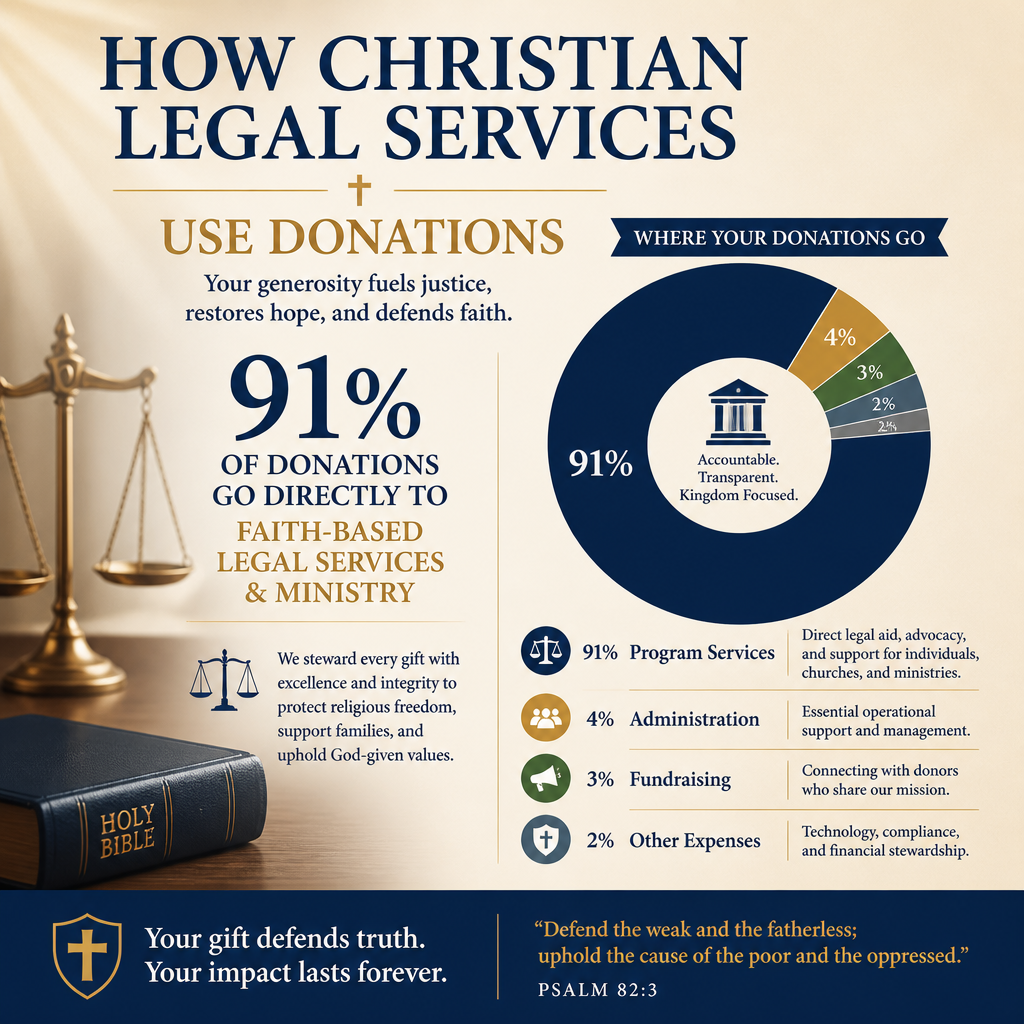
Competent legal work requires administration: HR, finance, compliance, and facilities. Donors influenced by the “overhead” obsession often assume administration is a necessary evil. The nonprofit sector has had to correct that assumption publicly. Charity Navigator, Candid (formerly GuideStar), and BBB Wise Giving Alliance jointly warned donors against judging organizations primarily by overhead ratios in their widely cited “Overhead Myth” letter, accessible through Charity Navigator. Christian legal services ministries, in particular, cannot keep client files secure, meet court deadlines, or supervise volunteers without administrative competence.
Restricted and unrestricted gifts shape what ministries can actually do
Christians genuinely disagree about how much giving should be restricted. Some donors believe restrictions increase accountability; others believe they unintentionally distort priorities. The most responsible ministries acknowledge both realities and are candid about what each type of gift enables.
Why unrestricted giving is often the quiet engine of effectiveness
Unrestricted donations fund the connective tissue: intake capacity, supervision, technology, development of volunteer networks, and the ability to respond to urgent cases that do not fit a restricted line item. In legal services, urgent does not always mean dramatic; it often means time-bound. A short window to respond to an eviction notice or a removal proceeding can determine whether a family remains housed or a person remains with their spouse and children.
Unrestricted gifts also allow ministries to invest in staff retention and professional development. Legal aid frequently competes with far higher salaries in the private sector. Ministries that refuse to address this tension often experience turnover that destabilizes client service. Donors may prefer their dollars to go “directly to clients,” but when experienced attorneys leave, clients pay the price in continuity and quality.
How restricted gifts can serve donors and clients when they are well designed
Restricted funding can be a strong fit for specific, measurable initiatives: a defined immigration clinic, a domestic violence protective order project, a reentry legal clinic, or a rural outreach schedule. The restriction becomes harmful when it is so narrow that it funds only public-facing activity while leaving the ministry to scramble for compliance, supervision, and follow-up. A responsible restriction is one that includes a fair share of the real costs required to deliver the service with excellence.
Administrative costs and the Christian duty of honesty
Donors sometimes fear that “administration” masks waste. That concern is not imaginary; the nonprofit world has seen scandals, and Christian ministries are not immune. The better response is not to starve administration, but to demand governance, financial controls, and transparency that can be verified. The ministries that merit long-term donor confidence can explain their accounting categories, provide audited financials when appropriate to their size, and show how back-office functions protect clients and strengthen outcomes.
What credible reporting looks like for donors who want to give with confidence
Because legal matters involve confidentiality, donors should not expect ministries to publish client stories with identifying details or to treat vulnerable people as fundraising content. At the same time, donors are right to expect verifiable evidence that gifts are producing real service and lawful, ethical outcomes. Accountability is not opposed to compassion; it is one way compassion becomes trustworthy.
Outcome reporting that respects confidentiality
Responsible legal services ministries often report outcomes in aggregate: number of clients served, cases opened and closed, legal issues addressed, and categories of resolutions (for example, protective orders obtained, benefits secured, housing preserved, or lawful status achieved). Where financial impact is reported, mature organizations distinguish between inflated “value of services” figures and more cautious measures that avoid exaggeration. In this field, overclaiming is not merely a communications misstep; it is a moral failure.
Case impact is more than court wins
Many matters never reach a trial. A well-timed demand letter, negotiated agreement, or administrative appeal can prevent harm without a dramatic verdict. Donors should ask whether the ministry defines “success” with professional and theological maturity: Did the client receive competent counsel? Were options explained truthfully? Were the client’s lawful interests pursued diligently? Was the client treated as a neighbor, not as a project?
Some ministries also engage in limited policy work, community education, or systemic advocacy. Christians will differ on the prudence of various approaches, and donors should examine whether a ministry’s positions and methods align with their convictions and remain consistent with a clear statement of faith. The key is transparency: donors should not be surprised by a ministry’s tactics or affiliations.
Verification and the role of The Most Trusted Standard
At Most Trusted, our work is not to tell donors which causes they must support, but to help them give with confidence by evaluating ministries against The Most Trusted Standard. For Christian legal services, that means evidence of a clear faith foundation, credible financial integrity, accountable governance, and transparency about outcomes and limitations. When a ministry can document board oversight, conflict-of-interest practices, sound financial reporting, and honest outcome measurement, donors can focus their energy on the spiritual question Scripture presses on all of us: whether our resources are being poured out in love of God and neighbor.
Donors considering this field may also benefit from reading more across Christian Legal Services Ministries as they weigh how different legal models serve different populations and how ministries communicate impact without compromising client dignity.
Giving that strengthens justice and honors Christ
How Christian legal services use donations should be evaluated with both spiritual seriousness and practical clarity. Donors can rightly insist on ethical safeguards, competent staffing, and transparent reporting, while also recognizing that legal ministry is often quiet, complex, and constrained by confidentiality. When giving is aligned with truthfulness, accountability, and mercy, it becomes part of the Church’s public witness that justice is not an abstraction, but a neighbor served in the name of Christ.



