
What administrative costs fund in Christian legal services is not a side question for serious Christian donors; it is the practical question of whether a ministry can sustain faithful, competent, and accountable work over time. Legal help for vulnerable neighbors is rarely simple. Cases turn on deadlines, evidence chains, trauma-informed client care, confidentiality duties, and shifting local court procedures. Administrative spending is the infrastructure that keeps that complexity from collapsing onto clients who already have too little margin.
Christians genuinely disagree about how much overhead is “too much,” and some ministries have harmed trust by using vague categories to hide inefficiency. Yet the opposite error is also common: starving administration until staff burn out, compliance breaks down, and legal outcomes suffer. The apostle Paul’s insistence that “all things should be done decently and in order” (1 Corinthians 14:40) is not a preference for bureaucracy; it is a moral claim about stewardship when the stakes involve people, promises, and justice.
Administrative costs are often the ministry’s promise-keeping systems
Christian legal services ministries make implicit promises to clients and explicit promises to donors. Administrative costs fund the systems that keep those promises credible. In the legal field, “order” is not ornamental. A missed filing date, a mishandled conflict check, or a poorly secured client record can irreversibly harm a family’s future.
Case intake, triage, and conflicts checks
Many ministries receive far more requests than they can accept. Administration funds the intake process that screens for urgency, eligibility, and legal fit, and routes clients to the right kind of help. It also pays for conflict-of-interest checks, a standard professional requirement that prevents a ministry from inadvertently representing opposing interests and undermining trust.
Docket control and deadline discipline
Legal work runs on calendars. Administrative staff and tools maintain docketing, court reminders, document templates, and internal review steps that reduce preventable error. Donors sometimes imagine that the “real work” is only the attorney’s time in a courtroom or drafting a brief. In practice, much of the real work is ensuring that the attorney’s work is timely, supported, and properly recorded.

Compliance and risk management protect clients and the witness of the ministry
Christian ministries are rightly expected to operate above reproach. For legal services, this includes professional ethics, data security, and careful boundaries with vulnerable clients. Administration funds the controls that keep a ministry faithful to both law and conscience.
Confidentiality, records, and data security
Client confidentiality is not only a legal duty; it is a matter of neighbor-love. Administrative budgets commonly cover secure case-management systems, encrypted storage, access controls, and staff training. When these safeguards are thin, the ministry’s most sensitive clients bear the risk.
Governance, policies, and insurance
Many legal ministries carry professional liability coverage, maintain board-approved policies, and document decision-making that can withstand scrutiny. Those functions rarely appear dramatic, but they reduce the likelihood that a ministry will collapse in the wake of an allegation, a mistake, or a leadership transition. For donors weighing long-term partnership, this is part of what makes a ministry dependable rather than merely sincere.
Across the wider nonprofit field, major charity evaluators have warned donors not to treat overhead as a proxy for impact. In their joint “Overhead Myth” statement, GuideStar, Charity Navigator, and the BBB Wise Giving Alliance argue that overhead ratios can incentivize underinvestment in the very systems that make results possible GuideStar. Christian donors can affirm that warning without abandoning discernment; the question is not whether administration exists, but whether it is proportionate, transparent, and disciplined.
Administrative spending underwrites competent people and sustainable capacity
Legal services can be mission-driven and still require highly skilled labor. A ministry can have doctrinal clarity and sincere compassion yet still fail clients if it cannot retain capable staff, train volunteers well, and build stable operations. Administrative costs often fund that capacity.
Staff who multiply the work of attorneys and volunteers
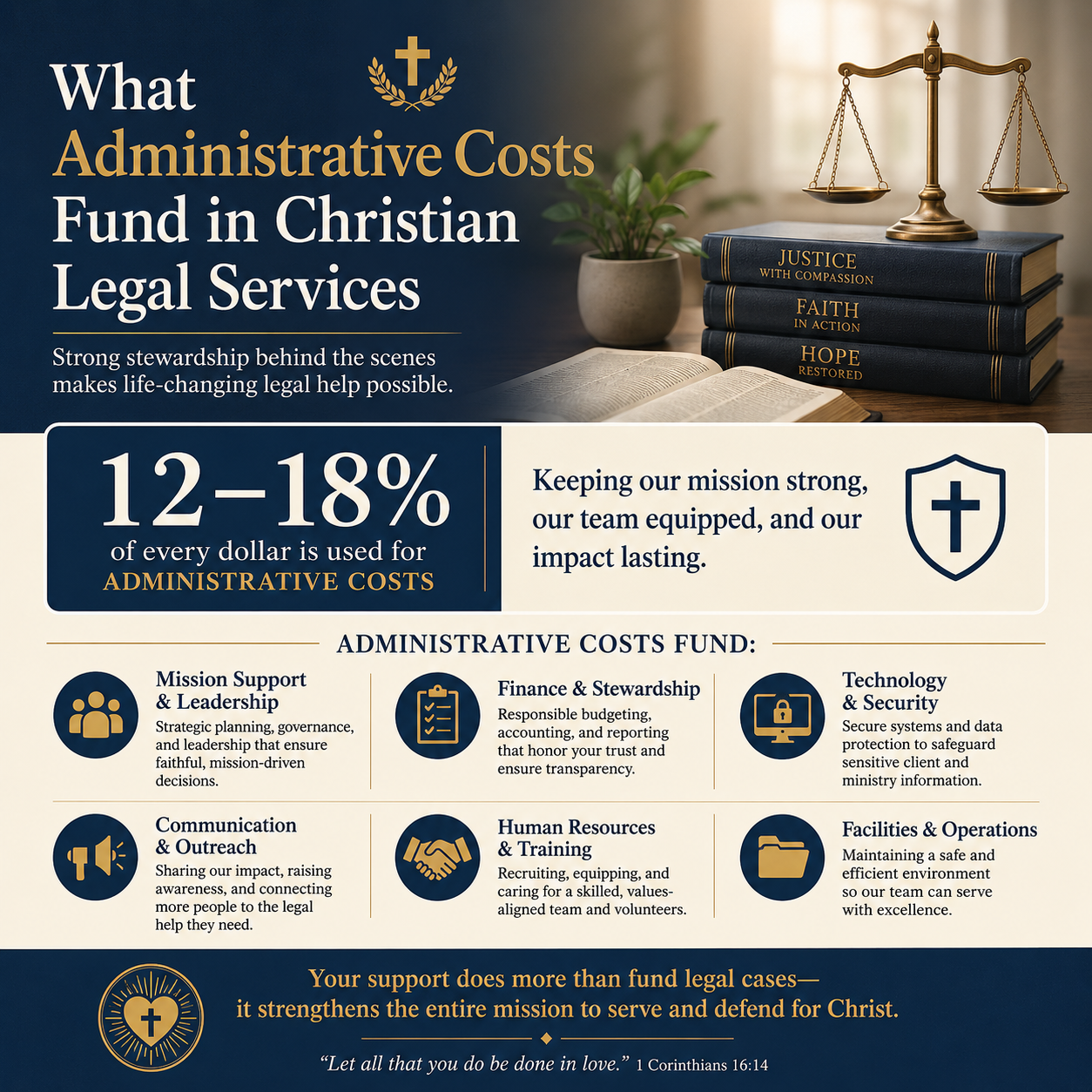
In many legal ministries, administrative roles are not “extra.” They are multipliers: legal assistants who prepare filings, client advocates who coordinate appointments and gather documents, program coordinators who schedule clinics, and operations leaders who keep finances and HR orderly. When these positions are absent, attorneys spend their time on tasks that dilute the value of their expertise.
Training, supervision, and quality control
Many Christian legal services ministries rely on volunteers, including pro bono attorneys and church-based clinic teams. Administration funds training materials, supervision, and review processes that protect clients from inconsistent advice. It can also fund continuing legal education and the internal quality checks that keep the ministry’s work aligned with current law and best practice.
The need for sound administration is sharpened by a simple reality: legal need is widespread, and vulnerable communities often face it acutely. For example, the Legal Services Corporation has reported that low-income Americans experience substantial civil legal needs each year and that many go unmet Legal Services Corporation. When need is deep and resources are finite, disciplined operations are part of justice, not a detour from it.
Financial administration is stewardship, not mere bookkeeping
Donors should expect Christian legal services ministries to handle funds with the sobriety Scripture demands. Financial administration is where integrity becomes auditable. It also determines whether a ministry can withstand volatility in giving or unexpected legal expenses without compromising its commitments.
Budgeting, internal controls, and audits
Administrative costs commonly include accounting systems, separation of duties, reconciliations, and—when appropriate—independent financial reviews or audits. Those are not merely “best practices.” They are the practical mechanics of avoiding misstatement, fraud, and confusion. When we evaluate ministries at Most Trusted, we look for verifiable evidence that financial controls are real, implemented, and reviewed, not merely described in policy documents.
Restricted gifts and donor intent
Legal ministries often receive restricted gifts for specific programs, client populations, or geographic areas. Tracking restrictions and reporting on their use is an administrative task that protects donor intent. It also prevents the common temptation to “borrow” restricted funds for general needs, a practice that can damage credibility even when done with good intentions.
- Accurate classification of program versus administrative expenses
- Clear documentation for restricted gifts and designated funds
- Timely financial reporting to leadership and board oversight
- Prudent reserves planning for predictable volatility
- Vendor management and cost controls that do not weaken quality
For donors who want to understand how giving is used across the sector, we address related questions under How Christian Legal Services Use Donations. The strongest organizations do not treat donor questions as a threat. They treat them as an opportunity to practice transparency with theological seriousness.
What disciplined administration looks like in ministries that merit confidence
Administrative spending can either protect mission focus or quietly replace it. The difference is not always visible from a pie chart. Mature Christian donors do well to ask what administration is producing: clarity, accountability, and client care, or vagueness, drift, and institutional self-preservation.
Transparency that makes categories meaningful
Healthy ministries explain what sits inside “administration” and why it is necessary. They publish annual reports that are consistent with their financial statements, define program outcomes without exaggeration, and make it possible for donors to follow the logic of the work from gift to client impact. In our verification work at Most Trusted, the ministries that meet The Most Trusted Standard tend to name trade-offs plainly: where they are investing, what they are not doing, and why.
Governance that keeps mission ahead of institutional comfort
Governance is one of the quiet places where administration either serves the Gospel or serves itself. Strong boards ask hard questions about case selection, client safety, theological identity, and financial sustainability. They review executive compensation and key policies without defensiveness. They also protect staff from impossible expectations by making plans that match reality rather than wishful projections.
Donors exploring the broader landscape of providers, models, and mission commitments can also consult Christian Legal Services Ministries. The field includes everything from immigration legal aid to human trafficking advocacy to criminal justice-related civil matters. Administrative needs vary by model, but the underlying ethical obligations remain.
FAQs for What administrative costs fund in Christian legal services
Should donors avoid ministries with higher administrative percentages?
Not automatically. A higher administrative percentage can reflect honest accounting, investments in compliance and quality control, or the realities of a smaller organization building stable systems. The more faithful question is whether the ministry can clearly explain the spending, show that it strengthens client service, and demonstrate accountable governance and financial integrity consistent with The Most Trusted Standard.
What administrative line items matter most for client protection?
In legal services, donors should pay particular attention to conflict-of-interest processes, secure case-management and confidentiality safeguards, staff training and supervision, and credible financial controls. These are not luxuries. They are mechanisms that prevent preventable harm, preserve trust, and keep the ministry’s advocacy worthy of the name of Christ.
Administration is part of loving the neighbor with competence
Christian legal services exists to serve people, not spreadsheets. Yet love without order can become a form of negligence when deadlines are real and clients are fragile. Administrative costs fund the disciplines that let a ministry keep its word: to clients who need careful help, and to donors who are offering a stewardship that deserves clarity. When administration is transparent, proportionate, and accountable, it is not a diversion from mission; it is one of the ways a ministry practices truthfulness in the sight of God and man.



