

How Christian financial service ministries measure impact determines whether donor dollars restore families or merely rearrange symptoms. For Christian donors, the burden is not only to fund good intentions, but to fund outcomes that align with biblical stewardship and with the dignity of those served.
Financial discipleship and relief ministries operate in a field with persistent confusion about what “works.” Christians genuinely disagree about the proper mix of charity and responsibility, about how quickly households should move from crisis assistance to self-sufficiency, and about whether measured outcomes can ever capture spiritual formation. Yet Scripture does not permit vagueness about stewardship. Jesus’ parable of the talents commends faithful management with real accountability (Matthew 25:14–30). The question is not whether to measure, but what to measure, how honestly, and with what moral safeguards.
Impact begins with a theology of money and neighbor love
Financial outcomes are never morally neutral
Christian financial service ministries sit at an intersection Scripture treats as spiritually consequential: money, power, and care for the vulnerable. We cannot speak about “impact” without first naming the moral vision underneath the metrics. Deuteronomy’s concern that there be “no poor among you” (Deuteronomy 15) is paired with warnings against hardening the heart toward a brother in need. The New Testament’s generosity ethic is similarly paired with integrity, honest work, and the call to provide for one’s household (1 Timothy 5:8).
What this means in practice is that credible impact measurement begins with clarity about the ministry’s theory of change. Is the ministry primarily delivering emergency relief, building financial capability, addressing predatory systems, or forming long-term habits of stewardship? Many organizations attempt to do all four. Donors should not assume that a single number can represent what faithfulness requires across such different aims.
Spiritual formation and material stability are related but distinct
Some ministries blur evangelism, discipleship, and financial coaching in ways that make measurement difficult. Others keep them distinct to protect trust with clients and to avoid coercion. Both approaches can be defensible, but neither is exempt from accountability. Material outcomes like reduced delinquency, stabilized housing, or increased savings are measurable. Spiritual outcomes are real but harder to quantify without reducing the work of the Spirit to a survey score. Mature ministries treat spiritual reporting with humility and resist inflating numbers to satisfy donors.
Donors who want to place this conversation in a broader context of sector norms will find that the core questions show up repeatedly across Christian Financial Service Ministries, even when programs differ dramatically.

Impact measurement in financial ministries requires clear outcome definitions
Outputs are not outcomes, and both matter
Many ministries report activity: number of coaching sessions delivered, budgets created, classes completed, or loans disbursed. These are outputs. They are not meaningless, but they can be dangerously reassuring if they become a substitute for outcomes. Outcomes ask whether the participant’s situation changed in a durable way: fewer overdrafts, sustained on-time rent payments, reduced high-interest debt, improved credit behaviors, or increased emergency reserves.
Responsible reporting connects outputs to outcomes and states limitations plainly. A ministry may deliver excellent coaching and still see uneven results because the client population faces unstable wages, medical shocks, or housing scarcity. The point of measurement is not to blame households for hardship or ministries for macroeconomic constraints. It is to understand where the program genuinely moves the needle and where it cannot.
Time horizons must fit the problem
Financial repair happens over months and years, not days. Credit recovery, debt payoff, and habit formation require time. Ministries that only measure at program completion can unintentionally reward short programs and penalize longer, more realistic interventions. Strong programs measure at multiple intervals: immediate completion, mid-term follow-up (often six to twelve months), and, where feasible, longer-term retention checks.
Donors can ask for concrete definitions. If a ministry says “families became financially stable,” what is the operational definition? Stable for how long? Stable against what kinds of shocks? Clarity here is not a technical preference; it is an integrity issue.
Credible evidence blends quantitative metrics with pastoral realism
Use numbers that can be audited, not only stories that inspire
Testimonies belong in Christian ministry reporting, but they cannot carry the full weight of accountability. Numbers can be distorted too, yet they offer a check against selective storytelling. At minimum, ministries should track metrics that can be verified internally through case files or systems of record: attendance, completion, repayment, delinquency, and follow-up contact rates. When ministries use credit score data or bank transaction data, they should explain consent, privacy safeguards, and how data are stored.
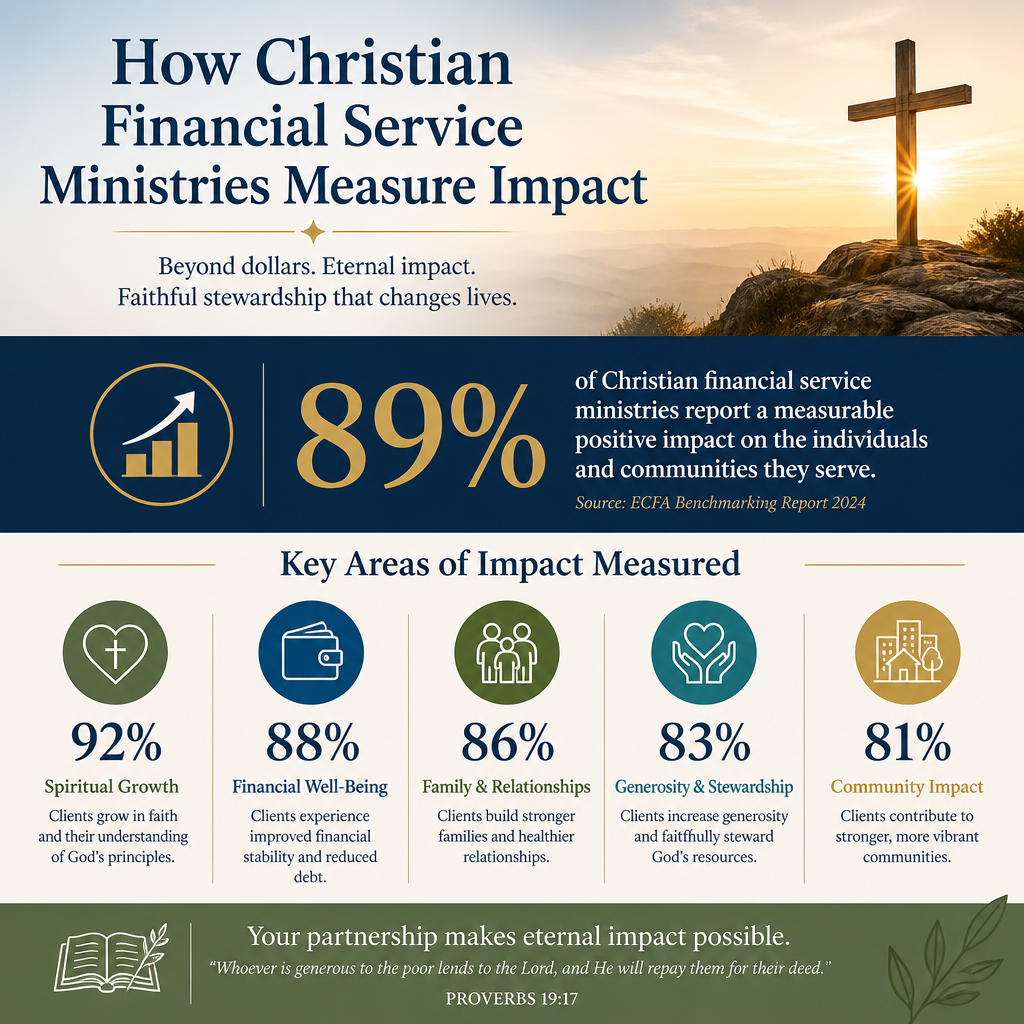
When donors fixate on overhead ratios, ministries can feel pressured to underinvest in data systems and staff training. The philanthropic field has repeatedly warned against this dynamic. In 2013, Charity Navigator, BBB Wise Giving Alliance, and GuideStar published an open letter commonly referred to as the Overhead Myth, arguing that overhead ratios are a poor proxy for effectiveness and can incentivize harmful underinvestment in infrastructure Charity Navigator.
Guard against spiritualized manipulation and coerced reporting
Financial ministries serve people in vulnerable positions: behind on rent, facing collections, or unable to meet basic needs. That vulnerability creates a moral duty to ensure that measurement does not become coercive. Participants should never feel that food, rent help, or counseling is contingent on giving the “right” answers about faith engagement or personal progress. Measurement that punishes honesty is not measurement; it is reputational management.
Healthy programs separate assistance decisions from the data collection process when possible, use clear consent language, and offer opt-outs without penalty. They also train staff to recognize that a household’s regression is not necessarily rebellion; it is often the normal volatility of poverty, unstable work, or chronic illness.
Strong ministries measure both household outcomes and systems outcomes
Household-level change is necessary, but it is not the whole story
Many Christian financial service ministries focus on the household: spending plans, debt reduction, emergency savings, and wise use of income. These are essential. Yet Christian ethics also recognizes structural realities: predatory lending, wage theft, discriminatory barriers, and housing shortages. Some ministries therefore add systems work: advocating for fair lending, partnering with employers, offering low-interest alternatives, or building community-based lending circles.
Measuring systems outcomes is more complex than measuring class completion. It may include tracking policy changes, the number of employers adopting a wage advance alternative to payday loans, or shifts in local access to safe financial products. Not every ministry is called to this, but donors should value honesty about scope. A program can be faithful and effective without claiming to reform an entire market.
Debt relief and lending ministries require special care
When a ministry provides loans, debt management, or debt relief, the measurement must include safeguards against harm. For example, a program might celebrate “loan volume” while ignoring that repayment terms are unrealistic for the client population. Or it may celebrate “debt eliminated” without counting the consequences if households fall back into crisis due to inadequate income or medical costs.
Donors can ask for a compact set of indicators that show whether the program is genuinely restorative:
- Default or delinquency rates, reported with clear definitions
- Repeat borrowing rates and whether repeat use reflects dependency or a prudent bridge
- Client retention and follow-up contact rates
- Evidence of reduced use of high-cost credit products over time
- Safeguards for client dignity, privacy, and informed consent
These questions are not adversarial. They are aligned with the biblical insistence that leaders must be “above reproach” in handling resources entrusted for the good of others (1 Timothy 3:2).
Donor due diligence should test for integrity, not just aspiration
Ask whether the ministry can show its work
Across our verification work at Most Trusted, we observe a consistent pattern: ministries that can explain their impact measurement in plain language usually have done the harder internal work of clarifying responsibility, improving documentation, and confronting uncomfortable results. Ministries that rely on generic claims—“transforming lives,” “breaking cycles,” “restoring hope”—often lack the internal discipline that faithful stewardship requires, even when their intentions are sincere.
For donors, the practical question is whether a ministry can show its work: what data are collected, at what intervals, with what safeguards, and with what independent oversight. Where the organization does not have the capacity for strong measurement, a mature posture is to say so and to state the plan for improvement. Humility is not a weakness in reporting; it is often a sign of integrity.
Independent verification matters because incentives distort reporting
Most ministries depend on donor confidence. That dependence can create pressure to report only favorable outcomes, to treat uncertain data as certain, or to avoid naming program limitations. Independent review does not remove all bias, but it can reduce the most predictable distortions.
Most Trusted exists to help donors give with confidence by evaluating ministries against The Most Trusted Standard, a 15-criteria framework across Faith Foundation, Financial Integrity, Governance and Leadership, and Transparency and Effectiveness. For donors assessing impact claims specifically, the question is whether transparency and effectiveness are treated as operational commitments rather than marketing themes. The related evaluation questions show up throughout The Mission and Impact of Christian Financial Service Ministries, where donor expectations rightly extend beyond sincerity to verifiable faithfulness.
Where ministries do report numbers, donors can also request clarity on methodology. Are results self-reported, staff-reported, or derived from administrative data? Is there a baseline? Is there a comparison group? Randomized controlled trials are not always feasible or ethical in ministry contexts, but basic methodological transparency is.
FAQs for How Christian financial service ministries measure impact
Should Christian financial ministries measure spiritual outcomes alongside financial outcomes?
They may, but spiritual outcomes should be handled with theological restraint and ethical care. Financial outcomes can often be measured with clearer operational definitions and less risk of coercion. If a ministry measures spiritual engagement, it should explain consent, avoid tying assistance to religious responses, and resist treating spiritual growth as a numeric performance metric. Mature reporting recognizes that the Spirit’s work is real and yet not fully captured by instruments designed for social programs.
What impact metrics are most meaningful for donors to request?
The most meaningful metrics are those tied to the ministry’s stated aim and reported with clear definitions and time horizons. For coaching programs, donors can ask about completion rates, follow-up rates, and sustained behavior changes such as on-time bill payment or reduced reliance on high-cost credit. For lending or relief programs, donors can ask about delinquency definitions, client safeguards, and whether households show improved stability after assistance. In every case, donors should also ask what the ministry learned from outcomes that did not improve.
Measuring impact is a stewardship discipline
Christian financial service ministries measure impact faithfully when they treat numbers as servants of truth rather than instruments of fundraising. The aim is not to reduce ministry to metrics, but to resist the opposite temptation: to speak about transformation without the accountability that Scripture attaches to stewardship. Donors who insist on clear definitions, ethical measurement practices, and transparent limits are not asking ministries to become something other than Christian. They are asking ministries to be worthy of trust.



