

What to do if a donation receipt is missing is not merely an administrative question. For Christian donors, it sits at the intersection of stewardship, accountability, and the ordinary discipline of telling the truth about our finances.
Most missing-receipt situations are resolved without conflict. Yet the process matters. A ministry’s willingness and ability to document gifts is one small but meaningful indicator of operational health, and it has direct implications for your tax records, your peace of mind, and your confidence that the ministry handles resources with care.
Start with clarity about what counts as a receipt
A significant portion of “missing receipt” cases are really “misunderstood documentation” cases. The IRS distinguishes between a bank record, a written acknowledgment from the charity, and a formal statement required for certain kinds of gifts. If the category is misunderstood, donors can spend time pressing for a document that is not actually required, while neglecting the documentation that is.
Bank records are necessary but not always sufficient
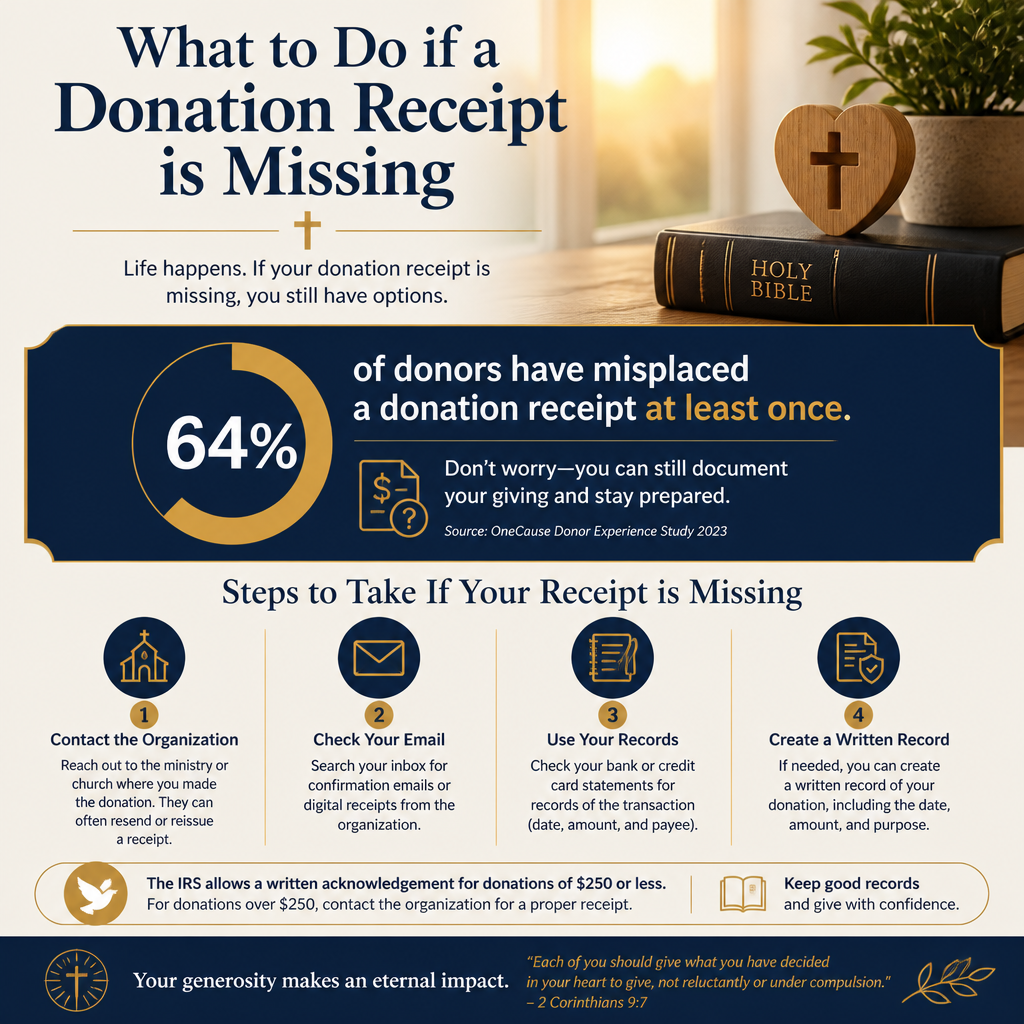
For many cash gifts, your canceled check, bank statement, or credit card statement is part of the required substantiation. But when a gift is $250 or more, the IRS expects a contemporaneous written acknowledgment from the charity describing the donation and whether you received goods or services in return. The standard is not arbitrary; it is designed to create an auditable paper trail for both donor and organization.
Before you contact a ministry, confirm what you already have: a bank record, email confirmation, donor portal record, or mailed acknowledgment. If you gave through a donor-advised fund or employer giving platform, the “charity” acknowledgment may come from the intermediary rather than the ministry you ultimately supported.
The $250 acknowledgment threshold changes the urgency
When a missing receipt involves gifts below $250, many donors can resolve the issue by gathering bank documentation and confirming the organization’s legal name and date of the gift. When the gift is $250 or more, the written acknowledgment becomes a practical necessity, not a convenience. The IRS sets this expectation plainly; donors should treat it as a normal part of responsible giving. See the IRS guidance on substantiation requirements for charitable contributions at IRS.gov.

Recover the record in the simplest way first
The best approach is usually methodical, not adversarial. Ministries handle year-end giving spikes, staff transitions, software migrations, and mail delays. A missing receipt can reflect ordinary friction rather than misconduct. At the same time, donors are not asking for a favor; they are requesting standard documentation that should exist.
Check the channels that commonly hold the receipt
Begin with the places where receipts most often reside but are overlooked: donor portals, spam folders, archived emails, and mailed year-end statements. If you gave through a campaign page or a third-party processor, search the processor name as well as the ministry name.
A concise internal review prevents confusion when you contact the ministry. It also helps you ask for the specific item needed rather than a vague “receipt.”
Contact the right person with the right details
When you reach out, provide enough information to locate the gift quickly: donation date, amount, the name on the card or check, email address used, and any transaction ID. Many ministries have separate contacts for finance, donor care, and church relations; the general inbox may be slow.
Keep the request narrow and concrete: “Please send a contemporaneous written acknowledgment for my gift of $___ on ___, including whether goods or services were provided.” Clarity reduces back-and-forth.
- Donation date and amount
- Method of giving and any transaction ID
- Name and email address used when giving
- Legal name of the ministry as shown on your bank statement
- Whether the gift was tied to an event, dinner, or benefit
Know what a compliant acknowledgment should say
Christian donors often assume a receipt is simply proof that money left their account. For tax purposes, a compliant acknowledgment has specific elements. When ministries issue vague or incomplete receipts, it creates avoidable risk for donors and signals that internal controls may be thin.
Required elements for gifts of $250 or more
A proper written acknowledgment generally includes: the organization’s name, the amount of cash contributed or a description of non-cash property (not the value), the date, and a statement indicating whether the donor received goods or services in exchange for the contribution. If goods or services were provided, the acknowledgment should include a good-faith estimate of their value.
If your “receipt” is missing these elements, treat it as incomplete rather than merely late. It is appropriate to request a corrected acknowledgment.
Quid pro quo is where many receipts fail
Events, banquets, premium mailings, membership benefits, and media subscriptions can introduce a quid pro quo element. Donors may still be able to deduct part of the gift, but the ministry must disclose what was received and what portion is deductible. The IRS provides specific expectations for quid pro quo disclosures at IRS.gov.
This is not about suspicion; it is about precision. Scripture’s call to integrity does not stop at worship or mission. It includes our recordkeeping, and it includes the ministry’s obligation to speak truthfully about what a donor gave and what the donor received.
Use the missing receipt as a governance signal, not a scandal
When donors cannot obtain basic documentation after repeated attempts, the concern shifts. A missing receipt may indicate disorganization, but persistent inability to document gifts can also point to weak finance operations, poor donor data practices, or insufficient oversight.
What healthy ministries tend to have in place
Across our verification work at Most Trusted, ministries that meet The Most Trusted Standard tend to treat receipting as part of their stewardship to donors, not as a perfunctory compliance task. They can explain their receipting policy plainly, correct errors without defensiveness, and produce year-end statements that align with individual gift confirmations.
In mature ministries, the finance function is not isolated from donor relations. Controls, documentation, and responsiveness are understood as spiritual and fiduciary responsibilities.
When to escalate and how to do it responsibly
If a ministry does not respond within a reasonable timeframe, escalation is appropriate. Begin by forwarding prior emails and requesting a response from the finance office or controller. If you have a relationship with leadership, a brief and respectful note can help the request reach the right desk.
The harder question is what to do when the pattern repeats. Donors may decide to pause giving until the ministry can document gifts reliably. That is not punitive. It is a prudent exercise of stewardship. For donors evaluating ministry practices more broadly, our research approach is explained across Christian Financial Service Ministries.
Protect your tax position without reducing giving to tax strategy
Christian giving is not justified by deductions. Yet tax compliance is a legitimate part of honoring governing authorities and maintaining integrity in public life. Mature donors often live in the tension: giving is worship, and recordkeeping still matters.
File with what you can substantiate
If you cannot obtain the required acknowledgment for a gift of $250 or more, the conservative posture is to avoid claiming the deduction for that particular contribution. Donors may be tempted to “claim it anyway” because the money was truly given. The issue is not whether the gift happened, but whether the documentation meets the standard that governs charitable deductions.
For donors who itemize and give at meaningful levels, documentation discipline is part of long-term generosity. If you are uncertain about your specific situation, consult a qualified tax professional; different gift types (non-cash property, securities, vehicle donations) can introduce additional requirements.
Establish a simple annual documentation rhythm
Many missing receipt problems are prevented with a consistent rhythm: download year-end statements, save individual gift confirmations for gifts above the threshold, and reconcile your records in January rather than April. If you support multiple ministries, a single folder structure and a monthly check can prevent end-of-year stress.
Because this issue often intersects with donor platforms, non-cash gifts, and ministry financial reporting, donors may also find it helpful to review Tax Receipts and Reporting for Donations to Christian Financial Service Ministries for the broader landscape of common documentation failures and what sound practice looks like.
FAQs for What to do if a donation receipt is missing
How long should we wait before following up with a ministry about a missing receipt?
For most gifts, a first follow-up after 7–10 business days is reasonable, especially during December and January when ministries process high volumes. If the gift is $250 or more and you need a contemporaneous written acknowledgment for substantiation, follow up sooner and be explicit about the documentation required. If there is no response after two attempts, escalate to the finance office with the relevant transaction details.
What should we do if the ministry sends a receipt that does not mention goods or services?
If the gift could plausibly involve goods or services—an event ticket, dinner, membership benefits, or other donor premiums—request a corrected acknowledgment. For gifts of $250 or more, the statement about goods or services is a key compliance element. The IRS expectations for these acknowledgments and disclosures are available at IRS.gov.
Stewardship that honors both generosity and truth
Missing receipts are rarely the most dramatic issue in Christian philanthropy, but they are revealing. A ministry that can document gifts promptly and accurately communicates respect for donors and seriousness about financial integrity. Donors who pursue proper documentation are not being legalistic; they are aligning their giving with truthfulness, order, and accountable stewardship—virtues Scripture commends in every area of life.



