

How to give stock to Christian financial service ministries is not primarily a technical question. It is a stewardship question with tax implications, governance implications, and discipleship implications, because it asks what we do with assets God has entrusted to us and how carefully we attend to the integrity of the organizations that receive them.
For many Christian donors, appreciated securities have become one of the most consequential ways to fund ministry without eroding liquidity needed for family obligations, business commitments, or long-term generosity. Yet stock gifts also expose a familiar tension: the desire to act promptly for the Kingdom, and the responsibility to verify that a ministry handles resources with the seriousness Scripture demands.
Why stock gifts can be a wise form of Christian stewardship
Giving from increase without forcing a sale
Appreciated stock often represents years of disciplined saving. When donors give shares directly rather than selling and giving cash, the ministry can receive the value and the donor can often avoid capital gains tax that would otherwise reduce what is available to give. This is not a loophole; it is a lawful feature of the tax code that can redirect more value toward ministry purposes.
What this means in practice is that stock can fund work that is difficult to sustain through small monthly gifts alone: debt relief counseling capacity, refugee microenterprise support, pastoral care for families under financial stress, or the less visible infrastructure required for faithful client protection and compliance.
Where the tax logic meets discipleship
Jesus’ warnings about money are rarely abstract. He speaks of treasures, barns, masters, and the heart’s drift toward security apart from God. Stock gifts can function as a concrete act of reordering: a decision to treat assets as tools for love of neighbor rather than private insulation.
Christians genuinely disagree about how to balance giving, saving, and investing, especially for donors with complex estates or illiquid business holdings. But most agree that generosity should be planned, proportionate, and integrated into a life of obedience rather than driven by emotion or end-of-year pressure.

Confirm the ministry is prepared to receive stock responsibly
Stock gifts reveal operational maturity
Not every Christian financial service ministry is equipped to receive publicly traded stock. A credible recipient typically has a brokerage account in the organization’s name, documented gift acceptance procedures, and a finance team or outsourced partner who can receive and liquidate shares promptly. When ministries lack these basics, donors face delays, valuation disputes, or administrative confusion that can harm both the ministry and the donor’s records.
Across our verification work at Most Trusted, we observe that ministries meeting The Most Trusted Standard tend to treat non-cash gifts as a governance issue, not a fundraising trick. They document who can authorize transactions, how gifts are acknowledged, and how conflicts of interest are prevented.
Ask questions that map to real risk
A stock gift introduces timing and control questions that do not appear with a check. Before initiating a transfer, donors should confirm a few operational details with the ministry’s development or finance contact:
- Whether the ministry can receive stock directly into its brokerage account and provide DTC instructions
- Whether the ministry’s policy is to liquidate immediately upon receipt or hold for a period
- Who approves the sale and how the decision is documented
- How the ministry will acknowledge the gift for substantiation purposes
- Whether the ministry accepts restricted gifts and how restrictions are honored in accounting
These questions are not intrusive. They reflect the biblical expectation that those entrusted with resources prove faithful, and they help donors avoid avoidable complications that can erode trust.
Choose the right pathway for the gift
Direct transfer of publicly traded stock
The most straightforward method is a direct transfer from the donor’s brokerage account to the ministry’s brokerage account using the Depository Trust Company system. Donors typically request transfer instructions from the ministry, submit the request to their broker, and notify the ministry of the ticker symbol, number of shares, and the expected transfer date so the gift is recognized accurately.
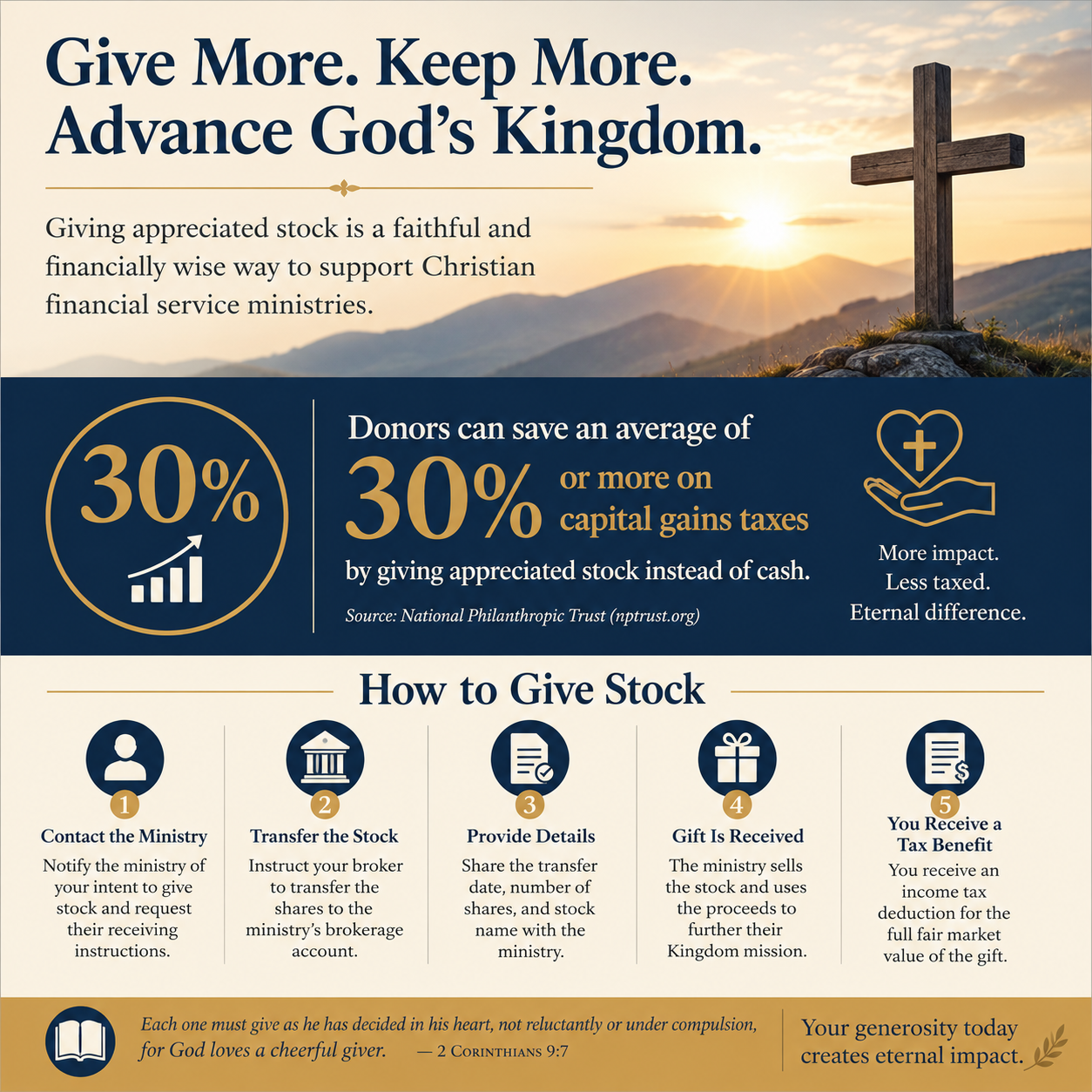
For donors who itemize deductions, the IRS generally allows a charitable deduction for the fair market value of long-term appreciated securities given to a qualified charity, subject to limitations that vary by circumstance. The foundational guidance is available from the Internal Revenue Service in Publication 526 and related instructions on non-cash contributions, and donors should review those materials with qualified counsel or tax advisors before proceeding. Internal Revenue Service
Donor-advised funds and other intermediaries
Some donors prefer to contribute stock into a donor-advised fund and then recommend grants to ministries over time. This can simplify administration, consolidate recordkeeping, and allow a deliberate funding plan. It can also add another layer between donor and ministry, which may matter for donors who want direct relationship, direct reporting, or targeted program alignment.
Other pathways include charitable gift annuities, charitable remainder trusts, and family foundations, but these require careful structuring and are not appropriate for every donor. The point is not to maximize complexity. It is to select a method that supports long-term generosity without introducing governance weaknesses or unclear donor intent.
Give stock with clarity about mission fit and accountability
Financial service ministries require more than good intentions
Christian financial service ministries often operate in spaces where harm can occur if systems are weak: debt counseling, lending, housing support, financial coaching, disaster assistance, or matched savings programs. Compassion is necessary, but competence is also a form of love. Donors should expect safeguards around privacy, client protection, and staff training, alongside spiritually serious pastoral posture.
For donors deciding where to concentrate giving, it can help to locate ministries within the broader landscape of Christian Financial Service Ministries and then evaluate whether a specific organization’s public reporting matches its claims. Mature ministries generally publish audited financial statements when appropriate, clear governance structures, and meaningful outcome reporting that does not manipulate stories for fundraising.
Use verification to reduce avoidable moral hazard
When an organization receives large non-cash gifts, the temptation to build around volatile giving can increase. The “Starvation Cycle,” described by Ann Goggins Gregory and Don Howard, explains how pressure to keep overhead low can drive underinvestment in systems, which then weakens performance and fuels further distrust. Stock gifts can unintentionally intensify this cycle if donors reward superficial frugality rather than durable stewardship. Stanford Social Innovation Review
The Most Trusted Standard exists because sophisticated donors need more than inspirational narratives. They need verifiable evidence of faithful doctrine, financial integrity, governance and leadership, and transparency and effectiveness. When donors pair significant gifts with serious verification, they protect both beneficiaries and the reputation of Christian ministry itself.
Execute the gift carefully and document it well
Coordinate timing, valuation, and acknowledgment
Stock gifts can fail for mundane reasons: transfers initiated late in December, mismatched account names, missing notifications, or confusion over whether the gift date is the trade date or the date the ministry receives control of the shares. Donors should start early, confirm the receiving instructions in writing, and keep correspondence that shows the shares transferred.
Donors should also expect a contemporaneous written acknowledgment for gifts of $250 or more, as required under IRS rules, and should ensure the acknowledgment contains the necessary statements. For larger non-cash gifts, additional forms may apply. The IRS provides direction on substantiation and appraisals, and donors should review it before making the transfer. Internal Revenue Service
Restrictions should be rare and precise
Many donors want to designate gifts to a program area, especially in ministries that provide financial coaching, emergency assistance, or job training. Restrictions can serve the donor’s intent, but they can also create rigidity that forces a ministry to contort operations. A mature approach is to restrict only when the ministry can clearly account for the restriction and when the restriction aligns with the ministry’s strategy rather than a donor’s preferred narrative.
Donors exploring program-specific giving within this field can often find better alignment by reviewing the broader category of How to Give to Christian Financial Service Ministries and then asking each organization to explain how designated funds are tracked, reported, and evaluated for impact.
FAQs for How to give stock to Christian financial service ministries
Should we give stock directly to the ministry or use a donor-advised fund?
Direct stock gifts tend to maximize immediacy and relational clarity with the ministry, and they avoid an extra administrative layer. Donor-advised funds can simplify recordkeeping and enable a multi-year plan, especially for donors who want to bunch giving in a high-income year and grant over time. The better choice depends on how closely the donor wants to track program reporting, how complex the donor’s tax situation is, and whether the recipient ministry is operationally prepared to receive securities.
What should we verify before giving stock to a Christian financial service ministry?
At minimum, donors should verify that the organization is a qualified charity, has written procedures for receiving and liquidating securities, and can provide clear acknowledgment documentation. Beyond mechanics, donors should evaluate whether the ministry demonstrates credible governance, transparent financial reporting, and evidence that its programs genuinely serve people rather than merely generating compelling stories. Most Trusted’s work applying The Most Trusted Standard reflects a simple conviction: significant gifts merit verifiable accountability.
A gift of stock is a test of seriousness
Giving appreciated stock can be one of the most effective ways for Christian donors to place substantial resources into faithful ministry. It also forces a clearer question than many cash gifts do: whether the ministry is governed well enough, transparent enough, and theologically grounded enough to be trusted with assets that took years to build. When donors unite generosity with verification, they honor both the giver and the God who gives every good gift.



