

How to give monthly to Christian financial service ministries is less a question of convenience than of spiritual formation and fiduciary clarity. Monthly support can steady a ministry’s operations, but it also binds the donor and the ministry together over time, which raises the stakes for trust, oversight, and theological alignment.
Christian financial service ministries occupy a sensitive space. They may provide debt counseling, budgeting help, housing support, lending circles, microenterprise capital, banking alternatives, or job-readiness pathways. In each case, money is both the tool and the terrain. That makes monthly giving powerful when it is disciplined, and dangerous when it is sentimental.
Monthly giving is a spiritual practice before it is a financial tactic
Steadfastness is the point, not novelty
Scripture commends steadiness in doing good and warns against hurried or performative generosity. Monthly giving embodies that steadiness. It quiets the donor’s appetite for dramatic impact narratives and places giving within ordinary obedience. For many donors, the deeper benefit is not simply that a ministry’s budget becomes more predictable, but that the donor’s heart is trained toward sustained mercy and justice.
At the same time, monthly giving can become a substitute for discernment. Recurring gifts can run on autopilot long after a ministry’s theology, leadership culture, or program quality has shifted. The spiritual discipline must include periodic re-examination, because faithfulness is not the same as passivity.
Christian donors should name the moral tensions openly
Financial service ministries often work with people under severe economic pressure. Christians genuinely disagree about the best models: direct cash assistance versus structured coaching, debt relief versus bankruptcy counsel, interest-bearing lending versus interest-free alternatives, and the role of explicit evangelism in services that resemble public-benefit programs. These are not distractions; they are part of the moral substance of the work.
Monthly giving is most fitting when donors are clear about what they are funding and why. If a ministry’s approach depends on a particular theology of work, dignity, repentance, and restoration, donors should know it and be able to articulate it without slogans.

Choose the ministry by evidence, not by familiarity
Financial help ministries must be tested for real safeguards
Because these ministries touch money directly, donors should ask for a higher level of verifiable assurance than they might require for less financially sensitive work. Across our verification work at Most Trusted, we observe that strong ministries tend to formalize their controls and make them visible: independent oversight, conflict-of-interest management, audited financial statements when appropriate, and documented policies around client funds and client data.
What this means in practice is that donors should not confuse a compelling founder story with an accountable institution. A ministry can be sincere and still be structurally fragile. Monthly giving magnifies that fragility when governance is weak.
Apply The Most Trusted Standard to recurring support decisions
Most Trusted exists to help Christian donors give with confidence by evaluating ministries against The Most Trusted Standard, a 15-criteria framework spanning Faith Foundation, Financial Integrity, Governance and Leadership, and Transparency and Effectiveness. Donors do not need to become auditors, but donors should insist on the kind of evidence that serious stewardship requires.
A practical way to begin is to compare a short list of ministries within Christian Financial Service Ministries and identify which ones publish the documents a prudent donor would reasonably expect: annual reports, clear program descriptions, leadership disclosure, and an explanation of how success is measured. Transparency is not the whole of trustworthiness, but the absence of transparency is rarely neutral.
Structure the monthly gift to match the ministry’s actual work
Fund what is durable, not what is most dramatic
Financial service ministries commonly mix direct aid with longer-term formation: coaching, training, job placement, entrepreneurship support, and case management. Monthly giving is particularly suited to the slow work. It pays for the staff time that keeps a client from falling through the cracks, the curriculum development that improves counseling quality, and the administrative controls that protect both clients and donors.
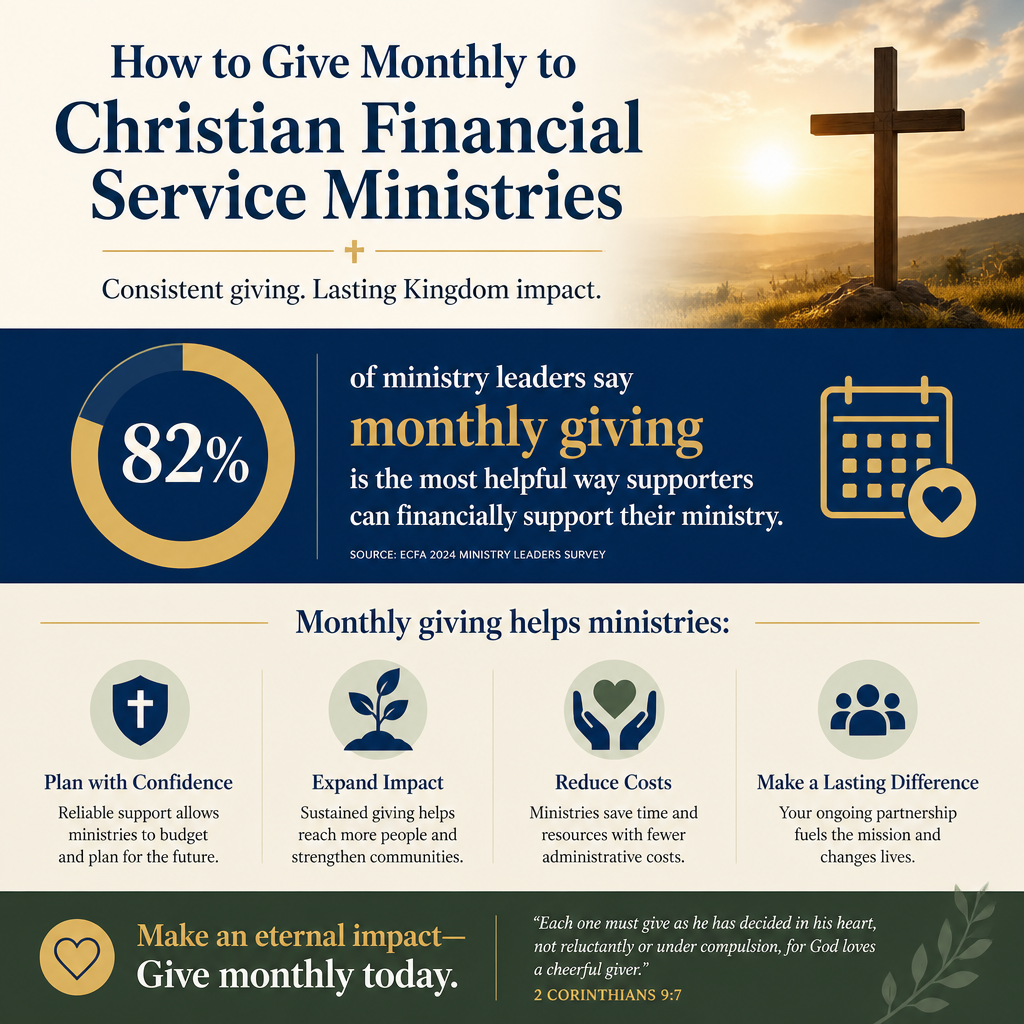
Donors sometimes prefer restricted gifts because restrictions feel precise. Restrictions can be appropriate, but they can also force ministries into short-termism or administrative contortions. If a ministry has demonstrated integrity and clarity, an unrestricted monthly gift can be one of the most trust-filled forms of support.
Use a disciplined review cadence
Recurring giving should come with recurring evaluation. A simple cadence, taken seriously, protects the donor and strengthens the ministry’s accountability culture. For most households, an annual review is sufficient; for larger donors, a semiannual review may be more appropriate. The point is not suspicion. The point is to honor the reality that leadership changes, programs drift, and financial pressures can reshape priorities.
- Re-read the ministry’s stated faith commitments and confirm they still govern the work.
- Review the most recent financial statements available and note changes in revenue concentration or reserves.
- Confirm current leadership and board composition, looking for excessive related-party overlap.
- Assess whether program descriptions still match what is being offered on the ground.
- Check whether the ministry reports outcomes with definitions that are specific rather than impressionistic.
Evaluate outcomes with moral seriousness and realistic expectations
Avoid both cynicism and naivety about measurement
Financial hardship is multi-causal. A family may stabilize income while still experiencing housing insecurity; a person may reduce debt while still battling addiction; a client may become employable while still facing barriers from criminal history. Donors should resist the demand for simplistic metrics that flatter the giver.
At the same time, it is not honorable to fund vague claims indefinitely. Ministries should be able to describe what change they seek, what activities they perform, and what evidence they collect. Even when outcomes are hard to quantify, the ministry should have a coherent theory of change and a willingness to be evaluated.
Understand why the overhead debate is a category error
Christian donors sometimes ask for a single “good” administrative percentage. The field has had to reckon with the limits of that approach. Charity Navigator, Candid, and the BBB Wise Giving Alliance jointly argued that overhead ratios are a poor proxy for impact and can pressure nonprofits into underinvesting in the very systems that prevent misuse and improve effectiveness Charity Navigator. Financial service ministries, in particular, may require compliance, secure data handling, and trained staff—costs that are not morally suspect but morally necessary.
Monthly donors should therefore examine spending categories with context. The central question is whether spending patterns align with the ministry’s mission and whether the controls are strong enough to safeguard people and funds.
Protect the relationship between donor and ministry over the long term
Monthly giving should not bypass accountability
Recurring support creates a quiet intimacy: the donor becomes part of the ministry’s expected revenue stream, and the ministry becomes part of the donor’s planned obedience. That relationship should be protected. Donors should know how to raise questions, how to see the ministry’s reporting, and how to exit gracefully if trust erodes.
One wise discipline is to keep monthly giving to a manageable number of ministries so that attention does not dissipate. Many households give to their local church as a primary commitment and add a small number of recurring commitments beyond that. For donors seeking comparable options and giving patterns across this field, How to Give to Christian Financial Service Ministries can help clarify what good practice tends to look like.
Pay attention to fundraising practices and donor care
A ministry’s fundraising tone often reveals its internal theology. Does it speak truthfully about need without manipulating fear? Does it treat donors as partners in stewardship or as targets in a revenue machine? Does it protect the dignity of clients, especially when telling stories about poverty? These are not secondary issues. When a ministry trades dignity for dollars, it eventually deforms both.
Donors should expect clear receipts, easy access to giving records, and prompt responses to inquiries. Such practices do not prove holiness, but they do signal whether the ministry is organized enough to carry the weight of long-term trust.
FAQs for How to give monthly to Christian financial service ministries
Should monthly giving be restricted to a specific program like debt counseling?
Sometimes. Restricting a monthly gift can be appropriate when the program is clearly defined, the ministry can track restricted funds without distortion, and the donor understands the trade-off in flexibility. Many mature ministries can use unrestricted monthly support to strengthen the infrastructure that keeps counseling ethical and effective, including trained staff, secure data practices, and supervisory oversight. The more trustworthy and transparent the ministry, the more reasonable unrestricted monthly giving becomes.
How can donors verify a financial service ministry without becoming investigators?
Donors can focus on a short set of high-signal indicators: clarity about Christian convictions, visible governance and leadership information, accessible financial reporting, and plain descriptions of programs and outcomes. Where deeper assurance is needed, Most Trusted’s evaluations against The Most Trusted Standard are designed to reduce the burden on donors by looking for verifiable evidence across faith alignment, financial integrity, governance, and transparency.
Monthly giving should mature into covenantal stewardship
Monthly support for Christian financial service ministries can be one of the most stabilizing gifts a donor offers, precisely because it funds patient work among people whose lives rarely change in a single moment. The same stability, however, requires a higher standard of discernment. When donors unite recurring generosity with periodic verification, they honor both the call to give and the responsibility to give wisely.



