
Planned gifts for Christian financial service ministries work by transferring assets in ways that fit a donor’s long-term stewardship, not only a year-end budget. The core idea is straightforward: a donor arranges a future gift—often from an estate, retirement account, or appreciated asset—so that a ministry can rely on durable support while the donor remains faithful to other obligations.
This form of giving raises sober questions for Christian donors. The decision is not merely technical. It touches family responsibilities, the moral weight of debt and consumption, and the desire to fund ministries that handle money with integrity. A planned gift can be an act of worship. It can also be poorly structured, misunderstood, or directed to an organization whose governance does not deserve long-term trust.
Planned giving is a stewardship decision before it is a financial instrument
Scripture frames wealth as entrusted, not possessed
Jesus’s teaching repeatedly treats money as spiritually diagnostic, not spiritually neutral. Planned giving belongs in that same frame. The question is not only, “How do planned gifts work?” but “What does faithful stewardship require of us over an entire lifetime?” The parable of the talents presents a moral expectation of wise administration under a master’s authority (Matthew 25). Planned giving is one way Christians attempt to order their resources under that authority, including resources that will remain at death.
The most common planned gifts are bequests in a will or trust, beneficiary designations on retirement accounts or life insurance, and gifts of appreciated assets. Each can be structured to provide a ministry a meaningful future gift without undermining the donor’s present responsibilities. The best arrangements avoid an artificial separation between “spiritual” and “financial” life; they integrate both under discipleship.
Christian financial service ministries occupy a distinctive place
Christian financial service ministries—credit counseling, debt relief, stewardship education, and related services—often work directly in the pressure points of family life. They meet people in anxiety, shame, and financial confusion. That proximity to vulnerability creates opportunity for gospel-shaped care, and it also creates risk: incentives can drift, messaging can become manipulative, or programs can substitute technical fixes for spiritual formation.
Donors who support these ministries through planned gifts should expect more than moving stories. They should expect verifiable integrity: a clear theological foundation, sound oversight, truthful reporting, and outcomes that can be evaluated honestly. In our verification work at Most Trusted, we have found that maturity shows up in the willingness to be measured, not merely the ability to fundraise.

The common planned gift types and how they function in practice
Bequests and beneficiary designations are the simplest
A bequest is a gift made through a will or living trust. It can be a specific dollar amount, a particular asset, or a percentage of an estate. A beneficiary designation names a ministry as a beneficiary on an account—often a retirement account, life insurance policy, or bank account that allows payable-on-death designations. These options are common because they are comparatively simple to implement and can often be updated without revising a full estate plan.
One reason retirement accounts matter in planned giving is that, under current law, many non-spouse beneficiaries must withdraw inherited retirement assets within a limited time, which can accelerate taxable income. Nonprofits can receive those assets without paying income tax, which makes them a particularly efficient asset for charitable bequests in many situations. Donors should confirm details with qualified counsel and current IRS guidance, since rules change and individual circumstances vary. The IRS provides official resources on retirement plans and beneficiary rules at irs.gov.
Charitable trusts and gift annuities add complexity and accountability demands
Some donors consider charitable remainder trusts (CRTs) or charitable gift annuities (CGAs). In a CRT, a donor contributes assets to an irrevocable trust that pays income to the donor or other beneficiaries for a term, with the remainder ultimately going to charity. In a CGA, a donor makes a gift to a charity in exchange for fixed payments for life; the charity carries the obligation to make those payments.
These arrangements can serve donors with appreciated assets who want income, tax planning, or a disciplined commitment to a future gift. They also require greater confidence in the ministry’s financial strength and governance because the arrangement creates long-term obligations and reputational exposure. State regulation of gift annuities varies, and donors should pay attention to whether a ministry is properly registered where required. The National Association of State Charity Officials maintains regulatory information at nasconet.org.
Why planned gifts are especially aligned with financial service ministry outcomes
Systems change and discipleship often require patient capital
Many Christian financial service ministries are not primarily “event-driven.” The work is often slow: behavior change, debt repayment, budgeting disciplines, reconciliation between spouses under financial strain, and long-term mentoring. Even when a ministry can point to clear outputs—classes delivered, counseling sessions completed—its most meaningful outcomes can take years to mature.
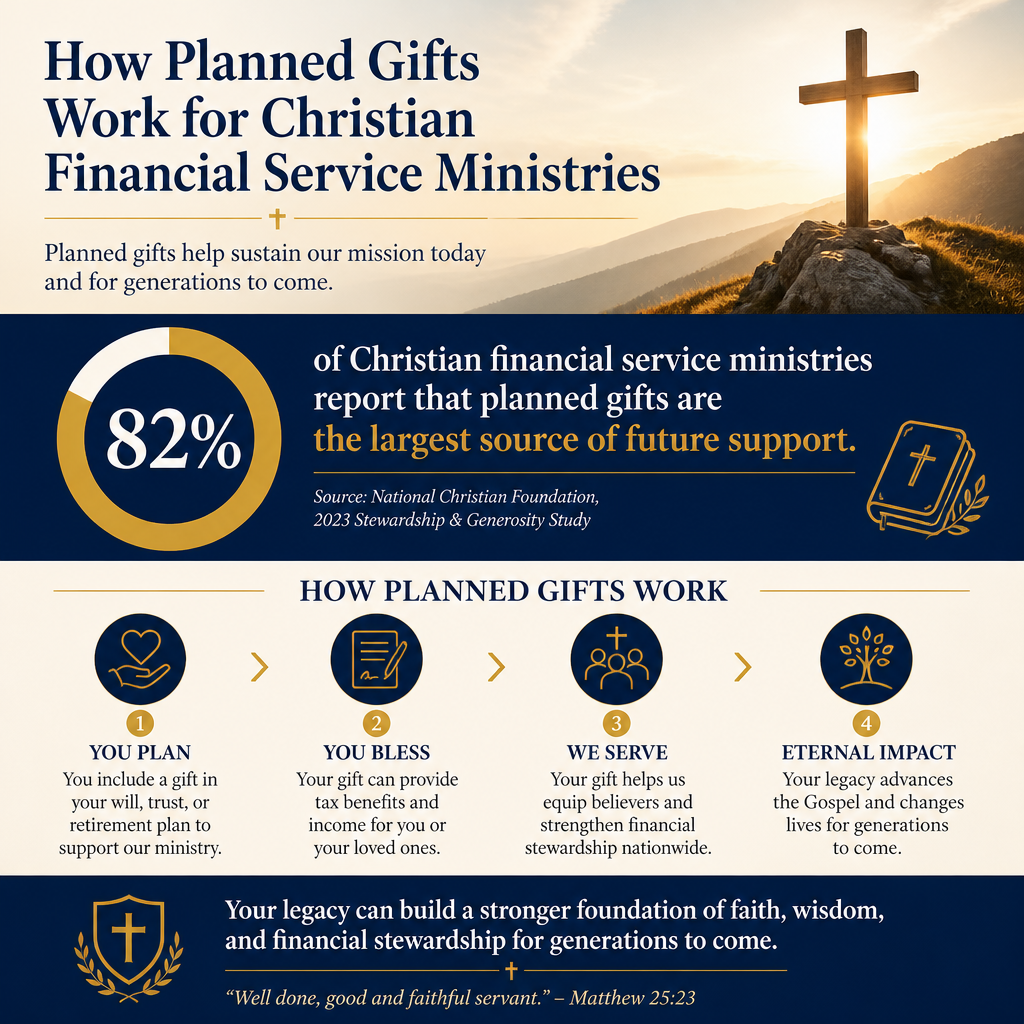
Planned giving can match that time horizon. A ministry that expects to serve families ten or twenty years from now needs capital that is not entirely dependent on the latest campaign cycle. For donors, this can be a sober but hopeful way to underwrite long obedience rather than short-term visibility.
The trust question becomes sharper, not softer
The longer the time horizon, the more weight trust carries. A planned gift is not simply a large donation; it is a form of delegated responsibility. Donors are effectively saying, “We trust you to steward this when we are no longer here to correct you.” That is an elevated claim. It belongs with ministries that can demonstrate stable leadership, responsible succession planning, clear financial statements, and a culture where truth is not treated as a threat.
What this means in practice is that planned giving should not be separated from due diligence. Donors looking broadly at Christian Financial Service Ministries should ask which organizations have demonstrated resilience over time and which are built around a personality, a moment, or a marketing engine.
Due diligence for planned gifts under The Most Trusted Standard
Verification matters because planned gifts outlast personalities
A ministry can appear compelling while still being poorly governed. Planned gifts intensify the consequences of that gap. The Most Trusted Standard is designed to help donors evaluate ministries using verifiable evidence across faith commitments, financial integrity, governance and leadership, and transparency and effectiveness. For planned gifts, the governance and transparency questions become especially acute because the donor’s ability to respond later is limited.
The field has had to reckon with the “overhead ratio” as a shallow measure of effectiveness. Mature donors increasingly recognize that underinvestment in finance, compliance, and evaluation can create moral hazard. The “Overhead Myth” statement, signed by leading charity evaluators, argues that overhead alone is a misleading indicator and that donors should look for broader markers of accountability and results. The statement is available through GuideStar’s parent organization at candid.org.
A practical checklist for planned gift confidence
Before naming a Christian financial service ministry in an estate plan, donors can insist on clarity in a few areas. A planned gift is a ministry partnership that extends into the future, so the questions should be direct.
- Clear doctrinal commitments and a public theology of stewardship that does not drift into prosperity assumptions.
- Audited financial statements or a credible independent review, with consistent reporting over multiple years.
- Board oversight that is active and independent enough to correct leadership when needed.
- Documented policies on conflicts of interest, related-party transactions, and executive compensation.
- Transparent program reporting that distinguishes outputs from outcomes and does not promise what cannot be measured.
Donors who want to go deeper on discipline-specific giving questions can also consult How to Give to Christian Financial Service Ministries, where we address giving methods, common risk areas, and what responsible transparency tends to look like in this category.
How to talk with a ministry about a planned gift without being pressured
Healthy ministries welcome questions and put details in writing
Planned giving conversations should feel like pastoral seriousness, not sales. A ministry should be willing to describe its planned giving policies, what kinds of gifts it can accept, and how it handles restricted gifts. It should also provide sample bequest language and encourage donors to consult their own attorney and tax advisor.
Donors should be cautious when a ministry discourages outside counsel, presses for secrecy from family members, or treats a planned gift as the proof of spiritual maturity. Those are not merely poor fundraising practices; they are misuses of spiritual authority. Christian generosity is voluntary and conscientious, “not reluctantly or under compulsion” (2 Corinthians 9:7).
Restrictions can protect intent but also create future burdens
Some donors want to restrict a planned gift to a particular program: debt counseling for pastors, financial literacy for single mothers, or emergency relief tied to foreclosure prevention. Restrictions can preserve intent, but they can also constrain future leaders who face different realities. The harder question is whether a restriction reflects enduring mission or a preference that may not fit future needs.
A sound approach is to write restrictions with a measure of flexibility: a clear purpose, a process for reasonable adaptation, and language allowing the ministry to apply funds to the closest practical use if circumstances change. Donors should expect a ministry to discuss this candidly, since responsible organizations know that poorly drafted restrictions can become a legal and moral burden.
FAQs for How planned gifts work for Christian financial service ministries
Are planned gifts only for wealthy Christian donors?
No. Many planned gifts are modest bequests or beneficiary designations that cost nothing during a donor’s lifetime. The defining feature is timing and structure, not size. What matters is whether the gift reflects faithful stewardship and whether the ministry has earned long-term trust.
Should we name a ministry or create a donor-advised fund for planned giving?
Both approaches can be appropriate. Naming a ministry directly can be simpler and can support that organization with clarity. A donor-advised fund can preserve flexibility for heirs or advisors to direct funds to multiple ministries over time, but it adds another layer of administration and requires trustworthy successor advisors. The better choice depends on the donor’s family context, the level of confidence in a particular ministry’s future governance, and the desire for flexibility.
A planned gift should be durable generosity anchored in durable trust
Planned gifts for Christian financial service ministries can fund patient work that strengthens families, teaches stewardship, and reduces the practical burdens that keep many believers from faithful generosity. Because these gifts extend beyond our lifetime, the moral obligation is not only to give, but to give wisely. The ministries most worthy of planned support tend to be those that tell the truth about money, submit themselves to meaningful oversight, and can be verified by evidence rather than sentiment.



