

Keeping your records current with Christian financial service ministries is not administrative trivia. It is one of the quiet disciplines that protects your giving, honors the people who steward your gifts, and reduces the risk that avoidable errors disrupt real ministry outcomes.
Christian donors tend to think first about faithfulness and impact, not paperwork. That instinct is understandable. Yet Scripture ties faithfulness to what is verifiable and trustworthy: “Moreover, it is required of stewards that they be found faithful” (1 Corinthians 4:2). Current records are one way donors and ministries practice that stewardship together, especially when financial service ministries operate at scale and across state lines.
Records are a stewardship issue before they are a compliance issue
Why small inaccuracies become real harm
Address changes, outdated bank information, mismatched legal names, and lapsed beneficiary designations can create a cascade of complications: declined drafts, delayed acknowledgments, misapplied gifts, and preventable year-end confusion. When donors are supporting time-sensitive work—disaster response, frontline pastoral care, pregnancy medical services, or translation projects—administrative friction can become mission friction.
Some donors assume that “the system” will catch these issues. Often it does, but at a cost. Ministries spend staff time reconciling transactions, reissuing receipts, and responding to donor questions that could have been prevented by routine updates. The less visible cost is trust. Donors are understandably unsettled when documentation is inconsistent, even if the underlying ministry work is strong.
What donor records are actually for
In mature Christian financial service ministries, current records serve several legitimate purposes: to execute your intent, to document restricted giving appropriately, to meet legal obligations, and to communicate transparently about the use of funds. The goal is not surveillance; it is stewardship. Donors are not merely customers. Donors are co-laborers who deserve accuracy, clarity, and accountability.
Across our verification work at Most Trusted, we observe that ministries meeting The Most Trusted Standard tend to treat donor records as part of their integrity system, not as an afterthought. They can explain why they collect certain information, how it is protected, and how it supports faithful administration rather than administrative expansion.

What to update and when
The core record changes that matter most
Donors often update the obvious items and miss the ones that trigger downstream problems. The practical objective is to keep every element that affects transactions, receipting, and communication aligned with your current reality.
- Legal name and household naming (especially after marriage, divorce, or a legal name change)
- Mailing address (including seasonal addresses if you split time)
- Email and phone number (so urgent questions do not get routed through outdated channels)
- Payment method details (bank account changes, expired cards, updated billing address)
- Giving preferences and restrictions (designated funds, project codes, memorial gifts)
Even for donors who give primarily online, mailing address still matters for year-end receipting and legal documentation. The IRS is clear that a taxpayer must have a contemporaneous written acknowledgment for certain gifts in order to claim a charitable contribution deduction; for cash contributions of $250 or more, the acknowledgment must come from the charity and meet specific requirements (IRS).
A simple cadence that fits most donor households
Most households do not need a weekly maintenance routine. A predictable cadence is usually enough:
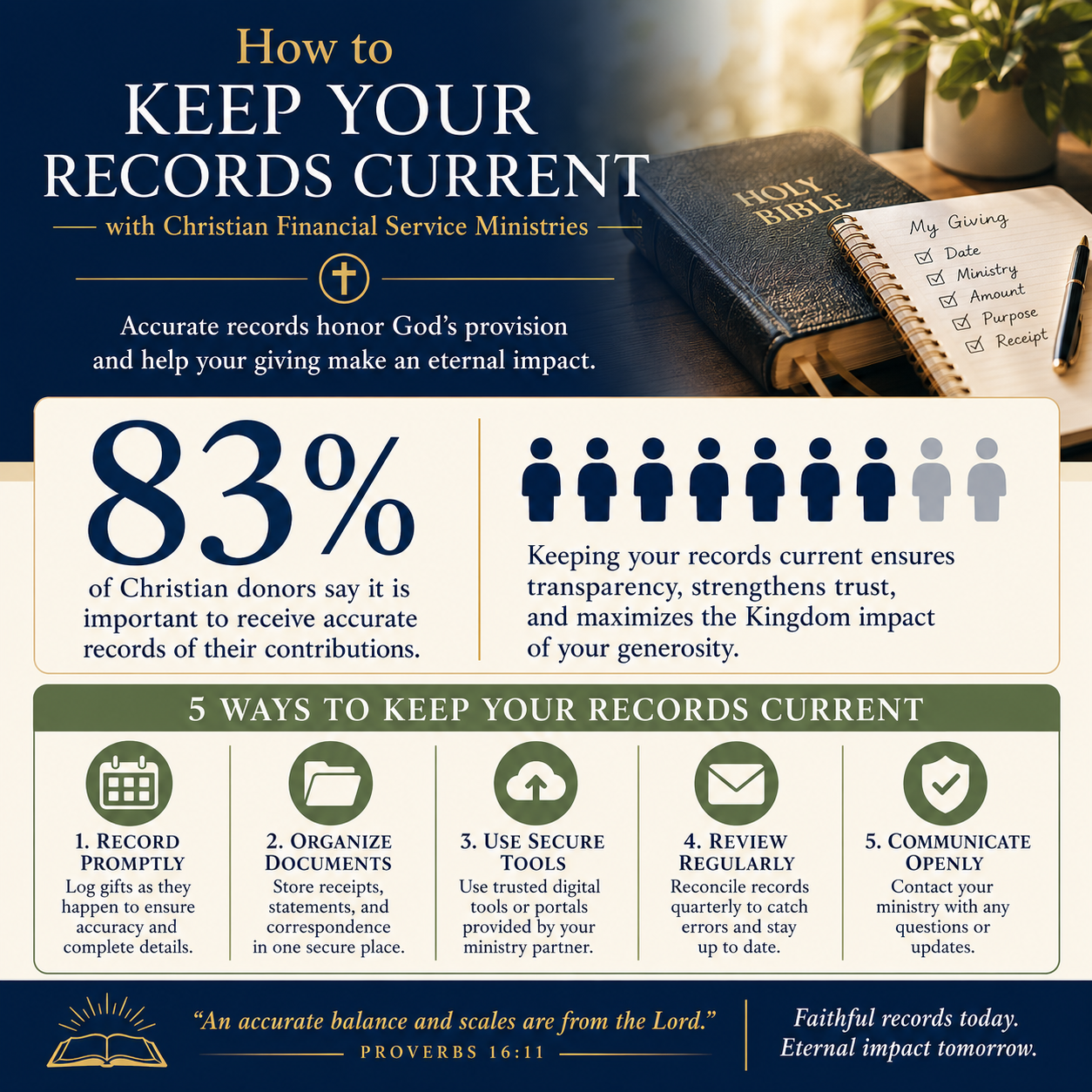
Quarterly review the payment method used for recurring gifts and confirm that your contact information is still accurate. Annually review designated giving preferences and confirm your year-end receipting settings. Event-driven updates should happen immediately after a move, a bank change, a major family status change, or a shift in giving strategy.
This cadence also respects the reality that many Christian donors support multiple ministries. When donor information is spread across several platforms, small inconsistencies multiply. A simple checklist kept with your household financial records can prevent hours of unnecessary reconciliation in January.
How Christian financial service ministries handle data and why donors should ask
Data protection is part of moral responsibility
Donor records contain more than contact details. They can include giving history, employer matching information, and in some contexts even pastoral or counseling-related notes if a ministry fails to separate systems appropriately. Christians should not treat data stewardship as a merely technical matter. “Whoever is faithful in a very little is faithful also in much” (Luke 16:10). A ministry’s care with small, unglamorous details is often correlated with its care in larger ones.
The donor’s responsibility is not to become an information security auditor. It is, however, reasonable to ask ministries basic questions: what information is collected, how it is stored, who has access, and how it is shared. Larger organizations may publish data privacy and donor privacy policies. Smaller ministries may have fewer formal documents but should still be able to give coherent answers.
The tension between personalization and privacy
Many donors appreciate communications that reflect actual giving patterns and ministry interests. Others find this intrusive and prefer a lighter touch. Ministries face a genuine tension: communications tailored to donor intent can improve relevance and reduce waste, but personalization requires data. The question is not whether data exists. The question is whether it is governed.
A credible ministry will be transparent about whether donor data is shared with third-party vendors for payment processing, email distribution, or analytics, and whether it is ever rented or sold. Donors can insist on restraint. A donor’s decision to give is not permission for a ministry to treat personal information as an asset to be monetized.
For donors evaluating these practices across multiple organizations, our work at Most Trusted focuses on verifiable patterns of integrity, including transparency and operational controls. This is one reason many donors consult independent verification alongside a ministry’s own public claims. The landscape is complex, and good intentions are not a substitute for disciplined governance.
Practical safeguards that prevent disputes and reduce ministry burden
Document your intent before a problem occurs
Most donor disputes are not about theology or mission drift. They are about ambiguity: “Did the gift go where we intended?” “Was it restricted or unrestricted?” “Why does the receipt not match our records?” These questions are often solvable when both sides have clear documentation.
Keep a minimal archive: confirmations for online gifts, copies of mailed checks (or at least check numbers and dates), screenshots of recurring gift settings, and any email or letter that describes a restricted designation. If you make a complex restriction, consider asking the ministry to confirm in writing that it can honor the restriction as stated. Some restrictions are administratively infeasible or create legal complications, and a responsible ministry will say so rather than accept the gift and hope for the best.
Use receipts as a health indicator, not merely a tax form
Receipting is often treated as a year-end obligation. In reality, it is an early-warning system. If a ministry’s receipts are consistently late, incomplete, or confusing, donors should ask why. Delays can have benign causes, but patterns of disorder are worth taking seriously.
It is also worth remembering that the IRS requires donors to keep a bank record or written communication for cash contributions regardless of amount, and to meet specific substantiation requirements for larger gifts (IRS Publication 526). Ministries cannot carry the donor’s recordkeeping responsibility. But they can either help or hinder it through their own administrative competence.
For donors who want a broader framework for evaluating a ministry’s administrative and reporting practices, the category of Donor Communication in Christian Financial Service Ministries addresses what healthy communication tends to look like over time, including the difference between transparency and promotional messaging.
When a ministry is unresponsive or unclear
Escalate with charity and precision
Even strong ministries have seasons of staffing turnover, software migrations, or surge giving that strain support teams. Donors should not confuse ordinary strain with negligence. Yet it is also appropriate to expect timely, accurate responses where donor records and receipts are concerned.
When an issue arises, we recommend communicating in a way that is both charitable and precise: provide dates, amounts, transaction IDs, and screenshots if available; state the exact correction requested; and ask for written confirmation when the correction is completed. Precision lowers the temperature. It also reduces the likelihood that your request is misrouted or partially fulfilled.
Discernment about whether to continue giving
Christians genuinely disagree about how much administrative weakness should affect giving decisions. Some donors prioritize the spiritual fruit they can see and accept disorder as a cost of ministry work. Others rightly argue that disorder in money-handling is never neutral because it creates temptation and erodes trust.
What this means in practice is that donors should weigh both the ministry’s mission and its demonstrated integrity. Across our verification work, we find that ministries that welcome reasonable questions, provide documentation without defensiveness, and correct errors promptly tend to be healthier over the long run. A pattern of evasiveness, contradictory statements, or refusal to correct records should be treated as a serious warning sign.
For donors seeking to compare ministries using consistent criteria, Christian Financial Service Ministries is a helpful starting point for understanding what verifiable integrity and transparency look like across the field.
FAQs for How to keep your records current with Christian financial service ministries
How often should we update our donor records with a ministry?
We recommend a quarterly check of contact and payment information for recurring gifts, an annual review of giving preferences and receipting settings, and immediate updates after major events such as a move, a bank change, or a household name change. The goal is to prevent avoidable transaction failures and receipting confusion.
What should we do if a receipt is incorrect or arrives late?
Request a correction promptly and in writing, providing the date, amount, payment method, and any transaction confirmation you have. Ask the ministry to confirm when the record has been updated and when the revised receipt will be issued. If errors persist or the ministry is unresponsive, it is reasonable to pause giving until the recordkeeping issues are resolved.
Faithful administration protects faithful giving
Christian donors do not keep records because faith is reducible to documentation. We keep records because love of neighbor includes refusing preventable confusion, and because integrity with money is one of the recurring tests Scripture places before God’s people. When donors keep their information current and ministries steward that information with clarity and restraint, giving becomes less fragile and more reliable—precisely what mature generosity requires.



