

What updates Christian financial service ministries send donors is not a peripheral question about communication style. It is a question about stewardship, truthfulness, and whether a ministry is willing to be known as it is, not as it wishes to be perceived. Mature Christian donors generally do not need constant reassurance; they need verifiable clarity about mission, financial integrity, governance, and the real outcomes of work done in Christ’s name.
Scripture treats money as spiritually consequential, not merely transactional. “It is required of stewards that they be found faithful” (1 Corinthians 4:2). Faithfulness in donor communication means more than positive stories and gratitude. It includes timely disclosure of material changes, clear explanations of how resources are handled, and honest reporting that neither manipulates emotion nor hides risk.
Why donor updates matter more in financial service ministries
Financial service ministries occupy a distinct trust category. They often manage sensitive data, provide debt counseling, facilitate benevolence, advise on giving, or administer funds and accounts. The ministry may not always “touch” a beneficiary in a way donors can easily visualize, so donors rely heavily on written updates to understand what is happening and why it matters.
What this means in practice is that donor updates become part of the ministry’s moral witness. Donors are not simply buying a product; they are participating in a Christian work that claims obedience to Christ. When updates are vague, overly promotional, or evasive about finances, donors should interpret that as a governance signal, not merely a communications choice.
Stewardship is a theological claim
Many ministries use the language of stewardship, but donor updates reveal whether stewardship is treated as a theological conviction or as fundraising rhetoric. Jesus warned against serving two masters (Matthew 6:24). In donor communications, that tension often appears as a choice between transparency that may cost short-term revenue and storytelling that secures donations but obscures reality.
Trust grows through disclosure, not through reassurance
Christians genuinely disagree about how much operational detail donors should expect. Some argue that too much disclosure burdens donors and distracts from mission. Others argue that opacity is incompatible with accountability. Our view at Most Trusted is straightforward: donor updates should provide enough information for a reasonable, mature donor to evaluate whether the ministry is acting consistently with its stated mission, financial practices, and theological commitments.

The core updates donors should reliably expect
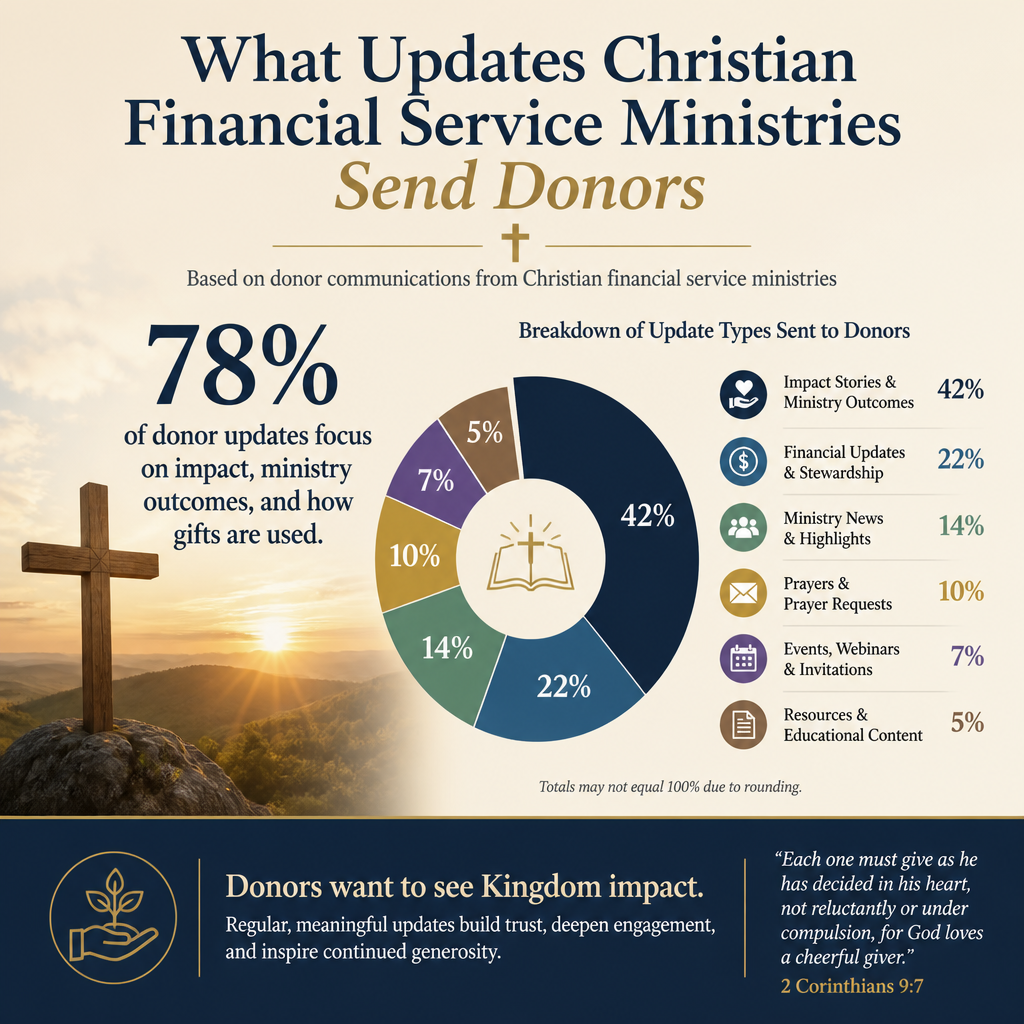
Across our verification work, the ministries that meet The Most Trusted Standard tend to send updates that are regular, specific, and tethered to documented reality. They do not treat the annual report as the only moment of transparency. They communicate throughout the year in a way that makes later reporting coherent rather than surprising.
Program and mission updates with concrete outputs
Because “financial service” work can be invisible, donors need concrete description of what was actually done. Strong updates name services delivered (for example, counseling sessions provided, resources distributed, training events held, or churches served) and explain why those services matter in discipleship and mercy. They avoid inflated spiritual claims that cannot be measured or responsibly attributed.
Financial updates that respect donor intelligence
At minimum, donors should expect a plain-language summary of revenue sources, major expense categories, and any material shifts. In the nonprofit sector, a long-standing misconception is that “low overhead” automatically signals excellence. The field has had to reckon with this. Charity Navigator, Candid, and BBB Wise Giving Alliance publicly challenged the simplistic overhead focus in their joint “Overhead Myth” statement, calling for evaluation that includes governance, effectiveness, and transparency rather than overhead ratios alone Charity Navigator.
What careful donors should watch for is not the absence of administrative costs, but the presence of disciplined budgeting, appropriate controls, and reporting that matches audited statements and IRS filings where applicable.
Governance and leadership signals
Donors should expect updates that clarify who leads, who oversees, and how conflicts of interest are handled. Ministries rarely include full governance policy language in donor emails, but strong organizations make it easy to find board composition, leadership structure, and accountability practices. When leadership changes occur, donors should be told promptly and with enough context to understand continuity of mission and oversight.
A short list of updates that should arrive without being requested
- Annual report with audited financials or clear explanation of financial review practices
- Quarterly or semiannual ministry impact narrative anchored in specific activities
- Material leadership transitions and interim oversight arrangements
- Significant changes in program model, target audience, or geographic focus
- Any incident that materially affects donor trust, with an explanation of corrective action
What strong updates look like in practice
Many donor updates fail not because they are malicious, but because they are shaped by fundraising incentives. Ministries are tempted to present an uninterrupted line of victories. But Christian truthfulness is not the same as marketing confidence. Donors are better served when ministries communicate as stewards who will give an account (Hebrews 4:13), not as brands managing a reputation.
Impact reporting that avoids both hype and cynicism
Financial service ministries often deal in long-term formation: habits of budgeting, freedom from predatory debt, growth in generosity, and strengthened family stability. Not all of this is easily reducible to numbers, and donors should be wary of simplistic metrics that imply guaranteed outcomes. Yet the lack of perfect measurement is not a reason for vagueness. Strong updates combine quantitative indicators where appropriate with clearly bounded qualitative testimony.
For example, a ministry might report what resources were delivered, what follow-up exists, and what safeguards prevent harm. In the broader Christian development conversation, the When Helping Hurts framework articulated by Steve Corbett and Brian Fikkert has shaped many ministries’ approach to avoiding dependency and prioritizing dignity. Donor updates should reflect whether a ministry has an operating philosophy for wise help, not only a desire to help.
Clarity about restricted giving and donor intent
One of the most important, and least discussed, update categories concerns restrictions. If a ministry solicits gifts for a specific purpose, mature practice requires subsequent communication about whether those funds were used as intended, redirected appropriately, or held for future use. Donors should not have to infer this from a generic story.
This is where mature donor communication intersects directly with verification. Donor confidence rises when a ministry makes it easy to trace the relationship between appeals, restricted funds, and reported outcomes—without demanding that a donor become an accountant.
Red flags in donor updates Christian donors should not ignore
Christian donors often hesitate to name warning signs because they do not want to be cynical. Yet prudence is not cynicism. Scripture commends discernment (Proverbs 14:15). A donor’s responsibility is not to assume wrongdoing, but to refuse naïveté that enables it.
Emotion-heavy communication without financial substance
If updates rely almost entirely on urgent appeals, tearful stories, or spiritual language that cannot be tested, donors should pause. Compassion is part of Christian obedience, but it is not a substitute for accounting. Ministries that consistently avoid describing controls, oversight, and verifiable results may be signaling that they do not want scrutiny.
Selective transparency and the absence of comparable reporting
Some ministries share only the information that flatters them. They publish “wins” but never report setbacks, course corrections, or risks. That pattern is especially concerning in financial service ministries, where operational failures can involve real harm: mishandled funds, compromised data, inappropriate advice, or governance failures. Donors should look for evidence of incident response maturity: timely disclosure, clear remediation, and accountability.
Pressure tactics that treat questions as disloyalty
In healthy Christian organizations, questions are treated as part of shared stewardship, not as spiritual resistance. When a ministry frames donor scrutiny as a lack of faith, donors should recognize the dynamic. Faith trusts God; it does not require donors to ignore ordinary safeguards.
For donors evaluating these dynamics across a range of organizations, our coverage of Donor Communication in Christian Financial Service Ministries addresses the common patterns we see in update cadence, content, and transparency practices.
How donors can evaluate update quality without becoming investigators
Donors do not have unlimited time. The goal is not to replicate an audit, but to form a disciplined habit of attention. The same ministry can communicate beautifully and still operate with weak controls; conversely, a ministry can be operationally strong but communicate poorly. Donors need a framework that holds both together.
Ask whether updates map to documents
One practical discipline is to ask whether the claims in updates can be anchored to public documents. If a ministry is a U.S. nonprofit, donors should be able to locate IRS Form 990 information in a reasonable way. The IRS provides guidance on nonprofit tax-exempt organizations and reporting expectations Internal Revenue Service. Donors should not expect perfection in every communication, but they should expect consistency between appeals, reports, and filings.
Use a coherent standard rather than impressions
Impressions are easy to manipulate. Standards are harder. Most Trusted exists to help donors give with confidence by evaluating ministries against The Most Trusted Standard, a 15-criteria framework spanning faith foundation, financial integrity, governance and leadership, and transparency and effectiveness. Verification does not replace discernment, but it strengthens it by insisting on evidence where evidence should exist.
For donors comparing multiple ministries within this space, our broader coverage of Christian Financial Service Ministries provides the context needed to interpret donor updates against the realities of this ministry category.
FAQs for What updates Christian financial service ministries send donors
How often should a Christian financial service ministry update donors?
There is no single biblically mandated cadence, but mature practice usually includes at least an annual report with financial statements and mission results, plus periodic updates during the year that explain program activity and material changes. The essential question is reliability: donors should not be surprised by major developments that were knowable earlier.
Should donor updates include audited financial statements?
Where an audit is appropriate to the organization’s size and complexity, providing audited statements is a strong trust signal. When a ministry does not have an audit, donors should still expect clear financial reporting and an explanation of what level of external review or internal control exists. The key is not a badge, but credible accountability proportionate to the stewardship entrusted.
Donor updates should be treated as moral communication
Christian financial service ministries are asking donors to participate in work that touches money, counsel, and trust. The updates they send are not merely informational; they are part of how the ministry bears witness to truth. Donors should expect communications that are regular, concrete, and accountable—because faithfulness in stewardship is not optional, and donor confidence should rest on verifiable substance rather than persuasive tone.



