
Knowing how to contact Christian financial service ministry donor support is not merely a customer-service question. It is a stewardship question. When donors cannot reach a ministry for a receipt correction, a designation question, or a concern about integrity, the result is often quiet disengagement rather than healthy accountability.
Donor support in Christian financial service ministries sits at a sensitive intersection: money, trust, and conscience. Scripture treats wealth as spiritually weighty, and donor care should reflect that seriousness. “Moreover, it is required of stewards that they be found faithful” (1 Corinthians 4:2).
Start with the right kind of contact request
Clarify whether you need transactional help or pastoral clarity
Christian financial service ministries range from donor-advised and grantmaking structures to debt counseling, generosity education, and relief funds. Donor support teams typically excel at administrative tasks—receipts, address changes, recurring gift issues—but may not be equipped to answer theological or strategic questions about giving. A clear first message improves outcomes and reduces the back-and-forth that can erode confidence.
What this means in practice is naming your request in one line, then supplying the minimum necessary details: gift date, amount, payment method, and any designation language. If your concern is ethical or doctrinal—such as whether funds are used in ways consistent with stated beliefs—say so plainly and ask for the appropriate person (finance, compliance, program leadership, or a donor relations director). Mature ministries should not treat principled questions as a threat.
Use the channel that matches the urgency and the paper trail you need
Email is usually best when you need documentation, such as for year-end giving statements, corrections, or restricted-gift confirmations. Phone is often best for time-sensitive issues like a failed transaction or a duplicate charge. Postal mail can be appropriate for formal notices, especially if you are requesting changes to restrictions or expressing a serious concern that you want routed to leadership or the board.
Across our verification work at Most Trusted, we observe that ministries meeting The Most Trusted Standard typically make it easy to identify at least two channels of contact (for example, a donor care email and a phone number) and clearly state expected response times. That clarity is not cosmetic; it is a basic indicator of operational maturity.

Find the correct contact point and verify you have the real one
Use official ministry pages and secure giving portals
Start with the ministry’s official website and giving portal. Many donor frustrations begin with outdated contact pages, third-party fundraising platforms, or social-media links that are not monitored. A ministry that handles funds should treat secure, current contact information as part of its duty of care.
For additional context on what tends to distinguish financially mature ministries, see Christian Financial Service Ministries. Donors should not need inside knowledge to locate donor support; access is part of transparency.
Guard against impersonation and misdirected giving
Christian donors are frequently targeted by phishing and look-alike domains, especially during disasters and major giving seasons. If you receive an unsolicited message requesting wire transfers, gift cards, or a change in banking details, treat it as suspicious until verified through the ministry’s primary website contact form or main phone number. Ministries themselves have a responsibility to warn donors about common fraud patterns.
When you are communicating about sensitive information (credit cards, bank drafts, addresses, or beneficiary details), do not send full account numbers by email unless the ministry explicitly uses an encrypted, secure method. A donor support team that understands stewardship will also understand prudence.
Write a donor support message that gets a serious response
Use a clear subject line and a disciplined structure
Donor support is often triaged. A well-structured message is not a matter of being “easy”; it is a way of honoring time and increasing accuracy. It also makes it harder for your request to be mishandled.
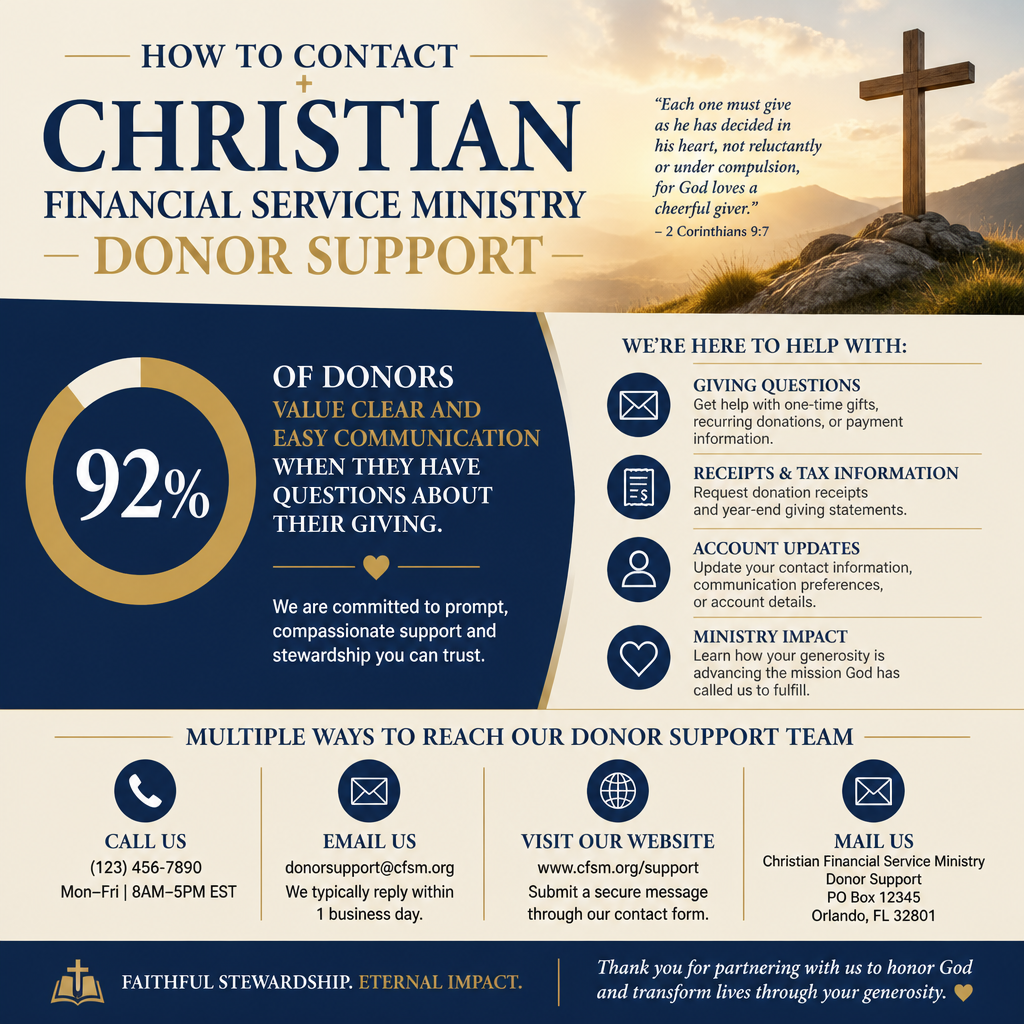
- Subject: “Receipt correction needed for gift on YYYY-MM-DD” or “Question about restricted gift designation”
- Identify: Your full name and the email/phone on the giving account
- Specify: Gift date, amount, payment type, and transaction or confirmation number
- Request: The precise action you are asking them to take
- Deadline: If there is a year-end or tax deadline, state it plainly
This level of clarity also protects the ministry. Mistakes in receipts and designations can create real compliance risk, especially when a gift is restricted. Clear communication is part of keeping both donor and ministry above reproach.
Know what you can legitimately ask for
Donors sometimes hesitate to ask questions because they do not want to be perceived as distrustful. Yet careful inquiry is not cynicism; it can be a form of faithful stewardship. You can reasonably ask for a receipt that meets IRS standards, a copy of the ministry’s privacy policy, confirmation that a restricted gift will be honored as designated, and clarity on whether your gift is tax-deductible (and under what entity).
The harder question is how much program detail a ministry can provide without compromising confidentiality, security, or dignity of those served. For example, financial counseling ministries may not be able to share case-level outcomes. A mature donor support team will explain limits without evasiveness, and will provide aggregate reporting when appropriate.
Escalate wisely when donor support does not resolve the issue
Escalation is not hostility when it is measured and specific
Some issues cannot be resolved at the front line: disputed charges, apparent misuse of restricted funds, conflicts of interest, or repeated refusal to provide basic documentation. If you are not receiving a response, ask for escalation to a donor relations manager, finance director, or operations leader. If the issue is governance-related, a board-level contact method should exist, even if used rarely.
Christians genuinely disagree about how much internal information donors should receive. Yet most agree that a ministry handling gifts should be reachable and accountable. When contact information is hidden, or when legitimate questions are treated as an intrusion, donors should pause.
Document your interactions and keep tone consistent with Christian witness
Keep a record of dates, names, and what was promised. This is not about building a case; it is about preserving clarity when memories differ. If your concern involves potential wrongdoing, documentation becomes more than a convenience.
At the same time, Christian speech matters. A firm tone can remain truthful and measured. “Let your ‘Yes’ be yes and your ‘No’ be no” (Matthew 5:37) is not a call to harshness, but to integrity and clarity—especially when money and trust are involved.
Use verification signals to set expectations before you ever need support
Donor support quality often reflects deeper organizational health
Donors often evaluate ministries by program stories and spiritual alignment, and those matter. Yet donor support is a practical test of whether a ministry can handle detail, follow through, and respect the donor’s role. The same discipline that produces accurate receipts often produces accurate reporting, appropriate internal controls, and clear governance lines.
Across the field, one recurring temptation is to treat administrative functions as spiritually secondary. The New Testament does not. When the early church faced a distribution problem, the apostles addressed it with structural clarity, appointing qualified leaders for the work (Acts 6:1–6). Administrative faithfulness is still faithfulness.
What strong ministries tend to publish in advance
If you want to reduce future friction, look for ministries that publicly provide clear giving and support policies. These are not peripheral documents; they set the terms of trust.
Within Donor Communication in Christian Financial Service Ministries, we see that the strongest donor experiences are built long before a problem arises: they include clear contact channels, written policies, and reporting that makes ordinary questions easier to answer.
Most Trusted exists to help donors give with confidence by evaluating ministries against The Most Trusted Standard—a 15-criteria framework spanning faith commitments, financial integrity, governance and leadership, and transparency and effectiveness. Verification does not eliminate risk or human frailty, but it does raise the baseline expectation: ministries should be reachable, accountable, and consistent in the details that protect both donor and mission.
FAQs for How to contact Christian financial service ministry donor support
What information should we include when contacting donor support?
Provide your full name, the email or phone number associated with your donor account, the gift date and amount, the payment method, and any confirmation or transaction number. State the action you are requesting in one sentence, and include any deadline (such as a year-end receipt correction). This level of specificity reduces errors and improves response time.
What should we do if a ministry will not respond to donor support requests?
Follow up once in writing, then request escalation to a manager in donor relations, finance, or operations. If the matter involves restricted gifts, suspected misuse, or governance concerns, ask for a board-level contact method. If the ministry cannot provide basic accessibility and accountability, it may be prudent to redirect future giving to organizations with clearer transparency and stronger operational discipline.
Stewardship requires both generosity and clarity
Christian donors are not purchasing services; we are participating in kingdom work through entrusted resources. That does not reduce the need for clear, timely donor support. It heightens it. A ministry that welcomes responsible questions and provides reliable contact channels is not catering to donors; it is practicing faithfulness in the ordinary details where trust is either strengthened or quietly lost.



