

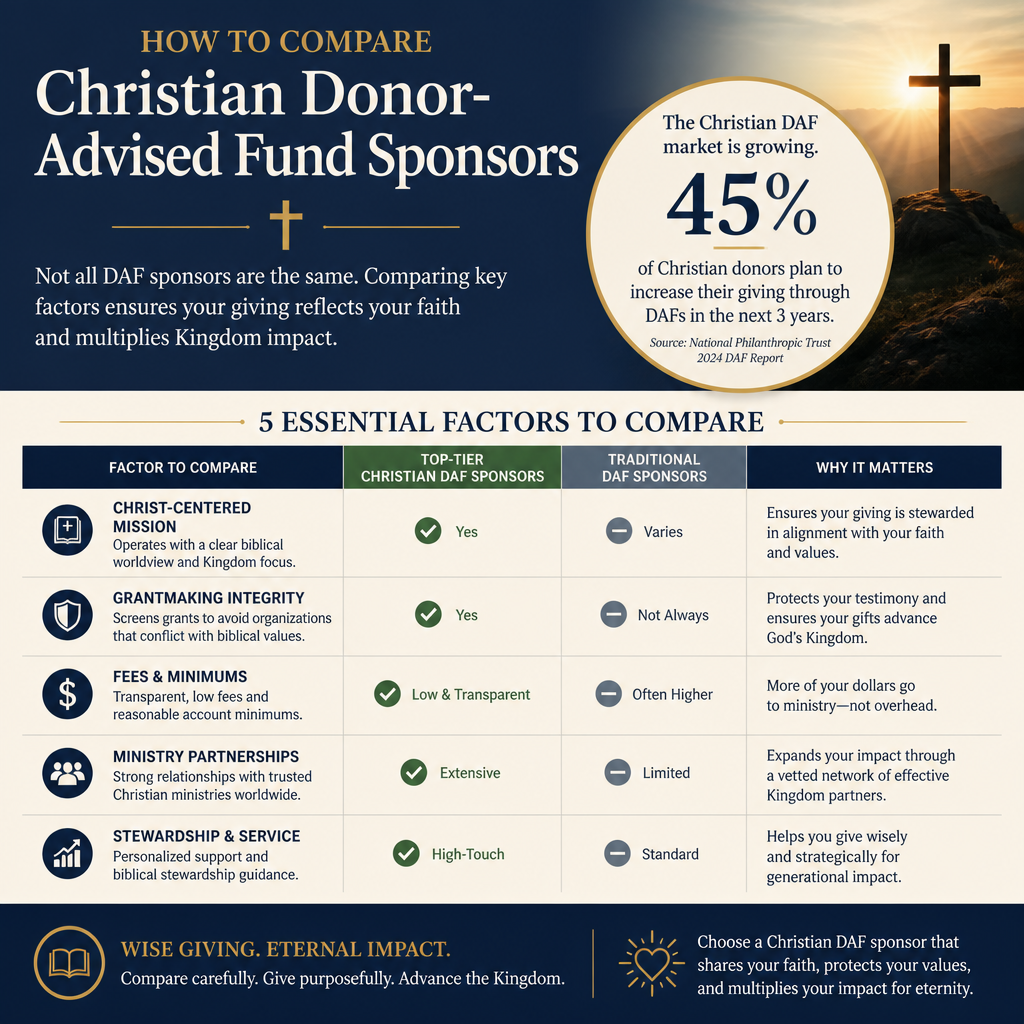
How to compare Christian donor-advised fund sponsors is ultimately a question about stewardship under authority: who will hold the assets, how faithfully they will administer them, and whether their decisions will strengthen or weaken the giver’s ability to pursue obedience over time. A donor-advised fund can simplify complex giving, but it also introduces a gatekeeper between the donor and the ministries the donor loves.
Christian donors often focus first on convenience, tax receipts, and investment options. Those matters are real. Yet the more consequential comparison is theological and institutional: what view of Christian mission shapes the sponsor’s policies, what controls protect against drift, and what transparency allows a donor to verify that stated commitments are operational realities.
1. Begin with authority and alignment, not features
Clarify what the sponsor controls
A donor-advised fund is not a checking account with a religious label. Legally, contributions become the property of the sponsoring organization, and the donor retains advisory privileges rather than ownership. That is not a flaw; it is how DAFs function. But it means the sponsor’s governance, discretion, and theology matter more than the website’s ease of use.
The sponsor’s policies determine which organizations are eligible for grants, what documentation is required, and how exceptions are handled. Some sponsors will grant only to 501(c)(3) public charities. Others add a religious screening layer, such as requiring a statement of faith, a church-affirmed mission, or certain views on contested ethical questions. Christians genuinely disagree about how narrow or broad those boundaries should be, but no donor should discover a sponsor’s boundaries only after the first grant is denied.
Ask what Christian commitments are enforceable
Many DAF sponsors describe themselves as “Christian” because of their origin story or leadership biographies. The harder question is whether the Christian character is embedded in enforceable structures: bylaws, board requirements, doctrinal statements, grant guidelines, and public accountability. When those structures are absent, donors should assume drift is possible, especially across leadership transitions or cultural pressure.
As donors compare options, it helps to situate the DAF inside a larger giving posture. Our work at Most Trusted serves donors who want to verify ministries against The Most Trusted Standard, because trust is strengthened by evidence rather than intention. The same instinct applies to a DAF sponsor: alignment is best measured by policies and governance, not marketing language.

2. Compare the grantmaking rules that shape your real-world giving
Eligibility rules and restrictions
Grantmaking rules determine whether a donor’s convictions will be honored with consistency. The basic questions are straightforward: Can the sponsor grant to churches? Can it grant internationally? Does it support scholarships or tuition assistance? Will it approve grants to mission agencies with complex structures, such as those operating through multiple affiliates?
Because the DAF sponsor bears legal responsibility, it may require documentation beyond what a donor expects. Some sponsors require a current IRS determination letter. Others accept reputable equivalents for churches that do not file as 501(c)(3)s. Some will require proof that a ministry is not providing impermissible donor benefits in exchange for the grant, especially around events, gala tables, or “thank-you” goods. Those compliance lines matter, and they can either protect donors or frustrate them, depending on how clearly and consistently they are communicated.
Speed, process, and pastoral realities
Speed is not merely a customer-service metric. In a crisis response, a delayed grant can mean delayed shelter, delayed counseling, or delayed food distribution. Ask how long grants typically take, how often grants are batched, and whether the sponsor offers expedited processing for emergencies. When a sponsor cannot articulate its typical turnaround time, donors should assume variability.
It also matters how a sponsor communicates when it declines a grant. A mature sponsor explains the reason in plain terms, cites the relevant policy, and provides a path forward when possible. A sponsor that treats declines as an inconvenience to be managed rather than a stewardship decision to be explained can create unnecessary friction and erode trust.
For donors who are weighing multiple channels for giving, it can be helpful to keep the broader landscape in view through the Christian Donor-Advised Funds topic page, where the conversation is framed in the context of faith-aligned stewardship rather than generic philanthropy.
3. Evaluate financial integrity with more rigor than fee comparisons
Fees, minimums, and the true cost of administration
Fees are not unspiritual. They pay for compliance, systems, due diligence, customer support, and audits. The question is whether the sponsor’s cost structure is transparent and proportionate to the services provided. Donors should request a clear schedule of administrative fees, investment fees, minimum account sizes, and any additional charges for complex grants or international activity.
It is also prudent to ask how the sponsor is funded beyond fees. Some sponsors receive revenue-sharing from investment providers. Others receive donor support or operate as part of a larger institution. None of these are necessarily disqualifying, but opacity is. A sponsor that cannot explain how it sustains operations is asking donors to accept risk without visibility.
Investment options and faith-consistent considerations
Many Christian donors want investments that avoid profiting from activities they believe contradict Scripture’s moral vision. The sponsor may offer faith-based screens, ESG-style approaches, or a limited set of funds curated for consistency. Others offer broad menus with optional “values” funds. The contested nature of moral screening should be acknowledged: Christians differ on what constitutes material cooperation, how to weigh indirect exposure through indexes, and whether exclusion is the best tool compared to shareholder engagement. A serious sponsor will articulate its approach without caricaturing other believers.
Donors should also ask how investment performance is reported and benchmarked. It is reasonable to expect periodic statements, clear benchmarks, and disclosure of who manages assets. For donors who want to understand the philanthropic economics shaping DAF growth, National Philanthropic Trust’s annual reporting provides helpful context on the broader sector, including aggregate giving and account trends National Philanthropic Trust.
4. Treat governance and accountability as primary theological questions
Board oversight, conflicts of interest, and continuity
Christian donors are often comfortable evaluating ministries, but less accustomed to evaluating financial intermediaries. Yet a DAF sponsor is a nonprofit institution with the same vulnerabilities that any institution faces: leadership failure, mission drift, conflicts of interest, and inadequate controls.
Ask basic governance questions directly. Who sits on the board? How are they selected? Are there term limits? Are conflicts of interest disclosed and managed? Does the sponsor publish audited financial statements, and by whom are those audits conducted? A sponsor that is reluctant to answer governance questions is not merely opaque; it is asking donors to suspend ordinary prudence.
The IRS framework for donor-advised funds exists precisely because discretion rests with the sponsor, and because certain arrangements can cross legal lines if donor benefits or control become improper. Donors who want to understand the legal category at a primary-source level can consult the IRS overview Internal Revenue Service.
Transparency that honors the donor’s stewardship
Transparency is not suspicion; it is a form of respect. A sponsor should make it easy to find governing documents, financial reports, and clear policies. Donors should not need private access to understand basic institutional realities.
This is one reason our team emphasizes verification as a discipline rather than an attitude. At Most Trusted, we evaluate ministries against The Most Trusted Standard, with attention to faith foundation, financial integrity, governance and leadership, and transparency and effectiveness. Donors can apply the same categories informally when comparing DAF sponsors: does the institution show durable Christian grounding, clean financial reporting, accountable leadership structures, and credible transparency?
5. Use a disciplined comparison process that matches your convictions
A short set of questions that surface real differences
Comparing sponsors becomes more fruitful when donors ask questions that force operational clarity. The following set is intentionally limited; it is designed to surface the differences that most often create friction later.
- What grants are prohibited, and can the sponsor provide examples of common declines?
- What is the typical grant processing time, and what causes delays?
- What fees apply at each account size, including investment expenses and special processing charges?
- What documents are publicly available: audits, board list, bylaws, doctrinal statement, and policies?
- What faith-based investment options exist, and how are screens defined and reviewed over time?
Hold tension honestly: donor freedom and sponsor responsibility
The field has had to reckon with a persistent tension. Donors often want maximal freedom to support nuanced ministry efforts, including church-based initiatives, international partners, or sensitive work in closed countries. Sponsors, on the other hand, have legal responsibilities and reputational risks, and must apply policies consistently to preserve integrity for all account holders. A sponsor that promises unlimited flexibility is often promising what it cannot faithfully deliver.
Christians should also resist the temptation to treat a DAF as a spiritual shortcut. A DAF can facilitate generosity, but it does not replace discernment. Scripture’s warnings about money are not addressed by better tools alone. Jesus’ teaching remains searching precisely because it addresses the heart behind the transaction (Matthew 6:19–24). Wise structures support obedience; they do not substitute for it.
For donors who want to evaluate options within a clearly defined set of decision factors, the How to Choose a Christian Donor-Advised Fund Sponsor category page provides additional coverage aligned with that kind of disciplined comparison.
FAQs for How to compare Christian donor-advised fund sponsors
Should a Christian donor prioritize a sponsor that only grants to explicitly Christian ministries?
It depends on the donor’s theology of common grace, evangelism, and neighbor-love, and on how the donor understands the Church’s responsibilities relative to broader social needs. Some donors want a sponsor that restricts grants to explicitly Christian organizations as a matter of spiritual focus and accountability. Others want the ability to support a wider set of charities, including hospitals, refugee agencies, or schools with strong public-benefit missions. The key is candor: donors should choose a sponsor whose stated boundaries match enforceable policies, so that grants are not negotiated case-by-case under pressure.
What documents should a trustworthy Christian DAF sponsor make easy to find?
At minimum, donors should expect access to audited financial statements, current leadership and board information, a clear fee schedule, grantmaking policies, and an explanation of investment options and related fees. If the sponsor claims a distinctly Christian identity, it should also disclose the doctrinal or mission commitments that govern that identity in practice. Transparency is not merely a governance best practice; it is part of honoring the donor’s responsibility to give with wisdom rather than presumption.
Choosing with sober confidence
The best comparison of Christian donor-advised fund sponsors does not treat the sponsor as a neutral conduit. It recognizes that the sponsor’s governance, rules, and transparency will shape the donor’s long-term faithfulness and the ministries’ ability to receive support when it matters most. Donors should choose the sponsor whose institutional commitments can be verified, whose policies are intelligible, and whose accountability structures are strong enough to endure the pressures that inevitably test Christian institutions.



