
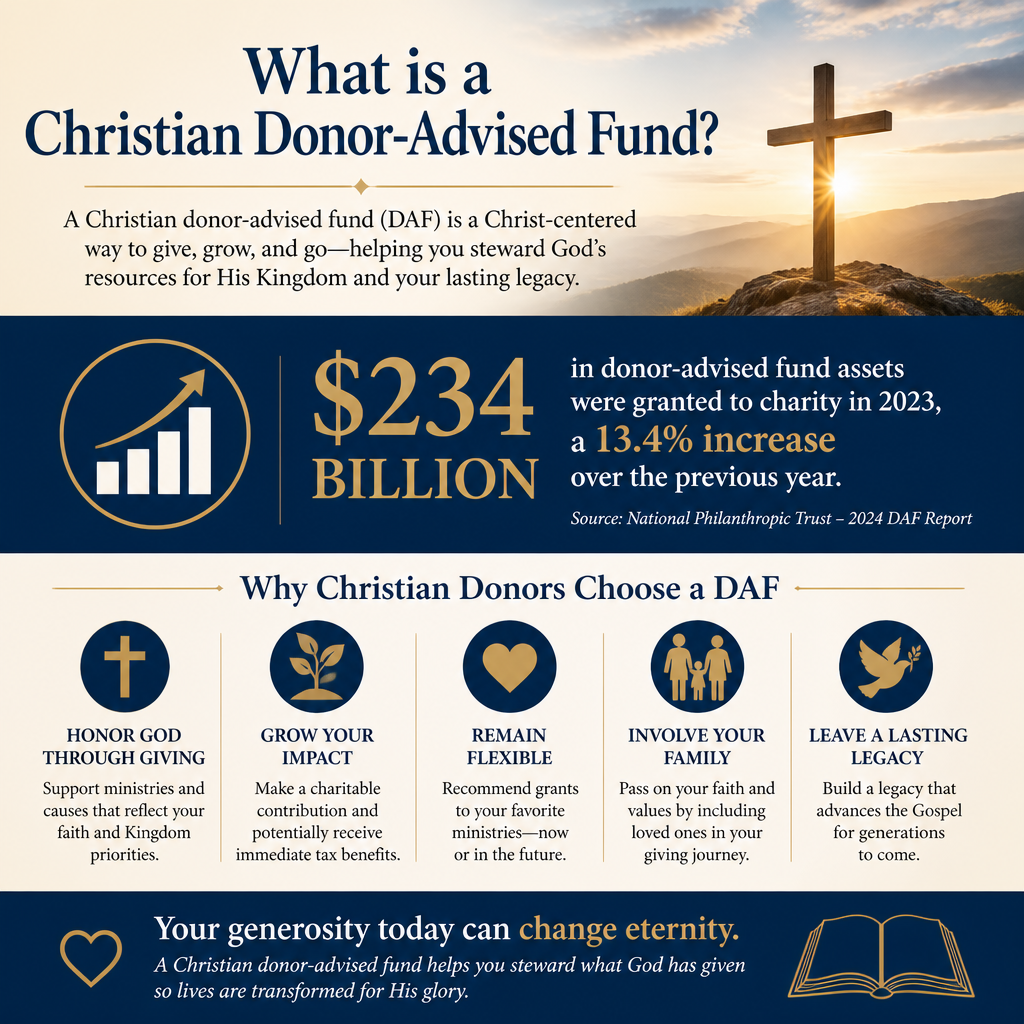
A Christian donor-advised fund is a giving account administered by a sponsoring organization that allows a donor to contribute assets, receive an immediate charitable deduction where applicable, and then recommend grants over time to qualifying ministries and other charities. For Christian donors, the appeal is rarely only administrative. It is the desire to give with clarity, discipline, and spiritual intent, without forcing every major gift decision into a single December afternoon.
The concept is straightforward, but the implications are not. Donor-advised funds can strengthen long-term generosity, simplify complex gifts, and help families give together. They can also distance a donor from the real work of discernment if treated as a purely financial instrument. Christian stewardship has always required more than efficiency; it requires truthfulness, accountability, and love of neighbor expressed through concrete choices.
What a donor-advised fund is and what makes it Christian
The core structure
A donor-advised fund, commonly abbreviated DAF, is not a private foundation and it is not a personal bank account. A donor makes an irrevocable charitable contribution to the sponsoring organization. In return, the donor receives advisory privileges: the ability to recommend grants to IRS-qualified public charities and, in many cases, to recommend how the contributed assets are invested inside the fund.
Most sponsoring organizations are public charities. Some are community foundations. Some are affiliated with financial institutions. Others are explicitly faith-based sponsors that aim to serve donors who want their giving governed by Christian convictions.
What Christians usually mean by Christian
Christians genuinely disagree about how explicitly theological a giving vehicle must be to merit the label “Christian.” For some, it means the sponsoring organization is Christian and grants are restricted to Christian ministries. For others, it means the fund is administered in a way that respects Christian moral boundaries and encourages prayerful discernment, even when grants may include a wider set of charities.
What this means in practice is that “Christian” is less a marketing adjective than a set of governance and policy commitments: what the sponsor will and will not fund, how it handles theological controversy, and whether it treats donors as customers or as stewards accountable to God.

How a Christian donor-advised fund works in practice
Contribute, then recommend grants over time
In most cases, a donor contributes cash, appreciated securities, or other eligible assets to the fund. The contribution is recorded as a charitable gift to the sponsor. Then, on the donor’s timeline, the donor recommends grants to ministries and other nonprofits that meet the sponsor’s requirements and applicable law.
DAFs are especially useful when a donor’s income or assets fluctuate. A business owner may have a year of unusually strong earnings. A family may sell appreciated stock or a property. A donor-advised fund can allow that charitable decision to be made decisively, with grants then distributed thoughtfully over months or years.
What the sponsor controls and what the donor controls
Donors advise; the sponsor decides. That distinction is not a technicality. It is the legal boundary that keeps a donor-advised fund from being a private account. The sponsor has final authority over grants and can decline recommendations that violate law or policy.
For Christian donors, this governance boundary can be a strength when the sponsor has doctrinal seriousness and a consistent ethical framework. It can also be a risk when policies are vague or when the sponsor’s commitments shift with cultural pressure. Due diligence on the sponsor is therefore part of stewardship, not an administrative footnote.
Why Christian donors use donor-advised funds
Stewardship, not simply convenience
Scripture treats money as spiritual terrain. Jesus warns against serving mammon, commends sacrificial generosity, and calls his disciples to store up treasures in heaven. The question is not merely how to give, but what kind of people our giving is forming us to become.
A donor-advised fund can serve that formation when it supports deliberate, accountable generosity. It can also enable avoidance when it becomes a way to move money “out of sight” without sustained attention to whether grants are faithful, effective, and appropriately governed.
Common use cases we see among mature donors
Across our verification work at Most Trusted, donors who treat giving as stewardship rather than impulse often use DAFs for a few repeatable purposes:
- Bundling multiple years of charitable giving into one tax year, while distributing grants steadily
- Giving appreciated stock to avoid capital gains tax exposure and increase grant capacity
- Involving children or extended family in a disciplined grantmaking process
- Supporting long-term ministry partners with multi-year commitments
- Responding quickly to crises while retaining the ability to vet recipients carefully
Those patterns reflect a deeper conviction: generosity is not only an event. It is a practiced loyalty, shaped over time through repeated decisions.
Discernment and risk in Christian grantmaking
The tension between urgency and verification
The donor’s strongest instincts are often compassionate and immediate. Crisis appeals are real. Suffering is real. Yet Christian donors have also seen enough public failures to know that urgency can be exploited. Discernment is not cynicism; it is love expressed through truthful attention.
One of the more persistent misunderstandings in Christian philanthropy is the idea that low overhead is the primary marker of faithfulness. The nonprofit field has had to correct this. The “Overhead Myth” letter, signed by GuideStar, Charity Navigator, and the BBB Wise Giving Alliance, argues that overhead ratios are a poor proxy for impact and can create perverse incentives in nonprofit behavior GuideStar.
Christian donors can honor both compassion and prudence by asking better questions: governance quality, financial integrity, evidence of effectiveness, and theological alignment where relevant. This is part of why we built Most Trusted around The Most Trusted Standard, a 15-criteria framework spanning Faith Foundation, Financial Integrity, Governance and Leadership, and Transparency and Effectiveness.
How a DAF can either sharpen or dull accountability
A donor-advised fund can sharpen accountability when it becomes the place where a family sets giving priorities, records grant decisions, and evaluates recipients year over year. It can dull accountability when the fund becomes a warehouse that reduces the felt responsibility to understand what a ministry is actually doing with donated resources.
For donors who want to build disciplined habits, it helps to treat grant recommendations as a formal act of stewardship. That means defining what “faithful ministry” requires in your giving, and checking those requirements consistently rather than episodically.
For more on the broader landscape, many donors begin with Christian Donor-Advised Funds as a category, then narrow toward the sponsors and policies that fit their convictions.
Choosing a Christian donor-advised fund sponsor
Questions that separate marketing from substance
A sponsor’s theology matters, but so does its governance. Christian branding without transparent policies is not protection. Before opening a fund, donors should press into specifics: what the sponsor will fund, how it handles controversial causes, and what accountability mechanisms exist when policies are violated.
Several questions are especially clarifying:
- What is the sponsor’s statement of faith, and is it operational or merely aspirational?
- Are grants restricted to certain categories, and who decides what qualifies?
- What due diligence does the sponsor perform before sending grants?
- What fees are charged, and how are they disclosed?
- What happens if a recommended recipient is later implicated in financial or moral misconduct?
These are not adversarial questions. They reflect the reality that Christian donors carry responsibility both for wise stewardship and for guarding the witness of the church when public failures occur.
Where verification fits into the decision
Most donors cannot personally investigate every ministry with professional rigor. That is why credible third-party verification matters. In our work at Most Trusted, we evaluate ministries against The Most Trusted Standard so donors can give with confidence grounded in evidence, not sentiment. A DAF does not replace this work; it can make it more practicable by giving donors the time and structure to do it well.
Donors who want to understand the mechanics and trade-offs in greater depth often continue through How Christian Donor-Advised Funds Work, since the details of sponsor policies, grant timing, and restrictions materially shape the integrity of the tool.
FAQs for What is a Christian donor-advised fund
Can a Christian donor-advised fund only give to Christian ministries?
It depends on the sponsoring organization’s policies. Some Christian sponsors restrict grants to ministries and explicitly Christian charities, while others allow grants to any eligible IRS-qualified public charity that aligns with their ethical boundaries. Because the sponsor has final authority over grants, donors should read the sponsor’s written grant guidelines carefully before contributing.
Is a donor-advised fund a substitute for vetting a ministry?
No. A donor-advised fund is a vehicle for giving, not a guarantee of ministry faithfulness or effectiveness. The sponsor may perform basic checks for legal eligibility, but donors still bear responsibility to discern whether a ministry is theologically sound, financially responsible, and governed with integrity. Verification services such as Most Trusted can help donors evaluate ministries against consistent criteria rather than relying on reputation or emotional appeal.
A tool that should serve the church, not replace discernment
A Christian donor-advised fund can be an instrument of steady generosity, disciplined planning, and family formation in giving. Used well, it helps donors align resources with convictions over time and respond to needs without abandoning prudence. Used poorly, it can become a way to postpone difficult questions about faithfulness, accountability, and impact.
The wiser path is not suspicion of the tool, nor uncritical embrace of it, but stewardship shaped by truth. Christian donors honor God when they give with open hands and clear eyes, holding both compassion and verification together.



