
How Christian donor-advised funds invest donations is not a technical footnote. It is a stewardship question, because money set aside for ministry is not neutral while it waits. It earns, it risks loss, and it is guided by a moral vision—explicitly, in some Christian DAFs; implicitly, in every case.
What makes this question difficult is that faithful donors are often holding two goods at once: the desire to increase future giving capacity and the desire to ensure that current assets are not funding what Scripture forbids. Christians genuinely disagree about where lines should be drawn in public markets, but serious donors agree on the premise: investment choices are part of discipleship, not merely back-office administration.
What a DAF does with donations between contribution and grant
Donations become charitable assets held by a sponsor
When a donor contributes to a donor-advised fund, the contribution is generally an irrevocable gift to the sponsoring public charity. The donor retains advisory privileges over how and when grants are recommended, but the DAF sponsor is the legal owner of the assets and carries fiduciary responsibility for their management.
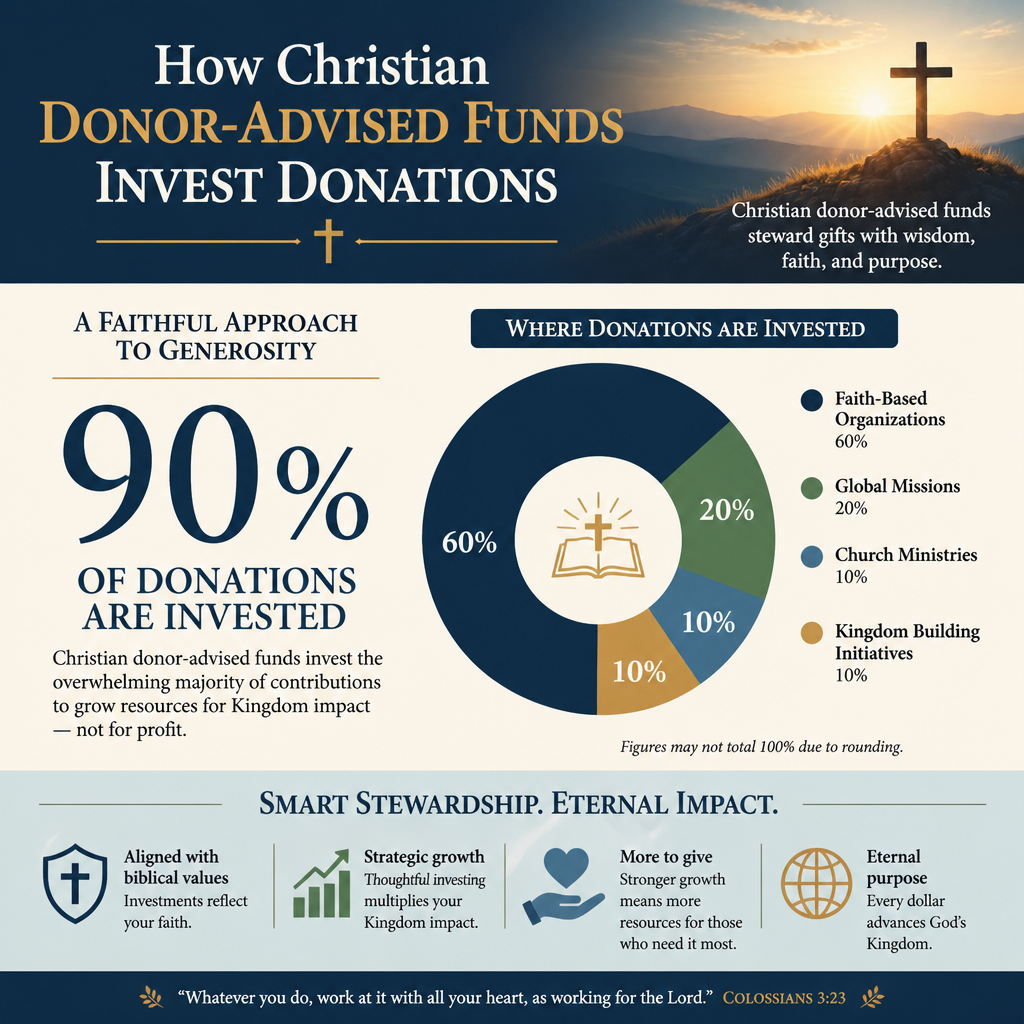
In practice, that means your contribution typically moves into an investment pool or model portfolio aligned with your selected risk profile. Some sponsors invest through mutual funds or ETFs, some through separately managed accounts, and some through proprietary pooled vehicles. The decision is rarely “invest or not,” but rather “how will these charitable assets be invested until they are granted to ministries?”
Why investing is standard practice
Most DAF sponsors invest because donors often do not grant all contributed assets immediately, and sponsors seek to preserve or grow charitable capital over time. This is partly a prudential response to inflation and market reality, and partly a way to increase the eventual amount available for gospel work.
DAFs have also become a significant channel of modern American giving. National Philanthropic Trust reported that U.S. DAF charitable assets were $251.52 billion in 2023, reflecting how much charitable capital may be invested at any given time National Philanthropic Trust.

The investment mechanics donors should understand
Investment options are constrained by policy
DAF sponsors offer a menu of investment choices designed to be administratively scalable and compliant with their investment policy statements. A typical lineup includes cash or money market options, conservative bond-heavy models, balanced portfolios, and growth-oriented equity allocations.
The harder question is not whether these options exist, but what moral and theological screening, if any, shapes the underlying holdings. Many mainstream options reflect broad-market exposure. Some explicitly Christian options attempt to apply faith-based screens, shareholder engagement, or both.
Fees, payout patterns, and timing pressures
Two features of DAF investing deserve sober attention. First, fees: sponsors commonly charge an administrative fee, and underlying funds carry expense ratios. Second, timing: charitable assets invested in volatile markets can experience drawdowns that affect grant-making capacity if donors grant during a market trough.
DAFs are often discussed alongside payout debates. The National Philanthropic Trust reported a 2023 grant payout rate of 24.3% from DAFs (grants as a percentage of year-end assets), which is frequently cited to show that DAFs are not simply warehousing funds National Philanthropic Trust. Payout rates, however, do not resolve the moral question of what the assets fund while they remain invested.
Christian distinctives in DAF investing
Faith-based screening and its real trade-offs
A Christian DAF may apply negative screens to avoid industries commonly understood to be incompatible with Christian moral teaching—often including pornography, abortion services, and certain forms of gambling. Some also screen out companies with predatory lending practices, exploitative labor patterns, or aggressive anti-family advocacy. Other sponsors prefer a narrower approach, arguing that overly broad screens can create moral confusion or a false sense of purity in complex markets.
Screening is not costless. It can concentrate holdings, reduce diversification, and increase tracking error versus a broad market index. It can also introduce disputes over definitions. Christians may agree that human life is sacred, yet differ on how to treat a conglomerate with a small subsidiary involved in morally objectionable activity, or a pharmaceutical company with mixed product lines. A serious sponsor names these tensions rather than pretending they do not exist.
Shareholder engagement and proxy voting
Some Christian investment approaches emphasize engagement: voting proxies, filing shareholder resolutions, and meeting with management to advocate for policies consistent with human dignity, religious liberty, and family flourishing. This approach assumes that owning a small stake can be a means of moral witness within the marketplace.
Engagement can be principled, and it can also be performative. The distinction is whether the sponsor can demonstrate a coherent engagement policy, consistent voting records, and realistic expectations about influence. Donors should ask for that evidence. Stewardship is not satisfied by aspirational language alone.
What investment choices communicate about stewardship
DAF investing sits under biblical moral seriousness
Scripture does not treat money as morally indifferent. Jesus’ teaching repeatedly ties the use of wealth to the condition of the heart, and the prophets condemn gain pursued at the expense of righteousness. The question for Christian donors is therefore not merely whether investments “perform,” but whether the means of growth aligns with the ends of generosity.
At the same time, Christian tradition recognizes that believers operate within mixed economies. The New Testament churches lived under imperial systems they could not purify. That reality does not remove moral responsibility; it does require moral clarity, proportionality, and humility about what can and cannot be disentangled in modern capital markets.
A practical set of questions donors can ask
Across our work at Most Trusted, we observe that high-integrity ministries tend to welcome scrutiny rather than resist it. The same posture is worth applying to DAF sponsors and their investment programs. Donors can reasonably request clear answers on governance, conflicts of interest, and moral policy.
- What specific screens are applied, and where are the definitions documented?
- Who sets the investment policy, and what accountability governs changes?
- What are the all-in fees, including underlying fund expenses?
- How does the sponsor vote proxies, and can it provide a voting record?
- What happens if a holding violates the stated screens after acquisition?
These questions are not adversarial. They are the ordinary responsibilities of donors who understand that charitable dollars are consecrated for kingdom work.
How due diligence on DAFs and ministries fits together
Verifying the channel does not replace verifying the destination
Even if a Christian DAF’s investments align with your convictions, the grants it makes still require discernment. A DAF can be a faithful instrument and still distribute funds to ministries with weak governance, unclear doctrine, or poor reporting. Donors should resist the comforting error of assuming that a Christian-sounding intermediary guarantees downstream integrity.
Most Trusted exists to serve this exact problem: donors want to give with confidence, and confidence requires verifiable evidence. When we evaluate ministries against The Most Trusted Standard, we examine doctrinal commitments and ministry practices alongside financial integrity, governance and leadership, and transparency and effectiveness. DAF giving becomes more fruitful when the ministries receiving grants can withstand that kind of scrutiny.
How DAF investing intersects with grant timing and ministry needs
DAFs can encourage thoughtful, paced generosity, but they can also unintentionally distance donors from urgent needs. Some donors delay granting because the assets are invested and “still working.” In certain contexts—disaster response, seasonal ministry cycles, or time-bound capital projects—waiting can impose real costs on frontline work.
What this means in practice is that donors should align their investment posture with their anticipated grant rhythm. Short-horizon giving often warrants more conservative allocations. Long-horizon giving may justify growth exposure, provided the moral framework is clear and the donor remains attentive to real-time ministry needs.
For a broader view of how DAFs function within Christian giving, see Christian Donor-Advised Funds.
FAQs for How Christian donor-advised funds invest donations
Do Christian donor-advised funds guarantee that donations are not invested in objectionable companies?
No sponsor can offer a meaningful guarantee without a clearly defined, auditable policy and an explanation of how it is implemented. Some Christian DAFs apply formal faith-based screens and monitor holdings; others offer a mix of screened and unscreened options. The responsible approach is to request the sponsor’s written screening criteria, monitoring process, and proxy voting policy, then evaluate whether the stated practices match your convictions.
Can donors choose their own investments inside a Christian DAF?
Some sponsors allow limited customization above certain balance thresholds through separately managed accounts or advisor programs, while many provide only a predefined menu. Customization can improve alignment but can also increase fees and complexity. Donors should weigh whether the additional control materially advances faithfulness and stewardship, or simply adds administrative burden without meaningful moral clarity.
Stewardship that remains morally awake
How Christian donor-advised funds invest donations is ultimately a question of coherence: whether the means of future generosity align with the ends. Christian donors do not need perfectionist anxiety, but we do need policies that can be explained plainly, governed responsibly, and defended theologically.
DAFs can be a wise instrument for disciplined giving, especially when paired with rigorous ministry due diligence. For further orientation to the practical workings donors should understand, see How Christian Donor-Advised Funds Work.



