

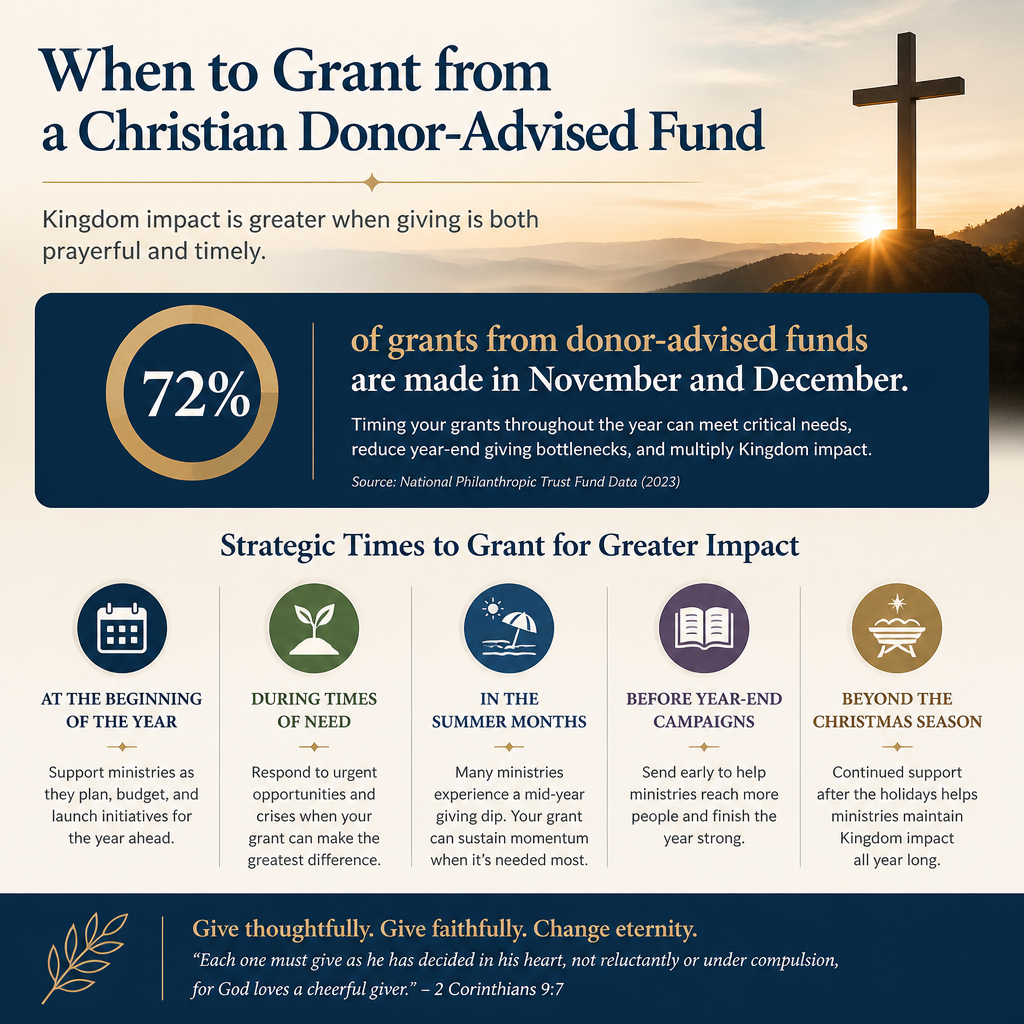
Knowing when to grant from a Christian donor-advised fund is a spiritual and practical question. The timing of a grant shapes what a ministry can actually do, but it also reveals how we understand stewardship, faith, and accountability before God.
A donor-advised fund can create healthy distance between the moment of conviction and the moment of disbursement. That distance is not neutral. It can become patient discernment, or it can become delay that starves faithful work. The challenge is learning to grant at the pace of love, not the pace of anxiety or habit.
Grant when the ministry can clearly deploy the gift
The first test for timing is not market conditions or year-end deadlines. It is whether a specific ministry can translate your intended gift into faithful, competent action in the near term. A grant made before a ministry has the leadership, systems, or permissions to execute can unintentionally create pressure to spend for the sake of spending.
Across our verification work at Most Trusted, we see that the ministries that meet The Most Trusted Standard tend to pair theological clarity with operational clarity. They can name what they will do, who will do it, how they will safeguard funds, and what meaningful evidence of progress would look like. That kind of readiness often matters more than whether the need sounds urgent.
Readiness is a stewardship category
Scripture commends zeal, but it also commends sober-mindedness and order. The apostles did not treat the distribution to widows as an afterthought; they established trustworthy governance for it (Acts 6:1–6). The passage is not a template for modern nonprofit structures, but it is unmistakable about a principle: the church should not confuse compassion with administrative neglect.
Ask for specificity before you fund urgency
Some needs are immediate and cannot wait, especially disaster response and time-bound crises. Yet even then, mature ministries can explain how funds will be handled, how partners are selected, and what safeguards exist against fraud and duplication. The Federal Emergency Management Agency has repeatedly warned that disasters attract scams and deceptive appeals, a reality FEMA addresses in its guidance to donors and disaster survivors FEMA.

Grant when your DAF is helping you give more faithfully
A Christian donor-advised fund is not merely a charitable account. It is a tool that can either strengthen or weaken formation. The question is whether the DAF is serving the convictions you already hold about generosity, or quietly rewriting them into something more comfortable.
For many Christian donors, the DAF’s greatest value is that it allows deliberate giving across seasons: when a liquidity event or unusually high-income year occurs, you can set aside resources for long-term generosity without rushing grant decisions. What this means in practice is that timing can be guided by discernment rather than tax pressure, even though the tax deduction happens when you contribute to the DAF.
Choose timing that resists performative giving
Jesus’ warning in Matthew 6 is not against public accountability. It is against using giving to secure righteousness in the eyes of others. A DAF can reduce the social pressure of public recognition, which is often a genuine spiritual mercy for donors who want to give quietly and consistently.
At the same time, anonymity can also reduce appropriate scrutiny. It becomes easier to grant to a familiar name without asking hard questions about governance, financial practices, or theological fidelity. This is one reason donors benefit from a disciplined approach to timing: do not grant until you can articulate why this ministry, why now, and what faithfulness would look like on the far side of the gift.
Integrate your DAF into a full giving strategy
Many donors want a giving posture that includes both stable support for long-term ministry and responsive support for emergent needs. The category Giving Strategies Using Christian Donor-Advised Funds is where we track the distinctive decisions that arise once a DAF becomes a central tool, including pacing, recurring grants, and how to avoid the spiritual drift that can come with deferred disbursement.
Grant when your due diligence is complete enough for the size of the gift
Christian donors often feel a tension here. We do not want to treat ministries as suspects, but we also know that sin and incompetence can damage sacred work. Mature generosity is not gullibility. Timing is one of the simplest ways to honor both trust and verification.
The larger the grant, the more your timing should be governed by clarity about governance, financial integrity, and transparency. That does not require cynicism. It requires proportion. A $1,000 grant and a $250,000 grant should not be processed on the same level of confidence.
What reasonable diligence can include
-
Clear theological commitments and a coherent statement of faith that matches the ministry’s practice
-
Recent financial statements and a credible explanation of revenue concentration and reserves
-
Board oversight that is real, documented, and not simply a group of friends without accountability
-
Specific reporting on outcomes that avoids both inflated claims and vague spiritualized metrics
-
Transparency about leadership compensation and conflict-of-interest safeguards
These are not merely best practices borrowed from the secular sector. They align with biblical themes of honesty, impartiality, and avoiding even the appearance of wrongdoing when handling funds given for the Lord’s work (2 Corinthians 8:20–21).
Use public records without overreading them
In the United States, many nonprofits file an IRS Form 990, which can offer real insight into finances and governance. It can also be misread by donors who treat a single ratio as a verdict. The IRS provides guidance on tax-exempt organizations and required filings, which can help donors understand what is actually being disclosed and what is not IRS.
Churches and some faith-based entities are not required to file a Form 990, and absence of a 990 is not proof of secrecy. The harder question is whether the ministry is voluntarily transparent in other ways, and whether it can demonstrate sound stewardship through documents, policies, and credible third-party verification.
Grant when timing strengthens the ministry’s actual cash flow
Most ministries do not operate like endowments. They operate like households: payroll, rent, program costs, and a continuous need for working capital. Donors sometimes prefer to grant in large bursts, but ministries often benefit more from predictable cash flow that allows planning, retention, and measured growth.
This is one place where donor intentions and ministry realities can quietly diverge. A DAF makes it easy to set up recurring grants, but it also makes it easy to delay. Timing should be tethered to the ministry’s operational cadence, not only to donor convenience.
Recurring support is often the most strategic grant
Many effective ministries can responsibly scale only when they can count on stable support for a defined period. A recurring monthly or quarterly grant can reduce fundraising churn, allowing leaders to devote more attention to discipleship, program quality, and staff care.
Christians genuinely disagree about how much a ministry should rely on recurring donors versus diversified revenue. There is no single biblical rule. Yet the New Testament pattern includes ongoing partnership, not only one-time gifts, and Paul’s letters assume continued material participation in gospel work (Philippians 4:15–17).
Large grants can be faithful, but they must be timed well
There are moments when a significant, time-bound grant is exactly what faithfulness requires: purchasing a facility, launching a new campus, translating Scripture, underwriting a training cohort, or expanding a crisis program. The discipline is to ensure the ministry has the governance maturity to manage restricted funds, report accurately, and resist mission drift under the pressure of expansion.
Grant when the gift fits your convictions about Christian witness
Timing is also moral. A grant communicates endorsement, and endorsement has a public dimension even when the gift is anonymous. We should grant at moments when we can stand before God with integrity about what we supported and why.
This includes attention to theology and ecclesial posture, but it also includes attention to practices that affect vulnerable people. The Christian sector has had to reckon with cases where fundraising narratives harmed those being served, where incentives distorted child welfare, or where governance failed in ways that wounded congregations and communities. The When Helping Hurts framework, articulated by Steve Corbett and Brian Fikkert, has helped many Christian donors and ministries name how good intentions can produce dependency, paternalism, and harm when local agency is ignored Moody Publishers.
Grant when you have clarity on what is being measured
Some ministries should not be forced into simplistic metrics. Others have hidden behind spiritual language to avoid meaningful accountability. The wise path is to ask what faithfulness looks like for that ministry’s calling, and what evidence would credibly indicate progress. That evidence may be quantitative, qualitative, or a combination, but it should be honest and not overstated.
Verification helps, but it does not remove discernment
Independent verification can reduce the burden on donors and raise the baseline of confidence. That is why Most Trusted evaluates ministries against The Most Trusted Standard, examining faith foundation, financial integrity, governance and leadership, and transparency and effectiveness. Even then, donors still have a stewardship decision: whether to grant now, later, or in stages as trust and evidence accumulate.
For donors building a disciplined approach over time, the broader context of Christian Donor-Advised Funds frames the distinctive opportunities and risks of DAF-based giving, especially the temptation to treat the account as an endpoint rather than a channel of obedience.
FAQs for When to grant from a Christian donor-advised fund
Should a Christian donor-advised fund have a minimum annual payout target?
Some donors set a personal payout discipline to guard against indefinite delay, even though donor-advised funds are not legally required to distribute a specific percentage annually. The wisdom of a target depends on the donor’s situation, but the theological concern is consistent: resources dedicated to charitable purposes should not be functionally hoarded. A payout discipline can serve love of neighbor when it is paired with careful verification and a clear plan for recurring support.
Is it better to grant immediately after contributing to a DAF or to wait?
Either can be faithful. Immediate granting can be appropriate when a ministry has a clear, near-term use for funds and your diligence is complete. Waiting can be appropriate when a contribution year is unusually complex, when you are building a portfolio of trusted ministries, or when you are discerning a major gift. The key is to ensure the delay is governed by prudence and clarity, not by inertia or the quiet comfort of leaving funds undistributed.
Granting at the pace of disciplined generosity
The best time to grant from a Christian donor-advised fund is when timing strengthens both the ministry’s faithfulness and the donor’s stewardship. That means granting when a ministry is ready to deploy funds responsibly, when diligence matches the scale of the gift, and when the gift advances a coherent Christian witness. A DAF becomes a gift to the church and to the world when it accelerates careful generosity rather than postponing it.



