

How Christian donor-advised funds reflect biblical stewardship depends on whether they are treated as a serious tool for faithful administration or as a spiritualized convenience. A donor-advised fund can discipline giving, strengthen accountability, and widen generosity across time. It can also tempt donors toward control, opacity, and delayed obedience if it becomes a holding account rather than a sending mechanism.
Scripture does not name modern charitable vehicles, but it does name the moral terrain: God owns; we manage. “The earth is the LORD’s and the fullness thereof” (Psalm 24:1). Jesus commends faithfulness with entrusted resources (Matthew 25:14–30). Paul requires that “stewards” be found faithful (1 Corinthians 4:2). Christian donors who consider donor-advised funds are not asking a technical question only. We are asking how to structure our money so that it serves love of God and neighbor rather than our own comfort.
Stewardship begins with ownership and ends with accountability
Donor-advised funds can clarify what we truly own
Biblical stewardship starts with a transfer of imagination. We do not “have” wealth as autonomous owners; we hold it as entrusted managers. That distinction matters because donor-advised funds institutionalize a real legal shift: once assets are contributed, they no longer belong to the donor. They become irrevocably dedicated to charitable purposes under the sponsoring organization’s governance.
That feature can reinforce Psalm 24 theology in a practical way. Giving is no longer a future intention; it is a completed act of relinquishment. Christian donors often carry sincere desire alongside understandable anxiety: market volatility, competing needs, family obligations, and a steady stream of urgent appeals. A donor-advised fund can reduce decision pressure while still marking a meaningful surrender of ownership.
Stewardship requires verifiable faithfulness, not sincere intention
The New Testament standard for stewardship is not sincerity but faithfulness. That is why governance and transparency are not “administrative concerns.” They are spiritual concerns because they govern whether entrusted resources are handled truthfully and competently.
Across our verification work at Most Trusted, we see that mature ministries build systems that make faithfulness observable: independent boards, clear financial reporting, conflict-of-interest discipline, and program claims that can be tested. The ministries that meet The Most Trusted Standard tend to treat donors not as customers to be retained but as partners who deserve honest information. That posture aligns with the biblical assumption that stewardship will be examined, weighed, and held to account.

Christian donor-advised funds can serve disciplined generosity, not delayed obedience
Bunching and timing can support wise planning without shrinking sacrifice
Many Christian households want to give more than they currently do, but their giving is reactive: a year-end rush, a sudden crisis, or a single emotionally compelling campaign. A donor-advised fund can help donors plan giving as a vocation rather than a mood. In practice, donors may contribute appreciated assets, simplify recordkeeping, and recommend grants throughout the year as needs become clear.
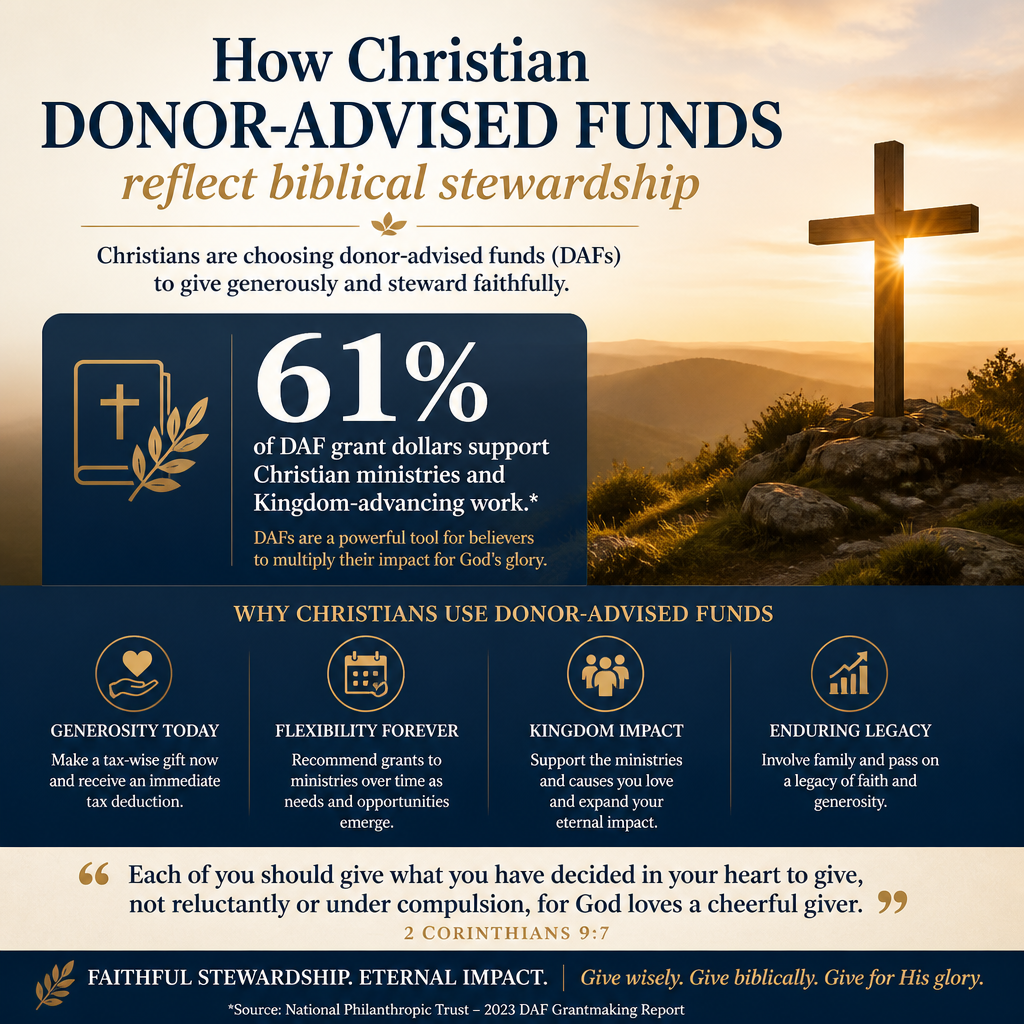
This is where the mechanics should be acknowledged plainly. In the United States, donor-advised funds are a significant part of contemporary philanthropy; grants from donor-advised funds to charities reached $52.16 billion in 2022 according to the National Philanthropic Trust’s 2024 Donor-Advised Fund Report (National Philanthropic Trust). That volume reflects usefulness. It also raises moral questions about whether funds are being granted promptly and wisely.
The moral tension is warehousing
Christians genuinely disagree about how much “time” is acceptable between contribution and granting. Some donors see a donor-advised fund as a warehouse; others see it as a reservoir for sustained, thoughtful giving through volatile seasons. The tension is real because Scripture commends prudence (Proverbs 21:5) while also warning against presuming on tomorrow (James 4:13–17).
A donor-advised fund reflects biblical stewardship when it supports deliberate generosity, not perpetual postponement. If a donor’s pattern is consistent accumulation with minimal granting, the vehicle has become a spiritual disguise for reluctance. If the pattern is consistent granting to carefully evaluated ministries, the donor-advised fund can function like a disciplined treasury for good works.
Stewardship is not only about where we give, but how we choose
Discernment requires more than compelling narratives
Christian donors are often asked to respond to powerful stories: a child’s photo, a church planter’s testimony, a humanitarian emergency. Scripture does not condemn compassion. It does warn against partiality and against decisions driven by appearance rather than truth (James 2:1–4). The modern equivalent is giving that is moved by narrative but insulated from accountability.
Donor-advised funds can either worsen or correct that tendency. They worsen it when donors make grants impulsively, assuming that the fund’s existence substitutes for due diligence. They correct it when donors build a disciplined process for selecting ministries and evaluating whether claims match reality.
What this means in practice is that donors should connect the vehicle to a standard for ministry credibility. Most Trusted exists because donors often cannot reasonably investigate every ministry’s governance, finances, and outcomes on their own. Our verification process evaluates ministries against The Most Trusted Standard, a 15-criteria framework across Faith Foundation, Financial Integrity, Governance and Leadership, and Transparency and Effectiveness. Christian donor-advised funds are most aligned with stewardship when donors use them to support ministries that can withstand serious scrutiny.
Evidence-based generosity is not faithless generosity
Some Christians worry that evaluation signals distrust, as though faith requires us to give without questions. Scripture’s approach is more sober. Jesus warns about wolves (Matthew 7:15). Paul insists on integrity “not only in the Lord’s sight but also in the sight of man” (2 Corinthians 8:20–21). A charity’s willingness to be transparent is not a secular obsession; it is often a test of whether leaders understand accountability before God and neighbor.
The philanthropic field has also had to reckon with simplistic assumptions about overhead and virtue. The “Overhead Myth” letter—signed by leaders from GuideStar, BBB Wise Giving Alliance, and Charity Navigator—argued that donors should not treat low overhead as the primary proxy for effectiveness (Candid Guidestar). For Christian donors, the takeaway is not that costs are irrelevant, but that faithful stewardship asks better questions: Does the ministry tell the truth? Does it govern itself responsibly? Does it deliver what it promises? Does it honor the people it serves?
Donor-advised funds intensify the need for trustworthy ministry verification
The separation between donor and ministry can reduce relational accountability
Historically, much Christian giving has been relational: support for a local church, known missionaries, or ministries within a shared network. Donor-advised funds can broaden reach, but they can also thin accountability. When donors give through an intermediary, they may feel less obligation to ask hard questions, and ministries may feel less pressure to answer them.
That is not an argument against donor-advised funds. It is an argument for rigorous selection. The absence of direct relationship should increase—not decrease—the importance of verifiable information. Mature donors should expect clear governance structures, accessible financials, and candor about results and limits. Where such evidence is consistently unavailable, a donor-advised fund can become a pipeline for well-intentioned but poorly vetted giving.
Practical due diligence that respects both generosity and caution
We encourage donors to adopt a repeatable set of checks before recommending a grant, especially when the ministry is not already well known. A donor-advised fund makes this discipline easier because it centralizes giving and invites planned review. A short, serious checklist can prevent many preventable failures:
- Confirm the ministry’s doctrinal commitments and how they shape programs and partnerships.
- Review recent audited financials or, where audits are not appropriate, reviewed statements and clear financial disclosures.
- Assess board independence, conflict-of-interest policies, and executive accountability.
- Examine program claims for clarity, measurable aims, and honest reporting of limits.
- Look for transparent communication practices, including how the ministry handles criticism.
Donors who want a deeper framework for this kind of discernment often benefit from reviewing the broader landscape of Christian Donor-Advised Funds, especially where questions of governance and accountability intersect with the practical realities of modern giving.
Faith-based stewardship includes the spiritual formation of the giver
The heart-level temptations are real: control, recognition, and safety
Jesus’ warnings about money are not theoretical. Money offers control, recognition, and a feeling of safety, and each can compete with trust in God. Donor-advised funds can unintentionally amplify these temptations because they give donors a structured way to maintain influence over charitable dollars even after they have been given.
Stewardship requires naming this honestly. The ability to recommend grants can drift into the desire to direct outcomes, shape messaging, or keep ministries dependent. Christian giving should strengthen the agency and integrity of the ministries we support, not bind them to donor preferences that compromise their calling.
The formation opportunity is also real: consistency, humility, and endurance
When used well, donor-advised funds can cultivate steadiness. They encourage donors to separate the act of giving from the emotional temperature of the moment and to build patterns that endure through personal and economic change. They also invite humility, because donors must admit that they cannot respond to every need and that not every ministry deserves the same trust.
This is where the category of faith-based stewardship becomes concrete. The question is not merely whether funds are distributed, but whether the process of giving is shaped by the character of Christ: truthfulness, patience, courage, and love. Readers who want a fuller treatment of these questions within our research lens will find further context in Faith-Based Stewardship in Christian Donor-Advised Funds.
FAQs for How Christian donor-advised funds reflect biblical stewardship
Are donor-advised funds biblical, or are they a modern workaround?
Donor-advised funds are modern instruments, but the moral evaluation is biblical: do they help donors surrender ownership to God, practice faithful administration, and direct resources toward justice, mercy, and gospel witness. A donor-advised fund is not automatically faithful or unfaithful. It reflects biblical stewardship when it supports prompt, wise generosity and when it is paired with rigorous discernment about the ministries receiving grants.
How can we keep a donor-advised fund from becoming a spiritual excuse to delay giving?
Set granting intentions that are concrete: a baseline annual grant amount, a planned portfolio of ministries, and a review rhythm that forces decisions rather than defers them. Pair that discipline with ministry verification, so that caution does not become inactivity. A donor-advised fund should reduce impulsiveness without reducing obedience; the measure is whether resources consistently move outward toward faithful work.
Christian donor-advised funds and the measure of faithfulness
Christian donor-advised funds reflect biblical stewardship when they embody a simple sequence: relinquish ownership, pursue truth, and practice faithful distribution. The vehicle can serve prudence and planning, but it must not shelter control or delay. In a field where claims are easy to make and hard to verify, mature stewardship requires both generosity and standards—so that giving is not only sincere, but faithful.



